26 Misc Laff: Lost Anthology

Updated: Oct 13

It is worth preserving as a remnant of that early era when there were giants on the earth. And, if it is preserved, someday someone will gaze into the old kerosene-powered receiver and cry out in astonishment in the words of the Greatest Bard: "—what poet-race shot such Cyclopean arches at the stars?"
Whoever you are, and whenever or whereever you read this first story in the book, it will be best story you will read this year.
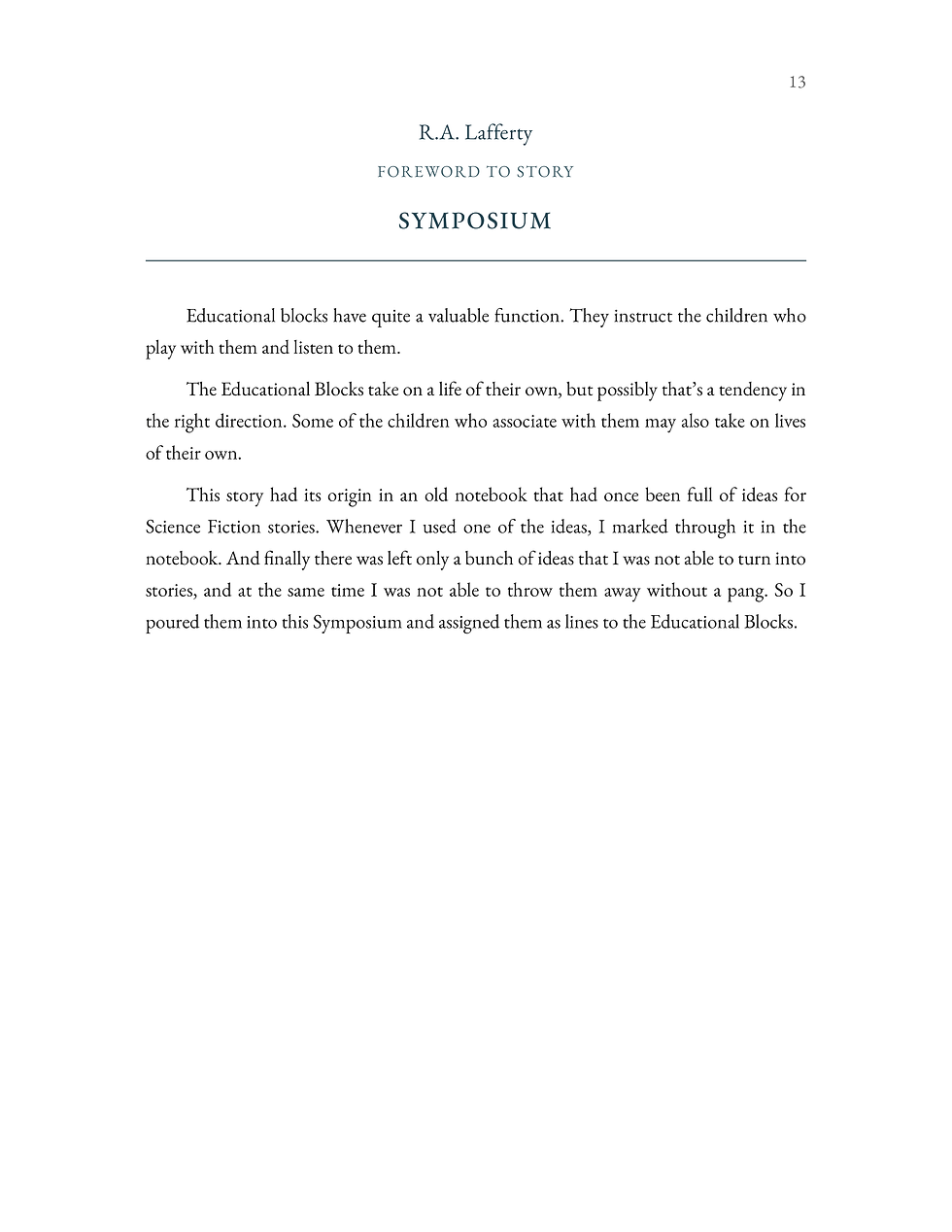
Of missed publishing opportunities and Lafferty, the most frustrating is Selenium Ghosts of the Eighteen-Seventies. One could hardly do better for an introduction to Lafferty’s short fiction, from stories that go down like Grey Goose to ones as knotty as a cedar picket. He clearly put a great deal of thought into it. Fortunately, Lafferty left a series of forewords for this book that does not exist.
The earliest mention I know of is July 10, 1980. Lafferty told Sheryl Smith that he might have two new books close to being sold, a novel called To Aurelia With Horns and "a collection of which 'Selenium Ghosts' is the lead-off." He had no contracts on either, and he said that there is "many a slip twixt unhatched chicks and the A*OK Poultry Market."
To Aurelia With Horns became Aurelia and has a complicated manuscript history. The short story collection never sold, and its materials were later collected elsewhere: several went into Ringing Changes, several into Lafferty in Orbit, and three into Iron Tears. What survives of the book as Lafferty imagined it are eighteen typescript pages, each a foreword to the following stories:
As I said, it would have been the ideal introduction to his work, much better than the recent Best of R. A. Lafferty, for a few reasons.
First, the period it covers. The earliest story, "Among the Hairy Earthmen," is from 1966. The lead story is from 1978, so the book takes in the central years of his short fiction, moving when his aesthetic was fully nucleated and ending at the time he was going into his whirlwind games with postfictional genre elements (Annals, space piracy; Sindbad, Arabian Nights arabesque; Serpent’s Egg, post-apocalyptic beast fable).
None of the eighteen had been collected in Nine Hundred Grandmothers or Strange Doings. A reader who has Nine Hundred Grandmothers, the usual starting point, would have had in this second anthology much of what made his reputation: Galaxy, Damon Knight's Orbit, Robert Silverberg's New Dimensions, Terry Carr's Universe, Roger Elwood's anthologies.
The second is that the selection has held up over time. "Eurema's Dam" won the Hugo. "Sky" was a Hugo nominee, and it should have won. Lafferty was salty about it, I think, and when he talks about “Eurema’s Dam” winning and not being near his best, he has the “Sky” loss in mind. Carr took the lead story for The Year's Finest Fantasy, Volume 2 (1979).
When Lafferty named the stories of his own that he particularly liked, in his 1991 interview with Tom Jackson, four of the fourteen were in this book that never was: "Selenium Ghosts," "All Pieces of a River Shore," "Configuration of the North Shore," and "Old Foot Forgot."
When Jonathan Strahan assembled The Best of R. A. Lafferty in 2019, seven of his twenty-two were vacuumed up: "Interurban Queen," "Eurema's Dam," "Selenium Ghosts," "Sky," "Old Foot Forgot," "The World as Will and Wallpaper," and "Days of Grass, Days of Straw." In short, as a selection, 1980 agrees with what Lafferty said of his own work in 1991 and with what a well-meaning editor chose in 2019.
The third is just range. Lafferty's forewords sort the stories by kind, and the kinds cover most of what he did exceptionally well in short form. To see this, one needs only read his forewords and think about the stories themselves.
The fourth is the need for an apparatus. Strahan's volume pulled together a roster of other writers to introduce the stories one by one. A lot of these intros were misses. Most were. Lafferty’s own introductions are gold.




Comments