"Days of Grass, Days of Straw" (1972/1973)

Updated: 1 day ago

There came a roaring like horses in the sky. Then was the multiplex crash (God save his soul, his body is done for) of bloody torso and severed limbs falling into the room froma great height, splintering the table at which the five of them sat, breaking the room, splattering them all with blood. But the ceiling above was unbreached and unharmed and there was no point of entry. “I am not man enough even to watch it,” Buford Strange gurgled, and he slumped sideways unconscious.
“Days of Grass, Days of Straw” is one of Lafferty’s masterpieces and one of his perfect stories, with much that is central to his art. I’ll walk through the plot and then say a little about how I understand its organization.
The story begins with Christopher Foxx seemingly wandering through an altered, primal version of his city. Everything is in a fog, and Lafferty is careful in how he builds the transition, but Christopher’s urban world has been replaced by one with tall grass, buckskin storefronts, and currency made of stone and clay. In this place, he is not Christopher Foxx but Kit-Fox, the name his old friend Strange Buffalo called him. This is a "day of grass"—an intensely felt, magical, rich, violent time outside the normal calendar where people fight battles alongside armed buffalo and can work elemental dances.
Above the landscape is a thundering, floating mountain. On it, ancient prophets physically wrestle with God to win these special days. Sometimes the struggle is won. Sometimes it isn’t. Severed bodies of defeated prophet warriors sometimes plummet bloodily to the earth.
The story then jumps to what seems to be another plane of reality, to Christopher Foxx's prosaic reality. This is a muted and highly regulated modern city. Foxx is an academic attending a symposium at the North Paragon Breakfast Club with his academic colleagues Buford Strange, Adrian Montaigne, and Vincent Rue. Over a meal of sheldrake duck, the men debate the "days out of count," such as Indian Summer, which they hypothesize are anomalous temporal spaces distinct from the regular year.
Helen Hightower, Christopher’s wife, eventually joins them, and the conversation ranges over legends of ancient prayer-men and frost giants who sweated blood in a mist to force these special days into existence, placing them on what the story calls a different "holy skin" outside of linear time.
The debate escalates, and then the mountain's primal reality begins to bleed into the university room where the characters have relocated. Children enter and chant that Buford Strange is made of straw, then no one can remember the children well. Adrian Montaigne begins to undergo a transformation, becoming a mountain wrestler. He vanishes to join the cosmic battle, while a broken Buford Strange passes out and is revealed to be a lifeless scarecrow stuffed with bloody straw.
Foxx's wife, Helen, assumes her alternate-world persona, Day-Torch, and screams in support. Foxx joins in. It is here that Lafferty refuses to compromise his mythic vision for the sake of realism, bringing the violent consequences of the mountain directly into the breakfast club:
There came a roaring like horses in the sky. Then was the multiplex crash (God save his soul, his body is done for) of bloody torso and severed limbs falling into the room from a great height, splintering the table at which the five of them sat, breaking the room, splattering them all with blood. But the ceiling above was unbreached and unharmed and there was no point of entry.
Day-Torch calls for the head, and it crashes through the wall of reality, exploding on the floor. Lafferty ends the story with a line of verse about the falling of bodies and the up-splashing of blood from the days of grass.
My preferred way of understanding the mechanics of this story is through Northrop Frye’s idea that modes of literature displace the mythic, so that the real is not less mythic in the sense that the myth has been drained from it, but rather made more superficially plausible. The primal structures of myth are always present—stories of gods, heroes, and cosmic patterns—yet they get adapted, muted, recostumed, and rationalized as literature moves from "pure" myth toward more realistic modes.
We can think of the far end of these poles as being the day of grass, which is plainly mythic, and the day of straw, which is not. The underlying shapes (quest, descent, rebirth, the dying god, the sacred marriage) rarely disappear, though there are major changes in the mythic imagination. Instead, they get displaced into forms the culture will accept as plausible. They become the de-mythicized content of academic analysis.
This is too simple, as that displacement works its way through cultural time: the god becomes a legendary hero, then a romantic knight, then a realistic protagonist, and finally—in ironic modes—an anti-hero. Under it all is the same archetype.
Frye calls the measure of successful displacement the "criteria of plausibility": as literature descends his modal ladder from myth through romance, high mimetic, low mimetic, and irony, writers have some tricks up their sleeves. They motivate their material by moral, causal, or psychological realism rather than by supernatural myth.
One thing that makes “Days of Grass, Days of Straw” so powerful is that it starts at the mythic pole, displaces the storyworld to a university setting, and then refuses to make concessions to the criteria of plausibility as it builds to its final explosion of sacramental affirmation and blood.
Consider the mythic pole, where Lafferty gives us the Day of Grass. It is condensed, not displaced, and one interacts with greater proximity to the archetypal. Things are close to what they do, and names are close to what they name. Kit-Fox is a fox in a kit society. Day-Torch is a torch that sets days on fire. Strange Buffalo is strange and is killed among buffalo. Day-Torch tells the river, "You've got the tune wrong," so the river changes its tune. The gap between saying and doing, between nomen and res itself, is narrow. This becomes obvious when Lafferty writes the great passages about rite, ritual, and ceremony, where action and outcome are inextricably linked:
Henry Drumhead added his beat to the tune. Then the folks had a rain dance till the sharp rain came down and drenched them through. They had a sun dance then, till the sun dried up the mud and began to burn the hides of the people. They had a cloud dance then. They had an antelope dance till enough antelope came to provide a slaughter and a feast. They had a pit dance, a fire dance, a snake dance, and an ashes dance: the ashes from pecan wood and hickory wood are a better condiment than salt to go with roast antelope.
For the same reason, Lafferty’s story refuses to police lines between the animate and the inanimate, the sacred and the practical, and the liturgical and the private.
Move to the other pole, and one has the day of straw, a world with the juice drained out of it. Lafferty writes,
The world was rubbed, scrubbed, and tubbed; it was shaved, paved and saved; it was neat, sweet, and effete. Ah, the latter was possibly what was wrong with it, if anything could be wrong with perfection. The colors were all flat (flat colors had been deemed best for nerves and such), and the sounds were all muted.
The grass day is gray, but its grayness is enlivening. The day of straw, by contrast, is full of flat color, which Christopher notes is meant to be good for the nerves. There is pervasive amnesia, which is not merely forgetting but what it always is in Flatland: the enabling condition.
If one wanted the story’s major symbol for what has happened, one needs look no further than Professor Timacheff, who is out of town. He is a joke on the deus absconditus, for both the day of grass and the day of straw are vertical cosmologies. The mythic mountain, with God as mist at its summit, has become the next story up in a university building, where an absent professor teaches not miracles but special effects.
This displacement from mountain to classroom is the kind of barrier realism creates when it satisfies the demands of plausibility. Lafferty punches a hole through it and allows a two-way passage: down the axis mundi for the falling bodies, which splash up blood from the mythically displaced underlay, and up the same axis for the warrior’s ascent. The blood splashing up is a violent counter jerk back to the mythic, a climaxing moment of anti-displacement.
Once one sees this pattern, one begins to see the story’s many smaller games. Christopher Foxx’s transition to the name Kit-Fox, and the way Lafferty’s narrator handles it, is one of them. It parallels Christopher’s gradual psychological assimilation into the primal reality of the day of grass. At first, he feels that his name does not belong in the environment. Strange Buffalo greets him as Kit-Fox, and that greeting makes him wonder which identity is the true one. The move reverses the usual pattern from myth to displacement, because it carries him, mid-sentence, from the displaced half of the schizo-gash, Christopher, to the mythic half, Kit.
Then there is Strange Buffalo’s death by buffalo in battle, which the story presents as more heroic than his later being torn apart as a man of straw, precisely because the first death does not lean toward the ironic. There are, in effect, two vertical cosmologies, one for each half of the story. The day-of-grass cosmos runs from the mythic to the heroic, with much comedy along the way; the day-of-straw cosmology runs from the low mimetic to the ironic. By the end of the story, the far ends of these poles are stretched between the highest and the lowest points: from Adoration’s ascent to the mountaintop to Buford Strange’s body of bloody straw in the university room.
The shape looks something like this:

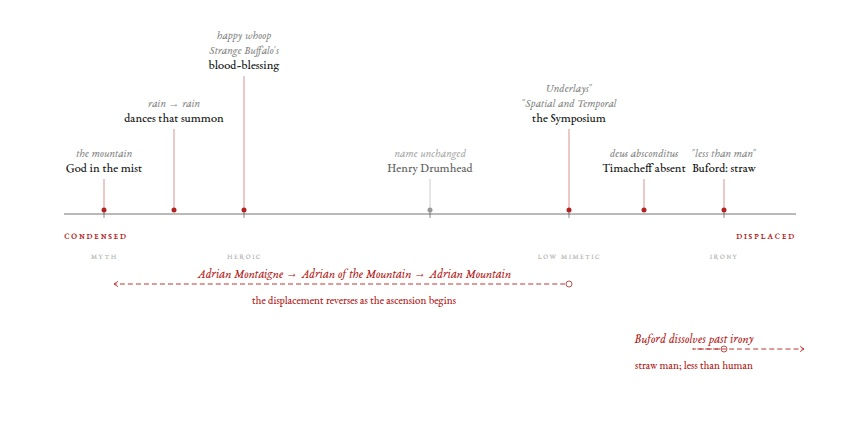
The vertical cosmology is then counterfigured. The Day of Grass, the mythically higher, is figured as the underlay, or ground of being, for the Day of Straw, a displaced version transposed onto it through a temporal metaphor: the days in count and out of count happen simultaneously. This creates a double vision, in which one sees two iterations of a single vertical cosmology, the first mythic, the second ironic. That is the deeper metaphysical picture, but it is not what the reader experiences. Rather, the reader experiences displacement of literary modes, which correlate to modes of perception.

In Okla Hannali, Lafferty uses Choctaw culture to reimagine the archetypal worlds of Eden and the Flood. In “Days of Grass, Days of Straw,” he does something similar but more radical: he uses Great Plains Indian culture as a mode of sacramental perception. The “good skin” is both a pun on the Bible as the “good book” and a Kiowa painted hide, because in the grass day these are not two things but one thing seen under mythic restoration. The Cahooche shadow-writing displaces Philippians 2:12’s “fear and trembling.” It becomes “in fear and chuckling.”
This is one of the more interesting moments in the story because it suggests that the “fear and trembling” of the Bible is already a discursive displacement of something more direct. To state the obvious, neither the Bible itself nor its words are sacraments because a sacrament is a tangible encounter with Christ. That is why all seven sacraments in the Catholic tradition forgive venial sins when they are received with the proper disposition, whereas reading the Bible, even with the proper disposition, does not. It recalls early debates in the church about the appropriateness of the literal reading of scripture for the simpliciores. Lafferty modifies the trembling of mysterium tremendum et fascinans with his own figure of the Laughing Christ.
Or is it a mistake to attribute this to Lafferty at all? After all, it is Strange Buffalo who says it. The line is at once a joke and a Catholic reflection on “the letter killeth, but the spirit giveth life.” “Chuckling,” after all, introduces the physicality of Lafferty's Laughing Christ. The story’s two central Christian images likewise hinge on bodily contact with the divine: Jacob wrestling at the ford of Jabbok, and Christ’s seamless garment. Lafferty transcodes both. Jacob’s single night of struggle becomes the engine of the story’s sacramental logic: prophets perpetually sweating blood and risking dismemberment. The text presents this as a direct, physical demand laid upon the divine:
“We will wrestle,” the Indian said to God in the mist, “we will wrestle to see which of us shall be Lord for this day. I tell you it is not thick enough if only the regular days flow. I hesitate to instruct you in your own business, and yet someone must instruct you. There must be overflowing and special days apart from the regular days. You have such days, I am sure of that, but you keep them prisoned in a bag. It is necessary now that I wrest one of them from you.”
This act of counting coup counterfigures the noli me tangere. Lafferty then uses Christ's seamless garment as a double metaphor for time. One can view it from the mythic pole or from the displaced pole. What one sees will be competing topologies. From the displaced pole, as Buford Strange sees it, the garment has holes because he imagines it as form, that of rationalized, linear time: May 7 succeeding May 8 succeeding May 9.
Seen apocalyptically, as Day-Torch, Kit, and Adoration come to see it, this is a partial vision. The displaced vision of the garment appears seamless only because what has fallen through its pockets is no longer perceived when one is in a state of straw, no matter how real it is.