01 Aurelia and Postfiguration

Updated: Sep 4

“Jump, jump, jump!” they called, and others took up the cadence “Jump, jump, jump!” People came from the hills and the lake and from all the luxury cabins around there. The “with-it” people came, and the sectarians, and all of the “Kill Aurelia Now League.” Even the strong partisans of Aurelia were caught up in the moment and cried “Jump, jump, jump!” Aurelia jumped. She lept out into the golden air, and she plummeted the thirty meters to the ground, a modified plummet, for she had her own style. And would she have her own style in death also? There is something electric about the long moment when the leaper is in the air. In the case of Aurelia, there was something doubly electric about it, and something triply long. It wasn’t that time stood still. It was that Aurelia fell slower than other persons would. For she came down light and easy. Barefoot and easy, she came down softly. There had never been much weight to her. By the bird-bones of her and her aerated flesh, she did make a soft landing! Then she laughed and ran, and the people followed her. Her peripateticus had begun.
Dionysus, the Greek god of wine and revelry, has his horns polled and gives them to two teenagers, a girl and her dark counterpart, who then blow them. On a riverboat, shadowy figures play a card game called brag (anagram of grab), which somehow ties into global politics and the unfolding action of the novel. What can seem like a picaresque mash-up of events culminates about two-thirds of the way through, when people scream at the young woman to jump to her death, and she does, leaping from a tower with her golden hair trailing behind her. Because her bones are hollow, she lands softly and begins her peripatetic course, giving, over a triduum, four homilies each day, one at each corner of the day. The whole thing ends in anticlimax, with the boy and the girl dying. At the gravesite of the young girl, who is completely forgotten, an ailanthus tree grows, along with a pair of antlers, because before she died, she had swallowed both:
They buried her there without a grave-stone. Her only monument was certain unfading words on water Preserve her Name. Her Name is Aurelia. [ . . . ] After Aurelia had been dead for a year, an ailanthus tree did grow there. It did smell funny, but it was pretty. [ . . . ] A set of branched antlers also grew out of the ground there, and people do stop to look at them.
A beautiful passage. It brings together the epitaph of the too-soon-dead poet Keats, the names written in the Book of Life, the waters of baptism, and the living water flowing from Christ's side into the new creation of the heavenly city. Keats said that his name was “writ in water,” and Lafferty takes that image and joins it to Scripture’s image of names written eternally in the Lamb’s Book of Life (Revelation 13:8; 20:12–15). Through the waters of baptism, one passes from death into life (Romans 6:3–4), and from the pierced side of Christ there flowed blood and water, signs of the Church’s birth and of the new creation (John 19:34). In the heavenly Jerusalem, the river of the water of life flows from the throne of God and of the Lamb (Revelation 22:1–2), where every redeemed name is remembered forever. This kind of typological compression is pervasive in Aurelia and necessary to understand why Lafferty bothered to write it. It is a demanding work that pretends to have bones as light as Aurelia’s.
Over the next few posts, I want to think aloud about Aurelia. Of the thirty-plus novels Lafferty wrote, it is one of the more challenging. The difficulty lies partly in its internal coherence: making sense of its many incidents, its symbolic economy, and especially its handling of horn and antler, white and black, high and low.
It is simply a book that places an unusual cognitive demand on the reader. For its length, it is perhaps a unique one in the Lafferty canon. Lafferty writes the novel as though the default reader were not especially knowledgeable about the Christian tradition. He was right about that. Yet that is the reader most likely to miss what gives the novel coherence. It is both exceptionally esoteric in its construction and daringly exoteric in its homilies. It is pure Lafferty, as if he has polarized the didactic and pamphlimpantic.
Anyone who reads Aurelia will recognize its messianic theme. Spelling out how that theme works is difficult because Aurelia is not a messiah. Lafferty is not doing the usual science-fiction or fantasy maneuver in which the false messiah simply becomes a parody.
The novel itself has an unusually clear shape, with a hard break at the tower leap and then Aurelia’s teaching. Yet, in my mind at least, it feels very light, almost like a novella rather than one of Lafferty’s long-form experiments. Unlike most of the late novels, it is easy to summarize, though any summary will miss much of what it does.
If you have not read it, Aurelia follows a naïve, clumsy fourteen-year-old girl from the highly advanced “Shining World,” who is sent to govern a backward, Earth-like planet as a high school assignment. Readers are never told that the planet she comes from is Camiroi (despite that 10th-grade assignment), the subject of two great Lafferty short stories, but Lafferty readers will catch the connection immediately. Still, it is probably wise not to say, hastily, that Aurelia is from Camiroi, because Lafferty doesn’t, a mistake I have made. Just as the reader is never directly told what planet Aurelia is on (it is whispered in Aurelia’s ear, and there are many clues), the reader is left in suspension.
When Aurelia crashes planet-side in her noisy, poorly constructed spaceship, she inadvertently gathers a chaotic traveling carnival of followers: mobsters, cultists, con men, and a rival “dark counterpart” named Cousin Clootie. After the tower leap come the three philosophy- and theology-filled days structured around Roman mealtimes. Aurelia, cheerfully for the most part, dispenses her homilies on happiness and law. She performs haphazard miracles and confounds the cynical locals who plot to exploit or assassinate her. Ultimately, she and Clootie are both killed in a bizarre accident involving a strange weapon, a yin-yang yo-yo double-dart, fulfilling a prophecy about a worm shooting a gun. Thus, within a matter of days, Aurelia, who is likened to a bolide, ends her brief, bright governorship.
What this summary misses is how the book works on the reader. Consider, for example, a set piece near the beginning of the novel:
They all heard the little space-ship, all horns blowing and all lights flashing, come down like a shouting and howling star. [ . . . ] There was someone or something lurking there when Aurelia climbed out of her ship. [ . . . ] ‘Nah,’ the thing said. ‘Get off the coy, kid. Come here.’ And then the thing definitely assaulted Aurelia, a bad beginning on this planet . . . The thing or person was twice her size and musky strong, but something was wrong with it. It was unable to take care of itself, and Aurelia apparently damaged it. She may even have killed it.
Her unintentional victory prompts a rapid-fire sequence of encounters. Local
groups converge on the crash site. First, a group of millennial sectarians comes
from their caves to hail her significance:
Aurelia, girl, have you ever done any rodeo announcing,” one of those horse-herders asked her as he cantered up. [ . . . ] “And you being from off-earth, we can bill you as the Shining Angel who has had experience with those great rodeos in the sky.
They are followed by a chaotic, “with-it” multimedia crowd. One of its members is turned into a ghost by the ship’s defense mechanisms when he tries to play its horns. Another fuzzy-brained woman tries to get Aurelia to sign a merchandising contract on a leaf. Next comes a wealthy tycoon, pitching a corporate partnership, only then followed by two horse-herders, aging rodeo wranglers, who canter up and try to recruit her.
Finally, two opportunistic young men from a local tow-truck service offer to haul her ship away, a problem Aurelia solves by tying a string to the vessel so that it can follow the truck obediently, like a pet.
A reader who does not see how much this set piece draws on Scripture will have a hard time with the novel. Although the action I have described takes only a few pages, a great deal is being remixed. What one is reading is a compressed Nativity. It draws on the Gospels and Revelation at once, with the seven horns sounding the apocalyptic note one always expects from Lafferty. The ship’s descent—“like a shouting and howling star,” with “all horns blowing and all lights flashing,” its sound “like the blowing of all the trumpets of Heaven”—sets the Matthean star, “the star, which they saw in the east, went before them, till it came and stood over where the young child was” (Matt. 2:9), beside the Lukan heavenly host, “suddenly there was with the angel a multitude of the heavenly host praising God” (Luke 2:13). The seven horns themselves are from Revelation, the seven trumpets. Aurelia’s ship is somehow connected to the slain Lamb seen by St. John on Patmos, the Lamb who is also the conquering Lion of Judah, “having seven horns and seven eyes, which are the seven Spirits of God sent forth into all the earth” (Rev. 5:6).
Although Cousin Clootie is not mentioned in the crash-landing set piece, he has a parallel descent “like black lightning.” Lafferty pairs this with Aurelia’s arrival in an aside:
(At the same time, and probably not far from there, Aurelia’s counterpart and adversary came down like black lightning, secretly and yet arrogantly. More, perhaps, of Aurelia’s counterpart and nemesis and adversary in a little while.)
Cousin Clootie will not finally be a Satanic figure (he is far stranger), and any reader who knows Isaiah or the Gospels will hear Luke’s falling Satan and the Messiah’s coming: “I beheld Satan as lightning fall from heaven” (Luke 10:18).
Or take the deranged convict who arrives to kill Aurelia. He is somehow connected to Herod’s attempt to destroy the newborn Jesus: “Herod will seek the young child to destroy him” (Matt. 2:13). And the horse-herders cantering up? They are, somehow, Luke’s shepherds, with horses in place of sheep: “there were in the same country shepherds abiding in the field, keeping watch over their flock by night” (Luke 2:8). The millennial sectarians from the caves are the populace come to hail the child. The with-it crowd, the tycoon, and the tow-truck men are the variegated visitors who, in the longer arc of the cavalcade, will give way to the named Magi—Rex, Melchior, Gaspar, Balthasar—with their pavilions and gifts: “they presented unto him gifts; gold, and frankincense, and myrrh” (Matt. 2:11). And beneath the whole scene runs John’s prologue: the light come into the world, and the world failing to comprehend it. “He was in the world, and the world was made by him, and the world knew him not. He came unto his own, and his own received him not” (John 1:10–11).
This scriptural patterning governs Aurelia in a loosely analogous way to how The Odyssey governs Joyce’s Ulysses as necessary knowledge, though one needs to qualify this radically. The table below gathers some of the more important parallels, but my table is deliberately conservative: not a full account, just the minimum apparatus the novel asks of its reader, and this only with the synoptic Gospels and John, though the law and the prophets are everywhere:

With this in mind, one might conclude that the task is simply to match narrative and verbal elements. Is a simple principle of equivalence at work? No, because the parallels in Aurelia do not act as equivalents. Aurelia is not all these things at once, because the novel is not an allegory. As the reader eventually learns, the Compensation, the crucifixion understood as ransom, has already happened on one of the universe’s planets.
To state the obvious, in allegory, the content of A, literal or not, has its real meaning as B, and B can be restated in conceptual or argumentative terms. In the emblem-book tradition, for instance, Opportunity is often depicted with a thick forelock and baldness: the image means that opportunity must be seized when it comes, because once it has passed, there is nothing to grasp. If one reads Aurelia this way, one will get very little. One will not arrive at B. Aurelia is not an allegorical representation of Christ. Nor is she a type of Christ in the ordinary sense, because typology depends on the type preceding the antitype. Christ has already come. The Compensation has already occurred. She isn’t even a Christ figure. Aurelia is something stranger: not an allegorical substitute for Christ, and not a prior type fulfilled by Christ, but a figure whose actions echo, refract, and misalign with the scriptural pattern. Aurelia is what, in an interview, Lafferty said she was: a nice girl.
If this is so, then whatever Aurelia is, it is, again, not an allegory of the Bible. But the techniques by which a Catholic reads the biblical tradition are indispensable for understanding what Lafferty is doing. So a word about typology, whose importance for understanding Lafferty’s work generally can hardly be overstated.
The etymology of type is so useful here that I want to bring it in. The word comes from a Greek verb meaning “to strike.” When something strikes hard, it leaves an impression. As many people have pointed out, one may think of that impression as a hollowed-out space. Later, something of a corresponding shape appears and fills that space, or rather, fulfills it. At the same time, type is not simply a metaphor. As Northrop Frye once put it, metaphor is static equivalence; typology, like causality, is temporal figuration. A type-and-antitype relation always exists in time. Causation looks backward to explain the past. Typology looks forward, but it does so from a present moment, by identifying the antecedent that has been fulfilled. It is recognition: I remember. Anti-amnesia. Anamnesis.
Nor is typology a metaphor in another sense. Metaphor works with any object, but typology concerns history. Its domain is the real: real events, real persons, real things. When St. Paul says that Adam was a type of Christ, he is not saying that Adam was an allegory of Christ. He is saying that Adam and Christ stand in a temporal relation to one another, and that each helps disclose the meaning of the other through what has been called escalation. The final antitype that fulfills the precursor types is somehow higher. Fuller. It is an intensification of all that preceded it, or, more precisely, its limit of meaning:


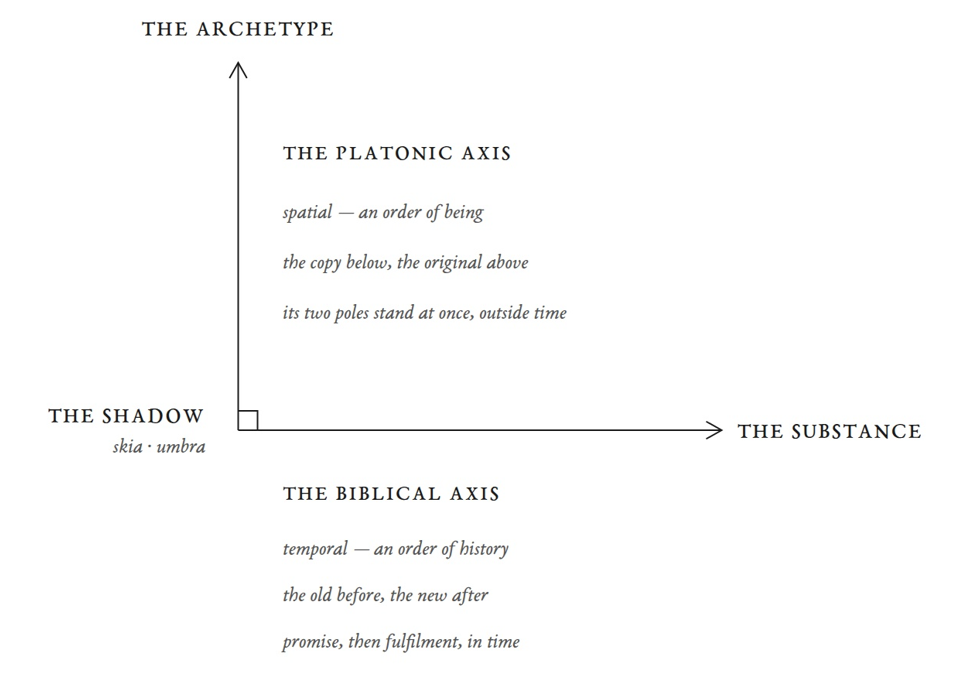

Now, Aurelia is not a historical person. She is a RAL creation. That fact does not by itself defeat a typological reading, since the rhetoric of typology can still work even when one term in the relation is not historical in the ordinary sense. Many modern readers would deny Adam’s historicity while affirming that there was a historical person now known as Jesus, yet Paul’s typology remains intelligible. The difficulty of Aurelia lies elsewhere. Typology is built for a relation between two terms; Aurelia introduces a third.
At any moment in a typological relation, there are the two quasi-historical terms present, though those terms can be enchained: Cain is to Esau as Abel is to Jacob; Esau is to Ishmael as Isaac is to Jacob; and so on through the brother relations in Genesis. With Aurelia, however, the relation does not quite work this way, because the fulfillment of the type has already happened. There were types of Christ, and then the Son was sent from his Shining World and fulfilled them. Those who come after Christ and resemble him are not types in the strict sense. They participate in him as his body or bride and signal analogy. We call them martyrs, saints, confessors, the cloud of witnesses. This follows from typology's nature as figuration within time. If the fulfillment of the type has already occurred, then anything that comes after the omega antitype is a participation, not an imperfect foreshadowing.
That is what Aurelia is. An imperfect participation. To understand her and the novel, one must (I am afraid) know a great deal of Scripture and know how to read typologically. It is the one Lafferty novel where he unhesitatingly lets his knowledge of scripture halo everything. But, again, one must also recognize that Aurelia does not prefigure. She postfigures. Postfiguration has a meaning in posthumanist criticism. That is not what I mean here. I mean only that postfiguration is a possibility after prefiguration and fulfillment, grounded in the Christian sense of salvation history, and an eschatology that is being realized. Aurelia arrives on a world where fulfillment has already happened and has been ignored or forgotten. Everyone acts as though he were still standing inside the hollow left by the original types. The fictional world's condition is typological amnesia. It extends not only to Aurelia’s world assignment but also to Aurelia herself. Why did she put those seven horns on her ship? Why does she throw herself down from the temple top? Does she know about the seven horns of the slain Lamb in the Book of Revelation? Does she know about the seven trumpets and seven cups of Revelation? The book does not have the seven seals or the seven cups or the sea and land beasts or the whore of Babylon. These are issues of what I call phantasmetaxis within postfiguration.
And those questions themselves? Not even askable on the narrative’s intradiegetic plane: there is no evidence that the Bible still exists on Gaea. There is just that vague knowledge of the Compensation. Yet Lafferty is relentless in his allusions to Scripture, which is the blueprint of Compensation. He says, you, dear reader, know what the Compensation is. He batters you, the reader, with it mercilessly, and he does it through such radical defamiliarization that many readers will miss how much he is doing, just how much biblical language and ideation is coursing through the hijinks.
Most will not even see that much of the novel’s oddness at the level of event becomes clear as water pumped from an artesian well once read typologically. Before the novel reaches the didactic turn following the Tower Jump, Lafferty has already, almost invisibly, catechized every reader in the rhetoric of the Bible. Perhaps one has a bad memory, is uncatechized, or has forgotten the long tradition of transumption of biblical language, but it is a large part of the Aurelia’s meaning.
One cannot see the crash without sensitivity to such knowledge. Aurelia will be a farrago for anyone who does not know things like this, who does not know the white stone with one’s name on it, or that goats (the Prince of Nysa, the cornutus) are tied to flocks, sacrifice, sin offerings, and judgment imagery, or that deer (Herr Boch/antlers) are tied to beauty, longing, speed, agility, resurrection, the crucifix, and sure-footedness, panting for the Lord. The resource at the end of this post offers a crib for some of what the novel demands its readers know. I’m also including PDF notes.
If any Lafferty work can be called a precursor to Aurelia, it is the underappreciated and flawed “Ishmael into the Barrens.” It is an ugly masterpiece. In writing about it, I had to bring forward the scriptural patterning that makes it intelligible, despite not liking to be a Bible thumper. What “Ishmael into the Barrens” does with the Old Testament in an amnesiac, postapocalyptic environment, Aurelia does with the New Testament. In each, the amnestic world has forgotten Scripture, but the typological logic of Scripture has not forgotten the world. It subsumes life, giving it meaning and interpretableness. It reconfigures all possible worlds. There is no choice, says Lafferty: you, the reader, will participate in Aurelia because it is your story.
So that is the first piece of advice I would give anyone who wants to read Aurelia: understand typology, and you will begin to recognize not only the novel’s scriptural intertexts but its internal typological repetitions of quotation, allusion, and echo. The crash landing, for example, is the type of a later antitype. There is the crash descent, then the jump descent. Two falls to anti-earth. The first is rough and apocalyptic, clumsy, flighty Aurelia out of control, falling from the sky, right out of Apocalypse, displaying the seven physical keratin horns of the slain Lamb, blaring the seven judgmental trumpets of St. John, and the final horn of Judgment itself.
Aurelia is from the Shining World’s perspective a screw-up. The planet-side crash fulfillment is Aurelia’s graceful, controlled, and chosen falling to the people to where she will teach, though this second descent points toward her death. The biblical allusions are spolia, with postfiguration being a forced participation without identity. That is the sacramental worldview. Interpenetration and identity through differentiation that Catholics call participation.
Lafferty is always alluding to Scripture and borrowing its language. For a reader like me it is genius. Nowhere does he do so with the intensity or significance he brings to Aurelia. As always, to read Lafferty well is to become a different kind of reader. It is to recognize partially realized eschatology and the participating, rather than the panoramic apocalypse. One sees the apocalypse as if it were outside one, projected onto a screen as only spectacle, and then the screen dissolves and becomes one’s environment, because the book is about post-Christian cognition as it attempts to force one into Christian cognition. Or it doesn’t and it looks like an incoherent SF novel, and one puts it back on the shelf, a little confused but after a few laughs.


