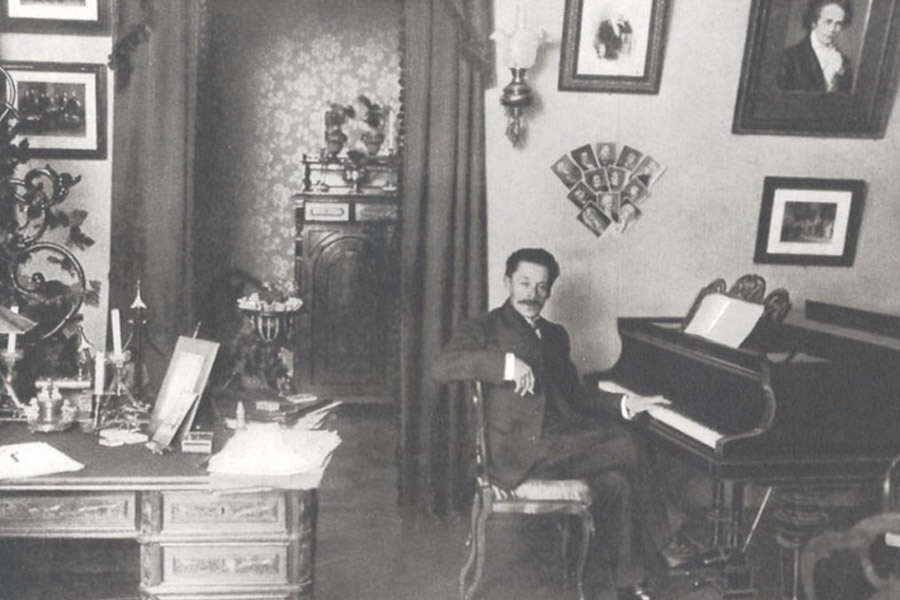
Montejo’s "There Are Three Ways to Open a Secret Door: R.A. Lafferty’s Bricolage Aesthetic."

Updated: 4 hours ago

Gregorio Montejo's essay, "There Are Three Ways to Open a Secret Door: R. A. Lafferty's Bricolage Aesthetic," is, in my view, the most incisive piece of Lafferty criticism yet published. I think it’s brilliant, but I break with it. It begins with Claude Lévi-Strauss's account of bricolage and ends with the Thomistic analogia entis, an arc that moves from structural anthropology to theological ontology.
Because Montejo positions those two ideas as mutually illuminating, the strength of his argument hinges on whether bricolage and the analogia entis can cross-ramify. If they cannot, the claim that Lafferty is a Thomistically minded writer who works in a Lévi-Straussian mode would need to be re-examined, for it would suggest a disjunction between Lafferty's aesthetic signature and a central aspect of his Catholic imagination.
Montejo first lays out Lévi-Strauss's theory: meaning emerges through the imaginative recombination of pre-existing fragments, which are signs, materials, stories, and other cultural leftovers. For Lévi-Strauss, the bricoleur is not just a stylist or outsider artist, but a thinker who, constrained by contingency, discovers latent structures by arranging what is at hand. Montejo's analyses of "Continued on Next Rock," Lafferty's "secret door," and the Duffey-and-time motif ask how recombination and juxtaposition work in Lafferty's fiction and demonstrate that a Lévi-Straussian perspective can be fruitful and interesting.
The essay's difficulty lies in setting what I consider an aesthetic effect beside the analogia entis. In Thomistic metaphysics, the analogia entis names the way every creature shares, by analogy, in God's act of esse: likeness is genuine, yet always outstripped by a greater unlikeness. From Aquinas to Przywara and Von Balthasar, theologians have stressed the participatory realism and the asymptotic transcendence embedded in the doctrine.
If Lafferty's sacramental poiesis is essential to his art, we should ask whether a reader's experience of his bricolage depends on (or can be detached from) Lévi-Strauss's account. Nothing requires that Lafferty be fully consonant with the bricoleur of La Pensée sauvage (1962); his recombinations could be consciously oriented toward a sacramental horizon that Lévi-Strauss, as a structural anthropologist, undermines.
Here, a parallel suggests itself: both bricolage and the analogia entis involve the play of the many within the one, yet they operate in different registers. Bricolage remains an aesthetic-cognitive procedure conditioned by historical contingencies; the analogia entis is a metaphysical principle describing the participation of finite beings in God. Therefore, any "Catholic" bricolage differs from Lévi-Strauss's structuralist model not by abandoning contingency but by allowing the play of fragments to hint at an order beyond themselves. The rest of this post will attempt to sketch out what that means.
Consider “Thus We Frustrate Charlemagne.” The narrative juxtaposes several alternate histories without merging them into one causal continuum. As a physical artifact (ink on paper or pixels on a screen), the story certainly has an act of existence, though only accidental, not substantial. However, the symbolic field created by the montage does not constitute a new substance endowed with its intrinsic esse; instead, it is an intentional unity offered to the reader's mind.
That intentional unity can powerfully evoke a higher coherence: the intellect glimpses analogically how disparate histories might be held together. In Thomistic terms, this is participatio intentionalis (formal, in the knowing subject) rather than participatio essendi (ontological, in the thing's very being). The montage is evocative, suggestive, even doxological, yet it does not itself become another participant in the one act of esse.
So, bricolage and the analogia entis correspond in a strictly formal and asymmetrical way: the first furnishes an aesthetic shorthand for unity-in-difference, the second names unity-in-difference as a metaphysical fact. Art can illuminate the shape of order and invite the reader into contemplative participation; it cannot add a new being. Whether Montejo means to claim more than this—that is, that Lévi-Strauss's bricolage already is compatible with the stronger mode of participation—is the big question for weighing his synthesis.
In its fully structuralist sense, the bricolage model carries assumptions that sit uneasily with the analogia entis. The structuralist is not merely describing a method of artistic composition; he is claiming the ground of meaning itself. For this reason, Lévi-Strauss's thinking would make the analogia entis itself a myth since in structuralist anthropology, coherence arises through juxtaposition within an immanent network of signs that mediates between contrasts found in the conceptual structures of culture, all ordained by the deep structure of binary oppositions. I will return to the danger of making the analogia entis a myth later.
The bricoleur has it especially hard in one sense: the bricoleur works inside a closed semiotic system, making do with fragments already caught in the loop of culturally inherited signs. Lévi-Strauss puts it this way: "the engineer always seeks to open a way through and situate himself beyond the constraints that make up a given state of civilization, while the bricoleur, willingly or by necessity, remains on this side of those constraints. This is another way of saying that the former operates using concepts and the latter by means of signs."
Thomistic thought is very different. Its signs begin not with this kind of concepts and signs circulating in an immanent structure but with the givenness of esse itself. Every finite thing participates in, and is exceeded by, the infinite act of being who is God. Meaning is first discursively received, because creation is already intelligible by participation; only then is it interpreted and articulated by human makers, whose very activity depends continuously on the conserving act of subsisting Being.
The disjunction is therefore metaphysical and methodological: if structuralism is absolutised as a self-sufficient theory of meaning, as it is in Lévi-Strauss, it delimits intelligibility to the play of immanent signification. The material stuff outside semiotics is, in one sense, meaning's mute environment. It thus eclipses the prior intelligibility grounded in actus essendi. If I am right, there are a few options.
If a drastically weakened view of bricolage is subordinated to that ontological horizon, it might serve as an Imaginative witness to participation rather than rival it. This raises a question. Does Montejo's reading keep bricolage within an asymmetrical, participatory frame, or does it slip into a closed semantic space sealed off from the analogia entis? I am unsure, but I suspect it gets pretty close. Why?
If you grant bricolage the kind of explanatory authority Lévi-Strauss does, the relationality of analogia entis collapses into decorative metaphor. That sounds harsh, but I'm not sure how else to put it. Meaning becomes a function of arrangement, not participation, leaving the reader in an immanent word game where nothing outruns the system.
Lévi-Strauss knew this. Jacques Derrida saw the problem in 1966 when he wrote, in perhaps the best known intellectual assassination of the last century, that should anyone accept Lévi-Strauss's model on its terms, his picture of the engineer, the master of concepts, is already the bricoleur's invention, the master of signs. By the same logic, analogia entis becomes what I have already said: one more mythic construct, a fiction produced by bricolage. Take this one step further, and you will see why the cosmic engineer would be Himself a semiotic illusion.
This did not bother Lévi-Strauss. In his sour Tristes Tropiques, he wrote that intellectual honesty is incompatible with any ultimate rationale for myths, even though humans find sensory satisfaction in living as if such a rationale existed. That is how it looks from the viewpoint of bricolage.
Now look at it through analogia entis. If participation in divine Being is ontologically prior, because every creature depends continuously on the conserving act of subsisting Being, then even the bricoleur's semiotic play is in transcendental meaning. The bricoleur doesn't need Lévi-Strauss's mid-20th-century theory.
The ends of Montejo's arc set conceptual limits on each other: bricolage cashes out meaning on the level of contingency and reusability of cultural forms. At the same time, the analogia entis insists that those forms remain signs of a prior intelligibility. More importantly, bricolage degrades analogy into cultural detritus reassembled for local effect; the analogia entis, by contrast, places bricolage within an economy of ontological gift, where fragments signify not wholly arbitrarily but sacramentally, eliminating the need for a totalizing, immanent semiotic explanans.
For Thomists, the analogia entis allows humans to speak truthfully about God. It affirms a real but proportionate similarity between divine and created being. It connects Creator and creature while grounding knowledge in reality.
Central to this is human intellectus, which is not de-centered discursive reasoning as it might be for Lévi-Strauss (a catty French gibe against him being that he created Kantianism without the transcendental subject), but a receptive insight that grasps being as both one and many. Meaning is recognized. The world speaks because it participates in being, which points back to its source. Human understanding does not construct significance; it encounters it. We are far from Lévi-Strauss, who said, "the ultimate goal of the human sciences is not to constitute, but to dissolve man."
And that is the problem with the structuralist account of bricolage. As Lévi-Strauss tells us, it is "imprisoned in the events and experiences which it never tires of ordering and re-ordering in its search for meaning." It operates within a centerless system. Everything must be explained without appeal to a beyond. The beyond is banned. Why? Because when meaning is produced through binary oppositions, nothing outside the code can fix the reference. Interpretation detaches from reality, or rather, the real becomes a reality effect. Ontology is subordinated to semiotics.
Faced with this impasse, four broad options present themselves.
(1) One may affirm the analogia entis and treat the fragments as sacramental signs participating in divine Being, Lafferty's implicit stance.
(2) One may adopt structural immanence: reject the analogia entis and read symbols as intratextual myths generated by a stable binary code, which is Lévi-Strauss's position.
(3) One may embrace a non-Thomistic realist reference, choosing any alternative metaphysics: Peircean semiosis, Scotist univocity, process realism, semantic externalism, and the like, just ANYTHING that grants extra-systemic reference without appealing to Thomistic analogy.
(4) Finally, one may opt for radical immanentism, denying that the fragments reach outward at all and treating every appearance of transcendence as projection within a self-contained aesthetic or post-structural free play where even structural codes dissolve.
These four stances are mutually exclusive in principle: each grants or withholds transcendence and the stability of reference in a distinct way. Choosing among them is not a mere aesthetic preference; it decides whether the bricolage of culture points beyond itself or folds back into an endless rearrangement of signs.
Lafferty's method resembles bricolage, but only up to a point. It departs from Lévi-Strauss's account, which aimed to explain the mythmaking function. Lafferty's practice needs a different qualifier—something closer to spolia: the reuse of sacred architectural or sculptural elements from earlier structures in later ones. In both antiquity and the Middle Ages, spolia preserved meaning across time. Artists and craftsmen embedded these fragments in new wholes, but their origins were not erased. Lafferty does something similar. Let's call it bricospolia.
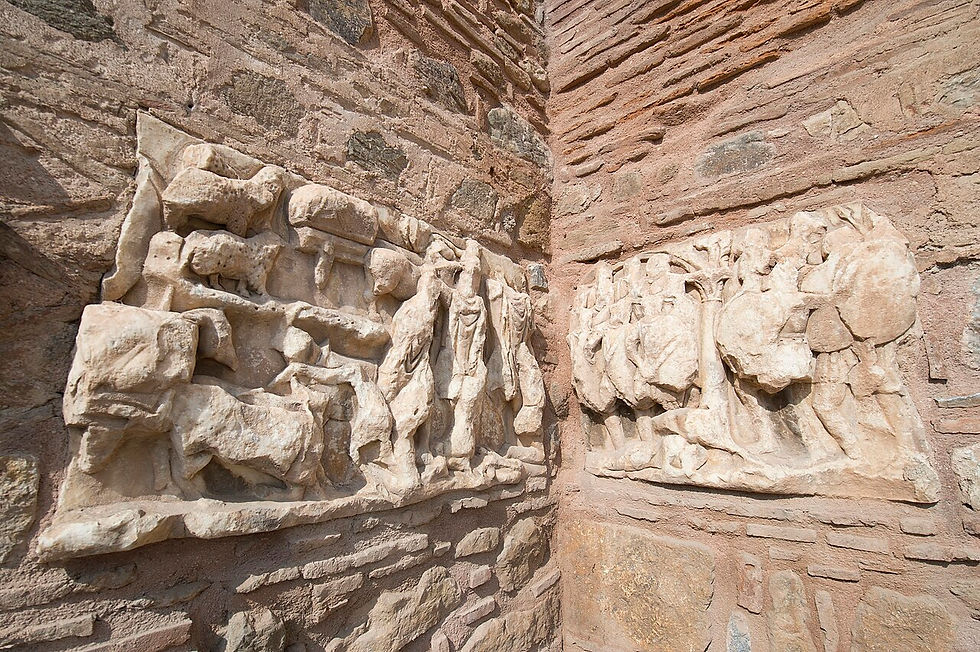
Bricospolia would designate the reuse of fragments drawn from Divine Revelation and natural reason, not merely as inert historical residue, but as ontically resonant components extracted from Heilsgeschichte, or salvation history. One might encounter in the cobbled face of such a structure a composite vision: the Virgin Mary as Eva, or inverted, as Ginny Wrapped in the Sun, ambiguous icons gazing backward and forward at once. Unlike structuralist bricolage, which operates within a self-contained semiotic matrix, bricospolia re-embeds these ontic fragments within a new whole whose coherence arises from the analogia entis as it has worked its way through time.
These fragments of destroyed worlds do not lose their referential weight in the shuffle of signs. Each retains its ontological force, pointing beyond itself and resisting the nihilism latent in semiotic relativism. Together, they mark not mere difference but participation—an opening into being. The result is a sacramental whole, ordered toward transcendence. To the secular humanist eye, what might appear as a collage assembled in the cramped apartment of an outsider like Henry Darger is, in truth, something produced by a flawed artist who cared about sanctification.
With this in view, we can clarify something Montejo essentially gets right but does not fully develop: his claim that Lafferty creates topoi that, through "ornamentation," become "Holy Lands." It's a compelling insight. Still, the term ornamentation may be too superficial for what the essay sees—consecration. We might follow Lafferty himself and retrieve the concept of adornment as it appears in the Summa Theologica (I, q. 44), where Aquinas describes the world's beauty as a necessary effect of its ordered participation in the divine. On this view, the transformation is not decorative but ontological: an ascent from ornamentation to adornment.
Bricospolia can account for that ascent. It salvages fragments whose form already embodies an analogical, quasi-sacramental reference, a potency that, on Thomistic grounds, inheres in the fragment's form (capable of becoming an intelligible species in the reader's intellect) and thus survives displacement, and re-situates them within a new narrative ordered by the analogia entis. In doing so, it invites the reader's intellect to conform to, and thereby truly participate in, that reference.
The practice converts decorative detail into ontological declaration. What begins as ornament is transfigured into adornment. An analogical radiance can emerge from a ktistic machine working out its ordo amoris, as in Arrive at Easterwine.
From disordered being, splendor formae, the radiance of form, flickers out into privatio boni, leaving behind only a tenuous vestigium entis, as in Not to Mention Camels. Recall the small bit of screaming flesh that ends the book: "It couldn't, of course, be an actual soul screaming forever in hell. It had to be some imitation." Radiance can also be held in suspension, narratively deferred and expectant, as in Past Master and The Elliptical Grave.
The "secret door" of bricolage opens onto other configurations within the system of signs; the "secret door" implied by analogia entis opens onto Divine Being. A concept like bricospolia resolves the central ambiguity in Montejo's argument, which turns on the meaning of the adverb as in his phrase "Bricolage as Analogia Entis." That "as" carries a lot of weight. Does it mean, "Think of bricolage the way you think of the analogia entis"? Or does it mean, "Bricolage is itself a case of the analogia entis"? As Montejo's argument stands, I don't know whether either works.
On the deepest level, this is because the analogia entis in Lafferty's fiction culminates in the Incarnation, what Von Balthasar called the "concrete analogia entis." One cannot bricolage the Incarnation. Christ is a symptomatic absence in Montejo's fascinating essay. The ornaments in Lafferty ultimately reveal a structure and adorn a Person, Lafferty's Laughing Christ.
All those potential mutations scattered through his novels and short stories? As I have banged on about, they are laughing meditations on fallenness, regeneration, new creation, divination, theosis, and more. Goof gloriously, Freddy: the pun is intentional. It plays on the possibilities of glorification.
I find this imaginative atmosphere in Lafferty's work: a divine comedy in which laughter, mystery, and terror converge in Christ, not through irony, but through something stranger.
In Orthodoxy, Chesterton ends with the puzzle of the Person of God in Christ hiding His mirth:
"The tremendous figure which fills the Gospels towers in this respect, as in every other, above all the thinkers who ever thought themselves tall. His pathos was natural, almost casual. The Stoics, ancient and modern, were proud of concealing their tears. He never concealed His tears; He showed them plainly on His open face at any daily sight, such as the far sight of His native city. Yet He concealed something. Solemn supermen and imperial diplomatists are proud of restraining their anger. He never restrained His anger. He flung furniture down the front steps of the Temple, and asked men how they expected to escape the damnation of Hell. Yet He restrained something. I say it with reverence; there was in that shattering personality a thread that must be called shyness. There was something that He hid from all men when He went up a mountain to pray. There was something that He covered constantly by abrupt silence or impetuous isolation. There was some one thing that was too great for God to show us when He walked upon our earth; and I have sometimes fancied that it was His mirth."
A similar idea appears in Chesterton's poetry, in the fiery image of a "raging mirth" at the center of the world:
Never we know but in sleet and in snow,
The place where the great fires are,
That the midst of the earth is a raging mirth
And the heart of the earth a star.
And at night we win to the ancient inn
Where the child in the frost is furled,
We follow the feet where all souls meet
At the inn at the end of the world.
The gods lie dead where the leaves lie red,
For the flame of the sun is flown,
The gods lie cold where the leaves lie gold,
And a Child comes forth alone.
How do we make sense of the raging mirth within the bricolage and at the center of Lafferty's world creation? Is it more than a parallel, more than what Lévi-Strauss calls the metier of the bricoleur, "a collection of residues of human works"? What hinges support the secret door?
These questions converge in a moment from The Flame Is Green, where Lafferty says something important about Christ, art, and doors:
“it would be a long weird way coming,” she said to the peasant painting of Christ Coming Through The Walls. “We will still look for it. We will come through walls ourselves. There aren’t any doors to where we have to go.”

Dimension | Structuralist bricolage (problem space) | Bricospolia — how it resolves the tension | Thomistic & Laffertian pay-off |
Ontological grounding | Meaning is generated within a closed play of signs; nothing fixes reference outside the semiotic circuit. | Re-uses sacramental sign-spolia that already signify analogical participation in esse. images and motifs conserving truths of revelation or natural reason; their inherited forms pattern the montage, while the story’s own esse is still received immediately from the First Cause. | Restores the analogia entis as the primordial horizon; cultural artistry is re-ordered to the actus essendi rather than vice-versa. |
Transcendence vs. closure | The bricoleur is “imprisoned in events,” mapping binary oppositions inside an immanent system; transcendence is methodologically banned. | Each fragment retains a vertical orientation toward the source of being; technique can be a sacramental window rather than a sealed kaleidoscope. | Opens the “secret door” from mere aesthetic response to contemplative ascent; imagination becomes an organ of participatory realism. |
Status of the fragment | Merely a recyclable residue, material whose previous context is cancelled for the sake of new function. | A reverent salvaging: the fragment’s earlier meaning is preserved and deepens its expressive potency inside the new composition. | Echoes medieval spolia: the Church builds its basilica from pagan columns without neutralising their history—an image of grace perfecting nature. |
Unity-in-difference “engine” | Structural coherence arises from formal juxtaposition alone; unity is heuristic, not real. | Coherence arises from a deeper ontological kinship disclosed by analogy; technique gestures to an already-given order it can hint at. | Distinguishes participatio intentionalis (in the reader) from participatio essendi (in the fragment) and lets the first serve the second. |
Authority of meaning | Arrangement is sovereign; interpretation never escapes relativism. Analogia entis risks reduction to a myth among myths. | The fragments’ sacramental surplus (grounded in prior esse) resists total domestication; reference outruns arrangement and finally terminates in Deo. | Safeguards doctrinal realism: Christ, the “concrete analogia entis,” is not fabricated by the artwork. |
Aesthetic register | Produces clever ornamentation—surface play that dazzles yet remains decorative. | Elevates ornament to adornment (splendor formae): beauty becomes an ontological declaration of order and finality. | Fulfils Aquinas’s dictum that the world’s beauty is a necessary effect of its participation in divine Being. |
Reader’s epistemic experience | Invites the intellect into an endless “word-game”; no stable resting place for assent. | Invites intellectus to glimpse analogical radiance, confirming that what is intuited symbolically is really so in act. | Moves from aesthetic wonder to theological wisdom; the story becomes a guided exercise in lectio mundi. |
Christological horizon | Absent or at best metaphorical; the Incarnation can only be another mythologeme. | Bricospolia orients every fragment toward the Laughing Christ who gathers histories into Himself. | Grounds Lafferty’s “raging mirth” in the Paschal mystery: comedy, terror, and glory converge in the Incarnate Logos, not in semiotic free-play. |
Metacritical consequence | Accepting Lévi-Strauss on his terms dissolves both author and reader into the code. | By subordinating bricolage to ontology, bricospolia safeguards the integrity of the human subject (creator and reader alike) as a participant in truth. | Keeps Montejo’s arc intact: Lévi-Strauss illuminates craft only insofar as his model is “baptised” and exceeded by Thomistic analogy. |
Analytic dimension | How bricolage / the bricoleur work | Key theoretical implications | Contrasted figure: the engineer / modern scientist |
Core definition & etymology | Bricolage (from bricoler, “to bounce/veer off course”) is the practice of fashioning new constructions out of the “odds-and-ends” left by earlier ones; the bricoleur is the agent who does so. | Names an intellectual and technical attitude rather than a technological stage. | Engineer begins with a project that determines tools; the bricoleur begins with tools/materials that condition every project. |
Universe of available means | Works with a closed, finite, heterogeneous stock (“whatever is at hand”) accumulated from past breakdowns & successes; each element is “half-specialised” and “pre-constrained” by its prior history. | The set is instrumental, not goal-determined; every new task starts with an inventory/re-inventory of this treasury. | Engineer’s universe is in principle open; he can design or order novel tools and raw materials to suit the plan. |
Semiotic regime | Operates with signs, not concepts: images/materials already loaded with meaning that can still be permuted; they “address somebody.” | Shows that mythic thought generalises through sensible forms; signifier and signified continually exchange places. | Engineer operates with concepts seeking transparency to reality; signs are tolerated only as interim labels. |
Method (logic in action) | First move is retrospective: dialogue with the stock, asking what each fragment “could mean” and how it might be re-functioned. Selection of one piece forces a total re-organisation of the emerging structure. | Logical model is the kaleidoscope: lawful generation of unlimited patterns out of finite shards. | Engineer’s method is prospective: start from a blueprint and coerce matter into it; resistance is a technical, not semiotic, interlocutor. |
Relation of structure ↔ event | Builds structures out of the residues of events (“odds and ends”); structure is after event (diachrony → synchrony). | Mythic thought is the same: bricolage on the plane of speculation. | Science produces events out of structures (experiments, hypotheses); the inverse relation. |
Creativity & “objective chance” | Because every choice is constrained, final products are always slightly out of phase with initial intention; chance combinations become eloquent (Surrealists’ hasard objectif). | Bricolage, therefore, speaks with things and by means of things; the work embodies the maker’s biography. | Engineer strives to eliminate contingency; success is measured by the reduction of surprise. |
Epistemic status | Constitutes a “science of the concrete”: rigorously classificatory, qualitative, and older than modern science, yet no less rational. | Explains why myths, rituals, folk taxonomies, outsider art, collages, etc. display internal logical necessity despite material heterogeneity. | Modern science is a “second science” grounded in abstraction and quantification; both modes are valid, complementary paths to knowledge. |
Ontological position | Stays within the historical constraints of a civilisation; works “on this side” of limits. | Guarantees cultural memory: every bricolage is a palimpsest preserving traces of earlier worlds. | Engineer tries to break through constraints, to locate himself beyond the given state of culture. |
Typical outputs | Patchwork myths, scale-models, folk rituals, naïve architectures (e.g., Facteur Cheval’s palace) — all rearrangements of inherited fragments that project new meaning. | Outcomes are structurally coherent yet metaphorical; they reveal alternative intelligibilities latent in the debris. | Scientific outputs are metonymic: machines, formulae, technical artefacts that directly intervene on reality. |
Dimension | Bricoleur’s sign regime | Engineer’s concept regime | Theoretical stakes / consequences |
Ontological texture | The sign is a concrete object-image that already carries meaning; it “accepts, and even requires, that a certain human density be incorporated into reality.” | The concept is a pure intelligible form that seeks to be “integrally transparent to reality,” stripping away cultural thickness. | Bricolage keeps knowledge embedded in culture, whereas engineering strives for an ideally culture-free representation of nature. |
Scope of reference | A sign can substitute for others, but its capacity is limited and “pre-constrained” by prior uses. | A concept possesses an unlimited capacity to refer, combine, and generate new predicates. | Explains why myths re-work a finite stock of motifs, while science can theorise an indefinite field of phenomena. |
Position on the nature ↔ culture axis | Works inside a subset of culture (the residues of human works); signs, therefore, mediate between natural qualities and social memory. | Seeks to situate itself beyond the given state of civilisation, aiming to interrogate “nature in the pure state” with concepts. | The two modes mark different strategic levels at which reality lets itself be grasped. |
Operational logic | Signification = re-organisation: the sign reshuffles an already-given set; it “neither enlarges nor renews the set” but generates new patterns among its parts. | Concept = opening-up: the concept is an operator that extends the set, forcing new properties or tools into existence. | Bricolage is transformational, engineering is expansive; both are rational but orient knowledge differently. |
Dialogic relation | Receives “pre-transmitted messages,” codes condensed from past practice (commercial codes, myths). | Anticipates the as-yet unspoken message that must be forced from an unwilling interlocutor (nature). | Foregrounds a contrast between the interpretive reading of residues and the experimental questioning of phenomena. |
Temporal orientation | First move is retrospective: inventories the stock and asks what each fragment might “mean.” | Method is prospective: starts from a blueprint and designs means to match it. | Gives bricolage a memory-work character; gives engineering a projective one. |
Combinatory freedom | Signs are permutable but finite: alteration of one element reconfigures the whole limited system. | Concepts enter theoretically unlimited relations; they form open, infinitely extensible systems. | Explains why mythic systems resemble a kaleidoscope (many patterns, bounded shards) while scientific theory resembles set theory (infinite constructs). |
Mode of address (Peirce) | A sign inherently “addresses somebody,” calling for interpretation and dialogue. | A concept seeks impersonal adequation; the interpreter’s presence is ideally irrelevant. | Shows that the bricoleur’s reasoning is relational and rhetorical, the engineer’s formal and detached. |
Epistemic form | Constitutes a “science of the concrete” that reasons through sensible signs and analogies. | Embodies a science of abstraction grounded in measurement and formal deduction. | Dissolves the old “primitive/modern” binary: they are complementary logics, not evolutionary stages. |