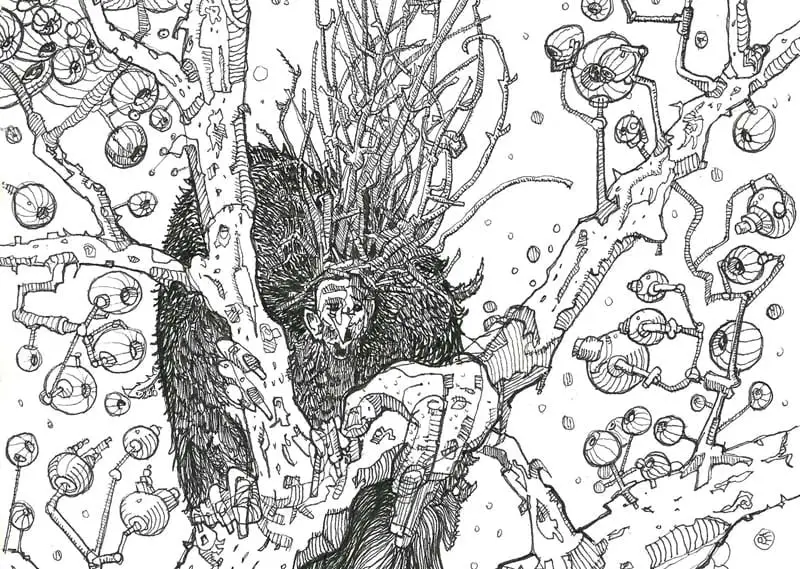
"By the Seashore" (1973)

Updated: 19 hours ago

Both Oliver and the shell had these deep, black, shiny eyes that were either mockingly lively or completely dead — with such shiny, black things it was hard to say which.
Men have become the tools of their tools. — Henry David Thoreau
Lafferty seems to have liked the idea of shells being communication devices. This is most evident in today’s short story and in his novel Sindbad: The 13th Voyage. They share a pattern. In each, shells are deceptive (at least in appearance) communication devices that connect simple protagonists to hidden, superior intelligences. In “By the Seashore,” we get Lafferty’s weird invention, the sinister Geography Cone. It is a biological telegraph and external brain for Oliver Murex, with its microscopic Annotating Crabs that manage Oliver’s affairs. The shell parasitically consumes and transfigures him into something shell-like.
In Sindbad, the dirty and overlooked freshwater ark shells are radio receivers for a secret magical network. They let a dim-witted character communicate with miniaturized Decremental Ifrits and partake in forbidden knowledge so that he can try to replace the real Sindbad. Lafferty shells usually appear somewhat ugly or dangerous to the smart characters. In contrast, dull characters gain a direct line to off-world or magical realities through the tiny, busy entities living within them. The crabs and Ifrits are cousins to the helpers of other dull characters in Lafferty, who have devices that perform similar operations. One thinks of Albert in “Eurema’s Dam,” a slightly earlier version of the character type in Lafferty.
At the story’s center is Oliver Murex. He is a young boy whom his family considers dull, perhaps retarded (Lafferty’s word). One day, he discovers a massive seashell on the beach that his sharp-eyed siblings overlook, though it is more accurate to say that the seashell discovers Oliver. As Oliver and his siblings squabble over what kind of shell they are looking at, the narrator reveals the secret: it is a deadly Geography Cone.
Oliver quickly forms an intense symbiotic bond with it. He carries it everywhere, and soon he can’t think without it. When he doesn’t have it, he appears unintelligent, but with it, he is brilliant. A psychologist explains that Oliver has a core personality located within a shell. Then a dentist discovers that microscopic crabs are eating Oliver's teeth and replacing the enamel with shell-like material. Oliver is being reconstituted.
When Oliver reaches adulthood, he doesn’t look entirely normal. He somehow resembles the shell, with his large head and dwarfish body. He enters his father's communications business, where he is able to be efficient by holding the shell to his ear to receive answers. A scheming gold-digger named Brenda Frances singles Oliver out as an easy mark and tries to seduce him; the relationship ends in a hilarious scene when microscopic crabs infest the bed, protecting Oliver and driving Brenda away. This part of the story, the seduction scene, is really amazing Lafferty, so unlike anyone else that it beggars description. Here is Oliver, not quite pitching woo to the predatory Brenda:
“After we're married, we're sure going to change that‘we’ stuff,” Brenda Frances said. “But how does Shell read?” “With his eyes like everyone else. And the annotating crabs correlate the reading for him. He says that seduction scenes are more fun where he comes from. All the seductors gather at the first high tide after the big moon is full. The fellows are on one side of the tidal basin — and then their leader whistles and they put their milt in the tide water. And the she seashells (Earth usage — they don't call themselves that there), who are on the other side of the tidal basin, put their roe into the water. Then the she seashell leader whistles an answer and that is the seduction. It's better when both moons are still in the sky. At the Sea of Moyle they have two moons.”
It is during this seduction scene that we learn that the shell comes from the distant Sea of Moyle.
Then the story takes another turn. An extraterrestrial tycoon with a beak arrives at the Murex home to finalize business agreements. The visitor spots the Geography Cone as the sentient executive and views Oliver merely as a pet. After the Annotating Crabs draft the necessary contracts, the visitor executes a fair exchange: he leaves the shell behind to run the corporation, but he puts Oliver in a bag and whisks him off to the Sea of Moyle. The story ends with Oliver, now fully transformed into a rare Oliver Cone, sitting on an alien beach waiting to be discovered by local children.
This strikes me as one of Lafferty’s lightest stories, though there is, as always, a cautionary element to be found. The image of Oliver’s dead, dull black eyes is memorable. Perhaps the most interesting thing about it is how dark it becomes just beneath its bright, playful, silly surface:
Well, it was either Oliver or his shell who had the almost instant answers. They had come to resemble each other in voice almost as much as in appearance and the father really didn’t care which of them answered —as long as the answers were quick and correct.
It is also a rich source for thinking about areas of Lafferty that rarely get addressed: disability, bureaucratic exploitation, colonial extraction, body horror, and communication tech as predation. Behind all of them, I think, is an old-fashioned lesson: surrender agency to external tools, and the tool becomes the master while you become a fungible object.