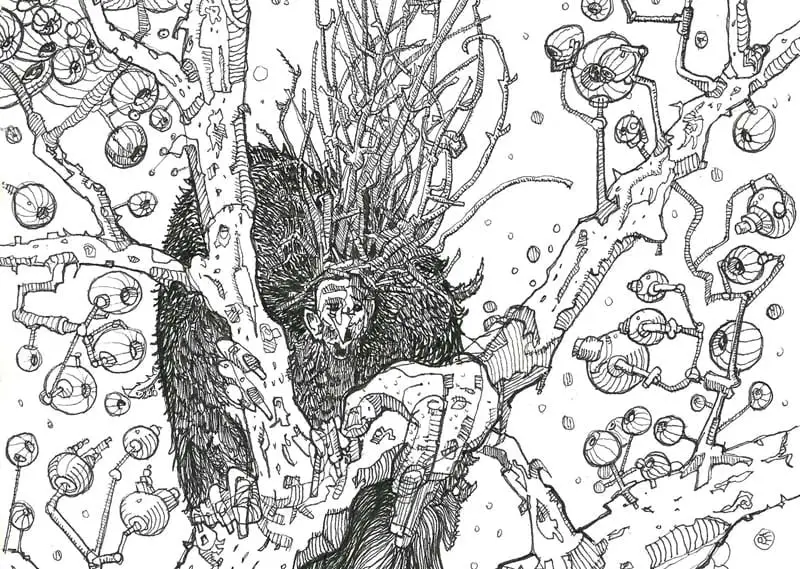
"The Man Who Never Was" (1961-64/1967)

Updated: 1 day ago

"What do you do when you have just hanged a man? Why, the man himself had showed us what to do. Besides, a future kind of man doesn't leave much of a hole in the present."
I've also sent you three other endings to it, designed so you can use any of the four page 16's here and throw the others away. Or, if none of these endings will do it any good, and if any of your sharpies can design an ending to make it sell, I'll split the proceeds with him. — Letter to A. L. Fierst, June 2 1961
The ancient Romans had a practice now called damnatio memoriae to posthumously disgrace a public figure, a practice some of our current politicians warrant. They would erase and disfigure all marks of official remembrance. This happened in several ways. For instance, names were chiseled off inscriptions. Portraits were smashed or recarved. Statues were removed, coins withdrawn, honors annulled. One was removed from the historical record to the extent possible.
The Romans themselves did not always use damnatio memoriae as a formal legal term, but it is the modern label for a cluster of senatorial and imperial acts that declared someone unworthy of public memory. This leads to a paradoxical result where the best records of it are the physical traces it left behind: erased names on stone, reworked busts, altered reliefs, damaged images, coin evidence, and literary references in historians such as Tacitus, Suetonius, Cassius Dio, and the Historia Augusta.
Some famous figures who got the treatment are Geta, Domitian, Commodus, and Sejanus. That we know those names shows that Rome couldn’t erase important people from historical memory, but that history itself was, then as now, a political battlefield.

“The Man Who Never Was” is one of my favorite Lafferty stories. When one sees it discussed at all online, which isn’t often, people talk about the ending where Mihai Lado, some kind of hypnotist with strange eyes, is hanged. As far as the action goes, that is the ending, but what makes it a favorite of mine is the postscript.
The original story had four alternative endings. In the end, Lafferty chose what I think is the strongest one, but then he rewrote that strongest ending, which dated from 1961, in 1964, pushing it from a pre-nucleation story to one that shows his nucleated themes with greater sophistication.
The story's history makes it an excellent example of how Lafferty deepened into his mature themes as he became increasingly concerned with consensus history, which makes it a great preface to his later works on the theme of consensus reality, including the difficult Three Armageddons of Enniscorthy Sweeny. I’ll run through the plot, discuss the four original endings, and end with a few words about the powerful coda.
“The Man Who Never Was” takes place in a small, unnamed town. An unusual and successful cattle dealer named Mihai Lado with mesmerizing eyes seems to possess supernatural abilities. He calls himself a "future kind of man." In an argument with a local man named Raymond Runkis, Lado brags that he can make any lie become reality. Runkis challenges Lado to erase a man from existence. Lado takes the wager and targets a seemingly familiar, simple-minded local named Jessie Pidd.
This is a wager, and it needs to be taken seriously, so to ensure no foul play goes unnoticed, Runkis and several other townsmen lock themselves in a house with Lado and Jessie. Over the course of three days, they watch as Jessie Pidd becomes transparent and ultimately vanishes.
Jessie Pidd is now gone. So what happens? The townspeople accuse Lado of murder. That leads to an official hearing overseen by a state commissioner named Ottleman. At the inquiry, Lado confesses that he did not kill anyone because Jessie Pidd never existed. Lado used his powers of illusion to plant the memory and physical appearance of Jessie in the townspeople's minds to win the bet. An investigation of the town's records supports Lado's claim. There is no documentation, employment history, or financial footprint for Jessie. Even so, Ottleman says that a murder occurred. He just needs a body before the state can authorize a legal execution.
The townsmen, however, take matters into their own hands and privately hang Lado and then hide his body. Knowing that Lado had no formal records and dealt in cash, the town orchestrates a mass cover-up to suppress all evidence of his existence. When Commissioner Ottleman returns with the militia, the locals feign ignorance. They say they have never heard of Lado, Jessie Pidd, or the hearing. And they seem to get away with it.
The townspeople avoid legal consequences, yet they are left with a feeling of paranoia. They sense that they will eventually have to face a fully realized, vengeful Lado in the afterlife. It’s the meaning of the paranoia that I want to look at because it doesn’t exist in the four original endings.
In Lafferty’s first variant, Ending A, the town hangs Mihai Lado. After complaining about the quality of the knot, Lado breaks down and is jerked off his feet, and he leaves behind a weird, perhaps illusory reverberation of his final claim that Jessie Pidd never existed.
In Ending B, the knot on the noose fails. Recognizing his advantage, Lado uses his abnormally large eyes to mass-hypnotize the gathered crowd into a standing trance; by the time the townspeople awaken, Lado has escaped in his car. He leaves the locals struggling to remember his face or confirm that he himself existed.
Ending C depicts the execution being interrupted when Lado smiles and looks toward the woods. This prompts the arrival of a crowd of beggars that seems to include Jessie Pidd. However, each of the townspeople identifies a different beggar as Pidd. The wavering, illusory nature of the crowd causes the confused townsmen to abandon the hanging, and Lado laughs at them. Finally, Ending D details the town actually hanging Lado and working together to obliterate all evidence of his presence. This is the ending Lafferty rewrote in 1964.

At this point, it should be clear that the story looks at the relationship between consensus belief and documented information, themes relevant to Lafferty’s ideas about historical memory and documentation in Three Armageddons. Mihai Lado is proof that a community can collectively fabricate a reality by suggesting the existence of Jessie Pidd, a man with a purported history and relationships but no real physical documentation. Lado’s defense in the end hurts him when he points out the discrepancy between the town's collective delusion and their lack of documentary evidence:
“I didn't know I was that good,” said Lado. “I turned it on. Why can't I turn it off? Ottleman, these people dream in bunches and build up what never was. Test it! Find me written reference to Pidd antedating these last four days. If a man did live in town for years, there would have to be some record of him, he would have to live somewhere. . . We live in a paper world, and somewhere there should be paper on him.”
It’s true that Pidd's existence relies on the town's manipulated memory rather than verifiable fact. But this is what allows the town to get away with lynching Lado.
To hide the lynching, the townspeople adopt his method to manipulate reality. Because Lado himself dealt in cash and used an assumed name, his own lack of documentation makes him a great murder victim. All the town has to do is destroy the few existing records of his presence. When the authorities arrive, the townspeople execute a flawless, collective damnatio memoriae, pushing Lafferty's premise to its outrageous extreme:
Hanged a man? Who? Us? A Mihai Lado? That name sure did not ring any bell in our town. Even our sheriff did not recognize Mr. Ottleman when he came; they had to be introduced all over again. Ottleman set his briefcase down on the ground in exasperation. There is some mistake, we said. This is Springdale. You must be looking for Springfield clear in the other part of the State. A previous hearing, you say? And only the day before yesterday? There must be some mistake.
In the coda that Lafferty added in 1964, Lado says he is a future kind of man with new powers to create illusions and alter perception. This coda is where we begin to see nucleation. The future is probably best thought of here, not just as a chronological time period. It is an era in which objective truth can be easily manipulated. It can be easily discarded by individuals with these specific abilities. The hypnotic eyes allegorize what we now call the post-truth world.
The town's manipulation of historical records to erase Lado shows that something has been set in motion that will punish the townsmen in the future. That is the abandonment of a socially objective, documented truth, something that Lafferty often called unstructuring. It is the first moments of the unstructuring of a world, or its incipience, and it is a self-inflicted wound that the townsmen bring on themselves by abandoning justice in their eagerness to lynch Lado.
In the story, Lafferty depicts this as a problem that happens in linear time. Usually, he treats the problem of consensus reality as a problem of world environment, with the great exception of Three Armageddons, where he tries to show it happening diachronically, which is one factor that makes the novella one of his masterpieces. In the final version of “The Man Who Never Was,” Lafferty underscores that all the townspeople must face this:
There's one thing about those future types, though: we all got to go through that future country. “He'll be waiting up ahead,” said little Mack McGoot, “one side or other of the barrier. He'll have us then.”[. . . ] Up ahead, around some dark corner, one side or the other of the barrier as little Mack McGoot says, there's a big ruddy freckled man who has some powers that will be beginning to get ripe. He's a man with crazy eyes that didn't grow around here, and he's like one man looking out through the face of another like a mask.
This inexorable advance will take them into an era dominated by men like Lado—men like the Pilgrim and the Media Lords of Not to Mention Camels and other archons in Lafferty’s work. In this future, humans with these reality-altering powers will be fully "ripe." The townsmen sense it, but they really don’t know what’s coming. But we in 2026 do.