"Two For Four Ninety-Nine" (1975/1984)

Updated: 6 hours ago
"I examined the four walls, the carpeted floor, and the ceiling of the room. There are only six interior sides to a regular room like mine, and if they are secure the room should be secure."
" . . . my girl friend Rosemary Korff told me, ‘but now you have acquired a mind without boundaries and a personality without a center.’ So I went about fixing drinks and cheeses and taco dips for my guests . . . at my own Party Without Walls."
There are so many memorable birds in Lafferty’s work. Some I would not hesitate to call characters, such as Astroid Midas and Amoy. Others are memorable presences within particular stories, like the bird in “Beautiful Dreamer” and the grackles in “The Skinny People of Leptophlebo Street.” Still others are threats around which whole plots turn, as with the roc in “Heart of Stone, Dear” and the thunderbird in “Oh Tell Me Will It Freeze Tonight.” Then there are the birds Lafferty uses to dramatize large ideas: time in “Been a Long Long Time,” thought in “Condillac’s Statue.” Finally, there are the birds in this short story, Rusty and Dusty. It seems unfair to call them criminals, but they are thieves.
“Two For Four Ninety-Nine” is one of the The Men Who Knew Everything stories, but that misleads. It is a frolic, and the men themselves are absent. Lafferty finished it after the wonderful “And All the Skies Are Full of Fish” and before the difficult “The Funny Face Murders.” In “Two For Four Ninety-Nine,” readers get Austro, Roy Mega, and Mary Mondo. Roy and Austro have just opened the Big Star Detective Agency and, on opening day, they take on two cases: one involving a mysterious death at a chaotic party, the other an impossible locked-room jewel theft. These are the two for $4.99 in the title.
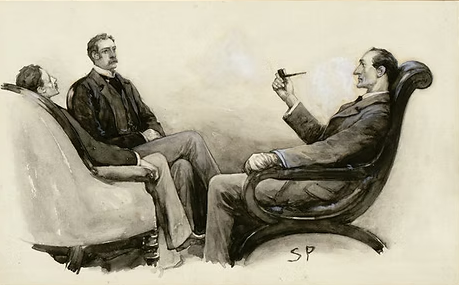
Roy and Austro eventually deduce that the two mysteries are connected through the dead man. He was a crook who trained one grackle to steal Artless’s jewels by flying down chimneys and replacing them with gravel, while the other acts as a distraction. Lafferty is parodying the detective genre and having a great deal of fun. To summarize the hijinks wouldn’t capture this story, since everything is worked out through overlapping, cross-cutting dialogue (for a reconstruction of the sequence of events, see below). There are nods to the Holmes stories. These I enjoy. There are, of course, no canonical Holmes stories in which the great detective solves the case without leaving Baker Street, but Austro manages it.
One point to note about the story is its preoccupation with walls. I don’t know what to do with this, but throughout walls are both flawed physical barriers and metaphors for social and psychological boundaries. Lafferty has them on his mind. They inform the character building.
One of the story’s two clients is George Artless, a sly jewel seller. For him, walls are all about security: he mistakenly believes that the six interior sides of his locked strong room are impenetrable. Lafferty plays Artless's justified paranoia into physical comedy, justified because he has overlooked the vertical breach in his safe room, the chimney. Artless is Client No. 2 at the Big Star Detective Agency, but he might well be called Mr. All About Walls.
The other client is a foil for Artless. She is Miss No Walls Ever, a bohemian type named Selene O’Keene who wears snakeskin shorts and red-lensed glasses. She and her party crowd reject physical and social boundaries and host what Lafferty calls the Continuing Party Without Walls, a gathering for people without boundaries or a center.
The story plays a large conceptual game in which extreme reliance on walls, or the extreme rejection of them, brings the two cases together because they are, in fact, a single case. Artless’s physical walls are easily bypassed by Rusty, the trained grackle that dives down chimneys, while the boundless nature of Selene’s life leads to her, and to everyone else except the grackle Dusty and the ghostly Mary Mondo, being dragged off to jail. The case itself is a schizo-gash. There is also the strange drug dexahexakrex in the mix.
For me, the story is most interesting as a formal problem that Lafferty sets for himself and solves: how to write a double mystery that is really a single locked-room mystery about two worlds, one obsessed with barriers and one obsessed with abolishing them, both corrupt. Its deft construction reveals itself when its implicit and explicit sequence of events is worked out.