"Oh Tell Me Will It Freeze Tonight" (1974/1976)

Updated: 8 hours ago

Reverence is the chief joy and power of life—reverence for that which is pure and bright in youth; for what is true and tried in age; for all that is gracious among the living, great among the dead, and marvelous in the powers that cannot die. — John Ruskin
What's this stuff about art not supposed to be didactic? I buy you geography and arithmetic books and you chew them up and don't learn what's in them. Then I put the stuff in SF parables, and you say it's fine but it doesn't teach anything. Sure it's supposeta. — Lafferty, Letter November 9, 1973
“No derision, please. Derision will imperil the whole business.”
Let’s start with how underdiscussed this significant Lafferty story is. Kevin Cheek has said it defies analysis. The earliest reaction I have found is a LUNA Monthly review of Frights (1976), which shrugs that “Bloch’s ‘The Warm Farewell’ is one of his lesser works, as is ‘Oh Tell Me Will It Freeze Tonight’ one of Lafferty’s.”
Decades later, MPorcius (2019) flipped the verdict, calling it “a sort of apocalyptic American folk tale.” He writes that it “can feel rambling,” but adds “the jokes and the final destination make the trip worthwhile.” That means you laugh, and a giant bird eats people.
In his 2020 PhD dissertation, Daniel Otto Jack Petersen calls it an exemplar of Lafferty’s knack for ending on an impossible punch, noting that it “concludes at the moment when a giant thunderbird . . . bites a man in two and gobbles him up.” He adds that we get “Fear and chuckling, scare-shaking and laughter-shaking.”
Beyond that, there is one slightly embarrassing reader-review blog angle, close to bafflement. The blogger stretches the meaning of "truly" and "fully" until they shatter: “I can’t truly pretend to understand it fully.” That blogger found “it neither thrilling, or horrifying.” Petersen is right about its importance, but as far as I know, he hasn't really analyzed it, which is a shame. It is in his wheelhouse.
“Oh Tell Me Will It Freeze Tonight?” is both incredibly fun and a little hard, so, with no hemming and hawing, I will say what I take as its big theme: reverence and irreverence for big mythic stuff. Recently, I wrote about mocking laughter in Lafferty, and I view what goes wrong in this story as the result of faithless laughter that leads to the withdrawal of the protections of grace.
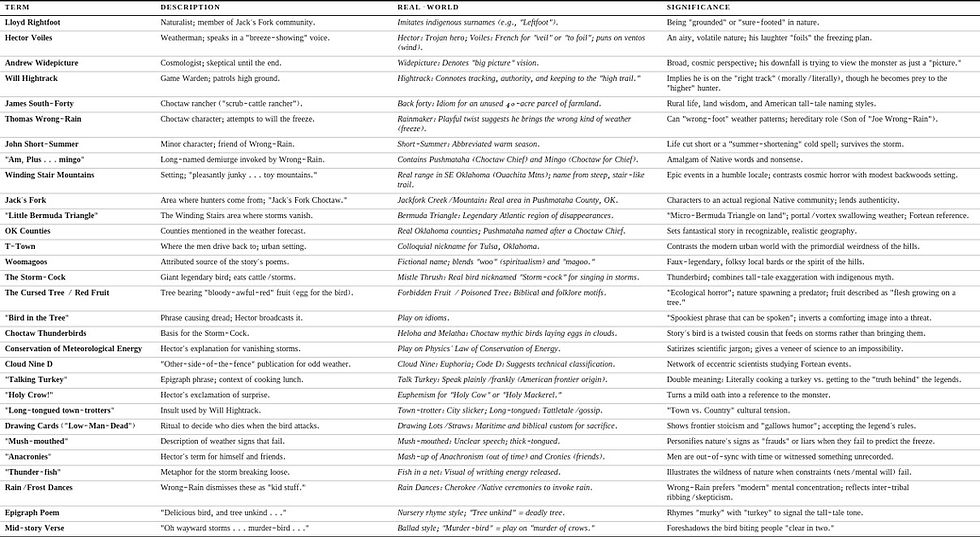
Behind that relatively simple theme lies a densely knotted set of symbols that does quite a few things. First, it reverses Charles Fort’s Super-Sargasso Sea ("thunder-fish"), one of Lafferty's 1970s wellsprings. The Super Sargasso shows up in quite a few stories, perhaps most clearly in "Fall of Pebble-Stones." Instead of strange objects falling from the sky, we have the reversal. Storms disappear into a Bermuda Triangle of weather in Oklahoma. This Fortean damned fact is somehow an endothermic process that creates a freeze.
Then there is a tight network of symbols that remixes Christian and Native American traditions, combining the Garden of Eden and Thunderbird. There is also another interesting Lafferty treatment of amnesia ("Normally it's good that the people should forget. This saves them from worry and stomach-rot and irregularity and anxiety. But some of us have to remember about the tree"). In this post, I won't be focusing on any of that, but there are some supplementary resources at the end.
“Oh Tell Me Will It Freeze Tonight” starts in the Winding Stair Mountains of Oklahoma. Three friends are out hunting and walking about: a weatherman, Hector Voiles; a naturalist, Lloyd Rightfoot; and a cosmologist, Andrew Widepicture. They’re in a region of the Winding Stair Mountains that Voiles calls the Bermuda Triangle of weather phenomena. Storms come here to vanish, leaving behind freezing weather. Voiles says,
“Oh, gathering storms do disappear here. They disappear as if something gobbled them right up . . . That storm will cease to spread. It will narrow, rather. It will narrow further, and it will grow in intensity. Then it will become quite concentrated and powerful so that it seems certain to break into thunder burst or cyclone. And then, at its most intense and threatening, it will absolutely disappear; and there will not be a trace or a track of it left . . . They transmute into cold, into very sudden and quite severe cold. This cold is always narrowly localized, of course. And, for that matter, so are the storms.”
They are soon joined by game warden Will Hightrack. Widepicture shoots a wild turkey. Two local Choctaw men, James South-Forty and Thomas Wrong-Rain, join the group, bringing the total to six.
At this point, important dialogue ensues. Wrong-Rain warns of a legend concerning a Bird in the Tree that grows inside a red fruit; he says it must be killed by a hard freeze before it hatches. If the freeze doesn’t happen, it will destroy the land and people. James South-Forty describes the Storm-Cock, a massive bird that eats victims, saying it measures over six feet between the eyes. The men inspect the tree, and an amnesia-inducing bloom-dust drifts down, causing most to temporarily forget the tree's rank murder-smell and the danger it poses. At this point, the reader knows that the fruit on the tree is incubating the giant bird.

We cut forward to night in T-Town. Wrong-Rain phones Voiles to plead for a weather forecast predicting a hard freeze. This might put some pressure on the weather and force the Bird in the Tree to die before it breaks out of the fruit. Voiles has a hard time believing a freeze could happen, since a strong, warm storm front is moving in, but he agrees to the plan. He broadcasts a prediction into the surrounding area that the storm will disappear into the Little Bermuda Triangle and be replaced by a sudden, killing frost.
During the broadcast, Voiles breaks down into derisive laughter. The prediction fails; instead of disappearing, the storm intensifies. It creates six deadly tornadoes and flash floods across four counties. The temperature remains mild.
The next morning, Wrong-Rain tells Voiles that because the freeze failed, the bird hatched from the riven tree. It grew as big as a herd of elephants. Wrong-Rain then tells Voiles what happened. The Storm-Cock creature tracked him and his companions, and it killed James South-Forty after the three of them drew cards to see who would be taken. Wrong-Rain warns that the bird targets those who mocked it or the legend.
Voiles calls Rightfoot and Widepicture to his office on the ninth floor of the Television Plaza Building to wait out the danger. They debate the creature's reality. Widepicture argues that the modern, sunlit context of downtown T-Town makes such a too-dark reality impossible.
The Storm-Cock suddenly crashes through the glass wall of the office, filling the room with its massive head. Voiles explains that the bird will take only one victim, so the three men cut cards to determine who will be the low man dead. Voiles draws a red six-card. Rightfoot draws a red four-card.
Widepicture puts on a brave face by striking a match on the bird's beak, but he draws a black three-card. The bird bites off Widepicture’s arm. Widepicture waves goodbye with the other arm. The bird eats him, and then clumsily flies away into the sky, leaving Voiles and Rightfoot to watch the aerodynamically impossible Storm-Cock depart.
Part of what makes the story so puzzling is the kind of laughter Voiles laughs: it's the kind Lafferty’s satiric norm agrees with. It is appropriate to laugh at the genuinely ridiculous, which is one reason Lafferty is so good at making us laugh. My take on the story is that the containment system of tree-freeze and the Storm-Cock stand in for sacredness, the sacredness of religion, and perhaps the mythic, Eden and Thunderbird, so Voiles’s laughter is blasphemous.
Making it even more difficult is the fact that Voiles is not a wholly unsympathetic character, nor is he the one who gets eaten in his group of three. In a way, Lafferty stacks the deck. When Voiles gives his weather speech, the reader is likely to laugh because of how ridiculous Voiles sounds:
“I predict that the storm will disappear completely within the next fifteen minutes; I predict that the disappearance will be followed by a quick fifty-degree drop in temperature in that same region; I predict the consequent very hard and killing freeze; and I predict that the big bird in the tree will be freeze-killed in the bloom tonight, and that it will not ravage the country and destroy the kin and the people tomorrow. These are the things that I predict, and I will stake my reputation and my life on my predictions. Who else makes such bold predictions?”
Well, the answer, of course, is that prophets do. A story that uses exaggeration and laughter to laugh derisively at mocking laughter is bound to be a little confusing.
It would have been bad even if Hector had left it at that. He didn’t. He broke up. He began to laugh, to yowl, to chortle. He went into cascades of clattering and rotten laughter. The monitors cut him off, but he continued to laugh like a bloated buffalo . . . "I don’t know," Hector Voiles giggled. "They would have come true, I think, if I hadn’t broken up. There’s something down there that can’t stand derision." "There’s something right here that can’t stand it either," Cantowine barked. "You’re deriding the wrong people when you start to deride people . . . You’ve made light of the last still-standing institution. If the weather isn’t sacred, what is?"
I think this is Lafferty wanting us to remember that rotten laughter contrasts with reverence and to see how it connects to the rotten fruit of the tree:
The fruit was huge and horrible and livid red. It had a rank murder-smell to it, and it would kill you. That fruit had been frosted, and it had rotted.
Cantowine’s line about the weather report being the last still-standing institution is funny. But it isn’t only funny. It points to the philosophically and spiritually conservative side of Lafferty’s imagination, even as we are given an insane story about the Bermuda Triangle of weather and a thunderbird. From the way Lafferty so returns to the problem of laughter that mocks versus the laughter that affirms, it is clear that this was something he took seriously. And if weather can be read as an index of God’s will and of the sacred order of the world (and what is more mythic than that?), then mocking it can express scorn about the sacred.
At the beginning, I mentioned the protections of grace. The freeze has protected the region for two hundred years. We learn of protection failing: "It hasn't done it for two hundred years. But that's just because the tree has had its fruit frost-killed every year." This freeze isn't something that occurs naturally. The protection requires reverent effort. Wrong-Rain "busts his mind for it, as did . . . . Joe Wrong-Rain before." Finally, it depends on a single condition: "No derision, please. Derision will imperil the whole business."
When Voiles breaks into his "cascades of clattering and rotten laughter," the protection ends. There will be no saving cold; the bird hatches, and people die. Wrong-Rain's response to his own wife's death is hilariously deadpan, but there is a deeper point about what comes first in the order of one's affections. Wrong-Rain says, "My house and barns blew away, and my wife got killed; but that's not what I meant by the worst that could happen. Didn't you hear me, Voiles? It didn't freeze." The worst is the withdrawal of grace. Rightfoot has it right: "No, nothing in nature likes to be laughed at." Voiles laughs anyway.
Lafferty often quotes biblical verses and alludes to tradition overtly (surprisingly, from the KJV), as is obvious to anyone who reads him closely. In “Oh Tell Me Will It Freeze Tonight,” he does not do this. My theory is that he refrains for a good reason: in this story, unlike in others, doing so would spoil the aesthetic effect, which depends on defamiliarizing the Christian tradition through indigenous myth to create a hybrid without undermining Christianity.
Even when Lafferty does not cite chapter and verse, we know how well he knows chapter and verse. What follows, then, is not intended as proof-texting or Bible-thumping. It is offered as an interpretive context for the tradition within which he writes—a tradition that treats scornfulness and mockery of the sacred as utterly wicked.
Perhaps best known is that Proverbs condemns scorners, treating scorn as a form of arrogance that invites judgment (e.g., Proverbs 19:29; 3:34). The same warning is unambiguous in one New Testament passage that nearly everyone will recognize: “God is not mocked” (Galatians 6:7). The Christian tradition has always taught that mockery hardens into defiance, and defiance is reckoned with (2 Chronicles 36:16). Of course, mocking laughter is also there in the Passion, when Christ is mocked before Herod’s court. Within canon, the seat of the scornful of Psalm 1 gives the title to "Scorner’s Seat."
I would add that this is not a condemnation of mockery as such. God mocks the schemes of the wicked. The prohibition concerns mockery of the sacred. And I wouldn't want this to sound like Lafferty is against mocking because the man was a fierce mocker.
As I have recently pointed out, scornful laughter that mocks the sacred is an important theme in major works such as Past Master and in minor ones such as “Something Rich and Strange.” An ongoing theme in Lafferty’s work, it is profoundly serious and significant if one wants to see what he does on his own terms, however one chooses to receive it. It must be recognized that one does not want to be confused by a story like this. Perilous, mocking, blaspheming laughter—what Lafferty takes to be the hilarity of hell—is as thematically important to him as other forms of laughter: absurdist, madcap, teasing, joyful, and all the rest.
This story is particularly difficult for many readers because they are modally estranged from its treatment of reverence and the sacred. I mean that they no longer possess or recognize the interpretive mode in which reverence is meant to be apprehended, rather than a mode like irony. This is a frequent problem for non-religious art, because religion solves the problem outside of art, and religious people tend to approach art from a different angle, with the largest circle not being the ethical or aesthetic. It is not unrelated to the celebrated lines Ursula Le Guin writes in “The Ones Who Walk Away from Omelas," though it has a different register and purpose from what one would find in Lafferty:
We have almost lost hold; we can no longer describe happy man, nor make any celebration of joy.
The difficulty of "Oh Tell Me Will It Freeze Tonight" is then not only contingent (matters of detail, though there is plenty of that here), but modal in a more basic sense: the story asks to be read within a mode many readers no longer inhabit as readers or maybe even as people. If joy is hard for moderns, reverence is probably harder. There is certainly more joy in the world than reverence, and there is far too little joy. If readers aren't open to reverence, wonder, sublime terror, and silliness, then this story is going to whoosh past them like the sound of thunder run backwards.
At the same time, Lafferty is never going to tell the reader to have a capacity for reverence. In his own voice, he won’t even say, No derision, please. Instead, he shows the photographic negative, hoping readers will feel something of the true things.
And if, while reading his work, a reader thinks, I don’t know what this story is doing—does it even have anything to teach me or say about what matters or is it just crazy weird fiction stuff about a Bermuda Triangle of weather and a thunderbird and guys eating wild turkey that barely hangs together?—Lafferty had an answer. Sure it's supposeta.
On June 15, 1987, he wrote the following to John Hall:
I am a strongly believing Catholic myself, and one sentence of Christ that I never forget is "Other sheep I have that are not of this flock." He also says (through Saint Paul) that we should preach the faith "in season and out of season." But the manner of the preaching is left to each one.
He is preaching out of season about reverence.
I’ll wrap up by saying there is architecture in the story. The card-cutting at the end can feel abrupt and odd. Note that it reverses Lafferty’s trick of using iconographic insetting. Instead of getting the small inset image or scene early in the story that patterns everything, we get it at the end, a little set piece that closes out the story.
That makes “Oh Tell Me Will It Freeze Tonight” more difficult than the typical Lafferty story, because if the reader doesn’t recognize that Lafferty has reversed the iconographic insetting pattern Lafferty almost always uses to orient the reader, the reader will feel confused (maybe unconsciously so) and then won’t know what to do with the card-cutting ending. The card cutting will seem strange or tacked on, and the reader might not think to look for its structural role, because the reader might not realize this is how Lafferty builds, but it is backwards. The reader won't see the callback, which is usually a Lafferty open-into.
In “Oh Tell Me Will It Freeze Tonight,” absorption restores order as a countdown. It parallels what the Bermuda Triangle does to storms. In the long first part of the story, three friends form a triangle. They become four men with the warden. Then they become six men, with the two Native Americans completing the figure. Now we have the six-set broken into two sets of three for our murderous Storm-Cock hijinks.
In the card-cutting finale with the second three-set, the three friends, the 3-4-6 sequence is replayed in reverse: the card numbers cut to each (red six, red four, black three) correspond to elements of the dialogue in the dense, dialogue-heavy first section.