"The Effigy Histories" (1975/1984)

Updated: 1 day ago

In the case of the Effigy History of Music and its author, there is a correspondence and mutual clarification between creation and creator that is not to be found in the Effigy History of Mountains, for instance. With almost any musical instrument, Karl Effigy can play out the clarifications of the statements in his History of Music. But Karl Effigy can not, to the same extent, clarify the obscurities of his History of Oceans or his History of Continental Upthrusts. And yet he illuminates those subjects very powerfully also, going back and giving one the feel of adolescent oceans and of swampier continents.
“Knowledge depends on the mode of the knower; for what is known is in the knower according to the measure of his mode.” — Thomas Aquinas
Advanced Lafferty today.
“The Effigy Histories” is one of my favorite Lafferty stories. It is unusually clear about a view of history and knowledge that runs through much of Lafferty’s work. That view is often only latently present because he so frequently suspends the ordinary operations of historical process and knowledge-making. Today I want to work through some of that and explain how I relate it to difficult content in Lafferty's misreading of history.
Lafferty gives us Karl Effigy, a young man and former juvenile delinquent. Karl achieves immense fame with the publication of the Effigy Histories. They are a series of books covering topics ranging from music to mountains, happy fictions that create delight and a sense of apparent wisdom. They’re also factually inaccurate. Karl’s admirers see him as a person of infinite wisdom, with Arpad Arutinov pointing to his perfect person-pattern. On the other hand, members of the Cosmo Club, to which most of the other geniuses in the story belong, are suspicious. Aren’t the Effigy Histories just a nonsensical art form? They think Karl’s sudden, comprehensive knowledge is some kind of illusion or fraud.
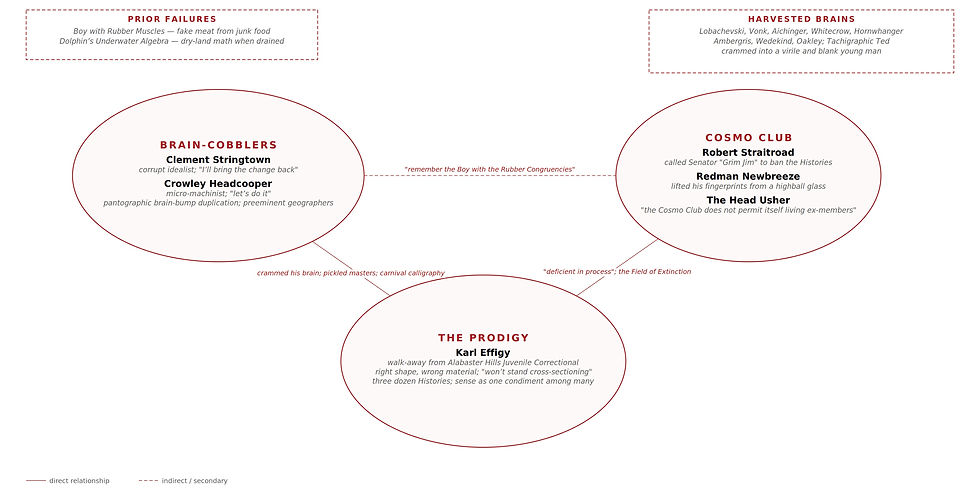
Next, we learn the truth. The source of Karl’s abilities is two inventors, Clement Stringtown and Crowley Headcooper. The two scientists are specialists in brain-cobbling. This technique involves physically reshaping brain wrinkles to match the brain patterns of geniuses. We learn about two previous brain-cobbling experiments. Lafferty uses this to write two fun stories-within-the-story, one about The Boy With Rubber Muscles, who developed a physique without strength, and the other about a dolphin that invented a form of underwater algebra. And then we come to the creation of Karl Effigy. The two inventors took a young man from a minimum-security facility and imprinted his brain with the duplicate patterns of history's greatest scholars and artists.
Skeptics eventually bring Effigy before the Cosmo Club for judgment. It is quickly determined that Karl is "deficient in Process." While Karl’s knowledge has the correct form, it lacks substance. The club orders Karl’s extinction. But there is a wrinkle when the sentence is interrupted by the arrival of federal marshals to arrest Karl. And then there is another wrinkle because the Feds are interrupted by an under-warden from the Alabaster Hills Juvenile Correctional Institute. The warden asserts his authority, and Karl goes back to where Stringtown and Headcooper found him.
So what is really going on here? Karl Effigy has form without content. His brain has been pantographically impressed with the corrugations of great minds, shapes that correspond to wisdom. Lafferty tells us that the shapes are fossils, which makes them the residue of processes Karl never lived through. The geniuses from whom the person patterns come are tied to causal chains. They earned their brain corrugations. They struggled, erred, revised, and grew. Karl gets the endpoint without the journey, which is important to the story's view of history.
As I’ve written about before on the blog, I see Lafferty as being a moderate foundationalist who likes to play games with extreme epistemological coherentism, the view that there is nothing beyond how our ideas hang together as a web of belief. So let’s step back and think about what history is for someone who holds a moderate foundationalist position.
The most important part of this is testimony as a source of justification. Testimony conveys truth by being a non-basic but epistemically legitimate source of belief that rests on more fundamental grounds. It is justificatory, but non-basic because it is of secondary order. Testimonial beliefs are not justified in isolation. Instead, they are supported by background basic beliefs, such as perceptual awareness, memory, rational intuition, and revelation (capital “T” Traditional and personal, in Lafferty’s case), that provide defeasible reasons to trust speakers.
How do you evaluate testimony, for instance, if you were to read something like one of Karl’s Effigy Histories? The strength of the justification for believing it is true is influenced by factors including Karl’s reliability, sincerity, and epistemic competence, all of which stand on foundational resources.
If the causal chain checks out, then testimony transmits truth without being infallible. Even here, its justificatory force is conditional. Counterevidence might arise. The takeaway is that moderate foundationalism preserves the epistemic importance of testimony while grounding its credibility in more basic forms of justification over the long term.
Karl’s histories just lack all justification. Indeed, they are cut off from the most basic forms of justification, which is why the narrator tells us that they are “not accurate in any of their particulars.” They are described instead as happy fictions: pleasant, euphoric, and aesthetically coherent, but nonsense all the same. Yet they communicate with “strange clarity and luminosity” and possess “the inner coherence of great paintings.” The form seems to be doing all the work.
We are therefore dealing with the question of aesthetic knowledge, if that phrase can even be allowed. We have to be, since there is no testimonial access to justified true beliefs about actual history. One can read an entire Effigy History and find nothing that conveys truth through the many forms of testimony historians use. You would see stuff that looked like it, but it would all be a mock-up.
The question the story poses becomes: what can this form accomplish on its own?
Lafferty works through a series of answers, making the story more than a set of tall tales organized around the novum of brain-cobbling. It becomes one of his more significant attempts to reflect on his hobby, history. In music, the logic of Effigy History suggests that form can do almost everything. (This is related to the demiurgic role of opera in The Three Armageddons of Enniscorthy Sweeny). We are told that Karl received Gordon Whitecrow's Musical Mastery, and he can play. When something in Karl’s Effigy History of Music is obscure, he can pick up an instrument and demonstrate what he means.
Lafferty goes to the trouble of giving this a marvellous description, a line of critical importance in the story. He calls it "correspondence and mutual clarification between creation and creator." The subject matter of music is something Karl can produce and reproduce. He can't prove his History is accurate, but he can show you the shape of what he has written about. With music, form demonstrates itself.
I would sum this up by saying that Lafferty is isolating the strand of his epistemology in which understanding and justification arise not from propositional proof but from form itself as a self-demonstrating medium: truth is apprehended through productive enactment and correspondence between knower and creation, rather than through verification.
Now we come to the natural histories. There are works by Karl on Mountains, Oceans, Continental Upthrusts, and so on, where form can only imitate. Karl "illuminates those subjects very powerfully," giving readers "the feel of adolescent oceans and of swampier continents." How we read this will be interpretively important. One could read it as saying that there is something very worthwhile here. This is the sheer aestheticist pole of the Effigy Histories. I read it ironically and darkly: "illuminate" is more counterfiguration. It is more noetic darkening. Readers of Effigy history are not really being illuminated. They are being fed codswallops. It’s nonsense because Karl "can not, to the same extent, clarify the obscurities." That is what real histories do.
We might wonder why Karl can't do this. Perhaps it is because Karl cannot produce a mountain. The subject matter of the natural histories lies outside him in massive causal chains involving countless multifactorial events he has no access to. The form of the mountain refers outward to content Karl just doesn't possess. This would be like Vico’s verum ipsum factum. Karl can indicate mountains; he cannot teach you about them from the inside. Lafferty gets in a good joke about Karl’s earth knowledge being a lot like his understanding of himself: adolescent. It is projective.
Then we come to math. Arithmetic is Lafferty’s limit case. The big joke here is the one the story ends on. Karl is writing "The Effigy History of Seven Months Five Days And One Hour And a Half In The Klinker," but his sentence is eighteen months. His counselor is worried about his arithmetic. Seven is not eighteen; no amount of aesthetic coherence bridges the gap. Pure particulars admit less clarification through aesthetic form. Jasper Johns’s 0 Through Nine is a painting of Arabic numerals, not of numbers, though if they measured anything, they would be numbers. Numbers are somehow what they are, and Karl doesn't know what they are.

The gradient, then, I think, looks something like this: where form can demonstrate itself (music), Karl succeeds. Where form refers to external content (natural history), Karl is showy and immature. Where form becomes pure particular (arithmetic), Karl is a complete washout.
Someone might think, "Come on now. Isn't the number the best example of pure form? How can you put it on the far end from music?" To this, all I can say is that Lafferty seems to do it, so I wouldn't read a Platonic account of number into him. As an objection, it seems to confuse what the story implies is aesthetic form (internal coherence and style) with ontological form (the nature of the thing). Lafferty emphasizes that Karl possesses the style of a mathematician, like the Dolphin who created underwater algebra, a perfect "being of reason" (ens rationis).

Consider it this way. Thomistic metaphysics defines truth as adaequatio rei et intellectus, the conformity of the mind to reality. Lafferty uses this standard in his major distinction regarding the Effigy History of Music: "there is a correspondence and mutual clarification between creation and creator." That must be important for Enniscorthy Sweeny, too. In music, Karl is the creator, so the reality conforms to his mind because he is enacting it. Isomorphism.
But in the case of the stubborn particular of the number eighteen, Karl is not the creator; that number is a measure of real historical time. His jail sentence is an objective "accident" of history, not a subjective projection of aesthetic will taking itself for or pretending to be knowledge. Because Karl is "deficient in Process," as Lafferty puts it—I would say cut off from the causal chain that links the mind to the external events of history in testimonial form—he cannot achieve conformity. The truth conditions for truth-based history are not met, so historical accuracy becomes a nonstarter.
"The Effigy Histories" places human history between natural history and arithmetic. Like natural history, human history records events of a kind Karl cannot produce. In this sense, Karl Effigy is Enniscorthy Sweeny backwards (Lafferty wrote The Three Armageddons of Enniscorthy Sweeny about six months before he completed "The Effigy Histories.") Karl cannot demonstrate the French Revolution by performing it, nor does he have access to its process as transferred through the causal chains of testimony. Historical narrative refers outward to content: to particular events, particular people, particular dates.
Karl might write an Effigy History of the English Middle Ages. That history might be bound in buckram, Smyth-sewn, and hand-finished, with deep texture, brilliant emplotment, exhilarating pseudo-insight, and thematic coherence. It would give you the feel of medieval England. But it would be dead wrong. It would be consensus history, with the history drained away. You would have the equivalent of the tank of water before the underwater algebra gets drained in the story. It would be nonsense.
“Underwater Algebra is all wet,” Professor RodneyMuldoon spoke with incredible crassness. And Professor Plato Platorhinus spoke of it even more sharply at an International Seminar: “Drain all the water out of all the equations,” he barked. “Then see what you have left.” “How will we drain equations, Professor Platorhinus?” the Marshal of the Seminar asked in confusion. “Aw Dromedary drek! What do they make Seminar Marshals out of nowadays?” Professor Plato cried in anguish. “Rotate all the vector values ninety degrees clockwise and let the water run out of them.” It was done. And what they had left was simple dry-land mathematics such as toddlers study in high schools and colleges.
Like arithmetic, history has its stubborn, non-aesthetic particulars. Henry II was crowned in 1154, not 1163. Seven is not eighteen. Against epistemological coherentism, no amount of aesthetic coherence makes a false date true, Lafferty seems to be saying. But history is more dangerous than arithmetic because the aesthetic form is more seductive and plays a far larger role. A history that gets the feel right but the facts wrong is a happy fiction (more irony). Some people will take to it instantly for all sorts of reasons, from artistic tastes to ideological pre-commitment to the many cognitive biases we are all prey to. Lies are harder to see through when given such splendid form.
For Lafferty, the ultimate stakes of this must be religious. Christianity is a historical religion, and Catholicism preserves the most developed record of its truth, at least according to Roman Catholicism. Catholicism also makes claims about particulars. Suffered under Pontius Pilate appears in the Creed: a time-stamp, a named Roman bureaucrat, a specific execution. The Incarnation is an event first, not a person-pattern like Karl Effigy. God enters history at a particular time, in a particular place, in a particular body. Had you been there, you would have seen it distributed across the brain’s regions and networks—what Lafferty turns into the wrinkles and valleys of the story.
We can sloganize it as The Incarnation can’t be pantographed. And you can’t pantograph a person into being the Incarnation. Whatever Lafferty’s satirical norm is, it will have an epistemology that protects this. That is how I see it.
In “The Effigy Histories,” Lafferty appears to be working with a distinction between basic and non-basic beliefs. It isn’t that the story is claiming that knowledge requires personal experience (though that is how it imagines the philosophical problem through Karl), but that non-basic beliefs, such as those about history, are justified only insofar as they can be traced through intelligible testimonial or inferential chains back to basic belief-forming faculties like perception, memory, or reason.
Karl Effigy’s defect is that he was confected in a way that cut the chain of epistemic ancestry. He is a history-making pseudo-golem who golems up history. His histories have the formal shape of knowledge, but they are not grounded in witness, memory, reliable testimony, or defeater-sensitive inference. This assumes that whatever plays the basic role must belong to an accountable knower whose belief-forming capacities are recognizably human and corrigible, rather than allowing that an opaque but reliable imprinting mechanism could itself count as a basic source.
I think Lafferty actually creates a space for such an imprinting mechanism in his mysticism, especially in his oceanic mode, and that he provides a foundation for revelation and sacred doctrine beyond what moderate foundationalism allows on its own. He believes that a narrow set of things is basic and incorrigible, but one of the rules he holds himself to as a writer of fiction is that he never preaches, so he never says this. That makes him an extremely weird moderate foundationalist, one who can appeal to both the whole-hog epistemic foundationalist and the radical anti-foundationalist.
For the latter, the religious carve-outs in Lafferty can be treated as fantastical elements. They are hard-coded but less near the surface, buried by Lafferty’s usual games with counterfiguration, allusion, and so forth, much like some of the subtler worrying elements. For that reason, they are exceptionally easy to evade if one refuses to look.
This is where Lafferty’s (sometimes justified) paranoid reading of history comes in. Karl Effigy's histories are "imposing bottles that have been emptied of all the liquor of fact and refilled with something else." They give off "luck and pleasant surprise and sheer delight." The counterfeit is indistinguishable from the real thing at the level of reception. One has to fact-check Karl at every point to break the mesmerism. Karl dazzles the usually contrarian Arpad Arutinov, one of Lafferty's jokes in the story. However, Diogenes Pontifex is suspicious. I think Lafferty's own view of bogus history is probably very much like Pontifex's:
If a large meteor should light in the middle of my neighborhood, would it be worth my while to step outside and see it? If the meteor should knock my house askew so that my floor was at an angle of 38°, would it be worth my while to investigate? Oh no, I see that the room isn't really slanting at 38°. That's an illusion. Nevertheless, I just believe I'll step outside for a look at the meteor of the meteoric illusion. I understand that the meteoric phenomenon is named Karl Effigy.
Pontifex understands that even when Karl Effigy’s history is seen for what it is, an illusion rather than a real meteor, it can still have cultural force and shape behavior. Fictionalized histories poison the present when they are believed by those unwilling to analyze stubborn particulars. As Lafferty writes, Karl Effigy’s “talk, if analyzed, has the mechanical element of a recording. But, left unanalyzed, it has the liveliness and humor of humanity at its best.”
Now here is the hard part. Lafferty believed that the Holocaust was a formally coherent account—coherent enough to gain historical consensus at least. To that degree, for him, it is like Diogenes Pontifex's floor canted at an angle of 38°. "The Effigy Histories" can be read as an attempt to think through unmoored historical coherentism, in which narratives whose “facts and happenings differ from the facts and happenings in corresponding reality” nevertheless act as history, with only a few figures (like those in the Cosmo Club) recognizing that “some sort of switch has been made.”
The Holocaust would be the kind of material that goes into an Effigy History of the Jews. It would have a shape imposed without reference to actual events. It would have an aesthetic form that "illuminates powerfully" and gives people "the feel of" something, but which is "wrong in every particular."
It is not surprising that Lafferty creates Enniscorthy Sweeny and Sweeny’s creations. When "The Effigy Histories" is read as a companion piece, The Three Armageddons of Enniscorthy Sweeny becomes two things. First, a masterpiece of authentic and Effigy-style history. And second, a magic eraser for what Lafferty sees as real-world Effigy history contaminating the twentieth century.