04 Misc Laff: Fungo Wood

Updated: 1 day ago

“Yes, basisphaira as you call it, baseball has been played at least seven hundred years,” old Josh told them, and he began to put a story together about old bingles and bunts and bases on balls. “The first regular team was a barnstorming team named The House of David. That was before a regular league was established. The House of David boys were bearded and they had a lot of hokus to them; but they could play baseball. They beat every town team up and down every valley and coast.”
As sometimes comes up on the blog, Lafferty loved baseball, and it shows. There is the early unpublished “All-Star Series,” a baseball story. Then there are stories that deal with baseball peripherally through characters who are baseball players. We find these, for instance, in “Fall of Pebble Stones” and “Royal Licorice.” In the Lafferty archives, there is a fragment called "Fungo Wood and Crackerjacks," a story that pretty clearly had something to do with baseball, though I hadn’t read it.
If you are not an American, or if you don’t care about baseball, fungo may not be a word you know. A fungo bat is one of those long, thin practice bats used mainly by coaches to hit fungoes, a fungo being a ball one tosses into the air and gives a directed hit. Coaches do this to run fielding drills. The shape of the fungo bat makes it easier to control the ball than a regular game bat, and because a fungo bat is longer, lighter, and narrower, a coach can hit lots of grounders and pop flies without as much fatigue.

No one knows where the word comes from, though some have speculated that it goes back to the Scots verb fung, meaning “to pitch, toss, or fling.” It is hard to imagine that Lafferty wouldn’t have been interested in the word’s etymology, with it being discussed in Mencken’s American Language.
Now here is some arrant speculation. Perhaps that oddity helped inspire the story: as with his “All-Star Series,” Lafferty certainly wanted to write something speculative rooted in the sport’s mythology. "Fungo Wood" is all about baseball, amnesia, origins, historical confabulation, and mythology. And fungo is a really curious word.
Many years ago, the American paleontologist and baseball fan Stephen Jay Gould (“Along the San Pennatus Fault”) wrote a brilliant essay on the Cooperstown myth that unraveled some of its aspects. The old myth is that Abner Doubleday invented baseball in Cooperstown, New York, in 1839. This origin was popularized by the Mills Commission (1905-1907), which sought the origin of baseball, and was later reinforced by the Hall of Fame’s being built in Cooperstown; Gould argued that the origin story was probably all about a Civil War complement and a young sport that desperately wanted an American origin. It’s a fun history, and very American.
Baseball historians now recognize that the Cooperstown myth is hogwash for several reasons. First, it always depended on the word of a man named Abner Graves (read the Gould for the whole story). Second, Doubleday was at West Point in 1839, not in Cooperstown. And, third, nobody invented baseball. Baseball evolved from earlier bat-and-ball games played by poor immigrants to the U.S. and native traditions rather than being created by a single all-American Civil War hero and sports savant in a single brilliant stroke. Gould’s training in paleontology and organic development made him suspicious of origin myths. He suspected that the origin of baseball was no more likely to have come from fiat than one of his beloved mollusks.

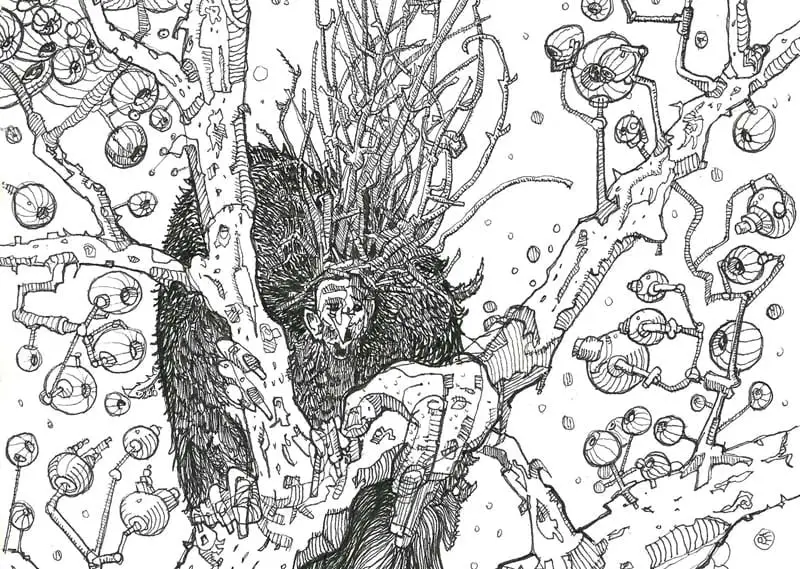
So what is "Fungo Wood and Crackerjacks?" Well, it is a post-apocalyptic baseball story that never quite came together. Scattered notes for it survive elsewhere in the archive. Lafferty tells of a group of child soldiers from the Young Soldier Hills who take a much-needed break during a grueling fifty-inning game of "basisphaira." Yes, fifty innings.
The boys, ranging from 11 to 17 years old, are playing a brutal version of the sport near a blinding-white desert. They use heavy rock balls and crude bats fashioned from broken ash lances. As they settle down to rest and hide their injuries, an old smithy and storyteller named Josh Hackensmith gives them water laced with citron juice and begins answering their questions about the game's ancient origins.
Old Josh’s version of the baseball myth blends biblical antiquity with twentieth-century Americana, though Lafferty is having fun here with the actual Jewish baseball team, the House of David. Josh says that baseball’s original golden age began when the ancient ships of Hiram of Tyre voyaged to Punt and returned with magical items that have since been lost. We readers understand that these mythical treasures are actually modern baseball staples: rubber for the balls, “Louisville tree” wood for the bats, “Fungo wood,” maize for Crackerjacks, and chicle for chewing gum. The disconnection between the lost past and the post-apocalyptic consensus reality comes through when Josh recites a sacred, ancient slogan: "Getahamburgergetahotdogget a coneyisland sandwich."