To Tulsa and Back

Updated: 3 days ago

Monster movies, philosophy, religion, classical art, puns, horror stories, linguistics, science fiction—how does he account for this quirky range of interests? Lafferty said, “I’m kind of a quirky guy.” And here we are . . . at the lake. Swan Lake is so beloved by the City of Tulsa, the water was drained out of it. The old lake was extensively renovated—dug deeper, reshaped, landscaped. When the land was refilled, the lake’s caretakers anchored wooden duck decoys in the water to encourage the return of the waterfowl. One of the attractions of Swan Lake is for people to throw bread to the lake’s population of swans, geese and ducks. What Lafferty likes to do is watch people throwing bits of bread to the duck decoys, unable to tell the difference. He is an Irishman with a story to tell; he couldn’t be happier. “I heard a mother tell her children, ‘Don’t worry,’” Lafferty said. “‘I think maybe that duck will eat when we’re gone.’” — Ron Wolfe Interview with Lafferty
Back in Houston after a quick trip to Tulsa, where I had a great time meeting Lafferty people.
I knew that Antonino Vescovo, Lafferty’s 1930s novel, was at Tulsa, but it had been misarchived and was not showing up in Tulsa’s system. When I inquired eight months ago, the archivists said they had no record of it. A few weeks ago, it occurred to me where it might be, and, sure enough, it was there, a thick folder that had been unlabelled. Had I been mistaken, it would have been a disappointing trip.
Antonino Vescovo is important because Lafferty wrote its hundreds of pages in his early twenties, and it precedes his long period without writing fiction, though he was studying languages and translating poetry. I had Tulsa correct the manuscript record, which is now findable here for anyone who wants to research it. (In adding the title yesterday, the friendly grad student on deck misspelled it "Antonio," but maybe that makes the manuscript feel at home. There are quite a few of these errors in the archive.)

Maybe a few preliminary thoughts about the book. It’s a biographical novel focusing on the early life of a future bishop in Renaissance Florence, almost certainly informed in part by this entry in The Catholic Encyclopedia. It starts with a legendary prophecy about the city's greatness, then moves to Antoninus's childhood. He is a pious and intellectually gifted boy. We learn about his ascetic practices, immersion in Latin and theology, and his interactions. One of the most memorable of the characters is his artistic peer, Casimirro.
A large part of the book centers on philosophical and theological debates among young monks and novices at a monastery in Fiesole. Lafferty covers the nature of faith, doubt, and cosmic infinity. There is a rich folk culture (street ballads, palmistry, and the like) alongside the structured life of the Dominican Order. So it is Lafferty’s take on the life of a scholar-saint in a bright, often humorous, intellectual landscape of medieval Italy, with a lot of playfulness in it.
As for the Whole Lafferty, one interesting character is a Jewish monk. He is a novice in the monastery. Lafferty writes that he was born a Jew and joined the order because of its unparalleled opportunities for study. At one point, in a discussion about the assumptions that make jokes funny, the character brings up the stereotype that "Jews talk funny and like money.” Then he refutes the stereotype. He points out that he speaks well and doesn't have "a penny in the world." This episode connects to other incidents that hint at Lafferty’s early thoughts about Jews, inviting further exploration.
One more example. An old scholar shares an absurd story about how the Jewish custom of stoning scarlet ladies to death was adopted by a town in Spain. This town had no stones within twenty miles, so it had to import them. After the executions, Jewish push-cart peddlers would gather the stones up and sell them back to the citizens at a high price for the next execution. When one of the Jewish peddlers asked the townspeople why they didn't just hang the women instead, they said it was because they had no trees.
What else about the archive this time?
I had a bunch of niggling questions that I was able to answer. For instance, I had suspected that “You Can’t Go Back” began as a Men Who Knew Everything story, but it turns out to be more interesting than that. The key connection is between Zoe Archikos in TMWKE (“The All-At-Once-Man,” the story that both begins the sequence and stands apart from both it and the Green Tree characters in curious ways) and the major figure Helen Penandrew, née Anastasis, in the Green Tree materials. She is the Helen of “You Can’t Go Back,” so the story concerns the later version of the Green Tree characters, but it is so fantastical that it fits more naturally with the high-concept TMWKE sequence.
My theory is that it was simply easier to change the characters’ names. The original manuscript uses the Green Tree characters, so “You Can’t Go Back” would make a wonderful pendant to that major Lafferty work. That changes its significance: rather than being a story of relatively minor interest, it is a piece about the My Heart Leaps Up period in the characters' lives and the Flatland period, something much more interesting. It is a part of that set of stories depicting the memory/nostalgia and amnesia/anamnesis axes. You can easily work out who Barnaby, Basil (GT)/George (TMWKE), and the others are.*
I was able to connect a few more dots about Ifreann. Slightly unrelated because Tulsa doesn't have Sardinian Summer, but if the Feast of Laughter people wanted to do Lafferty fans a real favor, they would publish the chapter from Sardinian Summer on diabolism and the birth of Ifreann, which is told about in The Devil is Dead. Ifreann's childhood. His birth is a dark parody of the nativity, and one won't forget holding a chalkboard to the gravid belly of Katie Noonan, about whom one learns a lot, so that Ifreann can communicate, or Ifreann being born and immediately eating his own afterbirth.
Tedious, though easy, was compiling the information necessary for a nearly complete timeline of what was composed when, so that one can have a clear snapshot of what Lafferty was writing and when. It will be useful for anyone tracking thematic and formal development in Lafferty's fiction. Expect a resource on that soon.
There was a melancholy moment when I saw Lafferty's financial records in two notebooks, where he meticulously tracked his earnings. The last entry in his very unsteady hand from 1995, followed by pages of emptiness.
Finally, I visited Swan Lake, near Lafferty’s home, where he used to walk. The wildlife was lovely, with turtles and many waterfowl, kids about, but the decoy ducks were gone. The fountain was back, as I had read. But there was also an unlovely modern sign admonishing the kids not to feed the birds.
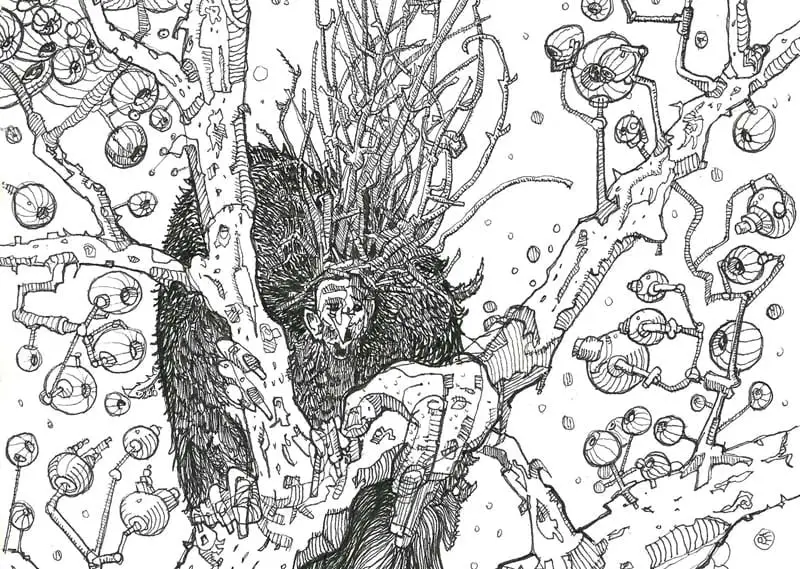
* I will be overjoyed when In a Green Tree is published, but something has been missed with its cover:

We learn at the end of the novel that the green tree is a specific green tree, an oak tree, and this tree looks like a mysterious forest tree, not an oak. Here is the passage:
"I've got a poem in it," she said. "I'm the only fifth-grader who has anything in it. All the other things are by the big seventy and eighth grade kids or by the teachers and priests." It was a good poem. It was this: "I'm a wave breaking Up on a brown shore. Push the old waves, and then Push them some more, Push them until they're No part of the sea, Push them until they Will make room for me. Push till they turn Into pebbles and sand. Rock and clay-soggy, And acres of land. What if they want to? What if they holler? And holler some more? 'Look,' I will tell them, 'Who's running this shore? '"I'm the sap rising Up in the Green Tree, Push the old sap until Bark it will be, Push it until it Will make room for me, Push the leaves out With a bang and a boff, To the ends of the limbs, and then Push them clear off. What if they whimper and Grovel to me? 'Look,' I will tell them 'Who's running this tree?'" "Oh, the verses are wonderful, and they are implicit in you from the beginning," Adriana said. "But you don't really push the old leaves off. That's not the right way to look at it. Even biologically that's not quite the way it is." "Yes, the Green Tree I'm writing about is the Live Oak Tree. I think that's the kind. The old leaves don't fall off until spring when the young ones grow under them and push them off. They're pushing them off of those oak trees right now. I was watching some of them flutter down as I came here." "But on the real tree, we don't push the leaves off." "You're sure we don't? Oh, something has happened! What is it?" "Just one of the leaves. It fell off." "Which one? Oh, I bet I know which one."
Comments