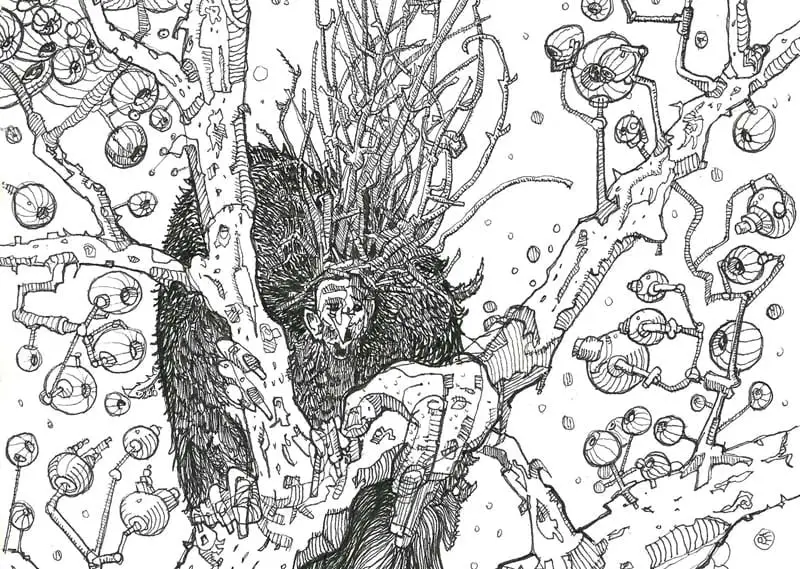
"Nine Hundred Grandmothers" (1964/1966)

Updated: 1 day ago

"No, no, you are no child of mine"
Originally titled "The Multitudinous Grandmothers," "Nine Hundred Grandmothers" was a Lafferty favorite. Many of his longtime readers hold it in especially high regard. Most come to it early for at least two reasons: its title is unforgettable, and it gives its name to Lafferty’s most successful short-story collection. It might as well be the Jaffa Gate to his canon.
Yet, contrarian that I am, I question its reception and am less smitten with it as a masterwork than most Lafferty readers seem to be. That is not to say it is anything less than a great short story. I have simply come to associate it with a way of reading Lafferty that I reject. A great many foolish things have been said about it. That may sound dismissive, but I take it to name a serious problem, because what I am identifying obscures where one agrees and disagrees with some of the most basic points Lafferty repeatedly makes in his fiction. It does this by being oblivious to them.
For example, here is what an appreciative blogger says about the story (I quote): “Ceran, youthful and desperate for answers, journeys backward in time (metaphorically), waking the sleeping ancestors and asking each the question. But as with Borges and his library, this physical manifestation of eternity and infinity is no more forthcoming or transparent than our own.”
Really? Ceran is a seeker blocked by cosmic opacity?
Another reader writes:
I am told little about this future fate of Ceran, but I am told enough to be prompted to ask myself: how will I respond to this disappointment? I shared with Ceran in his confusion and curiosity and frustration—will I likewise share with him in his giving up? How will I choose to live in a life the beginnings of which are obscure to me? Confusion, in fact, is not only a central feature of this story—it is a central feature of life. And it is that feature of life that Lafferty has foregrounded here, exaggerating it to the exclusion of most other “realistic” aspects.
This is more intelligent than the first person, but it still proceeds as though “Nine Hundred Grandmothers” had been written by an author who did not believe Revelation and Mystery to be compatible, by someone who believed that men and women must live, always and forever, in a phenomenological fog about ultimate things. This person’s full argument comes down to the thesis that shared confusion creates shared perspective. The idea is that Ceran’s confusion becomes the reader’s confusion, and that this shared bewilderment creates immersion. The effect is artful because life itself is confusing: art that captures confusion well can reveal something true about the experience of living without clear answers.
First, I find that reading shallow, though that may be only my view. You may find it profoundly insightful.
Second, I do not believe that it even begins to capture Lafferty’s point. As a brute fact, Lafferty believed that the cosmos was designed and that its Creator had revealed its origin in Genesis. He did not believe that people’s confusion on this point reflected any obscurity in first or final things themselves. He was never shy about saying that he regarded human origins as known.
Some examples. In “More Worlds Than One?” he writes, “Science Fiction also has a vested interest in there being a multiplicity of inhabited worlds and civilizations. That is one of the small number of things that Science Fiction is about. But Science Fiction is, after all, only a fiction.” In his review of Mysteries of Time and Space, he wrote, “A surprising thing is that the people who are infuriated by the facts that do not fit are the same people who will not admit the possibility of design in the universe. They are in fear of anything that will not fit into their particular non-design consensus.”
One may disagree with him on these matters, but he made himself plain. He did not believe in aliens. His fiction about aliens is therefore figural rather than speculative, and it springs from confidence in cosmic design and in divine revelation concerning reality. Yet many readers approach “Nine Hundred Grandmothers” as though it were offering an inscrutably smiling idol, and they fail to see how much of the problem lies in Ceran himself as a failed person. To put it bluntly, they do not laugh with the grandmothers. They stand slack-jawed before their giggling.
How odd for readers to see themselves in Ceran. How odd for them to read “Nine Hundred Grandmothers” as though its universe were structured by the principle that truth is “no more forthcoming or transparent than our own,” when the grandmothers know the truth of their origin and its author thought humans had the same access. How odd that readerly confusion is read back into the story and elevated into being “a central feature of life,” as though it were somehow artful, even admirable, to feel confused.
I truly do not understand why so many readers want to identify with Ceran. Then again, I am an oddball because I agree with Nabokov that identifying with a character is a terrible habit for a reader to develop. Why not recognize that Lafferty is laughing with the grandmothers? One can join in their laughter. Ceran is told how Proavitoi culture works, yet he proves himself a profaner of mystery, a liar, and a bully.
No, this is not a Borgesian story. I love Borges’s work, but Borges did not believe in divine revelation. Nor is it a story about epistemic humility. Nor is it about admiring the riddle of the sphinx. It is about standing outside Revelation as traditio, and about being a complete fool about it.
So Ceran Swicegood. He is a Special Aspects Man on a human commercial expedition to the asteroid Proavitus. He’s a black sheep amongst the crew. The other men, headed to Proavitus, sport macho names and tough-guy personas. That kind of thing helps one exploit worlds. Ceran, though, is different. He keeps his original name and mild demeanor. While the expedition's commander, Manbreaker Crag, wants to wring maximum profit from the alien world—mainly by targeting the chemistry behind the native Proavitoi's apparent immortality—Ceran is obsessed with discovering the origin of life. He is an intellectual. Nothing is more real to him than an idea. Lafferty shows the contrast between the two sorts, Brahmin and capitalist, when Manbreaker confronts him:
"You are Special Aspects Man, Ceran," he said, "and you have been running off after the wrong aspect. [ . . . ] It don't make a damn how it began. What is important is that it may not have to end."
Through conversations with his alien translator, Nokoma, Ceran learns that the Proavitoi do not die; instead, they shrink and sleep as they age. That results in hundreds of generations of living ancestors residing in the basements of their homes.
Now that he has a little information, Ceran infiltrates Nokoma's home while she is away to learn about the ancient beings. He descends a series of underground ramps, moving deeper into the bedrock beneath the house. Along the way, he meets older Proavitoi. He discovers that the crew's rumors of native "living dolls" are literal. The ancestors progressively diminish in size as they age, shrinking from the proportions of small humans down to the size of dolls, then birds, and eventually insects. And the smaller the ancestors become, the sleepier they seem. They speak in older dialects and wake only briefly when disturbed:
They smiled and stretched sleepily, not as humans would, but as very old puppies might. Ceran spoke to them, and they understood each other surprisingly.
At the lowest level, Ceran awakens the bee-sized "ultimate grandmother" of the Proavitoi. He demands to be told about the mysterious origin of Proavitoi. The tiny grandmother explains that their beginning was a highly amusing cosmic joke, but refuses to share it. She says there is a traditional ritual where Ceran must guess the answer over three days. Frustrated, Ceran holds the grandmother between his fingers and bullies her. He says he will crush her, but his inherently gentle nature prevents him from carrying out the threat. Seeing his bluff, the grandmother denies him the secret. The joke might cause a stranger to die of laughter, a risk she playfully refuses to take:
"No, no, you are no child of mine," chortled the ultimate grandmother. "Is too joke a joke to tell a stranger. We could not insult a stranger to tell so funny, so unbelieve. Strangers can die. Shall I have it on conscience that a stranger died laughing?"
And there is laughter, the giggling of a million tiny ancestors, and a laughing and weeping Ceran leaves empty-handed. On his next expedition, he changes his name.
Let’s strip this one down, chop-shop style: set aside the story’s tonal subterfuge around Ceran and its satiric pathos so that the moral architecture comes into view. This is strategically flattening because of how perverse the dominant family of interpretation is. I am going to argue this with a fluorescent yellow highlighter so one can see clearly what is being missed.
First, there is a joke about the sacred mystery of unitive and procreative sex, rendered through Lafferty’s tweaking of the imagery of ancestor worship. The Proavitoi are not ancestor worshippers, but that form of cultus clearly lies in the background of the story. Then there are two lines of epistemic and spiritual failure, each traced through a character. Manbreaker Crag is wrong about the final things. Ceran is, in some ways, worse, because he is not just crassly wrong about fundamental things, but arrogantly and pridefully wrong about them. He may look somewhat sympathetic beside Lafferty’s travestying of the tough-guy spaceman Crag, but Ceran is a great fool and the story’s real monster: a modern researcher who profanes the sacred.
Consider how badly Ceran conducts himself. Offered a catechist in Nokoma, he abandons her. Then he violates Proavitoi culture by sneaking in alone like a grave robber. He is told that the Ritual takes place once a year, is mediated by elders, is prefaced by three days of foolish guessing, and is received through laughter.
There is an Easter parallel here, but Ceran insists on having Easter on his own schedule. So he wakes the ancestors out of season, and then he lies to them. He claims that his violation of their cultus is itself a ritual. Asked whether he is one of the grandmother’s children, he lies again. The falsehood is recognized at once, which shows how completely he stands outside their sacred tradition:
"I am the oldest, the ultimate grandmother," one said gaily. "All the others are my children. Are you also of my children?" "Of course," said Ceran, and the small laughter of unbelief flittered out from the whole multitude of them.
Then he gets what is coming to him when they laugh at him. How dare he claim the inheritance without having been born into the tradition? And what does he do in response? He issues a threat that amounts to committing sacrilege without even having the conviction to carry it through.

The Proavitoi have a living tradition. Ceran can understand tradition only as data.
Here are two ways of looking at this figural crux. The first draws on the distinction between emic and etic understandings of religious culture. One may understand a culture emically, by entering into its local meanings, beliefs, and practices, or etically, by treating it from the outside and comparing it across cultures. One can imagine oneself as Proavitoi. Ceran appears to have approached the Proavitoi in a blunderingly etic fashion.
But that reading does not quite work within the story’s own logic. It uses the inside/outside to draw a secularizing circle around too much. Both the emic and etic stances are within immanent frames. If one were really inside the Proavitoi cultus, one would be immortal because the Proavitoi in fact do possess eternal life, and they possess a tradition transmissible only to those who keep the lineage, keep its times, and can laugh at the joke because they are inside it.
Ceran thus stands outside both the little-t traditions and the big-T Tradition of the Proavitoi: outside its ritual expressions, and outside the core transcendental truth those expressions mediate. He violates the first set of traditions by every procedural means available to him, and he stands outside the Tradition itself (he is not one of the "children") because he is hostile to Mystery. He does not accept the possibility of supernatural truth, truth that by its very nature exceeds finite intelligence. So why not cheat one's way through the ritualistic cruft? Ceran is a technocrat, convinced that at the bottom of everything there is data, not persons, so he ends up being smaller than the smallest grandmother.
Now let’s look at the story through the right end of the telescope. On Proavitoi, ancient grandmothers live deep inside the hill, growing smaller and sleepier as they age. Normally, they wake only once a year for a tradition in which their younger relatives try to guess how their people first began. One day, a human stranger sneaks down into their deepest rooms and rudely wakes them. Instead of screwing his head on right and turning around, he further violates their sacred tradition; he throws a tantrum, demands that they tell him their secret at once, and even threatens to kill the oldest and tiniest grandmother if she refuses.
The grandmothers simply laugh at him. The man breaks down, but the grandmothers keep laughing at the frustrated intruder and then peacefully return to sleep, while he runs away, crying and laughing, only to go on and behave like a macho sleaze toward another alien culture. Many Lafferty fans identify with this man and his confusion.
As for the story’s satirical targets, they are all very near the surface: heroic tedium, extractive commercial civilization, technological-immortality fantasies, modern research’s posture toward traditional knowledge, and Enlightenment epistemology.
I’ll close with something that gets overlooked: the lines about the odor of sanctity and sadness. This could not be more important for understanding the story. Lafferty writes, “They were kind and serene. There was an atmosphere about the scene that barely missed being an odor—not unpleasant, sleepy, reminiscent of something, almost sad.” That sadness is crucially significant to the governing image of the laughing grandmothers in “Nine Hundred Grandmothers,” because it belongs to Chesterton’s image of the laughing Christ and to the Chesterton-Lafferty theology of sacred laughter, perhaps best expressed in Chesterton’s poem “Secrecy.”
Readers who identify with Ceran, I suspect, are readers who do not see that for Lafferty Revelation and Mystery are siblings, and who would have little feel for the tradition of sacred secrecy found in verses such as Psalm 25:14. These are readers who have not thought through Lafferty’s view of the relationship of confusion (Ceran) and wisdom (the grandmothers). Where there is, in fact, a Sacred Mystery, they will always incline to confusion. As Lafferty told Hiroshi Inoue, "I do not mean to puzzle people with my writings, though any good story is the unraveling of a puzzle. There are interactions in every 'entertainment,' and the colliding of two very serious things may be hilarity."