33 Misc Laff: Past Master Refs

Updated: 3 days ago

Book editors don’t add glosses or footnotes to the old SF stories they reprint, but many of those stories require cultural references that modern readers are not likely to recognize, because the references come from mid-century (i.e. the last century) popular culture. How many people under seventy will recognize that Philip K. Dick’s “Oh, to Be a Blobel!” is a reference to Marianne Moore’s poem, “Oh, to Be a Dragon”? Or that his “We Can Remember It for You Wholesale” riffs off the once well-known novel “I Can Get It for You Wholesale” (which was later a [film] and eventually a [musical])? Or that, to its original readers, Alfred Bester’s “Of Time and Third Avenue” immediately recalled Thomas Wolfe’s “Of Time and the River”? I do suspect that writers Mark Clifton and Frank Riley’s “They’d Rather Be Right” (remembered only because it was the [second] novel to win a Hugo) was riffing off the [Rodgers] and Hart musical—forgotten now but a big hit in the late 1930s—“I’d Rather Be Right.” Many readers of, say, R. A. Lafferty’s story “The World as Will and Wallpaper” will fail to recognize the reference to Schopenhauer’s “The [World] as Will and Representation,” but that volume is regarded as a classic of modern philosophy. None of the above works, good as they may be (I like Moore’s poem), are remembered today. And who is writing the glosses? Nobody. — Gregory Feeley, Facebook.
Gregory Feeley posted this yesterday. He once kindly pointed out an error of mine, so I have done the same for some of his. Yet how right. Recognizing the Schopenhauer riff only requires basic philosophical literacy. To miss it would be embarrassing. On the other hand, Lafferty’s encyclopedic use of songs, films, and popular books presents a different problem: as those works fade further from popular memory, many of his jokes and arguments become harder to recognize. Genetic and source criticism are key to his works. A price of entry.
Here are three conspicuous examples of the faded past from Past Master that some readers miss.

This goes into the same box as the neon-lit allusion to Schopenhauer. A well-read reader ought to recognize it. If the reader misses it, so much for the reader. The Past Master chapter titles “The Shape of Things to Come” and “The Deformity of Things to Come” allude to H. G. Wells’s 1933 book and its film adaptation, Things to Come (1936). Wells imagines a world rebuilt under scientific administration, with organized religion suppressed as an obstacle to its development. Past Master reaches its climax with the Ban the Beyond Bill. The Wells callout is important stuff: thematic and structural.
Readers who know Wells only through The Time Machine and The War of the Worlds may miss the Wellsian future Lafferty is satirizing and fail to see that he has Wells, Belloc’s old enemy, as much in mind as Thomas More’s Utopia. Lafferty respected the genius of Wells, but here he mocks him. Astrobe has the planned cities, technological mastery, and material abundance Wells imagines as being desirable. Lafferty says what he thinks of it all by changing Wellsian “shape” to Laffertian “deformity”:
“When we have all become one perfect city in our totality, then our evolving will be completed. The individual must pass and be absorbed. The city is all that matters.”

Next up is something squarely in the category of neglected popular culture. The opening chapter of Past Master is called “At the Twenty-Fifth Hour.” It alludes both to Orwell’s opening and to C. Virgil Gheorghiu’s The Twenty-Fifth Hour, published in French in 1949 and in English in 1950. Gheorghiu’s protagonist, Johann Moritz, moves through a succession of camps and official classifications, his real identity counting for little beside the categories imposed on him. Gheorghiu’s subject is also close to Lafferty’s theme: the destruction of the human person by a civilization organized like a machine.
“The clock stood at the twenty-fifth hour so often that the very survival of man through it all appears a miracle.”
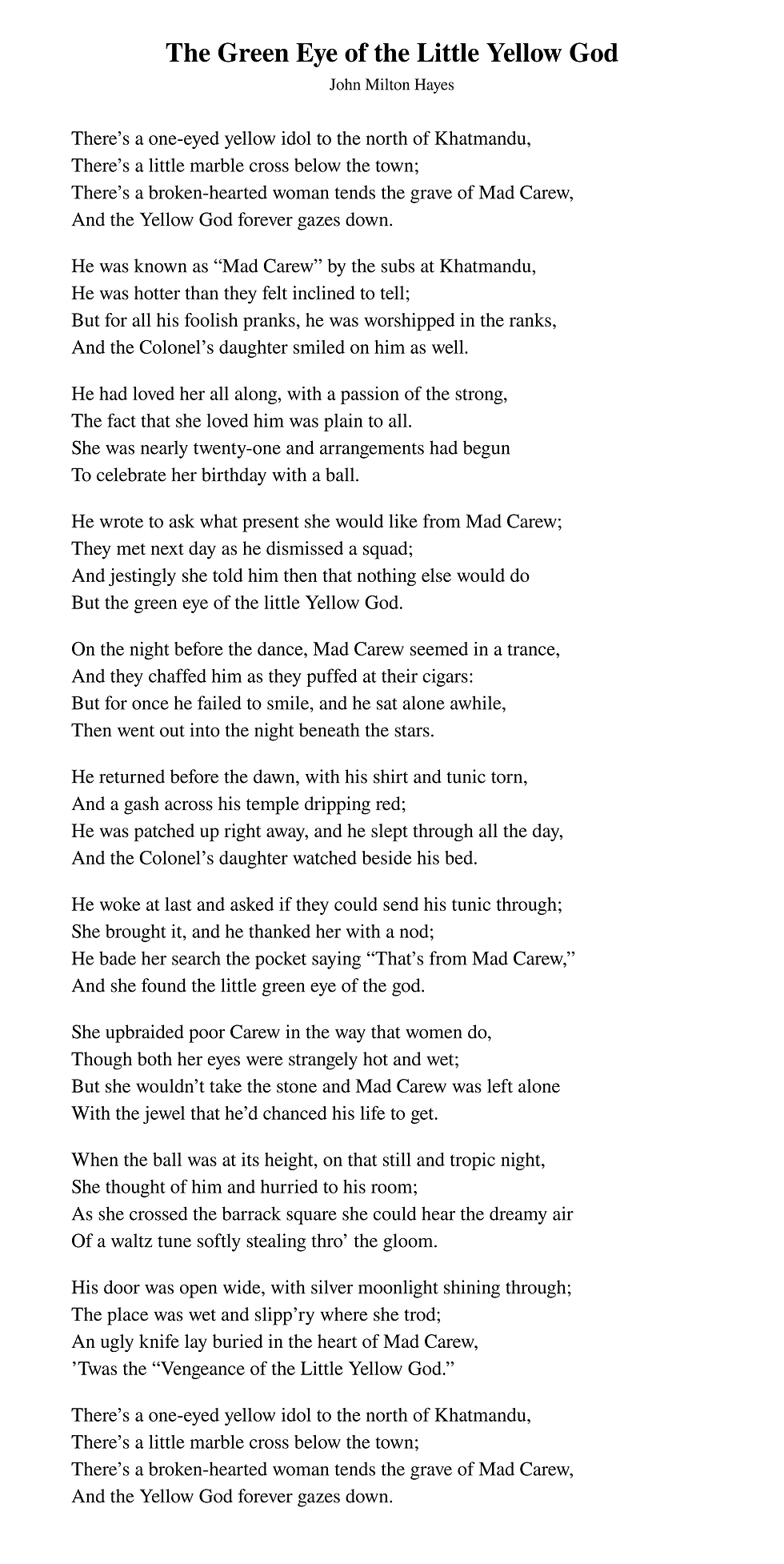
The third example is a favorite of mine. An earlier post discusses how important Sour John’s emerald-eyed idol is to understanding the conspiracy in Past Master. (An Easter egg: the name Sour John alludes to a place in Oklahoma.) The little set piece it riffs on takes us back to the culture of dramatic recitation. J. Milton Hayes’s “The Green Eye of the Yellow God” (1911), more often known as “The Green Eye of the Little Yellow God,” tells of Mad Carew, who steals an idol’s green jewel for a colonel’s daughter. Mad Carew is later found murdered, presumably by the idol’s servitors. The poem has largely been forgotten: people nowadays remember the ephemera of colonialism about as well as they do Kingfish and The Mystic Knights of the Sea.
These and other notes have now been added to Past Master.
Then Paul went back to the town, climbed up the idol at midnight (it was five hundred feet high and sheer and slick as ice); he pried out the emerald eye and substituted the green kidney. It fit perfectly. “I knew it would,” said Paul. [ . . . ] Three years later Paul (Sour John) was back in Ghazikhan. He was told that the center eye of the idol had been reappraised. By a miracle it had changed, the people said. It had become richer in color, finer in texture, of a deeper brilliance; and a grand new aroma came from it. And now it was worth thirteen million dollars. “I figure I lost two million dollars on the deal,” Paul said as he woke up.