"Great Day in the Morning" (1973/1975)

Updated: Sep 4

Refrain: Great day! Great day, the righteous marching; Great day! God’s going to build up Zion’s walls! Great day! Great day, the righteous marching; Great day! God’s going to build up Zion’s walls! 1 Chariot rode on the mountain top, God’s going to build up Zion’s walls! My God spoke and the chariot did stop,* God’s goin’ to build up Zion’s walls! [Refrain] 2 This is the day of jubilee, God’s going to build up Zion’s walls! The Lord has set His people free, God’s going to build up Zion’s walls! [Refrain]
“I am having some second thoughts for this day,” Duffy said. He was amazed. People were dismantling and taking off the walls of all the buildings. The buildings, without the support of the walls, didn't seem to collapse one floor upon another, though some of them sagged a little. “Faith maintains better than walls,” a pious and bearded teenager said. “Walls were the enemy of freedom.” Then he began to pull out his beard in big hunks.
* Even now, workmen as well as owners were taking the wheels off cars and putting on something else, something that came out of a kit. “Are you sure that that, whatever it is that comes out of the kits, is better than wheels?” Duffy asked a young car owner who was making the changeover himself.
In space, as in duration, the peduncle (or, which comes to the same thing, the bud) of a living branch corresponds to a minimum of differentiation, expansion, and resistance. What, then, will be the effect of time on this area of weakness? Pierre Teilhard de Chardin, The Phenomenon of Man, 120–21.
The holy figure of the demiurge Teilhard had come down on the altar. With him appeared McLuhan on his right hand and McGonigal on his left. They were transfigured with light. “Lord, it is good that we be here,” the Unfaithful Assembled intoned. “Great Day.” “Peduncle, peduncle, Point Edhead, cosmogenization, valorization, obfuscation. Great Day,” the holy demiurge blessed them. “Lord, let us build three tents here,” the Unfaithful Assembled intoned. “Great Day.” “Peduncle, neo-anthropocentrism, corpusculization, nookonos, peduncle. Great Day,” the holy demiurge blessed again.
Lafferty completed "Great Day in the Morning" on March 24, 1973. It appeared two years later in Damon Knight's Orbit 17. One wonders what anyone made of it. It is such a sly story, and I suspect the readers of Orbit were unlikely to pick out its exact reversal of Teilhard's design, the entire reason Lafferty wrote the piece. Nowadays, not many people talk about Teilhard. There is almost no online discussion of the story. The R. A. Lafferty Devotional Page rates it as “lame”:

Unsurprisingly, no one has written anything substantial about it. Like several other pendant pieces to the Argo legend, there is a complicating factor with it, because “Great Day in the Morning” has a complicated relation to Lafferty’s metaphysics of time in his first major cycle. The Great Day is one of the Seven Roads in Argo. These roads are those seven possible “endings” of the Argo cycle, all contingent but one somehow always being necessarily contingent so that Duffey's ashes end up in the box, a topic for another time.
Today I want to set the Seven Roads aside, as fascinating as they are. The proximate background matters more. Miss that background, and one will be lost. Maybe the story is lame, but you ought to know it on its own terms. Besides, there is no reason not to bracket Duffey’s larger arc when thinking through the Great Day. (A note: the name is spelled “Duffy” in the Orbit version.) After all, Lafferty published this story as a freestanding work. It reads wonderfully on its own. One gets RAL launching his strongest and most pyrotechnic attack on Teilhard de Chardin, the French Jesuit priest and paleontologist who became a spirochaete on the Catholic laity of 1960s America. "Great Day in the Morning" is a full-on assault on what Lafferty took to be a prime expression of theological modernism in his own time. That alone makes “Great Day in the Morning” an interesting story. It might only interest someone who would bother with a forgotten science fiction story from 1973, written to satirize a dead theological trend from the 1960s, which mocked a pretentious prose poem written in a Chinese desert in 1923. But that is Lafferty.
So the events first, then what Lafferty did with them.
Start with a brute fact. Teilhard is an important presence in Lafferty. Very important. The 1960s fascination with him feels as dated as bell-bottom jeans. Teilhard comes with another downside: his jargon-riddled work creates a high barrier for new readers of Lafferty. It is an open question how many Lafferty fans have ever read a page of Teilhard. But they should, because aspects of the Teilhard thing recur throughout Lafferty’s fiction, from Fourth Mansions to “How Many Miles to Babylon?”
There is a wrinkle with all this Teilhardism, though. Teilhard just isn’t a major generative source of Lafferty’s own wild ideas. Charles Fort was different: he fed Lafferty’s imagination and got into the woodwork of his private symbol system. No, when it comes to Teilhard, Lafferty usually gives him no more than a sharp elbow. Teilhard is hugely important in Lafferty, but mostly as shorthand. He appears often, but Lafferty seldom works with his ideas. That is what makes Lafferty’s beef with Teilhardism tricky.
A few examples. In “Thus We Frustrate Charlemagne,” readers are given funny asides aimed at Teilhard. Most readers will instantly forget them. Yet an impoverished world honors Teilhard as one of its few thinkers. In contrast, a richer alternate world recognizes Teilhard as “a talented science fiction writer with a talent for outre burlesque,” and Lafferty writes, “What a shaggy comic extravaganza he did make of it!” Teilhard is, however, essential to “Old Foot Forgot.” Sometimes he is just a name, as in Clement Chardin in “The Transcendent Tigers”; sometimes, he is one of his ideas, as he is the “noospheric fault” in “Narrow Valley.” One finds him showing up in the unpublished “Ahoy the Whale.” And in “The Forty-Seventh Island” and “Along the San Pennatus Fault,” he represents much of what Lafferty most dislikes: theological modernism linked to an ideology of science. Unlike Marx, however, Teilhard is an enemy within Lafferty’s own camp. He is a Catholic, and his Catholicism connects him with Marshall McLuhan in “Great Day in the Morning,” since McLuhan was also a Roman Catholic.
I enjoy very little about Teilhard, but understanding him is important for understanding Lafferty. His significance lies less in what he thought than in what he gave Lafferty: an anti-image against which to fashion his own counter-eschatological fiction. Lafferty fashioned elements of this anagogical fiction in opposition to the principal elements of Teilhardism. His many versions of the leap reject the Omega Point. Not for Lafferty were Teilhard’s flirtation with an immanent cosmos or the coat of paint he put on physicalism. As Lafferty wrote in his essay “The World’s Narration”:
Tracing the symptoms back to the ‘disease’ does indicate that the disease is multiple, that it has such names as Hard Science Fiction, Soft Science Fiction, High Fantasy, Low Fantasy, Non-Conforming Adventure Fiction. And sometimes it bears such non-consensus names as Biological Fiction, Ontological Fiction, Eschatological Fiction (did Teilhard, for instance, know that he was writing Eschatological Fiction?), Theological Fiction, or Psychological or Philosophical or Technological or Geological or Historical Fiction. These things and many others share the same complex of symptoms.
What is Lafferty if not a writer of Eschatological Fiction? What is Lafferty if not “a talented science fiction writer with a talent for outre burlesque” who often makes “a shaggy comic extravaganza” out of it?

Teilhard’s big idea was a nutty theory about cosmic evolution, brilliantly taken apart by Peter Medawar, something Teilhard himself called cosmogenesis. It is nothing short of the galaxy-brain process by which everything drives toward an increasingly organized cosmos. Teilhard describes humanity’s eventual gathering as “the natural culmination of a cosmic processus of organisation,” and identifies noogenesis as that “in which cosmogenesis, as regards our experience, culminates” (The Phenomenon of Man, 243, 297). This cosmic development follows a supposed law of complexity-consciousness: as matter undergoes greater complexification, its interior dimension rises toward consciousness. More complexity equals more consciousness. Teilhard condenses the principle into two equations: “Evolution = Rise of consciousness” and “Rise of consciousness = Union effected” (243).
Along the way, evolution crosses successive thresholds. At the material level is what is often called the geosphere, object of geogenesis and the “rocky lithosphere.” Above it appears the biosphere, “the living membrane composed of the fauna and flora of the globe” (180). Then comes the Teilhardian leap: psychogenesis gives way to noogenesis, producing the planetary “thinking layer,” for “outside and above the biosphere there is the noosphere” (181). Teilhard uses hominization to describe this transition, first as “the individual and instantaneous leap from instinct to thought,” and more broadly as “the progressive phyletic spiritualisation in human civilisation” of forces inherited from animal life (180). Within the noosphere, technological communication and human interdependence produce what Teilhard calls “human Planetisation,” or elsewhere socialization, drawing peoples into “a movement of convergence” (243).
This convergence is accompanied by interiorization, for Teilhard says that making room for thought requires him to “interiorise matter” (290). Crucial for Lafferty’s parody of Teilhard, his theory of convergence does not dissolve individuality. As persons approach Omega, Teilhard says that “each particular consciousness” becomes “still more itself and thus more clearly distinct from others” (261). He has a slogan for this: “union differentiates”: unification leads to greater personalization, since “we can only find our person by uniting together” (262). The whole evolutionary process is directed toward the Omega Point, the transcendent and already active center that draws evolution forward and gathers differentiated persons into perfected unity. Teilhard imagines his Omega to possess “autonomy, actuality, irreversibility” and “transcendence.” He even calls it “a divine focus of mind which draws it onward” (270). The eschatological completion of cosmogenesis is Christogenesis: “If the world is convergent and if Christ occupies its centre,” Teilhard writes, then Christogenesis is the extension of noogenesis and the culmination of cosmogenesis (297). This final fullness is the Pleroma, which The Phenomenon of Man describes as “perfect unity,” in which “each element will reach its consummation at the same time as the universe” and “God shall be all in all” (294).

Lafferty thinks all this is nonsense, and he fully rejects the notion that Teilhardian union would really differentiate. Poking fun at this fantasy of cosmic fusion that contrasts so vividly with something like Lafferty’s view of the Body of Christ underlies much of what “Great Day in the Morning” does. Where Teilhard goes cosmically big, Lafferty goes into reverse, winding everything down to a parody of the Omega Point. In the story, it takes the form of devolution down to a single cell.
A wonderful diagram in The Phenomenon of Man clarifies Teilhard’s vision. It shows anthropogenesis and offers a useful visual key to Lafferty’s reversal. Beyond providing necessary context for “Great Day in the Morning,” the diagram has a fun connection to Austro. One can imagine the line going off at the bottom from Australopith leading directly to “Barnaby’s Clock.” The diagram sticks in my mind because it is like a strange attractor for so much in Lafferty. One could use it to talk about all three of his major cycles.

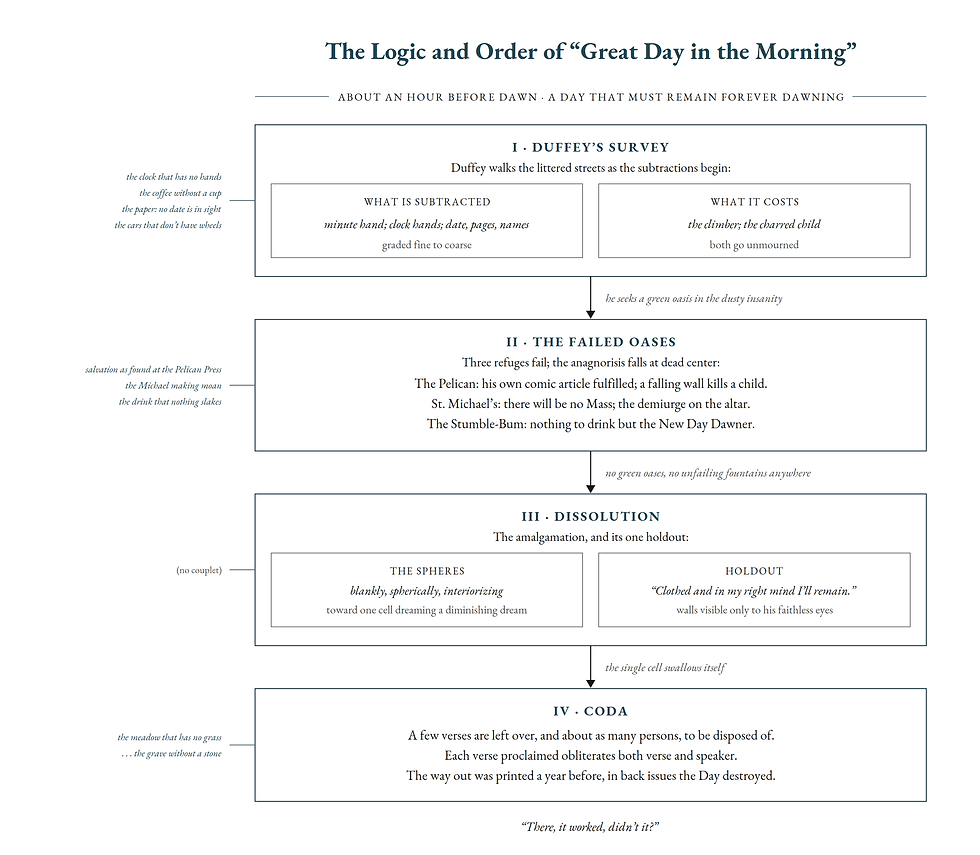
Before getting any deeper into what Lafferty is doing with Teilhard, let’s rehearse the plot of “Great Day in the Morning.”
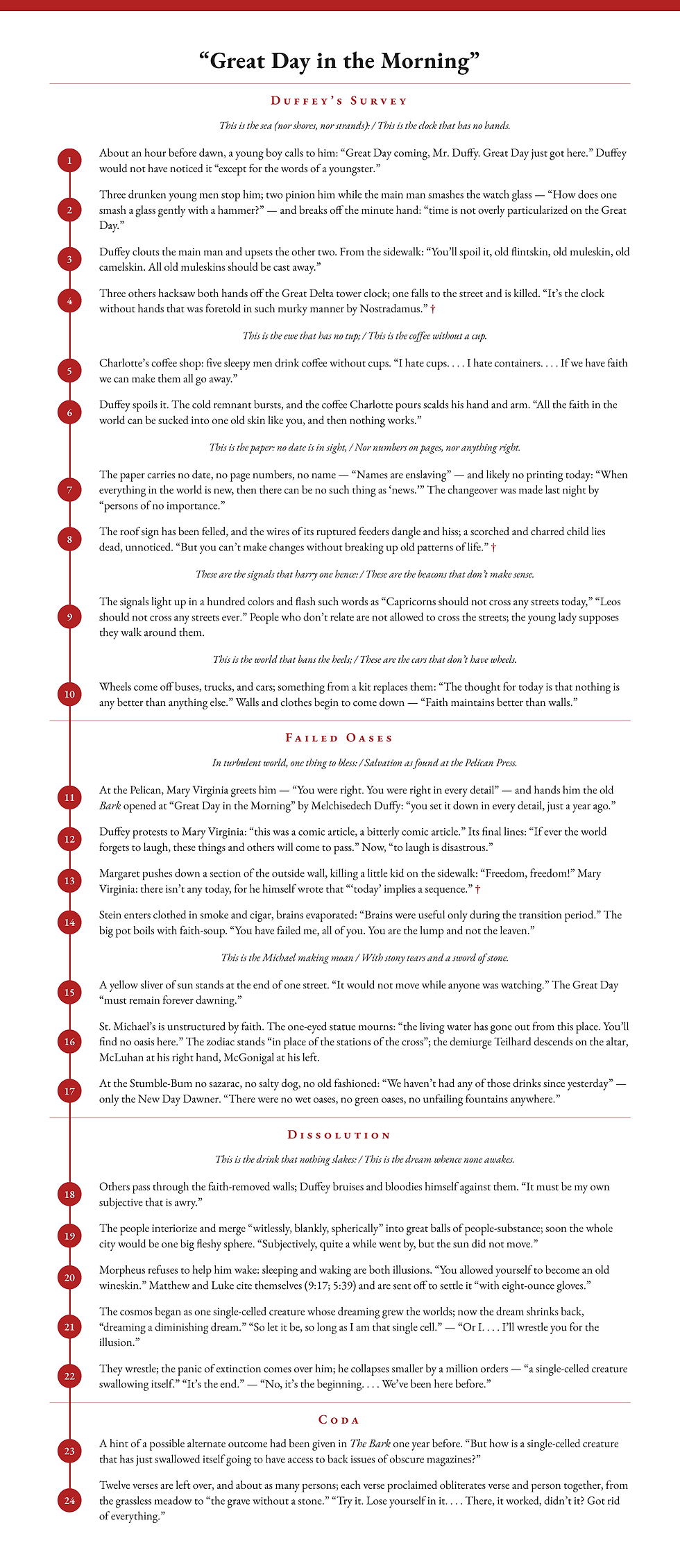
The story opens with Melchisedech Duffey taking a walk in New Orleans before dawn. He is stopped by three men who declare that the “Great Day” has arrived. To demonstrate this new era, they hold him down and remove the minute hand from his watch, explaining that “even you must realize that time is not overly particularized on the Great Day.” Duffey keeps his routine and visits a coffee shop, where the waitress and customers are drinking coffee without cups. They rely on blind faith to contain the liquid because “It isn’t right that anything should be contained by anything else.” Duffey can't go along with this and asks for a pour of hot coffee, which spills directly onto his bare hand and scalds it. This, in turn, breaks everyone's “faith,” causing the other customers’ cupless coffee to splash down their arms just as they take a drink.
Duffey next goes to a newspaper office to complain about the morning edition. The paper lacks a date, page numbers, and standard articles. An editorial assistant says that names and titles have been abolished because “Names are enslaving,” adding that they now only work when they feel like it in the name of “job enrichment.” Walking back through the city, Duffey sees traffic signals flashing subjective phrases like “To stop is to die” instead of colors and observes vehicles moving without wheels. Citizens physically dismantle building walls and remove their clothing, acting on the new societal rule that “Faith maintains better than walls” and that individuals must “be unenclosed, be emancipated, be unstructured.”
Looking for a familiar place, Duffey visits the Pelican Press. He discovers his friends are caught up in the Great Day madness, tearing down the office walls with axes and preparing to shed their skins. They show Duffey that these worldwide events match a comic article he wrote for their magazine a year prior, which ended with the warning: “If ever the world forgets to laugh, these things and others will come to pass.” Duffey declines their invitation to take his clothes off and leaves to check on St. Michael’s Church. He finds the building being unstructured by a congregation using new jargon. At the same time, a living stone statue of St. Michael complains that “the Unfaithful Assembled will not notice any difference” and wishes for a way “to put a good double edge on a stone sword.”
Duffey goes to a local bar but finds that it serves only a drink called “The New Day Dawner.” Outside, he watches the city’s inhabitants merge witlessly into large, rolling spheres of flesh, losing their individual forms entirely. He sits on a bench in Jackson Square and speaks with Morpheus, the god of sleep, who explains that the universe is the dream of a single-celled organism and that “A waking world would be a shapeless and formless monstrosity.” Morpheus reveals that the eons-long dream is now shrinking back to its beginning and that they will “end as two submicroscopic snakes . . . and then one of us must swallow the other.” Duffey and Morpheus wrestle until they collapse in on themselves, shrinking into a single-cell creature swallowing itself, like a snake choking on another snake.

To see what Lafferty does to Teilhard, one need only turn Teilhard’s diagram upside down. Teilhard imagines an upward movement of differentiation into unity; Lafferty parodies it as a downward movement of dissolution into enclosed monadic imprisonment.
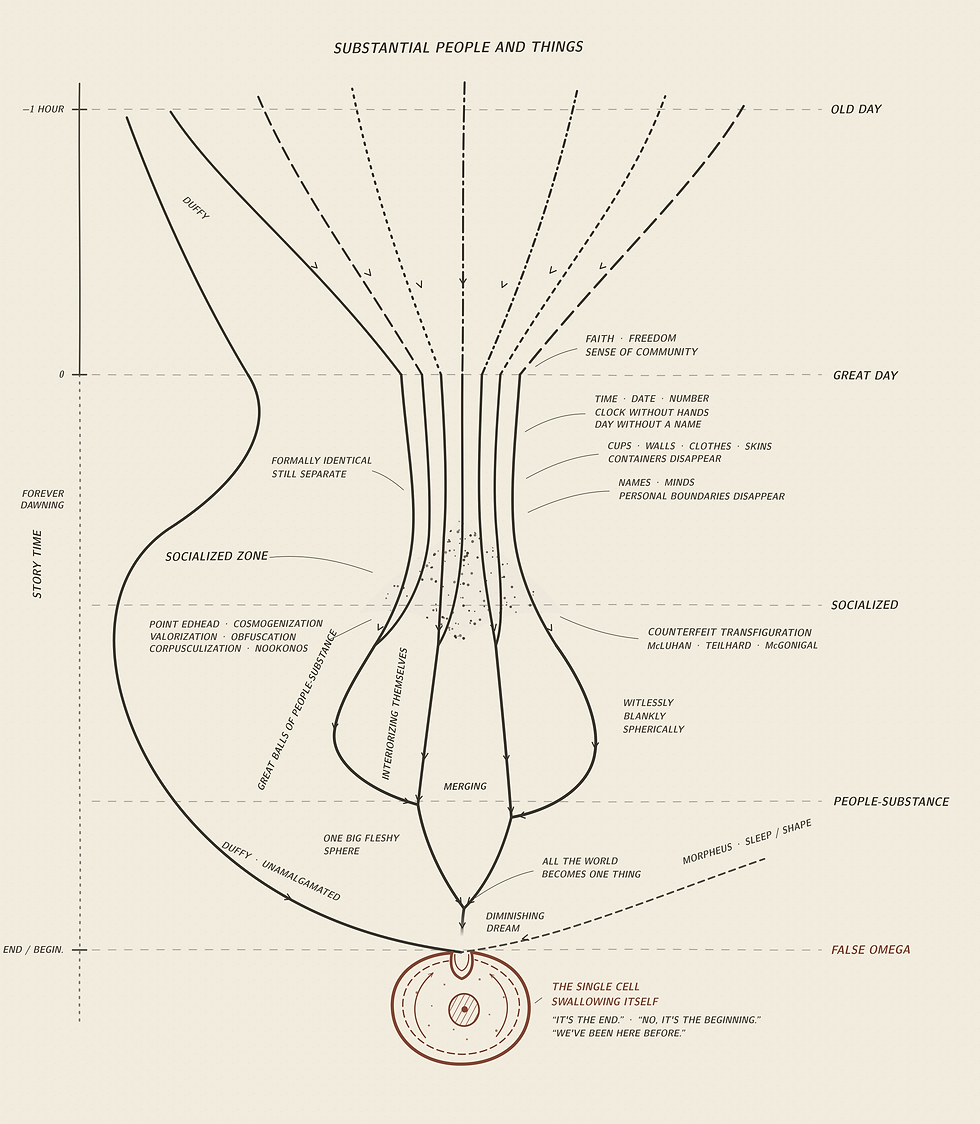
This diagram is what I think happens in "Great Day in the Morning." It is the engine block. It is not exactly what I have called counterfiguration. Only a hardcore Lafferty fan would care about it. It is much closer to Lafferty's old trick of thinking about how to reverse trajectories. He taught readers to look for this signature when he wrote "How I Wrote 'Continued on Next Rock'":
How did I write “Continued on Next Rock” then? Upside down and backwards, HOW I WROTE CONTINUED ON NEXT ROCK of course. I started with a simple, but I believe novel, idea that had to do with time. Then I involuted the idea of time (making all things contemporary or at least repeating), and I turned the systems of values backwards, trying to make the repulsive things appear poetic (“the nobility of badgers, the serenity of toads”) and trying to set anti-love up as comparable to love (the flattest thing you can imagine has to have at least two sides; it can have many more).
If you see the flip of Teilhard, you see what Lafferty is doing in giving the reader an "upside down," but it leaves open why he is doing it. This second issue is a much longer question than the first, and I can only make a few glancing points here.
First, as should be obvious, Teilhard himself is careful to say that he thinks union differentiates, yet Lafferty rejects that premise in lampooning him. Lafferty might seem to set up a straw man because he refuses to grant Teilhard’s insistent claim that “union differentiates.” In short, Teilhard wants to act as if he preserves the boundaries that make sacramentality possible. If Lafferty had granted Teilhard this theory of differentiation, his own story could not have taken place: the barriers would not have been broken down but would have become more perfectly, more completely, themselves. We would have superior coffee cups. The sea would have a more perfectly differentiated shore. The clocks would have more perfectly differentiated hands. The wine would have its differentiated-yet-in-union glass. All coffee cups, shores, minute hands, and wine glasses would be even more highly differentiated than the ones we now know. Complexification would occur, and, with it, the deepening of identity in difference. The "Within" of the coffee cups, shores, clock hands, and wine glasses would be more profoundly interiorized. Teilhard’s “science fiction” depends on this idea that greater complexity brings greater consciousness; yet Lafferty's Great Day is about the obliteration of barriers that enable identity. He thinks something has gone wrong on each side of the differentiation-and-unification equation.
Dietrich von Hildebrand is helpful here. Lafferty may well have read him. Even if he did not, he and Lafferty make for an illuminating parallel critique. They square with each other as orthodox intellectual Catholics responding to Teilhard.

Von Hildebrand makes many points relevant to “Great Day in the Morning” and the destruction of the Pelican Press, but the most important is that the Catholic ekklesia, understood as corpus mysticum and koinonia, presupposes distinct, free, and irreducible spiritual persons. Teilhard smuggles monism in through the back door of eschatology. Both von Hildebrand and Lafferty think that Teilhard’s “collective consciousness” and “totalization” threaten to replace communion in love with absorption into an impersonal whole. In Lafferty, this threat takes concrete form in the disappearance of walls, containers, names, clothes, skins, minds, and personal boundaries. No one becomes more differentiated or more intensely personal on the Great Day. Instead, they become “blank” and “witless.” In the end, they become indistinguishable masses of “people-substance” minus substantial form. The story thus gives concrete form to von Hildebrand’s view that a fusion built on material processes alone cannot create spiritual communion. Like von Hildebrand, Lafferty thinks that Teilhard, despite what he says about the Within and the Without, his versions of the spiritual and the physical, confuses matter and spirit, nature and grace, cosmic energy and personal love, technological progress and sanctity, and earthly development and transcendent salvation. His system is, in the language of von Hildebrand’s famous title, a Trojan horse. More precisely, Teilhard functionally immanentizes salvation by binding Christogenesis too closely to cosmogenesis.
For readers unfamiliar with Teilhard, Duffey’s wrestling match with Morpheus at the end of the story will seem strange, especially the meaning of the false etymology that connects dream to shape. Readers of The Phenomenon of Man, however, will recognize its sources, though I won't labor to show that. You will just have to read it if you haven't. Towards the end of that work, Teilhard writes, “Among those who have attempted to read this book to the end, many will close it, dissatisfied and thoughtful, wondering whether I have been leading them through facts, through metaphysics or through dreams.” Lafferty connects this to Teilhard’s obsessive use of metamorphosis and words formed from morph-, which occur dozens of times in Teilhard’s work. For Teilhard, metamorphosis denotes a change of evolutionary state. When life crosses the threshold of “reflection,” inherited animal powers such as perception, aggression, love, invention, and social behavior continue, but consciousness gives them a new dimension. The result is, in Teilhard’s phrase, “discontinuity superimposed upon continuity.”
The Neolithic metamorphosis is the collective form of this change, what he calls the deployment of the noosphere. Agriculture, settlement, population growth, and accumulated knowledge transform scattered human groups into an increasingly connected noosphere. Endomorphosis provides the corresponding geological metaphor. Just as rocks alter one another internally through contact, peoples and cultures transform one another through migration, exchange, intermarriage, conflict, conquest, and assimilation. Even a conquered or partially absorbed people modifies its conquerors.
Metamorphosis is therefore a master category in Teilhard’s thought. Through metamorphosis, humanity passes into a new mode of existence. Endomorphosis names the reciprocal inward transformation through which distinct human branches enter that common development. Together, the terms are supposed to explain noogenesis, the process by which human differences interpenetrate, reshape one another, and become incorporated into an increasingly unified planetary consciousness.
This is what Lafferty calls eschatological science fiction and mocks. Lafferty rejects every form of evolutionary human speciation. For him, noogenesis is an idolatrous fantasy closed to transcendence, figured by the single cell as a prison house.
Why, finally, does the story take place in the morning? I can't prove it, but I have a suggestion. The answer to that question might lie in one of Teilhard’s most important works, one that anyone who reads much of him would quickly come across, “The Mass on the World,” written at Ordos in 1923. Like "Great Day in the Morning," it is set at dawn. Lafferty's Great Day reads as a response to Teilhard’s purple meditation. To state the obvious, Genesis 14:18 associates Melchizedek with an offering of bread and wine, while Hebrews 5–7 identifies Christ’s priesthood with the order of Melchizedek. Teilhard begins without bread, wine, or altar and makes the whole earth his altar. I imagine Lafferty saw this as Teilhard taking it upon himself to rewrite the Mass by projecting it on a cosmic scale.
In any case, Teilhard makes the whole earth his altar and offers God labor, suffering, growth, decline, and death of creation. In Lafferty’s parody, this cosmic extension becomes the claim that skins, barriers, and boundaries are unnecessary. Teilhard asks the divine Word to pronounce “This is my Body” over the forces that bring life and increase, and “This is my Blood” over those that bring dissolution and death. The Eucharistic pattern thus encompasses the whole course of cosmic becoming, as though all creation were evolving into Christ and the Incarnation could attain its fullness only at the Omega Point. In “Great Day in the Morning,” Omega becomes “Point Edhead,” the pointed head of a dunce or intellectual, with an echo of "egghead." At St. Michael’s, however, no Mass is held that morning. The church is “unstructured,” and the zodiac, the sun, and the moon replace the Stations of the Cross.
At this point, Teilhard himself enters the story. He appears on the altar as “the holy demiurge,” flanked by McLuhan and McGonigal and “transfigured with light.” In place of the words of the actual consecration, he recites a pseudo-Teilhardian litany: “Peduncle, peduncle, Point Edhead, cosmogenization, valorization, obfuscation” and “Peduncle, neo-anthropocentrism, corpusculization, nookonos, peduncle.”

The “Unfaithful Assembled” answer, “Great Day.” Lafferty converts the cosmic Mass into mere physical mass. The people remove their skins, surrender their minds and boundaries, “interiorize” themselves, and merge first into “great balls of people-substance,” then into “one big fleshy sphere,” and finally into a single cell swallowing itself. Teilhard’s cosmic Mass is travestied. We are far from the Omega Point and the differentiated Body promised by Christogenesis.
Much else ought to be said about Lafferty’s use of Scripture in the story, particularly about the problem of world destruction and the old wine and the wineskin. I think “Great Day in the Morning” is Lafferty’s clearest look at what it meant for him to insist both on continuity with the past and on the need to inhabit a new world. Duffey is the old wine that is better than new wine, but he is also the old wineskin that the new wine will burst. The Great Day is what happens when there is no Day After the World Ended because what I have elsewhere called world-transcending elements have not been transmitted. These are the elements of any world bound to what Lafferty called the central fact of every possible historical world: the Incarnation. The Incarnation occurred in our past, but Christogenesis muddies it by making it a biological telos of evolution.
“Great Day in the Morning” is a very rich story, with many Easter eggs. For example, the “Bitter End” at the end of the story is a Lafferty joke about anchors, tying back to The Bark as a figure of the Church and to the name of the Pelican Press publication. Not knowing this misses the story's point of being about the Argo, which is the Church Militant as a ship in the world:
“Ah me,” Melchisedech said. “I had always regarded the Pelican as a refuge, as an anchor to hold fast in the great storms of the world.” “Both the sea ships and the river boats are cutting loose their anchors and letting them sink forever,” Zabotski said. “With faith, who needs anchors?”

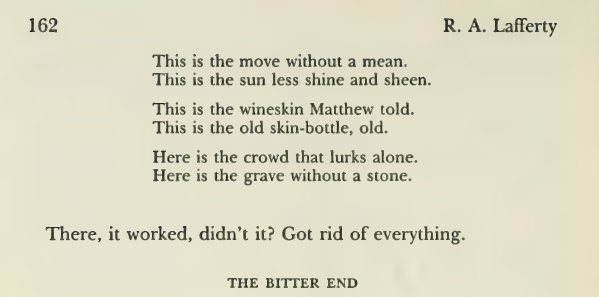
This Bitter End is the rope being cut to the Navicula Petri.

At some point, this post will have a second part. For now, I’ll end with a pseudo-conclusion about poor Marshall McLuhan, who in 1967 had a brain tumor the size of a lemon removed. A real conclusion would have to take up the story’s positive theology, and that would make this post twice as long. I justify this detour through McLuhan because “Great Day in the Morning” is about the turmoil after Vatican II, when people were looking for answers and turning to figures like Teilhard or gurus like McLuhan. I began this post wanting to write about all the wild things Lafferty does with Scripture in the story, but Teilhard took over. So let’s just end with Marshall McLuhan, whose star was already fading when Lafferty wrote the story. The brain tumor had been removed, and he was not the same overly-agitated dynamo he had been leading up to the operation.
Let it be known that I have a soft spot for McLuhan. Many of his quirks have long seemed to me tied to his health, which is one reason Lafferty’s caricature of him seems unfair in hindsight. Yet Lafferty was not wrong to detect Teilhard’s influence on McLuhan, even if he went too far both in his comic reworking of the Transfiguration at St. Michael’s and in his trash-talking of McLuhan’s own faith. In cozy terms, Teilhard was a heretic, but McLuhan was an excessively voluble monologist and brilliant flibbertigibbet. Something complicated is going on among these three minds: Teilhard, McLuhan, and Lafferty. One could have a lot of fun digging into it.
Near the end of his life, Tom Wolfe made a big deal of Teilhard’s influence on McLuhan’s account of the Electric Age as a version of the noosphere. This was after Wired magazine beautified McLuhan, and Wolfe was being somewhat opportunistic.

Wolfe’s simplifying account has never seemed quite right to me, though I am not the person to work out the details. What I do know is that it is too simple. Nor was the connection itself new. Several years before Lafferty wrote “Great Day in the Morning,” it was already on people’s radar: someone had even written a dissertation in 1969 on Teilhard’s influence on McLuhan. (I read it and it is, unfortunately, not good.) Lafferty had a good nose, though, and somehow he caught the chemical scent of Teilhard’s noosphere on McLuhan’s Electric Age. And yet some modicum of intellectual influence is not religious identity, and because McLuhan himself tended to downplay both his conservatism and his Catholicism in his work and public appearances, it was difficult to discern where he really stood as a Catholic. Lafferty saw McLuhan and recoiled. Whatever McLuhan’s contradictions, he was more old-fashioned than Lafferty knew. He said, “I am resolutely opposed to all innovation, all change, but I am determined to understand what’s happening . . . Many people seem to think that if you talk about something recent, you’re in favor of it. The exact opposite is true in my case.” This puts him on team Duffey. Old wine versus new wineskins.

How amusing, then, that McLuhan, a temperamental conservative like Lafferty, should have ended up in Lafferty’s crosshairs. McLuhan drew heavily on the rightist ideas of Wyndham Lewis, was a daily communicant, and was deeply angered by the vernacular Mass after Vatican II, just as Lafferty was. In many ways, McLuhan’s Catholicism resembles Lafferty’s and stands far apart from what Lafferty regarded as Teilhard’s creation of a new religion. Teilhard, of course, denied that his was a new religion. In Let Me Explain, he pleaded, “It is still Christianity, I repeat, and Christianity it will always be: but it is a re-born Christianity” (105). That “but” should set off alarms. The irony is that Lafferty could hardly have known how much religious ground he shared with Marshall McLuhan or how far McLuhan disagreed with key Teilhardian notions. Lafferty’s own experiments with media put him in the same orbit as McLuhan. And both men were Chesterton obsessives. In a way, McLuhan did to Teilhard what Marx claimed to have done to Hegel: he set him right side up. The full picture of McLuhan’s Catholicism became clear only with the publication of his letters in the 1980s. Those letters reveal, for instance, that McLuhan regarded the introduction of the microphone into the Mass as disastrous. A microphone at Mass is just the kind of thing Lafferty would have put on Astrobe. Lafferty and McLuhan have far more in common than either does with Teilhard de Chardin. For anyone interested in the real McLuhan, there is only one good book: Grant N. Havers’s recent The Medium Is Still the Message, a book that finally gets McLuhan right.