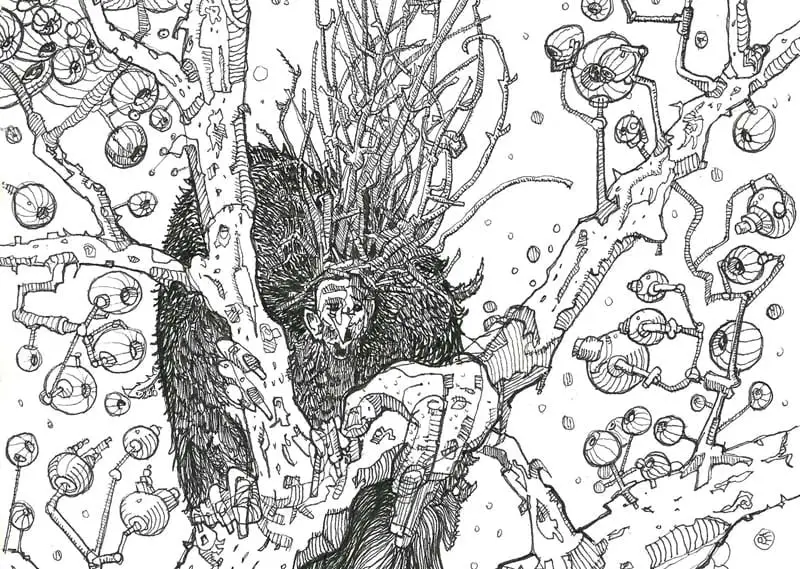
"The Transcendent Tigers" (1961/1964)

Updated: 1 day ago

Some modern scientists feel a powerful affinity with their ancient intellectual forebears. While Anaximander’s understanding of the apeiron may be hard to grasp, some 20th-century physicists found it a helpful concept. In the 1930s and 1940s, physicists worked to turn quantum mechanics (a theory of particles and their interactions) into a theory of particles and fields (i.e. quantum field theory). But they encountered difficulties, as attempts to do so often led to the appearance of infinities in their equations—indicating that they were not representative of physical possibilities. Attempting to dodge this problem, in 1944, Max Born and H. W. Peng, working in the Department of Mathematical Physics at the University of Edinburgh, published a letter to the editors of the highly respected journal Nature, on the ‘Statistical Mechanics of Fields and the “Apeiron”’, suggesting that the word apeiron, introduced by Anaximander to describe the ‘boundless and structureless primordial matter’, be used to refer to the subgroup of pure states that is intermediate between the ordinary notion of a particle or quantum and that of a mechanical system. The ancient and modern uses of apeiron are very different. Even though their suggestion did not take hold, at a time of crisis of explanation Born and Peng looked back to ancient Greek ideas for inspiration. Born was awarded the Nobel Prize in Physics in 1954. — Lisa Traub, Ancient Greek and Roman Science (2023)
Will all great Neptune’s ocean wash this blood Clean from my hand? No, this my hand will rather The multitudinous seas incarnadine, Making the green one red. — Macbeth, Macbeth, Act II, Scene 2
“The Transcendent Tigers” (Lafferty's title was the superior "Needle") is one of Lafferty's two stories about a funny group of children, the Bengal Tiger Club kids. The other is "Enfant Terribles." For the most part, "The Transcendent Tigers" is a simple story. Its main character, the seven-year-old and gloriously amoral Carnadine Thompson, is one of Lafferty’s most memorable inventions. Its plot and its execution are unforgettable. Others have written about Carnadine's savage precocity, so I will skip over that, summarize the story, and point to aspects that, if present, have been overlooked.
For her seventh birthday, Carnadine Thompson receives several gifts. One of these is a mysterious red cap. Another is an ancient, supposedly unsolvable wire puzzle. Upon putting on the cap, which Carnadine says grants her absolute authority, she gains reality-defying abilities, solving the unworkable puzzle multiple times. She also turns a hollow rubber ball inside out without tearing it (it is red on the inside), to the bewilderment of her parents and their neighbor. When questioned about these impossibilities, Carnadine attributes it all to her new gift:
“But it's impossible to turn it inside out without tearing it.” “Not if you have a red cap it isn't.” “Dear, how do you work the puzzle that your father says can't be worked?” “Like this.” “Oh, yes. I mean, how does it happen that you can work it when nobody else could ever work it before?” “There has to be a first time for everything, mama.” “Maybe, but there has to be a first-class explanation to go with that first time.” “It's on account of the red cap. With this cap I can do anything.”
After this, Carnadine forms a neighborhood club called the Bengal Tigers. It consists of Carnadine, her younger brother Eustace, and two friends, Fatty Frost and Peewee Horn.
Concurrently, disasters are occurring, truly catastrophic ones that obliterate towns and cities across the United States. Entire municipalities are replaced by miles-deep craters. That creates a national panic and baffles scientists, who detect that the destructive force operates on a strange, rhyming verbal logic. The narrative then does something odd. It jumps to a non-material world, where the reader learns that the disasters stem from a recent "investiture" of cosmic power. An alien named Acu says he used an instrument to scan Earth for a mind possessing absolute, unwavering self-assurance:
“Then I went into instruments, not trusting my own judgment. I set the Calm Assurance Indicator on automatic and cruised about that world. And on that whole world I found only one person with perfect assurance—one impervious to doubt of any kind and totally impervious to self-doubt. On this one I made the investiture and conferred the concept of great Power and Sharpness.”
Finding only one such person, Acu bestowed upon the person reality-altering power via the red cap. He didn’t realize that Carnadine was a kid, and he didn’t know that her total assurance is amoral.
Back on Earth, Carnadine begins to show a renewed interest in reading. She recites the names of the destroyed cities from the newspaper. Inside the Bengal Tigers' clubhouse, we learn that the children are orchestrating the global catastrophes by jabbing metal needles into a world map while improvising broken couplets. Carnadine wipes out New Orleans, Baltimore, and San Francisco. When she allows Eustace and Peewee to wear the cap and take turns, their poor rhyming skills result in clumsy destruction for Cincinnati and Chicago:
“Let me do one,” pleaded Peewee, and he snatched the red cap:“Hopping Froggo—Chicago.” “I do wish that you people would let me handle this,” said Carnadine. “That was awful.” It was. It was horrible. That giant needle didn't go in clean at all. It buckled great chunks of land and tore a ragged gap. Nothing pretty, nothing round about it. It was plain brutal destruction.
Frustrated by their lack of sociopathic grace, Carnadine takes the cap back and prepares to strike another target, initiating the rhyme "Knife and Fork—". As has been pointed out, the reader must supply the rhyme, which implicates the reader.

Reading “The Transcendent Tigers” this time, I began to wonder how the beginning and ending fit together. We have the wire trick, the everted ball, the red cap, and the sky needles. They probably connect to the philosopher Carnadine’s father mentions at the beginning of the story as the classifier of difficult puzzles:
“It is one of the nine impossible apparatus puzzles listed by Anaximandros in the fifth century before the common era,” continued Tyburn. “And do you know, in all the centuries since then, there have been only two added to the list.”
The puzzles of Anaximander are made up, but one concept that Anaximander originated goes some way to explaining much in the story, including where the aliens might be. We know they are in some strange place outside of ordinary space-time. Perhaps they are beings of what Anaximander called the apeiron.
The apeiron (ἄπειρον, "the boundless" or "the unlimited") is the foundational concept in the cosmology of Anaximander of Miletus (c. 610–546 BC). He was the second of the Milesian pre-Socratic philosophers, but the first of the great pre-Socratic philosophers to write anything down. His teacher Thales had proposed water as the archê or first principle of all things, with the earth itself arising from water.
Anaximander argued that the source could not be any substance, since no particular element could give rise to its own opposite. The hot cannot produce the cold, the wet cannot produce the dry. The origin must therefore be something prior to all such distinctions: unbounded, indefinite, qualitatively indeterminate. He thought the earth was suspended in equipoise because equidistant from all other things and had a quirky but brilliant theory about starlight.
How the apeiron works is unclear. Somehow opposed pairs separate out through a process Anaximander described in normative terms. He wrote that things "pay penalty and retribution to each other for their injustice according to the assessment of time," in the one surviving fragment of his writing (DK 12B1). It is one of the most commented upon pieces of philosophy in the world. The idea is that determinate things emerge from the boundless and return to it when their time is spent. That is a little like the needles that flash down from the firmament in “The Transcendent Tigers.”
Lafferty knew his pre-Socratics, and I suspect he chose Anaximander (under the variant Anaximandros) because the boundless is exactly right, thematically, for a story about unmeasurable power. It also fits the aliens’ no-place, which is also an infinite place, and several other elements in the story echo the concept of the apeiron in ways that feel deliberate. Moreover, the apeiron squares with the story’s atomic-bomb anxiety. The atomic bomb releases energy from what seems like the boundless underlay. The everted ball, its red interior exposed, would be a good image of the apeiron; the red cap becomes a kind of control center, with one’s head inside it. It pulls things from the boundless into existence.
As a sidenote, there is a math Easter Egg in the story. Stephen Smale proved in 1957 that a 2-sphere (an ordinary hollow ball in ordinary 3-space) can be turned inside out smoothly, allowing self-intersections but no creases or tears. The proof was later published in his paper A Classification of Immersions of the Two-Sphere, which appeared in 1959 and includes the theorem implying sphere eversion. I'd bet you a beer that Lafferty alludes to this idea when he writes,
“How did you make the rubber ball turn red and then white again, Carnadine?” “Turned it inside out. It’s red on the inside.” “But how did you turn it inside out without tearing it?” “It’d spoil it to tear it, mama.” “But it’s impossible to turn it inside out without tearing it.”“Not if you have a red cap it isn’t.”

But back to the story. In it, the apeiron as Logos turns out to be not divine reason but something sub-rational. It is sound, working through sonic correspondence rather than meaning, through homeoteleuton, as Lafferty writes. Carnadine, invested with the red cap, which is another version of the eversion sphere (iconographic insetting, again), hotwires the Logos. Her domestic world might look suburban, but it is far closer to “Snuffles” than to the bourgeois home life of the Willoughbys.
Hers is a story-world with a closed spin. It is a Lafferty nightmare world. Not that it feels like a nightmare, because it is so cleverly written, and because we are somehow charmed by Carnadine’s Zerstörungslust when her eyes glow with the green fire: "And Carnadine stuck it in with full assurance of her powers, red cap atilt, eyes full of green fire.” Lafferty revisits this green fire in the eyes of the Dulanty children at the end of The Reefs of Earth:
Six little pair of goblin eyes glowing green in the dark; and a seventh older pair nictitated by death slumber to a fainter green.
It is probably no coincidence that a red cap is a goblin in folklore.
Finally, one great storytelling trick. Lafferty makes us laugh at how Carnadine reacts to the kitten in the story:
She had had so much trouble with the story of the Kitten and the Bell in the First Reader that her mother had come to believe that she had no verbal facility at all. This had been belied a moment later when Carnadine had torn the offending pages out of the Reader and told her mother and the world just what they could do with that kitten, and told it with great verbal facility.
Then later, he makes us laugh again:
“But how can you read all those hard names in the paper when you couldn't even read the story about the little kitten?” “Mama, with things going the way they are, I think there's a pretty good chance that that damned kitten will get what's coming to her.”
And we find ourselves being amused and startled by Carnadine's amoral acts of mass murder. A special early story.