Babylon Thoughts and Teleological Doppelgängers

Updated: 1 day ago

There is rollicking good-humor all through every Scripture. Samson, the riddletelling judge and strong man, is full of high spirits even when going down to Gaza and to his death. David is full of fun when he invents the story of his victory over Goliath and sings it to his own harp music. Goliath was not that big, nor David that small; and moreover Goliath was killed by another warrior, Elhanan. But a story-teller can always fictionize accounts. There is a lot of fun in Balaam and his talking donkey, and in Ezekiel’s account of those primitive flying machines. Who were those early barnstorming aviators anyhow? — "Tell it Funny, Og"
“How Many Miles to Babylon?” is one of those Lafferty stories that readers tend to bounce off. Rather than go deep, I'll sketch its outline clearly, because the most disappointing thing about the story is its reception. To do so, I am going to pick on one Lafferty reader. Predictably, he was disappointed. His complaint was that Finnegan becomes a superman. This is so wrong-footed that one hardly knows where to begin. Finnegan, as Finnegan, is not the point of the story. Matthew 16:18 is.
It is understandable that a reader might want a more human point of identification, but “How Many Miles to Babylon?” is finally an eschatological comedy about holy offices, not the persons who occupy them. Finnegan in "How Many Miles to Babylon?" is not primarily a character whose papacy must complete a psychological arc. He is the improbable instrument through whom the Church’s indefectibility becomes visible.
The reader's second objection is that “How Many Miles to Babylon?” is too violently grotesque, too gleefully blood-smattered, too much Lafferty's version of the Théâtre du Grand-Guignol. The reader has in mind passages such as this:
The Cap-Stone himself (He was Paul the Eleventh in the listing of the Cap-Stones) had been decapitated the day before. Then his head had been put up on a pike at the Spanish Stairs where people could see it as they came and went. The head was not dead for quite a while. It could talk and answer questions, though in a tortured tone. Several times it cried in a miserable and snuffling sort of way. People came and stood on the little ladder there and pulled all the hair out of the head in bloody gouts. Several ladies asked their bravos to bring them pieces from the head for souvenirs. The bravos broke out the teeth and gouged out the eyes for their lady friends. But still the head was able to talk, and even to get a little the best of its tormentors in argument and discussion. One of the Stones climbed the little ladder there and cut out the Cap-Stone’s tongue. He took it into a little caffe there to have it grilled for eating. The head wept in a grotesque gurgling way after its tongue was cut out. Then a fire-tongue came down, and the Cap-Stone talked for a while in his own voice with the fire-tongue. He fell silent only when several of the Gates came and broke open his skull and scraped his brains out. They took these and fried them with onions to eat. The Cap-Stone was silent after that, and perhaps he was dead. All that was a sort of prodigy, but prodigies were quite common in Babylonia Bagascia that week. It was believed that the Ekklesia was ended with the destruction of the head of that last Cap-Stone. The Conclave would only confirm the end of it.
This, too, seems mistaken to me.
Does anyone suppose that Lafferty approves of what he depicts simply because he exploits it for imaginative exhilaration, especially in the Pentecostal comedy of the fiery tongue? He mocks the violence from within. Yet the deepest violence lies not in the scraping of the skull, the cutting out of the tongue, or any other physical torture. It lies in the attempt to murder Roman Catholicism by stamping out its attributes: indefectibility, infallibility, authority, visibility, and perpetuity.
The effort to strangle the Holy Spirit within the Church becomes the old flypaper gag: a man tries to pull the paper from one hand, only to have it adhere to the other; out come his teeth, and soon everything from doorknobs to passing bystanders has become stuck to him. Lafferty treats the attempt to stamp out the Church as an unwinnable piece of slapstick. The comedy is pitch-black, drenched in the blood of martyrs, and carried off in joyful bad taste. Every Catholic martyrdom is a metaphysical comedy. Such mayhem belongs to what Lafferty called “good humor.” That he could consider it good humor will always be a barrier for some readers.
Here is some good-humored mayhem from the Book of Judges, where sacred history crosses a fat joke with excrement:
17 And he brought the present unto Eglon king of Moab: and Eglon was a very fat man. 18 And when he had made an end to offer the present, he sent away the people that bare the present. 19 But he himself turned again from the quarries that were by Gilgal, and said, I have a secret errand unto thee, O king: who said, Keep silence. And all that stood by him went out from him. 20 And Ehud came unto him; and he was sitting in a summer parlour, which he had for himself alone. And Ehud said, I have a message from God unto thee. And he arose out of his seat. 21 And Ehud put forth his left hand, and took the dagger from his right thigh, and thrust it into his belly: 22 And the haft also went in after the blade; and the fat closed upon the blade, so that he could not draw the dagger out of his belly; and the dirt came out.

In “Tell It Funny, Og,” Lafferty has a great phrase for this. He calls it the “preventive mayhem” of storytelling. He doesn't deny the mayhem part (he enjoys that); but he does emphasize its preventive nature. It is a rhetorical strategy, and it either works for a reader or it does not.
Here is a brilliant example of Lafferty's preventive mayhem from "How Many Miles to Babylon?":
And there is one special form. Mad three-year-old human children are excellent, and the implications open unheard of vistas. Imagine a three-year-old child, patted and needlepierced at the same time by an “Oh what a handsome child you have there, madame” murderer. The child, quickly turned into a mad phenomenal creature, will break every barrier somehow and seek out its victim with uncanny directioning; and it will seek out many other three year olds on its mad career and bite them and envenom them, and these in turn will seek out the same prey in racing fury while they also bite and infect other three-year-olds. Imagine thirty thousand such three-year-olds converging on a victim within thirty minutes, getting to him no matter where he hides himself, eating the very doors of his house off their hinges to get to him, then eating his flesh and his bones and his marrow. (Little children everywhere love bone-marrow, but they do not always know that they love it.) Oh, wonderful, wonderful concepts!
Preventive mayhem, as I reconstruct it, occurs when grotesque comic disproportion prevents violence from imposing tragedy as the final form. Lafferty links it to definalization.
Since the attempt to destroy an indefectible Church is doomed from the beginning, its violence cannot impose a permanently tragic form upon the story. The result is eschatological black comedy. The mayhem is preventive because it guards against the false Conclave’s error: the belief that historically-bounded power can subordinate the Church's transtemporal spiritual power. It is mayhem because, well, mayhem still means harm, mutilation, and damage. It is “thirty thousand such three-year-olds converging on a victim within thirty minutes, getting to him no matter where he hides himself, eating the very doors of his house off their hinges to get to him, then eating his flesh and his bones and his marrow.”
Returning to the reader's first objection, it amounts to disappointment that an ice-cream sandwich is not a ham sandwich. The ice-cream truck should have been the clue. Lafferty’s character study of Finnegan in Archipelago is very far removed from what he is doing in “How Many Miles to Babylon?” He calls this pendant piece his “Petrine Spy Story” and an “eschatological comedy.” Finnegan is therefore a red herring if thought of as a social atom. He is not the main character. The Catholic Church is.
Some people have said that it is fitting that Finnegan becomes pope. That strikes me as being ridiculous. It is fitting that the Church is so indefectible that the Holy Spirit will even make Finnegan pope if such is needed to keep the promise of Matthew 16:18. That is, again, why the main character is not Finnegan, but the Church of Matthew 16:18, the line in the sand that separates Catholics and Protestants. Ubi Petrus, ibi Ecclesia.
Lafferty wrote the story in 1974 to say something about the Church’s fundamental attributes. It shares the mood of Pope St. Paul VI’s statement two years earlier: “We believed that after the Council would come a day of sunshine for the history of the Church. Instead there came a day of clouds, of storm, of darkness . . . from some fissure the smoke of Satan has entered the temple of God.” Lafferty intensifies and counterbalances that fissure with the one in the Resurrection of Count Finnegan, through which real sunshine enters:
The painting was really two paintings separated by a schizogash. In the larger portion, the burial crypt seemed to be an ocean cave under a rock shelf; but now there was a fissure in the rock roof of the cave, and air and sunshine were pouring in.
It goes without saying that Lafferty's fissure in the rock is the fissure in his Peter, who is petros and, in this story, the Petrine double. Mooring Rock itself is an allusion to Matthew 16:18.
If the Catholic Church is the main character of “How Many Miles to Babylon?” then the story’s action comments on the historical cardinalate’s response to the Modernist crisis. Lafferty saw the post-conciliar accommodation as accommodating Modernism's fruits. The cardinalate had done its best to make the Church appear all but defectible through compromise. In the novella, we see it in the following lines:
Every effort had been made to save the Ekklesia, the Assembly, the Crowd, even to changing the name many times, but the weight of history was all against it. It had built-in structure, and the true crowd must be unstructured. After the nations were gone, it was felt that the Crowd still might be saved, as a sort of museum piece, if only it could be given a broad enough base. New Princes, Gates, Stones were created to represent various broad bases. There were Gates and Stones of Labor and of the Media. There were Gates of the various rites of Freemasonry and Jewry. There were Gates of the Pentecostals and Roarers and Teilhardians, of the Gays and the Hot Brains and the Levelers. There were Gates of the various instrumentalists: Hornmen and Drummers had special Gates to represent them, and the electric guitarists had five Gates of their own. There were special Stones for the Trippers and the Dippers, for the Mushroomers and Hash-Bashers, for the old time Drunkards and for the Fundamentalist Drunkards. There were thirteen Stones for the Media groups, and sixteen for the Labor people. The Zero Growth lobby was represented. Everything was represented. It hadn’t worked. The Crowd, the Assembly was finished, but it wouldn’t die with dignity. Well, maybe it would die if it had its head cut off.
The story’s events are complicated, but its shape becomes clear once its teleological doubling and final causation are set out as follows:

Lafferty first gives this teleological pull invisible form in an impossible artifact: a prophetic painting of a future convergence. This is our story rule: eschatological ends determine the doubles' form, drawing them toward a shared and inevitable likeness; the ending will be happy, a comedy. So, decades before the narrative’s climax, the painting depicts Count Finnegan and Joseph Cardinal Hedayat as older men. The observers recognize that no trick can explain their resemblance:
“Nobody in the world except this multi-geniused Joseph Hedayat could, with many years added to him, be the Joseph Cardinal Hedayat of this picture.” “That's true,” said Duffey. “And yet it's clear fact that the Count Finnegan of the picture and the Joseph Cardinal Hedayat of the picture are of absolutely identical appearance.”
The story supplies no prior mechanism that could explain this future likeness. The painting gives visible form to the end toward which Providence orders both men: the preservation of the Petrine office. It does not produce their convergence. It reveals beforehand the providential order that makes their convergence intelligible. Upon his resurrection, Finnegan is drawn into this formal end, “given the role of Count Finnegan in an eschatological spy drama” alongside Hedayat, who receives the “announcement that he was to become the only transcendent man in the world for his time.” Hedayat later defines this teleological Covenant as an “intrusion into time and space, and it has changed time and space irreparably.” That, again, is our story rule.
Against this Covenant, the corrupt institutional Church wants to dismantle its own foundation. The princes of the Church gather in Babylonia Bagascia to dictate an end to Catholicism by repudiating the Petrine rock:
“You're damned right we have animosity, total animosity,” said Efram Gate Gratz. “We've come to bury Peter, not to praise him. We will kill him and we will ritually defecate on his grave, and we will be certain that nothing like this ever happens again.”
The cardinalate presents its accommodation to cultural modernity as a progressive victory over division. This is how, I think, Lafferty saw the political side of Vatican II. Howard Stone Ostwald puts it plainly:
“Certainly we intended the building to fall when we removed the cap-stone . . . We intend to remove every sort of cap-stone, and we intend for every building to fall down. Buildings divide people, and we have had enough of division.”
The cardinals try to self-destruct by electing a disposable “Straw-Man” to serve as “the Cap-Stone of the Ekklesia, the Peter of the Church.” They then incinerate him to announce to the world that “the only Papist is the StrawPete . . . So it will be finished.”
The teleological movement that draws Finnegan and Hedayat together also draws the Petrine office away from the corrupted center and toward the literal margins. As the corrupt institution attempts suicide, the visible center of the indefectible Church moves from the worldly Whore of Babylon to the indestructible Mooring-Rock. Lafferty writes,
X escaped from Babylonia Bagascia or Whore Babylon in an old oak-wood sail-ship that had once been named the Brunhilde, that had once been named Navicula Petri, and had several times been named the Argo.
Because the Church is indefectible, the Conclave cannot destroy it. It just displaces its visible center. At the novella’s climax, the true rock of the Church rises from the sea to replace corrupted Rome, completing the teleological design:
“Mooring-Stone,” John Giwa spoke the blessing to the new land above his head which he could sense but could not see. “Your old name of Babylonia Oceania now becomes Babylonia Sancta.” It was now changed from Oceanic Babylon to Holy Babylon.
Doppelgängers in science fiction and fantasy are usually explained by some prior mechanism: cloning, alternate history, psychological division, or wish fulfillment. Lafferty supplies no such mechanism for the central likeness in “How Many Miles to Babylon?” He makes it intelligible principally through its final cause. Finnegan and Hedayat serve convergent roles because those roles sustain the Petrine Church's continued visibility. Their end does not reach backward as an efficient cause. It governs the order and meaning of the events that lead to its fulfillment. The election at Mooring-Stone is the telos in light of which the painting, the assignments, the doubles, and the Conclave form a single design.
Yes, the story is grotesque and violent, but that is all part of the hellish game it plays with gates, with hell gates. It is a story about the gates of Hell rising against the Church to test Matthew 16:18. Lafferty goes fugal with this. Cardinal literally means door hinge, a pun Lafferty makes several times in his work. It should be obvious that this is happening in "How Many Miles to Babylon?" because Lafferty himself emphasizes it. He does not want us to miss it.
But sometimes there is a verve and variety in unholiness, and there were many sparkling people in town at the time of the Conclave. The Princes of the Crowd were popularly known as “Gates” (Cardines, Hinges, Swingers) or “Stones”; they were assembling to disorganize and dismantle themselves for the last time. They had the votes to do it, but votes were an anachronism now. They had the power to do it, and power was still in contemporary use.
Lafferty does not want us to miss the point: this is Matthew 16:18. I have banged on about that long enough, but let us look at the passage closely.
The Crowd in the story is the ekklesia, and the gates are the pylai haidou, the gates of Hell. A crib:

Lafferty knew what he was asking of his readers. He knew he was turning the dial way up on preventive mayhem. He knew he was doubling down on the line in the sand between Protestants and Catholics. He wrote, “It will be a puzzling, even incomprehensible piece to some readers, I know. But that’s the nature of the thing.” There is, however, no reason that it should be puzzling or incomprehensible.
===
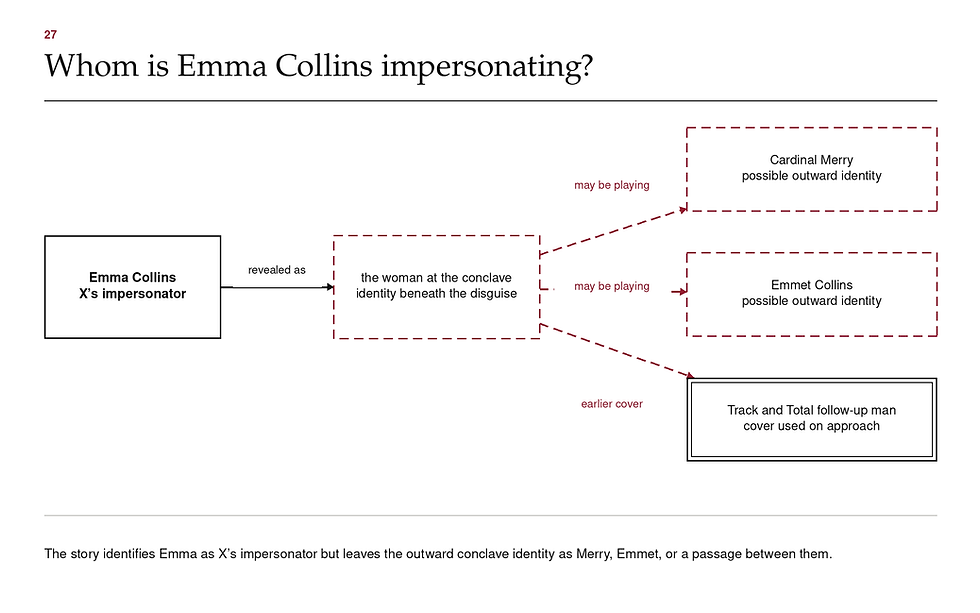
In “How Many Miles to Babylon?” Lafferty’s schizogash theme takes its maximal form as a logic of doubling governed by final causation. Because the story’s events are so compacted, numerous, and baroque, I have organized this differently. I begin with the character chart I usually provide. I then work through the story at the level of logic rather than event, though that logic is of course always exemplified in events. Finally, I provide my usual plot outline, which fills out the dense sequence of action.
The series of charts may seem excessive, but “How Many Miles to Babylon?” is excessive. Mapping the story this way is the best way I have found to keep its whole structure in mind.




Comments