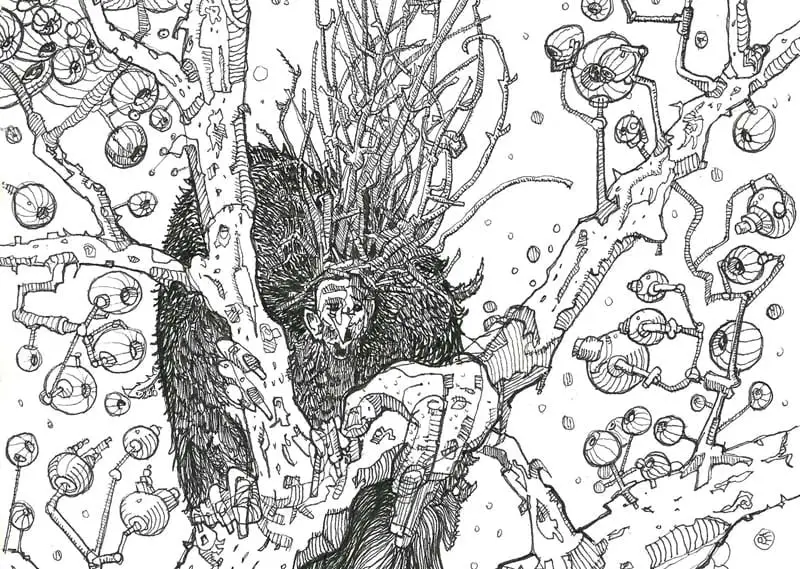
"Make Sure the Eyes are Big Enough" (1979/1982)

Updated: 14 hours ago

The "Distinction and Adornment of the World" is a scholastic phrase which covers our own province and position. The ‘Distinction’ is the special focusing on our own world apart from the billions of other worlds, all special, but not all special to us. It is the scale and site we are on. The ‘Adornment’ is the process and movement and composition, and finally the Flora and Fauna (including ourselves). Sure, we are an adornment, and so is all the other furniture of the world. The ‘Procession of Creatures’ is another scholastic phrase. I am sure you have been taught, somewhere in your five years of Catholic schools, that the Son proceeds eternally from the Father, and that the Holy Ghost proceeds eternally from both the Father and the Son. This is the main Procession. But I am not sure that you were taught that every creature proceeds evitemally (having beginning but not end) from the Holy Trinity. This is the ‘Procession of Creatures.’ There is an anti-scientific secular religion named Darwinism which calls this Procession ‘Evolution by Natural Selection.’ It would be better called ‘by Supernatural Selection.’ That a Procession is also a Parade is all to the good. We have a favored place in the Parade of Creatures. Several of my characters are able to explain these things much better than I am. Unfortunately, they are never around to be interviewed when I want things from them a little more exactly. — Interview with Paul Walker, 1977
“How thin and tinny and how few in number had been the objects in our old field of view! How mediocre in color and how undistinguished in style it had all been! How un-flamboyant the world had been before this!”
“Make Sure the Eyes are Big Enough” is interesting. It clarifies Lafferty’s thoughts about personhood, especially his full extension of the concept of the person. A fairly late story, it is what he called a joyful entertainment, one that takes the doors off his typical technique of noetic darkening. He does what he very rarely does: he reverses the current. Here, as in “Jack Bang’s Eyes,” instead of the eyes being devices of epistemic closure as they open, they open onto the sacramental creation. It is also perhaps his most overtly metaphysical, anti-Gnostic story. He is oddly unguarded. He is happy, having fun, and being both silly yet serious about a matter of significance. It really is joyful. I am glad he wrote it.
That said, it is not a story I particularly enjoy. I like Lafferty in his darker moods or when he is a little gremliny; and I will always take one of his broody operatic stories, such as “Ishmael Unto the Barrens” or “And Mad Undancing Bears,” or a minor black story such as “Thou Whited Wall” or a sullen stare-down such as “And Name My Name,” over his late scherzos. Not for nothing is my favorite Lafferty story the minor but wonderful “Berryhill.”
In “Make Sure the Eyes are Big Enough,” Lafferty gambles big on the brilliant idea of a sensual pleroma as the total rejection of the Gnostic pleroma. As the narrator explains early in the story, this pleroma is a multisensory apprehension of reality’s hidden depths:
The new experience or discovery was a wider range of seeing and sensing. It was the quick cognition of animations and people and off-people and pantograms and joyous beasts and monsters that had heretofore been invisible. It was seeing the other nine-tenths of the world in its racing brightness, and the realizing that the one-tenth of the world that had always been visible was comparatively a little bit sub-par. It was — well, it was the sensual pleroma, the fulfillment, the actualization, all this laced with the excited “Hey, where have you guys been!” motif.
The previously invisible nine-tenths of the world is filled with racing brightness, quasi-humans, astonishing animals, primordial fauna, and mythical creatures. Phenomenal psychologist Rusty McSlim learns of it after attaching a microscopic camera to his daughter Mary Crisis's eye. Rusty’s bedridden grandmother, Mary Imperial, wants to live vicariously through Mary C.’s daily activities. Mary C. and her friends first experience this expanded reality, which they refer to as the "Big Circus," and, unknown to anyone, it is being triggered by chewing gum. Rusty soon experiences the multi-sensory phenomenon himself. Being a phenomenal psychologist, he realizes the scope of the newly visible world. Lafferty wants us to have in mind the distinction between the unavailability of the noumenal and the present-at-hand nature of the phenomenal.
That evening, Rusty convokes twelve of his colleagues to observe and record the new entities. The psychologists discover that the observation goes two ways: the newly visible creatures are also recording and studying the humans. They talk with strange beings, including a green giant who puts the Jolly Green Giant to shame, Lafferty tells us; a fish-faced person; and a frog-faced "Urstuff" person. This last entity turns the anthropological lens back onto the humans, viewing them as absurd chemical constructs:
“Oh, you're a chemical species,” a fine-looking, rubbery, frog-faced person said, “just as I myself belong to an Urstuff species, non-molecular and non-all-that-detail. You are not so much creatures right out of mythology as you are creatures right out of a chemistry book. You remind me of some of the cartoon characters in Elementary Basic Chemistry Number One. You yourself, entity Dogstar, are an almost perfect depictment of the protean spirit of Protein as drawn in our elementary texts. You are hinged and articulated just as a protein molecule is.”
During all this talk, one of the new persons explains some of their lack of reliance on linear time. We also learn that a new species is added to the community of visibility every aeon. All is documented and rushed to publication in a book by electronic psychologist Dr. Darrel Dogstar.
The next day, the psychologists lose their expanded vision, yet millions of people worldwide begin to experience the phenomenon. What is its source? A global computer analysis identifies a specific batch of Sappig-Happig chewing gum as the trigger. This leads to a worldwide shortage and subsequent withdrawal symptoms when new batches fail to create the effect. Investigators question the gum factory's flavor master, John Mastic. Rather than viewing his work as mere industrial chemistry, Mastic describes his craft in terms of divine sub-creation:
“I am an artist,” John Mastic told the articled investigators. “When I mix the first batch of a new flavor, I am painting a dawn, I am composing a symphony, I am creating a folk drama, I am bringing up cool deep meanings from the cellar of the soul, I am setting the juice of life to flowing. Each first batch of a new flavor is blended in this one big vat here in the amount of about eighty thousand kilograms.”
He details how he made the gum, but he either decides not to tell them or forgets to mention that he substituted synthetic corn cobs with cattle feed pellets in the original mixture. That explains the giggling cows from earlier in the story. There is some good news, though. In the earlier encounter with the rest of the persons in the community of visibility, the scientists were treated with “luciferic fluid,” so even if the scientists can’t see the new people now, the new people can still see them. Suddenly, the expanded vision begins manifesting naturally in various animal and insect species across the globe, including cockroaches and moles. The new people said there would be a few bumps during the three days that it takes to transition. Lafferty leaves the story with the giggling moles digging up the McSlims' yard.
This is one of those Lafferty stories with many biblical allusions, from the triduum that we see in works such as Fourth Mansions and “Dig a Crooked Hole,” both of which take place at the "Bug" in Washington, D.C. The entire story echoes creation, giving praise—giggling, which Lafferty figures as a version of joy, drawn from various Psalms such as Psalm 148—and the giggling-cows idea, which comes from cattle in the Books of Job and Isaiah. This cascade of cosmic joy culminates in the story's final moments, illustrating an awakening that bypasses humanity to include the lowest of earthly creatures:
Gar-fish are giggling in the lakes. Honker geese are giggling in their skies and in their swamps. Earthworms are giggling in the ground, and squirrels are chortling in the hickory trees. [. . . ] It is a many-fronted chemical advent, a worldwide movement. It has come to the gophers in their tunnels. [. . .] What's that funny noise in the front yard? It's giggling moles tearing up the ground. But they are seeing the ‘Big See’ too.
Then there is the gum as communion host. We learn that Mary Imperial misses the experience because she does not understand that the passage into communion is transubtantian, one of the story's themes, along with glorified bodies (the luciferic fluid): "But the old tyrant Mary Imperial didn't get all of it. She got only the visual part, and she got that second-hand. She should have opened up and lived a little, as Mary Crisis told her. But she missed it by declining the symbol that was more than a symbol."
Rather than focus on those aspects of the story, I want to focus on what Lafferty is doing with St. Paul. He draws on one of Paul’s favored words, pleroma, and on its orthodox meaning, in a way that contrasts with how pleroma is understood in the Gnostic tradition, a contrast Lafferty explores many times elsewhere. Once one has a sense of how Lafferty uses the term "pleroma," one is better positioned to see what the story is doing with its novum: the sensual pleroma. That is where we see Lafferty's genius in fictionalizing metaphysics. One has to see just how weird a “sensual pleroma” is and how hard Lafferty goes at Gnosticism by inventing it.
The short version of the history is that pleroma enters the Christian tradition through both Pauline and Johannine currents, but it is especially important in the Alexandrian churches, with their interest in Platonizing currents of Hellenistic thought. One first finds it in classical Greek during the fifth and fourth centuries BC. There, it is a non-mystical concept, one just denoting "fullness" or "complement." It is mundane language. Pleroma is what makes an entity complete; a ship's crew is the ship’s pleroma.
Between the third and first centuries BC, the Septuagint expanded this meaning, and it came to refer to cosmic totality. In short, pleroma was used to translate Hebrew ideas regarding the earth and its total contents, as seen in Psalm 23(24):1.
It is worth reading that Psalm if you are reading the story, because Lafferty is drawing on it and playing with the idea that eyes are gates, as well as with what he does with Jacob in two ways in the story. It is probably the appearance of Jacob in the psalm that inspires Lafferty to use his brilliant three variations of Jacob. It’s a detail that is easy to miss, but significant.

First, there is Jacob's membrane, an anatomical term for the layer of rods and cones in the retina. It is named after the Irish ophthalmologist Arthur Jacob, who first described it in 1819. There, one finds the microscopic layer of photoreceptor cells located at the back of the eye. Those cells are responsible for capturing light and converting it into electrical signals that the brain processes into visual images. Hence, all the business in the story is about electronics. What happens is that "Jacob" first refers to this anatomical structure; it is the spot in Mary Crisis's eye where her father attaches a microscopic camera probe.
Later, Jacob is the biblical Jacob when the psychologist compares the newly visible entities to angels on "Jacob's Ladder." That prompts one of the newly visible people to ask whether she is old enough to have known the historical Jacob personally.
The third point is subtle and, unlike the first two references, interpretive. I am convinced it's in the story. That is the relevance of John’s prologue about the Word (the passages where Lafferty gets Ouden), and then John 1:51, where Jesus tells Nathanael that he is the fulfillment of Jacob’s ladder: “Verily, verily, I say unto you, Hereafter ye shall see heaven open, and the angels of God ascending and descending upon the Son of man.”
My reading of this story is that Lafferty is doing something so obvious, so in plain sight, that he knows most readers will not have eyes big enough to see it. He’s using two puns. First is the “Big See” as a homophone for “Big C,” as in Christ. Second is the pun in the title on eyes: “Make Sure the Eyes Are Big Enough.” Lafferty goes out of his way to talk about the new person's size.
The next major moment in the history of the pleroma comes in the New Testament. By the first century AD, it was used in both concrete, everyday senses—such as leftover basket fillings or a replacement patch for a garment—and in highly theological contexts. In Pauline and deutero-Pauline literature, pleroma takes on historical and Christological maximalization, or “big eschatology,” representing the "fullness of time," the "full number" in salvation history, and the complete totality of divine presence dwelling in Christ. At the same time, it is quoting Septuagint intertexts to assert God's ownership of creation.
In the early second century, Apostolic Fathers such as Ignatius of Antioch adopted the term pleroma. They put it in an ecclesial and devotional context, describing God's fullness as actively blessing and indwelling the Church. I am convinced that Lafferty is drawing on Origen’s use of pleroma here as well as Paul’s, which is why we read about the aeon.
But whatever the truth of that, by the mid-to-late second century, Valentinian Gnostic systems had conceptually reified pleroma into a spatialized metaphysical world of divine emanations and aeons. That is something we see in Lafferty stories such as “Continued on Next Rock” and “The All At-Once Man.” It is a development that infuriated figures such as Irenaeus, who noted the distinction between what occurred "within" and "outside" this divine place.
By the late second and third centuries, Catholic intellectuals—most importantly Origen—had thought through and debated Gnostic exegetes such as Heracleon. Origen’s history in the Church is complicated, as I have written about on the blog, but suffice it to say that orthodox theology was now in a position to clarify or, depending on your view, to police Pauline usages in contrast to Gnostic technical meanings.
In fourth-century and later patristic traditions, pleroma is an exegetical crux for understanding Catholic ecclesiology. This is especially true in the case of Ephesians 1:23, where the Church is interpreted as the complement that makes Christ the Head and His Body a single living completeness. This is why contemporary biblical scholars are split on whether Ephesians and Colossians are by the historical Paul; they seem to have later and perhaps Johannine-influenced elements. Moving into late antiquity and the medieval period, the pleroma lost its Wild West quality. The fight was for now. It became the much more domesticated Latin translation, plenitudo. That, in turn, preserved the theological concept of fullness. You don’t find pleroma in the scholastic tradition much because the Greek loanword fell out of standard usage.
In the twentieth century, pleroma became a hot topic again through the work of scholars on the Gnostic tradition. It went through a conceptual revival and subsequent academic stabilization. In 1916, Jung used the term in his Seven Sermons to the Dead and The Red Book. In Jung’s thought, pleroma is the psychological and mythic symbol of undifferentiated metaphysical totality that exists prior to the appearance of opposites. In 1945, the discovery of the Nag Hammadi library gave scholars direct access to primary Gnostic sources, such as A Valentinian Exposition. That made it possible to understand the term's use as an internal cosmological category structured around decads and dodecads—the decads may be why Lafferty settles on the idea of full creation being ten-tenths.
That is a lot, so I’ll cut to the point now. In Paul’s writings, he uses two very important ways of talking about the pleroma that one should know regarding this story. The first is that he says that Christ is the pleroma of the Godhead because in Christ, the Father becomes visible. The other is that he says the Church is the pleroma of Christ, or the body of Christ. In my take on this story, the sensual pleroma is the pleroma of the Church as all of sacramental creation, participating in what Lafferty calls, in interviews, stories, and private notes, the Adornment of the World.
That is why there is so much in this story about participation and participatory language:
He did not hear by conventional sound that is often irritating, but by the most wonderful invention ever, sound without noise! And he understood the "talk" of these nations of creatures, though perhaps it should be called ‘communication’ rather than literal "talk."
But the most startling observation that they made was that the observing was a two-way street. The "new-appearance persons" were regarding the human psychologists as themselves being new appearances, and they were quite interested in them.
"“Oh, it's just a little knock-about model. It is good to see you folks, really good to see you! Every new acquaintance we make enlarges all of us."
" . . . we can see and sense you almost as easily as we can see ourselves and persons of the other participating groups . . . And yet we welcome you as a participating species, if you are such."
This is Lafferty at his most metaphysically generous, hiding his Christology and expansion view of communion behind giggling cows and giggling cockroaches: "It's circus come to town," "We'll say it's the circus come to town, the Circus," "They had already been giggling for a quite a long while before we began to see the Big Circus," "Generally we are in a horizontal of 'big circle' relationship with each other, and there isn't much ascending or descending to it." That he chooses to make such a positive, affirmative Origenist statement in such a light story is typical of some of his later work. As the new-appearance person lizard says, "Up with the lateral movement! That's what I always say."
As I often argue, Lafferty is an esoteric writer who managed to get away with being read as a writer of quirky stories full of exoteric enjoyment until he didn’t. At that point, he often became outwardly esoteric. Then something happened, his last breath. He found a balance that isn't understood yet because one probably has to pass through much of the really esoteric stuff to fall in love with the later novels. Despite its surface fun—giggling cows and chewing gum, which is how it has usually been read so far—this is an esoteric psalm, his most pleromic expression of his maximalist sacramental ontology in its most affirmative form. It is also an exoteric story about just being open to life. A good reminder for us non-gigglers.