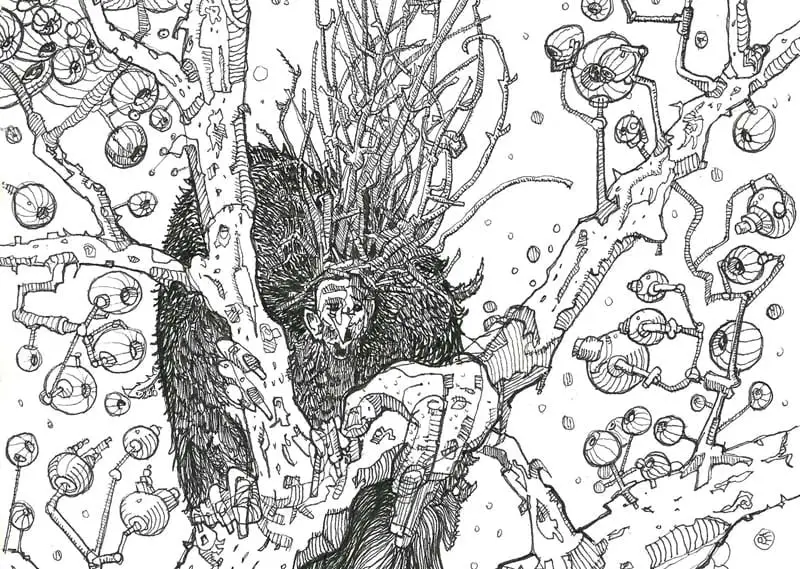
"And Mad Undancing Bears" (1972/1974)

Updated: 14 hours ago

“The berserks speak of light as though it were white or golden and as though it were singular. Apparently they cannot even see the shattered and dynamic psychedelic lights nor even the kaleidoscopic psychedelic sun. And the berserks, the marching virgins, are serious in their madness.”
Only at first glance. In reality he had the plastic smooth, primordial, unfinished look of a typhonian. He could still bemolded into anything. But the noise of him and of his apparatus!
Most readers, sooner or later, will ricochet off some part of Lafferty. For many, it will be the novels. I tend to ricochet off, and so have to muster persistence, the psychedelic cluster, a loosely linked 1970s run that includes “Horns on Their Heads,” “Sky,” and “And Mad Undancing Bears,” using techniques that appear elsewhere as well. These stories share an aggressive aim: they assault American counterculture by estranging its psychedelic aesthetic from the inside—though “inside” here really means a parodic facsimile of linguistic interiority. Lafferty adopts a skewed psychedelia to turn it against rock music, sexual license, and drug-inflected cant, advancing the attack on the grounds that popular culture is damaging spiritual goods.
In the story world of “And Mad Undancing Bears,” the threat is noise, so the story is saturated with the clanging noise of chaotic rock culture, indiscriminate human rutting, and ritualized drug use. Sanity itself becomes a contested category when a small group of silent, disciplined pilgrims—the Berserkers—come forth from the deserts. These figures recapitulate the early Christians, bearing the names of saints and clad like John the Baptist in animal skins.
They reject the mandatory cacophony of the cities and are accordingly declared “mad” by the ruling council, Glomerule. Its members, including a bio-engineered bear-man named Boris Medved, regard the pilgrims’ silence and chastity as a contagious threat, a kind of virus endangering their civilization of terminal sanity.
As the pilgrims move toward the cities, they are intercepted by violent enforcers. This is where Lafferty begins the story, after a brief opening that creates a tonal contrast to the prose that will soon overwhelm it. Readers are given parallelism that sets out a natural order that will contrast with what comes later:
They had been wandering forty years in the desert, so most of them had been born there. There were probably two hundred small groups of them, and they came now for bloodless conquest of the dark and dismal cities of the plains and valleys. They could hear the din of the cities from many miles away; they could see the smoke above them like clouds during the day, and the dancing lights at night. The deserts that the small groups came from were the badlands, the silent salt plains, the alabaster hills and the potato hills, the gopher gulches and the bear brackens of middlewestern North America. And other continents had other deserts where perhaps similar movements were taking place. The silent things were coming to the towns.
This is where the giant motorcyclist Whole-Hog McCloud rides out, giving us some of Lafferty’s best writing in the psychedelic stories, with the Whole-Hog’s pillar of motorcycle dust counterfiguring the pillar of smoke in the desert of Exodus:
“The whine of the approaching chopper-cycle hadbecome a scream. The dust of it was a pillar in the air. Itcame into sight as a howling dot at the bottom of the pillar,and it grew. Riding it was the chopper whom several of themhad seen while he was still far below the horizon. He was ahuge, bearded, slavering man, the whites of whose eyeswere as big as apples, and the black pupils of them werelike insane black holes.”
But he is no match for the berserkers. McCloud wrestles like Jacob and is converted. Renamed Whole-Man McCloud, he joins the church militant.
At the same time, Glomerule knows that it has a plague on its hands, so it organizes a week-long ritual concert in the Colosseum. Captured pilgrims are to be executed by being fed to wild animals amid deafening amplified noise. Children will be fed into the beast of Moloch, his head full of speakers and a furnace for his belly.
When the pilgrims enter the arena in part III of the story, however, one of them—Domitilla—gestures for silence. The amplifiers fail, and a hush falls over the stadium. The lions and tigers won’t attack. Real bears in the pit move to protect the human Berserkers. They reject Boris Medved as a surgical obscenity rather than a true bear. They kill Medved, and the spectators, abandoning the regime’s noisy rites to Moloch, descend into the arena to join the silent pilgrims, Christianity rising again from the ashes.

Because the aesthetic effects in the psychedelic stories are so intensified, they are unlikely to leave the reader feeling neutral. Lafferty pushes affect to the point of decision. He does so by deploying extreme counterfiguration to construct a postapocalyptic atmosphere.
In “Horns on Their Heads,” the governing image to be counterfigured is the horn of sacred tradition; here, it is the bearskin. From the opening reference to the “cities of the plain and valley,” the urban world is under judgment, since the cities of the plain are Sodom and Gomorrah in Genesis 19. Against this backdrop, the bearsark counterfigures the fig leaves of Genesis 3:7 and the virtues of modestia and pudor, the spiritual goods the rockers lack.
Where the Glomerule, the ruling elite, reads the bear-sark as a sign of animalistic violence, the so-called mad pilgrims in bearskins are disclosed as the only fully rational humans. By contrast, the people of the cities appear as plastic, surgically altered monstrosities like Boris Medved, who is neither more nor less physically unhandsome than a man, yet is spiritually a perversion.
The same counterfigurative logic modulates the story’s imagery of light. The “psychedelic sun” and “kaleidoscopic lights” do not illuminate. They blind the populace to the single white or golden light of truth. This kind of rhetorical strategy on Lafferty’s part either succeeds for the reader or it fails, but it is so relentlessly high-concept that it cannot pass unnoticed.
Also driving the story is Lafferty’s construction of a pathologized language. He renders degradation through the degradation of syntax and lexis. After the opening pages and the Whole-Hog set piece, “And Mad Undancing Bears” becomes an onslaught of grotesque nomenclature and jingling patois, a linguistic rock opera in which rhyme and noise have displaced reason. Characters no longer argue. In schizophrenics, this verbal pathology is called clanging.
Take Helga Navel, a member of the “Umbilical Chords.” She attempts to reason, and it comes out looking like this: “A scatterbrain is a catter-brain, for we are the catter-brained cats.” This is not a bad argument; it isn't an argument. The same degeneration governs ritual practice, which has hardened into a rhythmic checklist: “mesh the flesh,” “sing the thing,” “dance the ranch,” “twitch the itch.” Language is loud and numbing, mirroring the drugs, “placid acid” and “holy hash,” that the culture consumes:
“These mad folk come from the badlands,” Helen twanged like vibrating mountains. (One could actually hear her. She had always had a voice that could cut through the howling ululation of strings and chords.) “They come from those deserts of nonsound, from the silent salt plains, from the alabaster hills and the potato hills, from the gopher gulches and the bear brackens. The horrible silence has driven them mad, clear mad. They wear cloaks of bearskin; that is the truth. They refuse obeisance to the Fundamental Rock. They refuse all conjecture. They will not meet the beat, or mesh the flesh, or sing the thing, or grass, or hash. They will not touch the raper-caper, or the placid acid, or the ranchy dance. They will not bollix Moloch with the rid-kids; they disdain the itch-twitch. There is no bottom to their madness. They are mad beasts in human form. They are coming in groups of a dozen or more, and each group brings with it a cloud of silence. The secret of their madness lies in that no-noise cloud.”
The passage is instructive. It is the sonic derangement of the psychedelic stories at its most intense. It corrodes social connection, a process visible in the way verbs of utterance are reduced to noise production. The rockers are described as trumpeting, roaring, screeching, howling, twanging, clattering, crowing, booming, and shrilling. Speech no longer serves description or exchange. It has a saturation function, one that exists to limit thought and proportion. The narrator observes, almost in passing, that because everything is so damn loud, everyone must read lips.
Against this auditory violence are the mad undancing bears. Their mode of communication contrasts with that of the rockers. Polycarp speaks softly, Scholastica speaks lightly, and Cecilia lilts. The world of the Glomerule, which calls itself sane, is thus exposed as a regime of crooked noise, while the pilgrims’ cloud of silence emerges as a precondition of intelligibility and of worship.
The story’s theopoetics of silence draws on scriptural wisdom—trust, obedience. It’s a large set of passages, but it includes Habakkuk 2:20, “But the LORD is in his holy temple: let all the earth keep silence before him,” prayerful silence, as well as the apocalyptic silence of Revelation 8:1, “And when he had opened the seventh seal, there was silence in heaven about the space of half an hour.” Verses like this cast the story’s closing silence as reverent, obedient trust—speech stilled before God’s presence and the weight of what comes next, the eschatological hope that runs through Lafferty.
Now some carping. What prevents the psychedelic stories from being entirely successful (and maybe they do succeed) is that the language devised to annihilate Lafferty's target is liable to appear hysterical. If a reader comes away from “And Mad Undancing Bears” thinking something like, gosh, Lafferty really didn’t like sex, drugs, and rock and roll, then the story has failed, in my view. Lafferty wanted to do more. But it only seems fair to acknowledge that Lafferty’s rhetorical amplification invites that response, since it doubles down by being as extreme as the music issuing from the rockers’ roar boxes to counterfigure the target into ashes.
On the other hand, the story reaches for old-fashioned wisdom at a moment of cultural crisis in America. It affirms the priority of silence and contemplation over machinic activity. It exposes the destructiveness of youth cultures that sever themselves from the past, only to be absorbed by commercial and ideological forces. It understands spiritual conversion not as conquest but as rehumanization. It treats monstrosity as incompletion rather than sheer evil ("typhonian"). And it distinguishes the eternal from the passing, a distinction rendered with particular clarity in “And Mad Undancing Bears” through opposing the severe, stark beauty of the desert and the lurid concert of Moloch.
Another one for the Lafferty playlist.