"And You Did Not Wail" (1974/1983)

Updated: 20 hours ago

But the spider meant to bite her. It glittered with the meanest eyes ever seen, and there was a noise right at the lower level of sound — malevolent spider laughter.
"And You Did Not Wail" has a simple plot. Sometime in the future, the world is overtaken by emotional excess and collective hysteria. A few refuse to go along with it. Among them is our main character, Basil Cubic, a rational engineer whose name is ironic but perhaps complicatedly so. "Basil Cubic" is unsurprisingly basically square, but he is not unsympathetic. He wants a solution the way an engineer wants a solution.
A solution to what? To nosebleeds, a loss of individuality, and a collapse of inhibition, all signalling The Thing, a sickness that has infected every part of society, most of all the arts. Basil’s friend in the arts, Andrew Giro, recognizes this as a disaster. “It’s a sniveling madness returned,” he says, “and it’s the enemy of quality.”
So Basil turns to O’Malley’s Agency to bring out some leased engineers. Instead of helping, all but one of them celebrate The Thing. Finally, with nowhere else to turn, Basil calls Brian McClain. McClain offers the solution: start over from lemurs. In eighty million years, a new humanity may rise. Basil had believed the world could be repaired. Now he wails with the rest.
On December 15, 1974, Lafferty completed “And You Did Not Wail.” December 19th is a day that, depending on the year, falls either in the second week of Advent or, as it did in 1974 when Lafferty was sixty-one, on Gaudete Sunday.
In case you are not Catholic, Anglican, or Lutheran, I should say more about this. Gaudete comes from the Latin gaudete, meaning “rejoice”; and Gaudete Sunday comes halfway through the season, a sign that Christ is near. On Gaudete Sunday, the rose candle is lit, rose vestments replace the purple ones of penance, and the heavy penitential mood of Advent lifts for a moment of gladness. This is why there is a pink candle in the Advent wreath among the purple ones. The center white candle in the wreath is usually called the Christ Candle and is lit on Christmas Eve or Christmas Day.

That Lafferty finished “And You Did Not Wail” on Gaudete Sunday is pretty interesting, because the two great images in the story are candles. Lafferty would have wrapped up the story before or after going to the Gaudete Sunday mass.
Here is what he writes about candle 1:
"They still have the outlawed signature candle burning in their heads; they still have the 'Maker's Mark' statement, burning in their breasts."
And here he gives us candle 2:
"Tongue scrapings,” they said. “We scrape the coatings from our tongues and save it all because we are a happy-holy-tongued people. And now if you will give us your own tongue scrapings, then you can begin to have meaningful relations with us."
We have two candles. The first is a metaphor of the soul, the Imago Dei candle. The second is its negation, a profane parody that takes the candle literally. In the story, this becomes the candle of humanism and machine worship, man exalting not the divine image within himself but only the non-divine part of man.
We will reach out . . . into persons, and we will pull out (haireisthai, draw out, select out, heresy out) the special quality or statement, and we will destroy it with a blast of sound. Then that person, who had been sick, will be well . . . Now we will make everyone free of it. There will be no more special qualities, not anywhere, not ever.
Midway through the story, Lafferty devises an etiological myth to explain how this works. In "Article Number Four," the Leased Engineer Number Six presents the story of mechanical people manufactured by the great rationalist Eratosthenes. They are the "first really normal humans." This origin myth is another picture of the profane second candle.
These mechanical beings feel "great glory at being created in the human image," a knockoff Imago Dei that replaces the divine spark with a worship of the raw biological collective—the "people-thing." They are the product of the haireisthai, created from the start without the "Signature Candle" that the heretics want to destroy in others. By having Eratosthenes, a pinnacle of reason, make these "ecstatic" (the word is paradoxical here) soul-less beings, Lafferty is being very crafty indeed: the attempt to perfect man as a machine results not in a higher being, but in a debased, gibbering creature, establishing a historical and scientific ideal for the sickness Basil Cubic confronts downstream of history.
But like Eratosthenes before him, Basil is an engineer, which is one reason Lafferty's depiction of him is complicated. Basil is an intellectual cousin of Eratosthenes, that uber-rationalist. Basil sees the problem, but he is unequipped to solve it.
He turns to the kind of mechanical persons Eratosthenes produced, the Leased Engineers, which is to say he thinks mechanically. But he is not one of the mechanical persons. This is why his wailing at the end of the story is not like all the other wailing produced by The Thing.
In "You Did Not Wail," the O'Malley Girls are Basil Cubic's new, mass-produced office staff who act as a unified, chattering chorus. They're pretty much the very anti-rational, emotionally incontinent "sickness" he is trying to cure. The O’Malley girls are the ones who eventually hand Basil Cubic the cheap candle “stuck in” a “little dirty white cake of something.” Lafferty assumes the reader knows why it’s white. Baptismal candles are white, and the Paschal Candle is white. The “something,” they say, is a lump of “Tongue scrapings,” the filth of the “happy-holy-tongued people.”
The story throws down an absolute choice. Guard the God-stamped light of the Maker’s Mark, or accept an anti-sacramental flame, the scum of your own mouth. Be a humanist. Be a lolling tongue, joy-be-goy-goy. There is no God: it’s all about the funnilingus.
They swooned for joy, they forewent bathing lest any of the blessed human unction might be washed away from their hides, they raised their howls of praise to themselves and to their kindred, they danced and pranced, they talked with their happy tongues, they indulged in gibberish (funnilingus), they clasped each other fervently and uttered incantation phrases which fortunately have not come down to us, they smelled each other about the crevasses and articulations of their bodies and they were impassioned by the smells. They just could not get enough of themselves and of the people-thing to which they belonged. They did new and great things in the arts (creatively destructive things). They continually made little cries and sighs, their noses bled a lot, and they wept and tittered. What is there like the titter to make all mankind akin? And when ecstasy reigns, can logorrhea be far behind? No, it could not. There was instant logorrhea. Tongues bloomed like scarlet flowers, as they are doing once more today.
So, unlike Gaudete Sunday, this story is not joyful. It is one of Lafferty’s unhappiest, which really is saying something. The grandfather of all Lafferty sites online, Mulle-Kybernetik, calls it “OK” and adds this: “Recurring theme of teenager behavior indicating or causing a cultural downfall.”
It’s not that simple, but Lafferty is gagging at the counterculture, and it does get the better of him here. He falls into the same excesses that weaken “Horns On Their Heads” (1971). I like “And You Did Not Wail.” It’s just minor and flawed, and the main reason is that there’s a lot of cane-waving at the neighborhood kids.
Lafferty sees antinomianism as spiritually corrupt—I agree with him there—but he doesn’t care that his critique isn't hitting his own generation's taste as hard as it hits the counterculture. That’s both fair and unfair. It’s fair because, as T. S. Eliot said, “The decline of art is a symptom of the decline of a culture,” a point anyone with any sense has heard a hundred times and agrees with. But it’s also unfair, because some things are just a matter of taste. Not walking that line carefully can come off as a cheap shot.
Then again, maybe I’m not being fair to Lafferty. He knows the difference, and he is doing satire. He is being deliberately silly, aware that Basil and Giro are self-satisfied that their generation was spared its own version of The Thing. Or maybe it is fair to knock Lafferty here, because he wants to make such a serious point at the end, and the satire should be expected to carry such weight better if it wants to be this profound. That’s always the issue for me when Lafferty misses. In the past, I’ve called the exact issue theotropic dissonance.
On the bright side, the story does remarkable things with language. Much of it is told through a clever series of parodic reports from engineers; it’s rich in allusion and inventive in its use of it, from its title to many small word games.
And yet, everyone should have known what was coming. The title tells us this will be a rebuke. It alludes to Luke 7:32, where Jesus compares His generation to children who won’t respond: “We played the flute for you, and you did not dance; we sang a dirge, and you did not wail.”
Lafferty returns to this verse again and again. It’s in the title. It’s in the epigraph because Lafferty really wants us to get it. It’s behind the story’s mockery of popular music such as “Joy To The World,” with digs at Three Dog Night (“Three Eyed Dog”) and the Rolling Stones (“Lolling Tongues”).
In the end, it’s flung at Basil by the O’Malley girls, who shout at him through a “miasma of sound”: “Oh, you impossible man . . . Why don’t you wail? Everybody is wailing. That’s the Lolling Tongues doing ‘Wail All Night’, and you do not wail!” It’s important to hear, whatever the messenger, that these are sacred words.
The crowd refused to hear either John the Baptist or Jesus. “You did not wail” means: you did not repent. The warning didn’t move you. The invitation didn’t move you. Your heart stayed hard. Lafferty clearly says his target is the whole world, but it still feels like he is talking about younger generations more than his own. That's part of the miss, at least for me. The rebuke hasn't been fairly recapitulated.
Lafferty’s unfairness here toward youth culture makes him vulnerable to critical unfairness because Basil Cubic isn’t a full stand-in for Lafferty, though he’s much closer to Lafferty than the youth culture is. Basil is right about the problem, and he is part of it. Lafferty surely did not see himself that way.
While the story talks about mechanical people, built with the Imago Dei factored out, Basil is a little too mechanical himself (Lafferty is not); and, while the story mocks the youth culture—the lippies, the bippies, and the rest—it also mocks him. He is being rebuked for not wailing, just as the others are rebuked for cheapening both joy and sorrow.
They are sentimentalists of the soul, and Lafferty plays with this by giving the plague a cycle. “‘All the arts had become very tearful . . . and all of them had become happy-jappy,’” swinging back and forth between moods that, in the end, “‘were not really extremes or opposites; they were the same thing.’” Lafferty ties this to “‘sentimentality in fiction since the eighteenth century German and the nineteenth century Russian.’” For Lafferty, it is an artistic problem as well as a spiritual one; in a way, it just isn’t for Basil. Basil is one-sided and needs a Giro.
The story also takes a hard swing at low-church Protestantism, showing the spiritual confusion of youth culture as part of a wider disorder, one that includes Charismaticism and its test of speaking in tongues. A lot could be said about this, but suffice it to say that Lafferty stages a miniature theological debate, quoting scripture (St. Paul on God not being the author of confusion) and having the with-it people immediately mock it:
“Oh Paul is wrongsy-bongsy! Gibberish is in like Quinn. Let’s all make a mighty gibberish around the altar. Gibb, gibb, gibber!”
Lafferty goes nuclear whenever he shows cultural collapse as a collapse in language. Here, we see it in the baby talk. In the brilliant opening scene, one of the O’Malley girls sees a spider and cries out, “‘Oh what a horribly human reaction! How unhumanly human!’” Then she coos at it: “‘Here, let me take the mumms tumms goowoo dumms mumswums—’” Basil’s disgust is instant: “‘Baby-talk to a spider!’” The girl says—“‘spiders are better people than a lot of people are,’”—but the spider bites her, and she yelps, “‘Ow Wow Gow!’”
The baby talk, once cognitive, even if degraded, has become non-cognitive, a yelp of pain that can be written as words but does not truly amount to them. Back to St. Paul, speaking in tongues, and gibberish.
Thucydides, writing about the Peloponnesian War, noted that during civil strife, words were twisted—recklessness was called courage, caution was called cowardice. It’s a set piece in many classrooms. Lafferty’s story made me think of this because of how it plays with the corruption of language. In this light, it is fun that Engineer Sixteen—the so-called “sanitary engineer,” a textbook example of language as social lie—alone appreciates the story’s only genuine engineering idea: a governor.

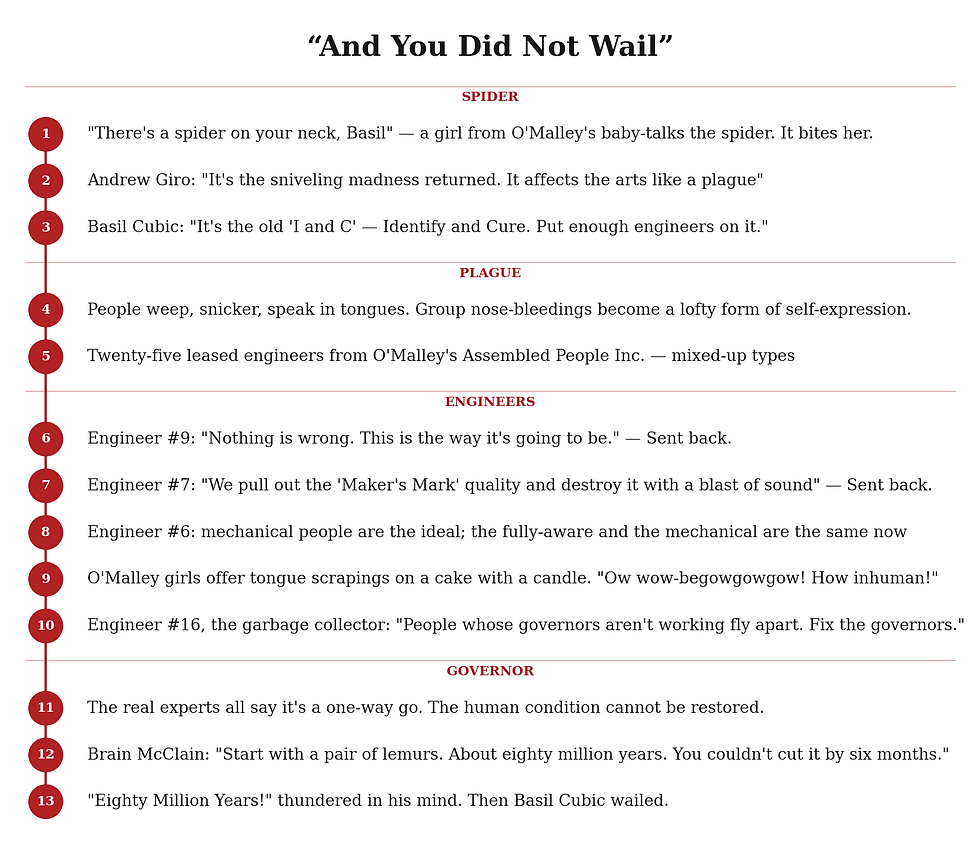
Engineer Report | Core Argument | Tone | Diagnosis of The Thing | Basil's Reaction | ||
Article 1 (No. 9) | This is not a sickness; it's the new, superior human normal. | Pseudo-intellectual, condescending | The "sickness" is the old, rational way of being. | Fires him immediately. | ||
Article 2 (No. 17) | Refusing to join the collective self-worship makes one a "fink," not a human. | Pompous, cult-like, propagandistic | The problem is specifically Basil Cubic's individuality. | Fires him for a lack of "content." | ||
Article 3 (No. 7) | Describes "mind-blowing" as a tool to destroy the individual's "Signature Candle." | Chillingly methodical, conspiratorial | The sickness is individuality (the "Signature Candle"). | Dismisses it as worthless "alley" trash. | ||
Article 4 (No. 6) | Creates a fake history where mechanical people were the original, ideal humans. | Gleefully absurd, pseudo-historical | The problem is "unliberated humans" not yet merged with the mechanical ideal. | Fires him, disgusted by the movement's rituals. | ||
Article 5 (No. 11) | A pure celebration of chaos, linking the movement to mass hysteria and rock music. | Ecstatic, fannish, incoherent | There is no sickness; "This is the ideal." | Angrily wants him gone, using violent metaphors. | ||
Article 6 (No. 16) | People have a broken "governor" (self-control); it is a critical malfunction, not a new way of being. | Plain-spoken, practical, blunt | A literal malfunction: "Busted governors." | Praises him as the only one who correctly identified the problem. |