"The Last Astronomer" (1979/1983)

Updated: 16 hours ago

You may tell that German College that their honor comes too late, But they must not waste repentance on the grizzly savant's fate. Though my soul may set in darkness, it will rise in perfect light; I have loved the stars too fondly to be fearful of the night. — Sarah Williams, “The Old Astronomer to His Pupil”
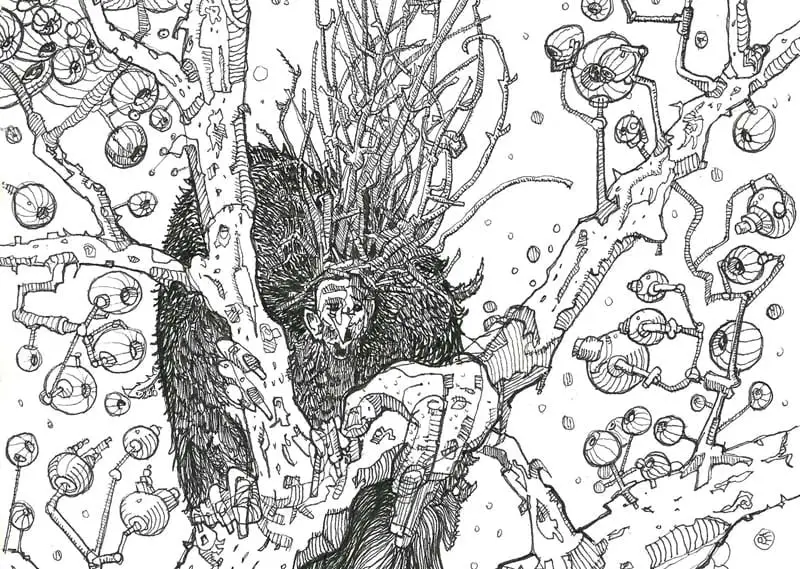
“Tell me when I'm dead,” High Rider mumbled. The girl hammered the two stalks into his eyes. Bam! Bam! “You're dead now,” she said. “This part is fun. Stars for the star man! How ritual can you get!”
In “The Man Who Lost His Magic,” Lafferty takes aim at Jacob Grimm’s dream of the German state, a rationalizing project, and he uses Grimm's best-known work to do it: the legends and fairy tales. In “The Last Astronomer,” he does something similar. He uses the imagery and tropes of pulp Mars to take the wind out of rationalizing cosmology. Just as the target of critique in “The Man Who Lost His Magic” is not philology or the nation as such, but their hyperrationalization, so “The Last Astronomer” is not attacking astronomy but distorted prioritizations about the cosmos.
In each story, Lafferty uses fields, meadows, and enchantment to point toward a wider circle of meaning. Both "Jacob Grim" and High Rider Charles-Wain are men who have stored up their treasures in their work, and both end up in similar states for it, Grim a pile of bones, High Rider buried with flowers growing from his eyes. After sketching the plot, I’ll say something about how Lafferty’s Catholicism shows up in the story.
“The Last Astronomer” centers on High Rider Charles-Wain. He is a disillusioned Earth astronomer living on the Red World of Mars. At the beginning of the story, he steps on a weighing machine, and it plays “Winterset’s ‘Funeral March.’” Then it issues a rhymed print-out saying that he will die today. High Rider tosses the crumpled message into the red Martian grass, and the machine wails with a “poor man's siren” and insults him. We are told that on Mars there is "no clear line between machines and animals and people,” and even vehicles are often inhabited by the Spirit of Automobile.
High Rider himself is an exile from something called the “Great Astronomical Bubble” collapse, during which the old cosmological models were disproved. In any case, High Rider accepts the machine's prophecy, and while death is “the only honorable thing for a discredited astronomer to do,” he is reluctant to leave a life while the sun is out. He wants to die at night: “I wish that I could live into the late evening and see stars again.”
On this, the final afternoon of his life, High Rider is visited by a Bird Man who has just completed the grueling Phobos Regatta. Straight out of the earliest days of pulp fiction, it is the kind of flight from the Martian moon that the scientific literati could hardly help but mock. The Bird Man laughs at the dumb old theories about space. He calls Earth’s astronomy "Astronomy Fiction." High Rider agrees. He says that astronomers followed one another trunk-to-tail until Occam's Razor cut the science to pieces. We next learn that a space expedition proved the edge of the universe is only thirty light-years away. The perceived vastness of space was a house of mirrors. Beyond the edge? A total nothingness so absolute that a crew member who touched it lost an arm without a scar, as if he had been born without it.
The Bird Man leaves. High Rider makes his death march to the Star-Flower Burial Meadow, whistling "A Land Two Meters Long The Destined Home For Me." When he arrives, two Mars Maids await. They are ready to dig his grave. This burial act isn’t wholly altruistic. They plan to harvest High Rider’s nodal enzymes and glands to sell for "nine dollars red money." High Rider then notices something interesting: the star flowers in the field grow two by two from the graves of other star-lovers. It turns out they are growing from the eyes of dead astronomers. The maids fulfill High Rider’s wish to see the stars forever by driving sharpened flower stalks into his eyes. As the aromatic red dirt covers him, High Rider feels the excruciating pain of the plants taking root. He calls it wonderful.

As a theological fantasy that repurposes the pulp-era imagery of Mars, “The Last Astronomer” corrects a category mistake about God and cosmic scale. It plays with an anxiety that Lafferty returned to several times: the shape of the universe. (It is, of course, the subject of the climax of his novel Arrive at Easterwine.)
Religious anxieties about the universe’s shape have their own mythology in the modern imagination. There is Galileo (1564–1642) and “it moves.” And the anxiety goes back at least as far as Giordano Bruno (1548–1600), whose philosophy of an infinite universe with countless worlds was spiritually upsetting to many in his time. It threatened the ordered cosmos. In the received cosmos, Earth and humanity had a clear position, and everything pointed back to Earth and to God’s plan. If there are innumerable worlds, what does that mean for doctrines of creation, humanity’s uniqueness, and salvation?
Then there is Blaise Pascal (1623–1662), for whom cosmic vastness produced an existential, inward anxiety. The immensity revealed by astronomy made human life feel tiny, fragile, and exposed. He famously wrote, “I see the terrifying spaces of the universe that enclose me, and I find myself attached to a corner of this vast expanse, without knowing why I am in this place rather than another, nor why this little time that is given me to live is assigned to me at this point rather than another, out of all the eternity that has preceded me and all that will follow me.” How can a vast universe index something that cares about us? If not, why should anyone take God's omnibenevolence seriously?
In the terms of “The Last Astronomer,” all of this is prehistory, because High Rider is not the sort of man who feels such anxieties. He is a total creature of the astronomy-only worldview. His God is the observable universe, and it is a bubble that bursts.
High Rider reacts to a smaller universe by saying it diminishes him and even diminishes God. Here, the story punctures the idolatry of vastness, as if bigness were transcendence. Classical Catholic theism obviously holds that God isn’t one more (very large) thing; God is the source of being itself, so no amount of galaxies makes God more God or less God. Creation is contingent and depends on God, a set of accidental causes not one of which is essential. That is another way of saying that existence is not self-grounded, esse is not ens. Lafferty gets in a jab that the old astronomy violated this divine economy: “economy” (ordering, fittingness) implies reality is purposive and divinely ordered.

So what happens when High Rider looks through the flower stalks? His post-mortem star-sight is another instance of definalization in Lafferty. Does he see luminous superheated gas held together by gravity, or does he see the lesser lights ordained to govern the night? So much of the story turns on a failure of vision that I think the Mars maids' eye ritual is likely to be a form of contrapasso. High Rider is annoyed by a Mars that turns out to be more wonderful than the old pulpsters imagined, a Mars with bird men and Mars maids, with red grass and Martian canals, and weird fish dinners. That makes the story a parable about foolish ordo amoris: you become the order of your loves, for good or ill.
Contrapasso, of course, is the trope in which punishment or penance mirrors sin. The flowers are driven into the eyes because sight was the organ of High Rider’s disordered love: High Rider, whose name points to superbia, wished to behold the stars as an ultimate concern rather than to behold God. The star-flower motif exteriorizes the Catholic idea that desire in-forms the soul’s destiny. Attachment can open or narrow vision. In place of the beatific vision, High Rider chooses a lesser “forever,” “seeing . . . the stars forever.” He sees the universe from the wrong side of the empyrean. That is an ersatz beatific vision. Accordingly, what results is a parody of sacramentality: vegetable matter mediating spirit without mediating grace.
Then again, I may be mistaken. The flowers themselves could be the mediation of grace. There may still be hope for High Rider, as there is for the bones of Jacob Grim. The contrapasso might be purgatorial. Flowers that hurt the eyes for a year have purgatorial logic.