"Saturday You Die" (1959/1960)

Updated: 1 day ago

The metamorphosis of human children into adults is a disguised sort since children look more like adults than caterpillars look like butterflies or tadpoles look like frogs. — Letter
The rest of the week was filled with great expectation. Henry dreamed it out in the mornings as he sat in the cave, and in the afternoons as he sat on top of Doolen's Mountain. The appeal of a completely untrammeled existence has always been strong. It would be perfect to be no more than a pair of eyes. To be on the highest stick of a ship and to be able to see further than anybody else in the world, that would be a new sort of ultimate. From the very top you would be able to see whole islands that nobody else had seen, to see whole ships before they came into view. Being so high, you could see the tops and the backs of the clouds, and look at the inside of the cloud rooms. You could look down and see the green whales, bigger than catfish, snoozing in the weeds. And some day you would be able to see what made the first wave. The first wave pushes the next one, and that one pushes the one you see. But nobody has ever seen the first wave that starts them all.
“Saturday You Die” is powerfully semi-autobiographical. Lafferty said in an interview, "As for me: I was born November 7, 1914, in Neola, Iowa. I moved to Perry, Oklahoma, when I was four years old. With summertime visits back North again and with many relatives in both states, I have enjoyed what have been called the two most educative experiences: to be a small Northern boy in a small Southern town, and to be a small Southern boy in a small Northern town.” The interview was given long after he wrote “Saturday You Die.”
“Saturday You Die” is also one of the early literary stories, and so it belongs with “The Wagons” and “The Ugly Sea.” They are all special pieces of the Lafferty canon, and one wishes Lafferty had written more like them. He never abandons the moods and effects they achieve. Instead, he smuggles them into his genre work.
I’ll add that “Saturday You Die” is one of my favorite Lafferty stories. It is easily on my personal short list, though I would never rank it among his best. It isn’t terribly ambitious. It is simply such a personal story. Because so many of its elements recur throughout his canon, it is a tuning fork for a Lafferty reader. One could take any of a dozen threads from it and trace them through the rest of his work.
For instance, “Saturday You Die” is one of his first sallies into the amoral world of childhood. Before it came the unpublished “Handful of Fire,” which shows how savage Lafferty’s children can be, but it isn’t well known. As far as I know, there are two fans: Chris Merrick and me. Then there are two earlier stories that explore what it is like to be a child living in the ambient of storytelling: “Ghost in the Corn Crib” and “Rain Mountain.” The first is an early example of Lafferty’s treatment of definalization; both stories are metafiction.
But in “Saturday You Die” the guardrails are down. Readers first encounter one of Lafferty’s great images of childhood: piracy as the Laffertian correlate of the amorality of kids. Piracy is murderous and violent kid think. That reaches full form in When All the World Was Young.
In Lafferty’s own pirate novel, Annals of Klepsis, the pirate theme is far less interesting than when he uses piracy to imagine the connection between the inner lives of children and the fantastical world of pirates. With kids, blood and threat are filtered through the artistic imaginations that were imprinted on Lafferty’s generation, the imaginations of people such as Robert Louis Stevenson and Howard Pyle. They are stages for confrontation. The kid think theme itself receives its most memorable treatment in The Reefs of Earth, in the dire situation of the Dulanty children, and in the novel’s secret history of the Puca. All of the best of the legendary historical pirates were Pucas simply going about their trade:
“Captain Kidd and those were only earth people, and second-rate pirates. But Blackbeard and Bartholomew Portuguese and the great ones were Pucas, and our own people.”
Within the threatened world of the Dulanty children, the piracy fantasy peaks when Helen Dulanty recounts a phantasmagoric night encounter with shallow-draft pirate ships sailing up the Green River, including the incredibly fast Spanish Dancer, the Vampire, and the Gigantis Transfixus, a spooky ship that uses an enslaved, spellbound giant as its mainmast. The older Elizabeth Dulanty dismisses all the pirate stuff as fiction invented by Earth people; Reefs keeps open the theme that Earthlings modeled their legendary pirate stories on the real exploits of the Puca, but we know we are talking about the inner lives of children, and Elizabeth is leaving that behind. It still burns inside Helen.
The Dulanty children are aliens. Henry, the main character in “Saturday You Die,” is just an ordinary boy who has moved from a northern town to a southern town, paralleling Lafferty’s childhood move from Neola, Iowa, to Perry, Oklahoma, where Lafferty and his family are buried. If Helen Dulanty gets to have pirate adventures, Henry gets to fantasize about them.
Henry meets a group of larger, tougher local boys. It includes Howard Glass, Stanley Savage, and Clifford Welch. The older boys talk to Henry and tell him about a secret cave beneath Doolen's Mountain where they claim to bury their victims. They talk big, though it doesn’t feel exactly like bullying, though Howard Glass might be the exception here. Howard is a real jerk. In any case, the local boys have a custom where the newest boy in town is always murdered and cut up.
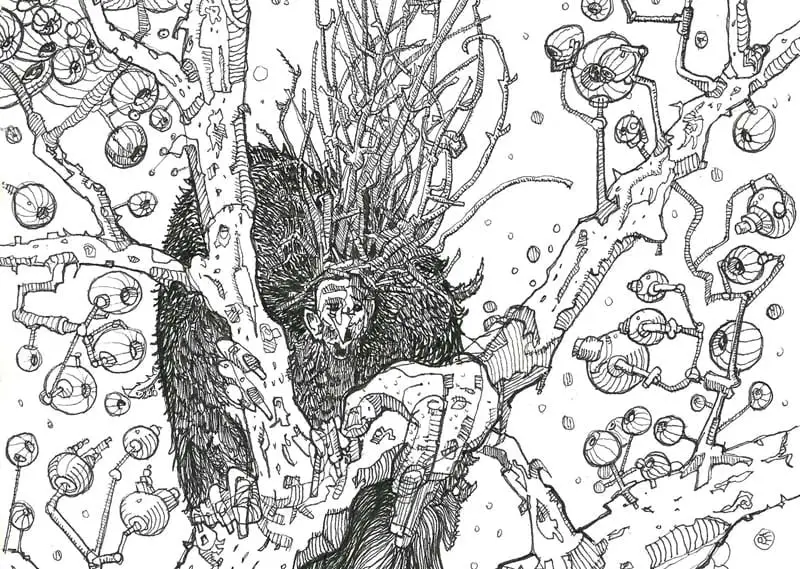
Henry is an unusual child: he feels no fear. Instead, he is captivated by the boys’ elaborate stories about his fate. Stanley Savage tells Henry that the cave connects to a deeper cave and an underground ocean where the boys trade with pirates. He says Henry is being killed so his eyes can be harvested and traded away. Stanley explains the transaction:
“They nail them to the masts of their ships. They like to have a lot of eyes on the mast. It makes the ships see better in the dark.”
Enthralled by the oceanic, Henry spends the week anticipating Saturday, daydreaming about the adventures and unseen wonders he will experience as a pair of eyes traveling the world. It is a wonderful example of Lafferty in a lyrical mode, and the sentimentality avoids cloying because it is rendered with Lafferty’s genius for the grotesque.
Henry's hopes are crushed on Saturday morning when he meets Baxter, a boy whose family had moved into a neighboring house the night before. Baxter has just arrived from Kansas, and Henry, in the middle of talking tough to Baxter, realizes that he is no longer the newest boy in town. Local custom will dictate that Baxter take his place and have the pirate adventure instead. This devastates Henry. Denied his grand destiny, he withdraws:
Henry ran in black horror—(Baxter instead of him)—out to the edge of town—(it would be Baxter's eyes and not his eyes)—past the cave with the other cave under it—(Baxter would get to see the Islands and Whales, Henry wouldn't get to see anything)—sobbing up to the top ofDoolen's Mountain.
Lafferty's children tend not to be criers, though there is a great exception in Rufinus Lifshin in When All the World Was Young, whose crying plays a key role in the novel. Rufinus is the youngest child at Captain Kusman’s School for Gifted Children, and he knows how to get his way through tears, including by becoming the ruler of the world. That ends with Rufinus’s real tears, which are usually performances to get what he wants.
The last tears flow after he makes a deal with the Prince of the World to get everything he wants, betrays the New World’s connection to art, leading to the awful death of his friend, the patron of the arts, Claud Cobbing, and he has to face the consequences of that deal. Cobbing holds on to the singing anchor rope that twists all the arts together:
“Not the rope that I —” “Not the rope that you — no, Rufinus, not the monkeyshine rope, not the ecclesiastical rope that you yourself are involved with. Others will take care of that one and I will have no need to. And fact, there isn’t much choice left. Most of the ropes are already gone and I’d as soon see them all go quickly. The rope, the line that I’ll cut now is hardly an adversary line at all. I’ll not tell you which it is, but you have always regarded it as a bit minor.” “Cut it!” “There will be a very slight backlash when it is cut.” “Cut it!” “The backlash will kill one of your friends who will have held too long to that line.” “How important a friend?” “You have always regarded him as a bit minor.” “Cut it!” “It’s cut,” said the Prince of the World, “and the world and all its kingdoms belong to you now. You may enjoy them for the full term of your office as World Leader.”
And later:
“It didn’t break. It was cut,” Rufinus said. “How do you feel, Claud,” the Surgeon General asked. “I feel as if my head was going to explode, from the false resonance and the backlash of the cut line.” And Claud Cobbing’s head did explode, killing him, and forcing thick and gruty matter from his ears and eyes and nose onto the table in front of them. And also he was bleeding like fountains from his wrists.
Rufinus dies crying in front of the world. Henry, though, goes off to cry alone.
The story is, on a miniature scale, what one gets repeatedly in Lafferty: the ending of a world. Henry had wanted an apocalypse—the scales fallen away, his eyes opened, nailed to the mast. Instead, he goes up to the hilltop to cry. Part of it is certainly that Henry must now live in the small town. Part of it is that he will have to move away from what Lafferty, in When All the World Was Young, calls “preprimitive intellectuality.” A significant Lafferty coinage.
In the novel, readers learn that the early brilliance of the kids taken in by the benevolent Captain Kusman was doomed to be temporary in the Old World. Lafferty outlines human development through Rufinus:
The horrible retrogression known as “teen-ageing” will not happen to us. We will have the good fortune to miss that bleak period. This may be the greatest gain that mankind has ever made. We all start strong now. What used to be a strange period of premature intelligence that was doomed to vanish has now become a sound and early-ripening intelligence that will grow and strengthen without interruption. As to ourselves here, we have come to the new awakening and realization in just four days. We have discovered our direction and aims. And an intellectuality that will be of explosive and exponential increase is ours. Whatever that "teenage syndrome" obstacle was placed in the way of full human development is done now . . .
So "teenage syndrome" creates an obstacle that hinders full human potential. All that stuff about frontal lobe development? A lie. Unlike Henry's fantasy about his eyes being opened to a wider field, it is a form of noetic darkening and amnesia.
Because the plague in When All the World Was Young eradicates everyone over the age of ten (though it is a little more complicated than this because of a major subplot involving the Prisoner of Gridley Graves), most of the surviving children see their new reality as an evolutionary triumph, though a handful want to hold onto anchor ropes or what I have elsewhere called bricospolia. Anchor ropes tie one to the past after a world has ended and are an accessible remainder of Prime.
In the novel, the most important anchor rope is the Special Gift (the holy orders as apostolic succession) Bishop Muldoon left to the later assassinated boy Jimmy Rose. The either pathetic or tragic Rufinus, a steward of the Special Gift (Jimmy having given his Special Gift to Rufinus), fails:
"The idea of an anchor and anchor rope are yours, for I never heard of the idea. But it's a fetish idea, that the rope is within reach and that it must be touched for security. It is a fetish idea that belongs to the New World and not to the Old."
This desire both to escape from and to hold on to anchor ropes is one of Lafferty’s deepest ambiguities as an artist.
Imagine extending the biographical fantasy he has written in "Saturday You Die." Henry does not die. Henry grows up and enters Flatland, as the people of Green Tree do, and as Lafferty believed he himself had. Like the children in When All the World Was Young, Henry wants to skip adolescence through his pirate adventure, becoming eyeballs nailed to the lookout and yardarm. If that were possible, the adult problem of Flatland would never arise. But that is impossible.
One of the more interesting features of Lafferty’s imaginative universe is that something like a pre-flattening of adolescence happens to everyone, and there is also the historical condition of Flatland. The connection between these two varieties of experience, lowercase flatland relative to biology and uppercase Flatland relative to Western culture, is important for understanding what he was doing in the works dealing with children versus the ones dealing with adults.