"Rain Mountain" (1959/1988)

Updated: 1 day ago

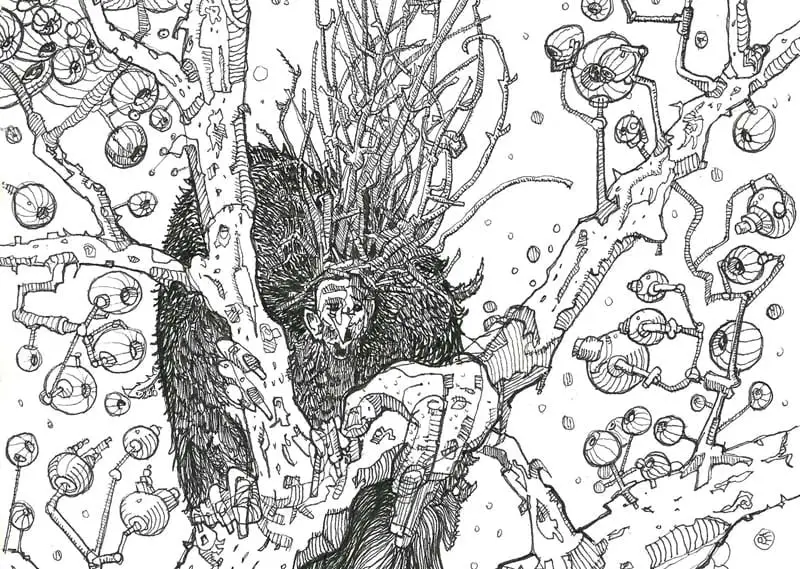
“The footfalls are those of Panther and his panthers. And who is Panther? Panther is Pan-Therion or Pan-Therium, the All-Animal, the prototypical animal. He is the cool-fever-flesh from which all others diverge. He is the composite (‘you should have seen some of the things and pieces of things that went into him’) and the generating force. He is the red-clay which is clay-flesh. He is also the Dream-Master.” — The Three Armageddons of Enniscorthy Sweeny
“The Panther or Pan-Therium denies that he is a creature. ‘My belched dreams become creatures as soon as they acquire flesh,’ he says, ‘but I am a pre-creature.’” — The Three Armageddons of Enniscorthy Sweeny
“Rain Mountain” is one of my favorite Lafferty stories, though it is a simple story with a stock pattern: children undergo an initiation ritual. Lafferty wrote it for the New York School when he was trying to break into writing. For whatever reason, it is highly memorable to me, and, for what it is, exceptionally good, with a great deal of Lafferty flavor that becomes more interesting the more one knows about his work.
I think of it as belonging to a small set, along with the deeply personal “Saturday You Die,” and perhaps “Berryhill” as the evil sibling of the other two. If we discount his portrait of the childhoods of Antonino Vescovo and Dolly, as well as his abandoned Green River Cave, they are his first strong works on childhood, a subject that Lafferty, of course, never stopped exploring. “Rain Mountain” and “Saturday You Die” are especially clear-eyed pieces about amoral childhood.
If his plague novel, When All the World Was Young, is ever published, one will see that in each of Lafferty’s main decades of productivity, he wrote a significant novel about childhood. To the 1960s belongs The Reefs of Earth; to the 1970s, When All the World Was Young; and to the 1980s, Serpent’s Egg. They form his thematic Oceanic trilogy about childhood. They should be read with volume one of Green Tree in mind, the revivification of his own childhood displaced onto a slightly uchronic Tulsa of the 1920s.
While Lafferty’s novels explore childhood on an increasingly apocalyptic scale, “Rain Mountain” achieves an interesting effect through a neat narratological turn at the end. It begins as if it were not focalized through a narrator at all, with talk of Atorrante, a large, pale mountain lion whose black facial markings resemble those of the legendary black panther:
Atorrante was a four-year-old male, of the colour and texture of pale moonlight. One who knew lions would have guessed him at two hundred and twenty pounds, yet he moved as though he were without weight; and a great part of the time he was invisible against the evening background.
After losing his mate to hunters and taking a gunshot wound to his shoulder, the puma lights out on a fast, relentless journey across the landscape. His travels take him to Rain Mountain, the most rugged and isolated peak in the region. Rain Mountain is in the middle of wild terrain and squabbling creeks. But there is a sparse history of human habitation, which includes an abandoned rock hut once occupied by a man with a mining claim and then by an American Indian, now dead, named Charley Coldstream.
Meet the Panther Patrol. On the first Monday in June, six members of its local boys' group hike up Rain Mountain to camp in the "hardly walled" rock cabin near the summit. They gather wood and cook their dinner, and the older boys begin the initiation ritual. They talk about local folklore, which includes the legend of Charley Coldstream. They say he was killed by a Black Panther exactly seven years ago that very night, and that the image of the panther was permanently imprinted on the dead man's eyes. They also say that Coldstream's ghost returns every seven years to light a warning fire in his old rock hut. This specific piece of folklore—the image imprinted on the dead man's eyes—serves as a brilliant narrative seed that will later blur the line between campfire myth and reality.
Much of the pleasure to be derived from the story is how predictably it sets itself up, and part of this predictability is that the spooky stories are the setup for the initiation prank coordinated with the group's older seventh member, Carl Cornhouse. Carl secretly climbs the mountain. He lights a fire at the old hut, which will spook the kids (there is the spirit of old Charley Coldstream). Most importantly, he roars his highly practiced panther scream to terrify the younger boys. The story’s first twist is that Carl's fake screams awaken the real mountain lion, Atorrante, who is resting nearby:
Then it came again. It wasn't as loud or fancy as the panther scream of Carl Cornhouse. It hadn't that sobbing effect and that strangle in it. But it had something else. It was solider. There was hair on this panther and you could smell him.
Agitated by the noise, Atorrante runs to the camp, lets out an authentic, truly terrifying roar, and leaps right over the paralyzed boys before disappearing down the mountain. Just as the boys had whispered about Coldstream's final sight, the narrator confirms that the image of the Black Panther "would be imprinted forever" on the eyes of the seven boys.
And then the story takes its real Lafferty twist. The narrator’s voice becomes personal. It is now talking directly to the reader, and we learn that we are, in fact, seven years downstream from when Atorrante leaped over the heads of the Panther Patrol group. The voice says that the boys will never forget the encounter, and it points out that another seven years have since passed, the storied time for the panther's return:
But this year could be different. For it has been seven years again since Carl Cornhouse gave the panther scream, and was answered by Atorrante on top of Rain Mountain. And the Black Panther commonly returns every seven years.
That repositions the reader through narrative re-focalization. Readers are addressed as if they were Panther Patrol boys now undergoing the initiation ritual, and in this way, childhood is strangely restored through the recovery of a mid-initiatory state. “Saturday You Die,” which is also an initiation story, is moving because it leaves the reader in the post-initiatory state of innocence lost. “Rain Mountain” is much gentler. By placing the reader in the crosshairs of the legend’s seven-year cycle, it leaves one in a state of suspension, frozen in the zone of crisis where the later novels of childhood take place.