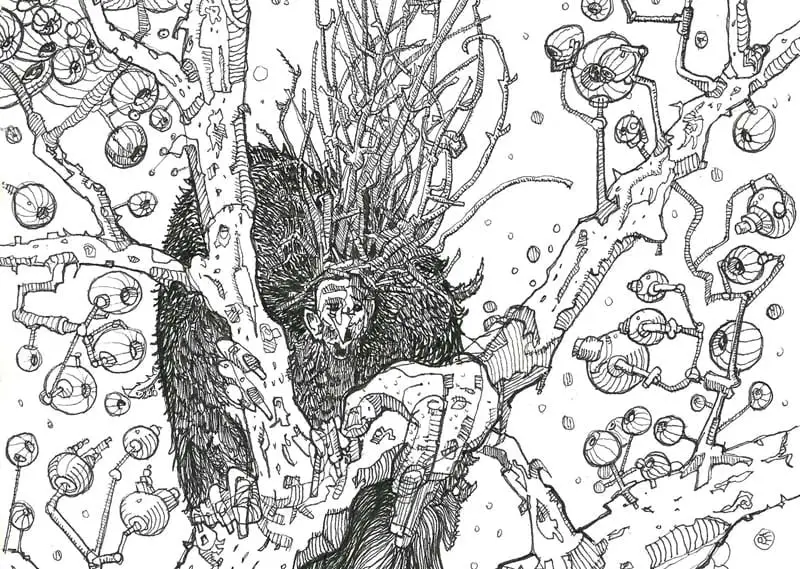
"The Man with the Speckled Eyes" (1964)

Updated: 15 hours ago

“It is inconceivable, that inanimate brute matter should, without the mediation of something else, which is not material, operate upon and affect other matter without mutual contact…That gravity should be innate, inherent, and essential to matter, so that one body may act upon another at a distance, through a vacuum, without the mediation of anything else, by and through which their action and force may be conveyed from one to another, is to me so great an absurdity, that I believe no man who has in philosophical matters a competent faculty of thinking, can ever fall into it. Gravity must be caused by an agent, acting constantly according to certain laws; but whether this agent be material or immaterial, I have left to the consideration of my readers.” — Sir Isaac Newton (Third letter to Bentley, 25 Feb 1693. Quoted in The Works of Richard Bentley, D. D. (1838), Vol. 3, 212–3.)
A straight-ahead Lafferty story.
Sometime in Earth’s future, monopolistic capitalism has consolidated so much capital that a clique of six men controls all new discoveries and inventions. Four of these men, Claridge, Lone, Immermann, and Quinn, have vanished on successive days. The authorities investigate the disappearances, but the surviving witnesses will not say what they saw. In fact, they refuse to provide any useful information. They do not want to be branded insane or charged with murder, despite the absence of bodies, and so they withhold the truth of what happened. Claridge’s assistant, Gueranger, captures this shell-shocked defiance perfectly during his interrogation:
“No, I don't. That's the whole point of the matter: I will not accept, and will not tell, what I saw. Certainly I know that I'm held on suspicion of murder. But where is the body? You find it—anywhere—in any shape and I'll sure sleep better.”
That leaves both the investigators and the media speculating about extraterrestrial kidnappings. Meanwhile, the remaining two capitalists, Umholtz and Easter, suspect that they will be the next targets.
The action starts with Umholtz being visited by an eccentric hayseed inventor named Haycock. Haycock has blue eyes speckled with gold and a mocking mouth. He comes across as sardonic, and he has a pantherine menace. He also has a fiery temper, and it turns out his previous meetings coincided with the other brokers' vanishings.
Haycock is now in Umholtz’s office to present his anti-gravity device and a set of incomplete mathematical equations. He wants funding to perfect his machine over a couple of years. Unimpressed by the whole idea of antigrav technology, a standing joke in the invention industry, Umholtz mocks Haycock, and he makes a mistake. He asks for an impossible four-second demonstration. When Umholtz pushes him with a needling guffaw, Haycock explodes:
“You laugh at me!” Haycock howled out. Gold fire popped from his eyes and he was very angry. The hayseed began to look like the panther. He touched his machine, and it responded with a sympathetic ping! to the anger of its master.
Following this threat, Haycock informs Umholtz that the machine is already working on him, altering his mass signature from positive to negative. Almost immediately after this, Haycock is hauled away by the authorities at Umholtz's behest.
Later that evening, while walking in a park with his assistants, Umholtz (though he does not yet know it) begins to feel the physical effects of reverse gravity. Suddenly, he is terrified that he is falling upward, so he clings to a small elm tree, bear-hugging it. His assistants try to pull him back down to the ground. After all, he is only a few inches above it. But once they pry him loose, something unforgettable happens:
“Throw a rope down to me! Do something!” he sobbed upsidedownly from the tree top. “I'll fall all the way, and I can't even see bottom.” The topmost branch broke, and Umholtz fell off the world.He fell upward into the evening sky, his scream dropping in pitch as he accelerated. He fell end over end, diminishing till he was only a dot in the sky. Then he was gone.
Left behind on the grass, his terrified assistants agree to lie about the event to protect their own sanity. The story ends with the last clique member, Easter, being approached unannounced in his office by Haycock.
A cliché about Lafferty is that there is not much science fiction in Lafferty’s science fiction. “The Man with the Speckled Eyes” is one of the stories in which he seems to answer: so what? He takes one of the hoariest novums in the genre and makes it new. He does so first through the brilliance of the dialogue, and second through the dazzling passages on what happens to Umholtz.
One can even imagine the businessmen punished in the story as stand-ins for science-fiction editors. Robert Silverberg rejected “Ride a Tin Can” because it was not psychologically plausible. Of the whole rejection process, Lafferty wrote, “The reason is that editors are kind of dumb. The reason they are kind of dumb is that everybody is kind of dumb. But it all evens out.”
Like zooming spaceships or FTL travel, antigravity is one of the sticky points in the genre, because gravity is only attractive. Under Newtonian gravity, it is simply a universal attractive force proportional to mass, with no “thing” one can even imagine reversing, since there is no underlying geometry to manipulate. Under general relativity, gravity becomes the curvature of spacetime produced by mass-energy, and since mass-energy is positive, that curvature bends things together. To reverse it, one would need negative mass. That would mean rebuilding the universe at a basic level.
Of course, science fiction sometimes does exactly that. H. G. Wells invented Cavorite in 1901; E. E. Smith gave his heroes an inertialess drive in 1928; James Blish sent cities across the galaxy on spindizzies in 1950.
Real-world history, by contrast, is a graveyard of failed demonstrations. Roger Babson’s Gravity Research Foundation in 1948; Podkletnov’s spinning superconductors in 1992; Ning Li’s disappearance after a DoD grant in 2001; NASA’s Breakthrough Propulsion Physics Program from 1996 to 2002, ending in defunding. In 2023, CERN’s ALPHA-g experiment dropped antihydrogen into a magnetic trap and watched it fall, not rise, ruling out the most dramatic empirical possibility that still seemed open.
Reading “The Man with the Speckled Eyes” in 2026 offers new pleasures as a wish-fulfillment fantasy about the contemporary tech economy. Swap in names like Cook, Nadella, Huang, Pichai, Jassy, Zuckerberg, and Musk. Over the last few decades, we have watched innovation consolidate under a handful of mega-corporations, the Googles, Apples, and Metas whose venture arms and patent portfolios now serve as gatekeepers, deciding which technologies reach the public and which never receive a hearing. In Haycock, the speckle-eyed scourge, Lafferty gives us a ministering angel who is also an archetypal figure like Rainbird, transplanted into the conditions of late capitalism. The story is ghoulishly entertaining, and about as entry-level a Lafferty story as one is likely to find.