"Other Kind of Animal" (1960)

Updated: 2 days ago

Being without clothes, he was embarrassed of the girl sitting there on the box. "I am sorry, Temo. I will get on my pants as soon as I find out whether these things are pants, and if they have the proper holes in them. I am sorry, Temo, that you should see me like this." Then he smiled, for he knew something else like a fundamental thing. The girl was dead and could not see him at all . . .
Be sober-minded, be vigilant; because your adversary the devil, as a roaring lion, walketh about, seeking whom he may devour. 1 Peter 5:8
“Other Kind of Animal” is a short story Lafferty wrote for A. L. Fierst, sent to him, and then abandoned. Finished in September 1960 and still unpublished, it is set in the red-light barrio of a Mexican border town, where an amnesiac American wakes beside a dead girl, pieces together his name and circumstances, and kills the man who murdered her.
It contains several elements that are not at all rare in Lafferty’s pre-nucleation fiction: Spanish flavor, prostitutes, animal imagery, a tavern, and crisp dialogue that borders becomes unnaturalistic. The plot is pure pulp formula—amnesia, pursuit, showdown—and it resolves as the formula demands.
But Lafferty does not leave it there, even in such a formulaic story. He brings in his Catholic theology. There is a barmaid who knows what a person is like after Purgatory (or says she does), a dead girl whose kindness extends beyond the boundary of death, and a man improvising mercy for a prostitute with no authority behind it except love.
Andrew Ferguson’s blog post on “Other Kind of Animal” is worth reading for the background it provides on Fierst, Lafferty’s correspondence-course agent. It is essential information. I also think he is right that the story’s unusually formulaic shape reflects Fierst’s pulp-writing method, and right too that it constrains Lafferty.
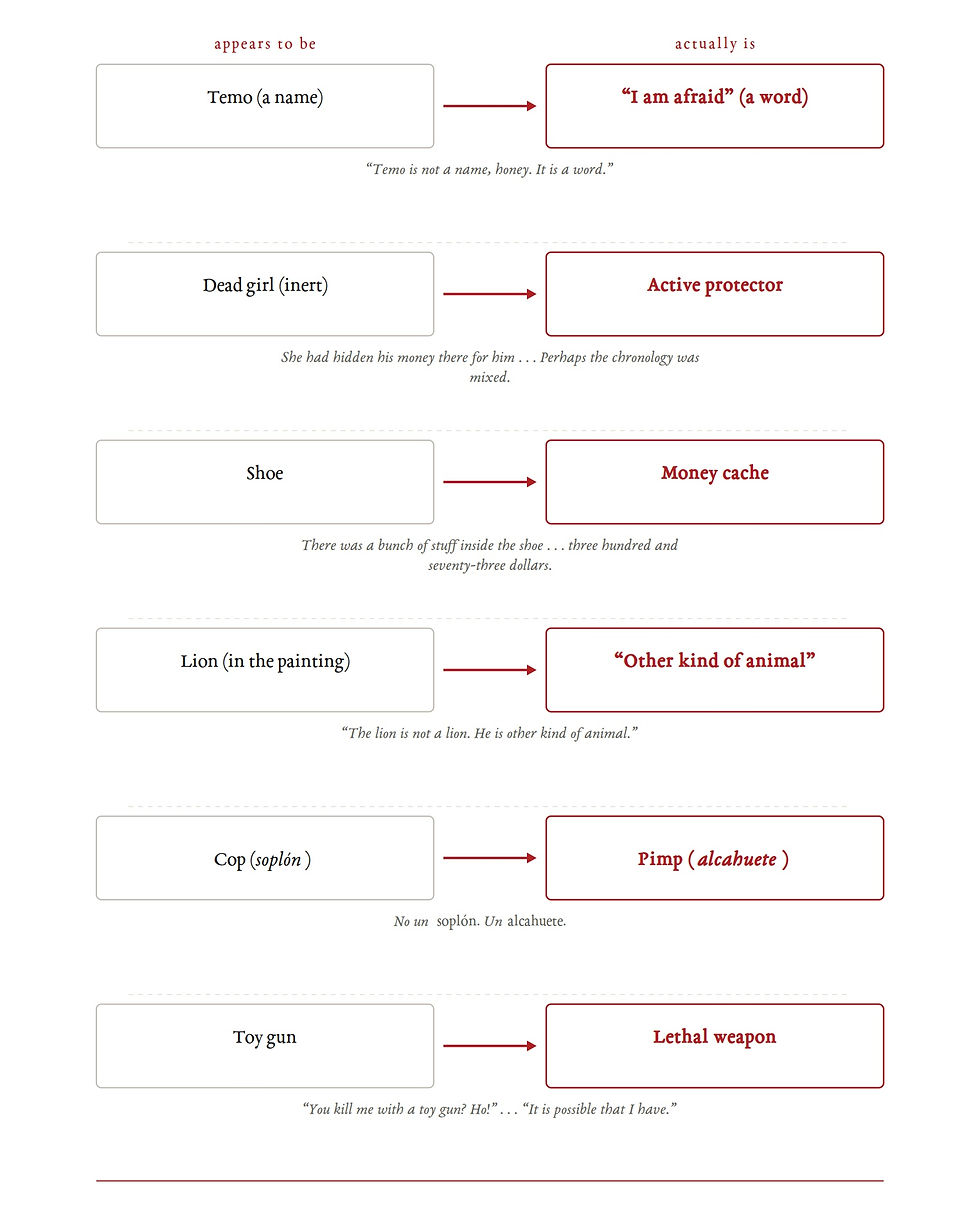
He calls the title conceit—a painting of an "other animal" that is not a lion—“the one bit of extravagance.” I think this misses how reclassification governs the whole story and provides the underlying structure in which the amnesia, pursuit, and showdown unfold. We move from name (“Temo”) that becomes word ("I fear"), from cop to pimp, from toy gun into deadly weapon, from dead girl to one who is somehow a protector, and so on.
What is good about the story is this concatenated pattern of Joe Savage's correction, in which something taken for one thing is revealed to be another. As Joe pieces his reality together in the dunes, he links the painting to his own fatal misreadings:
The lion is not a lion, he is another kind of animal. The big man is not a cop; he is another kind of animal. No un soplón. Un alcahuete. Why had I thought him a cop? Half of the toughs in the barrio carry pistols. He was the one that Little Rosita was afraid of when she said 'Temo.'
Then there is the theology that Lafferty cannot help but bring in. This is not Ferguson’s interest, so it is unfair to point out that he does not address it, yet it is a major part of what makes the story a Lafferty story, with Lizeta's coded eschatology, Rosita's communion past death, and Joe's improvised mercy. Returning to the shack to face the man hunting him, Joe gives a weirdly beautiful, makeshift absolution over the murdered girl, where he restores her name:
"It hasn’t worked out, Little Rosita. You were afraid of dying, and I am a little afraid of it too. Maybe it will be better for you; they will know how kind you were always, and I understand they have a special department for barrio girls. But if I ever did any good, I did it too late to matter. I will wait here for your lion, who, I understand, is an other kind of animal."
And then there is what I take to be one of the big questions the story raises. How can one not wonder what kind of animal is painted above the bar if it is not a lion?
My theory is a jaguar. Joe Savage, the gringo, looks at it and sees a badly drawn lion—but the girl keeps correcting him: "It's some other kind of animal." Jaguar comes from the Tupí-Guaraní yaguar, "he who kills with one leap," and Joe's complaint about the painting is that the animal "looks as though he will end up his leap sitting down, and that will hurt."
This is a defective jaguar. First, we see Joe Savage doing what he does in this story: asserting something and being corrected. He reads the lion image through his Anglo perspective and gets a bunch of things wrong: first, the type of animal; second, the significance of the leap; and third, the usual outcome.
A jaguar in mid-pounce, stocky and compact, would look nothing like the long-bodied leaping silhouette of an African lion. To Joe, who doesn't know what he's looking at, it is a botched job. That makes the painting a piece of iconographic insetting in the larger narrative, and Joe can't decode it, just as he can't decode "Temo" as a word rather than a name, or the big man as a pimp rather than a cop.
The painting is the story’s primary icon that expands into story pattern. The jaguar is the lord of the underworld in Mesoamerican tradition, the creature that moves between the worlds of the living and the dead, day and night. In the story, the jaguar is something like the pimp, an infernal lord who holds the barrio's women captive and kills anyone who tries to take them out. And the painting's mostly incorrect interpretation by Joe comes true: the animal that kills with one leap does land sitting down, and it does hurt. The physical toll of the delayed death mirrors the botched leap of the painting:
For something had happened. The big man no longer had the same strength. He was not beating Joe to death, he was hardly beating him. . . . The big man stood still and rocked on his feet. His face broke open in a dark grimace and he wobbled badly. Then he went down. "I would laugh if it were not so painful,” [Joe murmured]. "I killed him with a toy gun after all."
So Joe gets the animal wrong, but his interaction with the iconographic insetting of the leaping jaguar foreshadows the resolution of the shootout. The big man dies on his feet, wobbling, then going down.
Finally, perhaps something on the guns in the story. Ferguson reads the pimp's oversized pistol as phallic. He calls it "comically oversized, ludicrously phallic," and I suppose one could do that: look at the big gun, which is supposed to be a big dick. So the “cop” with the big gun becomes the pimp with the big dick, peacocking with the gun as compensation or not. Anyone who wants to end here is welcome to do so.
But I think the story's metaphors point elsewhere. Joe Savage's running critique of the barrio treats everything around him as bad art: the lion in the painting is badly drawn, the big man/pimp looks like "a bandit out of the funny papers," the barmaid and her neighbors are "hams." The gun is part of this aesthetic deficiency. The phallic gun is present because this is a story about prostitution and a pimp.
Ferguson usually jumps at the first chance to go metafictional, so I don't quite know why he doesn't do that here. Consider what Lafferty writes about the gun. It is "larger than life, like something carried by a circus clown.” Joe Savage’s objection is that "a caricature can be too broad." I read that as saying the pimp’s gun is like an artistic distortion, a bit like the Fierst exercise Lafferty is doing.
The resolution of the story confirms this: Joe kills the pimp with a small pistol so modest that the dying man mocks it as a toy. The "toy gun" then enters the transformative displacements that we looked at earlier. Phallus point taken, in other words, but look at the phallus a little less closely, and you see the larger pattern of characters circulating inside a set of predetermined genre constraints:
Why had he even come to the barrio? Well, he had come out of curiosity. He had come because he had been told of it. He had come like many of the tourists to make a night of it, but he had stayed for three nights and was well into the third day. And he had met Little Rosita, and they had formed the Not-Like-The-Others Society. It goes a little like this: "What is a nice man like you seeking here? You are not like the others. How lucky it is that you have found me, the only one who could possibly understand you at all."And then it goes like this: "Why does a nice girl like you lead such a life? You were not meant to be a barrio girl. Let me take you away from here. No, it is not a joke. I will take you away. I have the means." The Not-Like-The-Others Society did well for many hours . . .
All this is more sophisticated than it first appears. Even within the hackneyed confines of Fierst’s playbook, Lafferty’s characteristic devices are at work.