09 Aurelia and Christ among the Doctors

Updated: 6 hours ago

A brief supplemental post about how Aurelia puts late modernity under judgment. Judgmental pressure expands Aurelia’s postfiguration sideways into epistemology. All in it should be read in light of what Aurelia says about Final Happiness, full personhood, justice, and the Father of Lights.
To show this, I have created seven diagrams at the end of the post that unpack the pre-Tower-Jump interrogation, which postfigures the questioning in the temple, commonly known as Christ Among the Doctors or the Disputation in the Temple (Luke 2:41-52). The whole thing is absurdist, a sequence of specialists arriving at Rex Golightly's "Potlatch" cabin and questioning Aurelia. One after another, the experts parade their credentials. Each represents a rough precinct of (parodied) modern knowledge (which, following Lafferty, we might call the subject matter of post-consciousness, the entire sequence constituting one large syllabus of post-consciousness); each “doctor” has a professional deformation and advances the themes Lafferty is exploring.
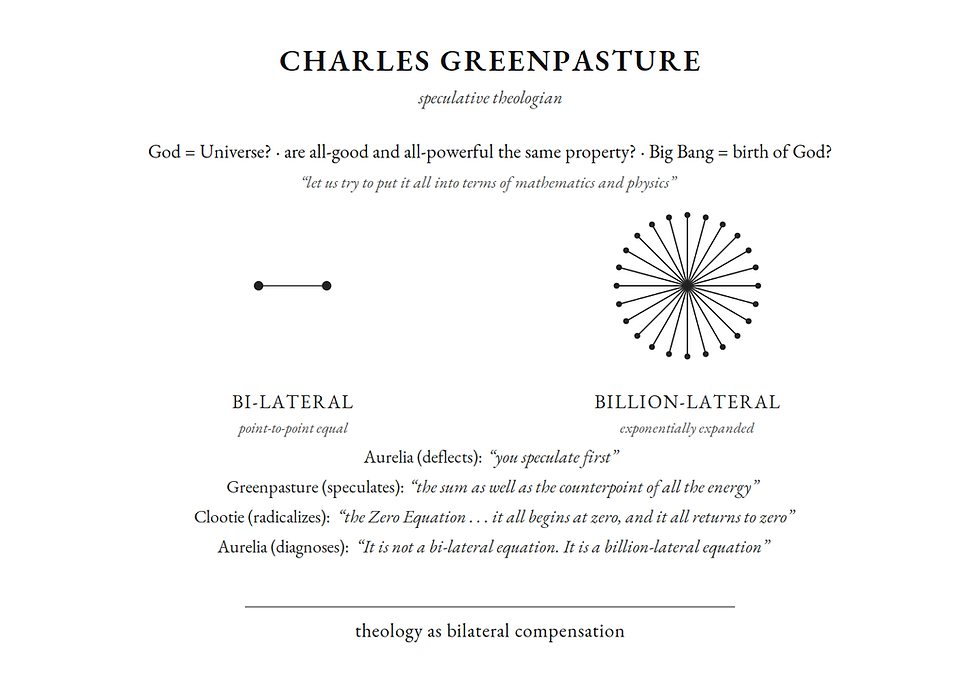
Crabman teaches corporate raiding as if it were the ultimate rationale of commerce. Peter Principle celebrates modern politics as the ritual lynching of the blameless. George Cheros smuggles cosmological dualism under the cover of astronomy. Charles Greenpasture mathematizes theology as bilateral compensation, thereby walling off God. Walter Kunste, H.H.H., humanist extraordinaire, could not be happier about the descent of the humanities through animalities into diabolities and the gusto-disgusto dynamic of contemporary culture. Rory McCory works in mathematics with a rogue prime inserted between five and seven—Aurelia names it the Hell number, the Number of the Beast, continuing Aurelia’s apocalyptic motifs.
Among the seven, James Forcedmarch, the artist, alone sees Aurelia as a person whose arc pushes beyond. Lafferty has an image for this: her pseudo-surface and true surface twenty millimeters apart, her pointillistic constitution, her identity as what the book calls the Beatrician Moment.

Forcedmarch’s Interior Science is the discipline that still sees some of what the other disciplines have lost. I think of him being the way Lafferty saw Jung: very wrong, but not quite as wrongheaded as many other currents of thought. Inside out.
Aurelia's homilies after the Tower Jump don't refute the specialists one by one. Instead, they lay out a unified counter vision that will be present for anyone who rereads the novel and re-weighs the pre-Tower interrogative segments. After all, the homilies happen only after the reader has passed through the predominantly “kerygmatic” first part of the book. Then one learns about Final Happiness as the human end, the will and intellect together, more about the Father of Lights, all Law being One, the arc of the person being completed/perfected beyond the present world. It is what Montejo correctly associates with the Greek noun didache via C. L. Dodd.
Each specialist's deformation distorts the movement toward that perfected whole, which Lafferty calls life under the Law of Happiness. The First Ientaculum rules out wealth, power, and pleasure as the goal of the Life Affair, disqualifying Crabman's commerce and Peter's politics. The Second Prandium's account is the powerful explanation of the person whose arc cannot be completed inside its own world, which is the billion-lateral ontology that Greenpasture's yin-yang bilateral equation misses, as well as the dimensions beyond that McCory's endlessly enchained mathematics, which ties into what I have elsewhere called Lafferty’s interest in something like Hegel’s bad infinity as a metaphysical problem.
The pleasure-versus-happiness distinction and the scholastic intellect-and-will interaction bear on Walter's gusto-disgusto dynamic in the contemporary humanities. The Father of Lights is the un-shadowed source that breaks Cheros's misunderstanding of the Universal Dark-Companion claim and shows what is wrong with either Manicheanism or Yin-Yangism as covering laws that obtain in the cosmos.
Aurelia's saying she was sent and will not abort her mission bear on the exchange with Forcedmarch. I take his overall perception to be correct directionally, but his counsel is wrong: he thinks Aurelia should run away, back to the Shining World beneath the transcendently Shining World. The homilies show that he is wrong.