"The Wagons" (1959)

Updated: 18 hours ago

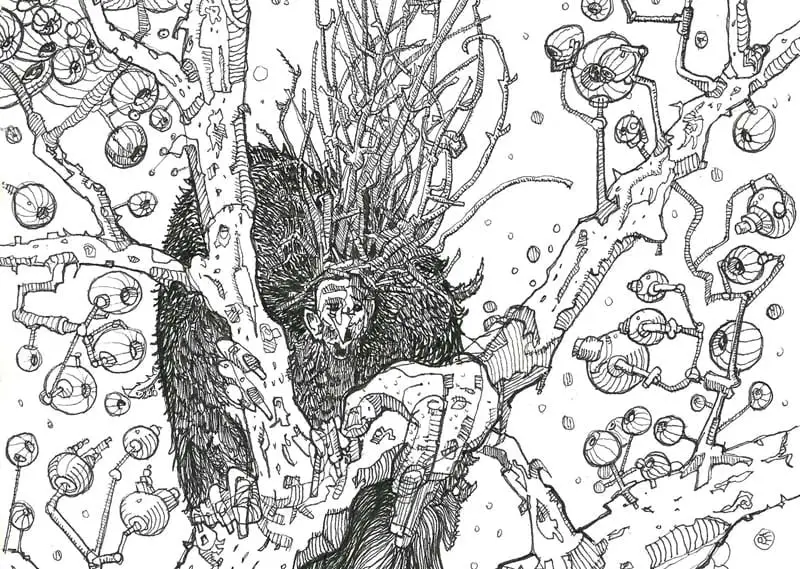
The psychoanalyst C. G. Jung (mostly in the essay Aion) argued that the human person was made up of the Ego, the Self, the Shadow, and those opposing twins the Anima and the Animus. That’s five persons in us, and he hints at quite a few more. But can these different persons in the PERSON be physically separate and visible? They can be, but not as a usual thing. But in certain hysterias and raptures and hilarities and exuberances and plain High Spirits (when the Ghost hangs high) the various persons of an individual maybe seen, and have been seen, with various degrees of clarity. In all really meaningful moments a human may be seen in his multiplicity. This is another item of the Detailed Workings of the World Itself. — “An Essay Explaining the Alternate Endings of the Book Argo, in the Course of Which I’m Obliged to Explain the Detailed Workings of the World Itself”
Jimmy got out his guitar. He couldn't play very well buthe liked to try. He played and sang Cattle Call, Rye Whisky, Wagon Wheels, Camp Town Race Track, Chisholm Trail, Wagon Wheels, Frankie and Johnny, Red Wing, Way Out West in Kansas, Wagon Wheels, Streets of Laredo, Trail ofthe Lonesome Pine, Golden Slippers, Wagon Wheels, Blue Tail Fly, Hot Time in the Old Town, Way Back in the Hills, Wagon Wheels, Blues in the Night, Wabash Cannon Ball, Wreck of the Old Ninety-Seven, Wagon Wheels, Empty Saddles, In a Little Spanish Town, The Old Grey Goose Is Dead, Sweet Genevieve, Wagon Wheels, Ramona, Tree in the Meadow, Mule Train, Wild Goose Song, Wagon Wheels. He sang about an hour and a half. Then he did Wagon Wheels once more, and afterwards rolled up in his blanket and went to sleep.
In any archive, some documents have more aura than others. Lafferty’s “The Wagons” has an aura for several reasons. It was his first published story—an obvious source of its charge. Anyone who has read him for any length of time will also recognize how deeply personal the work is. It lightly touches on some of his deepest concerns and exults in his beloved Southwestern landscape, drawing in mysticism and cowboy kitsch. It is a literary story for people who love literature.
It is also a vulnerable story, vulnerable in the way “Saturday You Die” is vulnerable. This stands in contrast to the older, more guarded Lafferty, a guardedness that develops over time and becomes most visible after his heart attack in the early 1970s. The guardedness is not a change in persona; that remains constant. He continues to invite the reader into imaginative possibility, from start to finish. Rather, the distance he creates in later fiction arises from a sense of being besieged—by the second-rate, by heroic tedium, by the trashed-life principle.
As a reader of Lafferty, I am not surprised by what happens to poor Axel in Serpent’s Egg. I single out Axel because, for me, he has the saddest end of any young character in Lafferty. Lafferty’s authorial relation to Axel and to many of the later children in his work differs from his relation to his earlier children, to characters such as Jimmy in “The Wagons,” or to the protagonist of “Next Saturday You Die.” Axel is another version of Jimmy, another boy who does not fit in, but he is not indemnified. The world Lafferty writes against has changed, more amnestic, as he would say. Jimmy is pre-Flatland.
In the early stories, the personal Lafferty stands a bit closer to his characters. He is more exposed, like Barnaby looking out for Austro.
Finally, Lafferty’s most important works are usually about the story itself, the great, awkward gold of it, and “The Wagons,” his first appearance in print, is a meditation on story, storytelling, and imagination, his central themes. It even contains a set piece that mixes storytelling and economy. For readers who care about such things, this, too, gives “The Wagons” aura.

“The Wagons” now is not “The Wagons” then. It must have taken on a new role in Lafferty’s reception over roughly the last ten-plus years. The older “The Wagons” appeared in New Mexico Quarterly Review in Spring 1959 and was rescued by Dan Knight in The Early Lafferty (1988). For a long time, it was obscure, peak obscure. It remains obscure, but now in a different way, and for an unusual reason.
Lafferty’s work is now distributed largely outside official publication channels. Blame his estate. Blame Locus for its indifference to treating his work with care. Centipede does a good job, but that is like being sold to a nice master. The state of the canon resembles where Lafferty himself ended up, out in Broken Arrow, Oklahoma, silenced.
Many internet readers now discover his short fiction and get hooked, perhaps through a YouTube video by Daniel Petersen, a social media post, or because someone like Bill Hader mentioned him. That reader looks for more short Lafferty, sees what the mercenary secondary market of nerd collectors is asking, and ends up with The Man Who Talled Tales fan compilation. Thanks to the Sands people, the reader meets “The Wagons.”

There is something wonderful about this. Because it happened to be Lafferty’s first publication (a small, mostly forgotten, deceptively simple story), it squats near the front gate of a fan project, where the two Jimmys can begin to work on the new Lafferty reader—a greenhorn who might arrive thinking, I really liked “Snuffles,” so I might as well start at the beginning. What is this wagons stuff? And then the wheels start rolling, rolling, rolling, ur-Lafferty, Lafferty’s most primitive version of the schizo-gash, rolling, the crudest possible formal solution for introducing the split figure that runs through his work. More on that in a moment.
The uninitiated will suspect none of this. The story is just a chronological item No. 1. It is as if a donor pressed a ring into the reader’s palm and said, Enjoy your quite ordinary Lafferty ring. Only much later will the reader know how much is here, germinal and prenucleated, rawly present and already rolling. You and I know things the new reader doesn’t. We know there are multiple people in Lafferty, and they are ghostly. That is Jimmy and Jim. Those two surge outward in different directions and dimensions. They seem like poles. They aren’t poles. They are a dialectic.
History and myth are already so thoroughly entangled in “The Wagons” that anything like a conservative theory of subcreation becomes philosophically untenable. History and fiction loop into each other. In this story, Lafferty takes an euhemeristic approach. It isn’t gnostic yet. Later, it will expand into the monstrously euhemeristic worlds of Coscuin and Argo and the problem of history with a capital “H.”
Here I want to pause. I want to say something a little tricky and patience-trying about Lafferty and character, because we see it so clearly in “The Wagons.” From the jump of item No. 1, character and person in Lafferty are classical and non-classical at once, so let's do it right and go back to the old Stagyrite, whose Poetics distinguishes between human persons like you and me in all our confused contradictoriness and the representation of human persons through human action.
As you know, Aristotle says that tragedy does not imitate people as such; it imitates action. We can say that differently. Fiction’s organizing principle is praxis, not psychology. Character (ēthos) matters insofar as it makes action visible, revealing the kinds of choices agents make as the process before us. From this pattern, we infer the thing we call character.
Unity and coherence are formal requirements of the artwork, not facts about human beings. The artist does not give us a person (we have to meet persons in real life) but a mark—a character—whose traits and actions cohere into an intelligible whole by way of trace. We then treat the character, its mark, as a person. After all, real people are barely unified at all, which is one reason Aristotle is an elitist:
“Neither by nature, then, nor contrary to nature do the virtues arise in us; rather we are adapted by nature to receive them, and are made perfect by habit.”
Characters are “readable” on page and stage because they are, frankly, easier than people. Follow the rules of unity, says Aristotle, and there will be artistic coherence. People are nothing like that. Most of them are inscrutable. Parents, children, ex-wives and husbands, the great men of history, and the data points of history from below are inscrutable. We know them as characters. We can only see them at all because we can see marks. That is type. Character as a shape, the mark.
Think you know a person? Lafferty says you have known one of their eidola, one aspect of human ghostliness. Those people? They might not even know that part of themselves. Talk to Finnegan after a bender. At least, that is how character works in Lafferty. He wants his fictional characters, despite being nothing like realist characters, to be more like people. It’s a gamble. Realism, with its confident promise to tell you all about people, might have been a mistake, an irrelevant one now that we can all see the world is unstructured.
This is an artistic choice meant to capture a metaphysical, a religious intuition Lafferty has: characters as we usually know them are falsely unified in a way real people are not. Since we are stuck with a great un-structuring, let’s be realists about realism. Lafferty gives us characters who get confronted with disunity in ways that realist fiction cannot accommodate. The novel typically handles character disunity by unfolding character over time—through many pages of intense focus—so that the reader can observe breaks, shifts, and contradictions as they emerge. Add that up, and you get what Forster called a rounded character.
Lafferty throws that out the window. For him, it happens all at once, the way we always already live with schizo-gashes. He writes,
. . . almost everybody in his lifetime will see some person in his duality or his multiplicity. And this “almost everybody” will mumble, “I must be seeing things,” and he will try mightily to put the “seeing” out of his mind and out of his memory.
The upshot is that in practice, Lafferty rejects the Aristotelian approach to character without replacing it with anything modern. Lafferty does not give us characters who are simple unities. But he also does not give us characters with richly implied interiorities either, the sort of psychological depth the short story and the novel often prize—and that now often appears, in debased form, in the writer’s workshop novel or in the desperate attempt to put its severed organs on a new market, which we see in the explosion of memoir writing. He will not let us be lonely with the lonely pageantry of the atomistic characters in the novel tradition.

Lafferty’s "people" can thus be said to lack both classical unity and novelistic interiority, but Lafferty's metaphysics of personhood is still more classical than modern. That is how I'd put it, at least. It makes writing about him very, very hard. In that limited sense, Lafferty's creations resemble real people because he wants them observed against a non-reductive metaphysical backdrop, at least on his terms.
He achieves this not by deepening “character” in the modern sense, but by relying on character type. In this crucial respect, his work looks backward rather than forward in the history of artistic representation. Being a schizo-gash is being more than one type at once. The gravity of type wants to make you one type only.
I took a class from a medievalist once who was terribly annoyed that some students wanted to treat the Wife of Bath as a modern character, as if she could sit down with us and have a conversation about Simone de Beauvoir. Then we could catch her up. Lafferty’s figures are closer to the Wife of Bath than to The Time Traveler's Wife. He is, in fact, far more Theophrastian than novelistic, just as he is more Menippean and Juvenalian than psychological. Terms of art, but terms one ought to know.
This difference cuts across politics and helps explain why Lafferty’s satire feels so unlike that of other brilliant science-fiction satirists. One thinks, for instance, of the great Thomas Disch, a real-life Lafferty foil, who was able to move with relative ease into contemporary mainstream prose without defanging his satire, as he did in brilliant satires such as The Sub, The Businessmen, The M.D., and The Priest.
What titles! They might lead one to think Disch was being Theophrastian, that he is dealing with type, but he wasn't. He was too much of a novelist for that. The Theophrastian titles are great, but the books themselves are a million miles from something like Samuel Butler's Characters or Thackeray's Book of Snobs, works that are closer to Lafferty's methods than anything in Disch. Disch was too sophisticated to create types. He loved Proust.
Setting aside the particulars of biological reductionism and libido-drive theory, it may also help explain why Lafferty found himself far more at home with Jung than with Freud. Freud interprets people as if they were characters in a German Bildungsroman, organized around a developmental narrative and a claustrophobically interior causality. The Interpretation of Dreams is, as everyone has long recognized, a masterpiece of "literary" criticism.
Jung, by contrast, treats people as premodern types who only believe themselves to be novelistic individuals, because what they experience as subjectivity is really a constellation of complexes. They are types who happen to read novels that flatter their sense of individuality.
For good reason, Freud has no real theory of types, though he has perverts, melancholics, and neurotics, which are not really types at all. Jung is the architect of the modern theory of types and personality functions—an aspect of his thought arguably far more influential than his notion of the collective unconscious. Lafferty readers see the connection between Jung and Lafferty at the level of the unconscious, not least because Lafferty himself pointed to it and built it into his works, but the Jung-Lafferty kinship runs deeper. It is why there is an overlap on the issue of the unconscious.
They shared a practical belief: the most useful way to think about individual humans passes through human type. I think this is why Lafferty became increasingly drawn to animal characters as his career developed: an animal is typological shorthand. One doesn't have to explain it. No reader has made the mistake of reading Lassie as if she were Madame Bovary.
In “The Wagons,” Lafferty divides the single “person” into two sides of the gash—father and son—and gives myth-making to the child and empiricism to the father. In a Green Tree will later thematize the Wordsworthian notion that the child is the father of the man, and the first part of that work reads a little like Lafferty, as Adult Jimmy revisits Young Jimmy. The splitting device solves a problem, but it does so by cutting the Gordian knot, as it were. Lafferty will continue to play with this device. Soon, he looks less like Alexander, slashing through the problem with simple polarization, and more like a man who designs rope puzzles.
So the plot. Nine-year-old Jimmy and his father, Jim, take a long camping trip into brush country, living out of a Ford pickup and sleeping on the earth. At night, Jimmy says he hears the sound of old wagons traveling along a ridge, wheels, harness, the weight of a train moving in the dark, while his father responds with the practical objection that no tracks ever appear in the morning. The boy and the man argue seriously, treating the problem more like a theorem than a bedtime fancy. Already one sees a great deal of future Lafferty in this back-and-forth, as if we are watching the workshop of his imagination at work.
Jimmy and Jim talk about wagon history: who used wagons first and when, the Spanish and Indigenous peoples, and the technologies that enabled specific journeys. Jimmy’s mind keeps worrying about the problem. Soon, it becomes a cosmology—a storyworld. If the wagons Jimmy hears are always heading west, he reasons, and if they never arrive, then perhaps they are not traveling toward a place at all. Perhaps they are circling the globe endlessly, as if the earth itself were a track. This is a spatial metaphor, but it is metaphysically coded: the opposition between time as arrow and time as circle that appears so frequently in Lafferty, and the suggestion that there is, finally, only eternity.
To fill the days, Jimmy entertains his father with tall tales and scraps of song. He spins an elaborate account of prairie dogs mining gold in order to pay “protection taxes” to owls and rattlesnakes, a secret natural history he claims to have learned from a man in Aguila. He then serenades the camp with a guitar he cannot play, running through a vast repertoire of western folk songs, returning again and again to “Wagon Wheels,” before falling asleep still puzzling over the mechanics of the phantom trains. Because the songs are so important to the feeling the story creates, here they are as a single audio track:
Eventually, Jimmy and Jim reach Cielito. It is barely a town at all—one house, one human. Jimmy looks at the derelict wagons and talks with a resident, Mrs. Munyos. She tells him a legend about los osos, the bears: long ago, she says, bears were the masters of civilization, owners of mills, drivers of wagons, served by horse-like creatures.
Jimmy’s imagination is captured by the story, but he tries to extract what he calls its “anthropomorphic truth.” The “bears,” he decides, were really large, hairy men, men like his father, who hid their horses from the Spanish. He persuades Jim to hike up a narrow canyon to Villaoso to confirm the theory. There they find caves, yes, but the caves hold ordinary bears, not artisanal mill-owners in disguise.
That night, perched on a cliff ledge, Jimmy listens again to the darkness. He says he can distinguish the voices of more than twenty coyotes. He can hear, in the groan and rattle of approach, not just a wagon but a whole train of them, each with its own mechanical defect.
Jim tries to shut him down. There are two coyotes, he says, and one wagon. When the wagon passes, it is indeed solitary. Yet the story ends without granting the father a final victory. Jimmy turns to a flock of bull-bats and assigns each one its own traits, its own identity, while Jim insists there is only one—only one bat, only one wagon, only one world that counts because it can be counted.
That is “The Wagons.” It shows that, had Lafferty not been swept into science fiction, he would have been a marvelous local-color writer. There is real wagon history embedded in Jim’s replies to Jimmy’s questions, my favorite being the description of early wagons whose front wheels do not pivot, with the tongue “pegged” to the undercarriage or axle so that turning becomes a matter of dragging the whole geometry around a corner. The technical detail exemplifies a technique Lafferty never abandons: no matter how imaginatively strange things become, there is always someone present with a frighteningly concrete sense of how the real.
If a future reader does discover most of the short fiction through The Man Who Talled Tales, what happens in its four thousand or so pages is a boy speaking and a man speaking in every possible relation between the two. Sometimes the voices separate and we hear Jimmy, or we hear Jim; sometimes they harmonize. “The Wagons” already intimates that Lafferty’s ghost story will take the form of his own Okie Goldberg Variations, a baroque version of Jimmy’s anthropomorphic truth. In doing so, it introduces the two senses of fugue that Lafferty masters: the musical logic of variation in the schizo-gash theme, and the psychological fugue states of his most schizo-gashed characters.