"Gray Ghost: a Reminisce" (1987)

Updated: 8 hours ago

And he said unto him, If they hear not Moses and the prophets, neither will they be persuaded, though one rose from the dead.
“We won't be taken in by that, Mr. Sheen,” Hector O'Day said. “We're too smart for that.” “So was the little boy who got pulled all the way down to Hell nine years ago,” Anselm Sheen said. “He was a really smart boy. He reminds me of you, Hector.”
Jack of diamonds, Jack of Diamonds, I’ve known you of old / You’ve robbed my poor pockets of silver and gold.
Ghosts are everywhere in Lafferty’s fiction, from the first stories he wrote to the last. They can be gaseous breath-spirits, possessing spirits (diabolical or not, as in the case of his poltergeists), eidolons and splinters, pseudo-organic revenant bodies, speed ghosts and other perceptual artifacts, constructions, animals and omens, psychic-weather ghosts, social-ecology ghosts, rhetorical ghosts applied to living people, schizo-gashes on different planes of fictional reality, and, finally, misclassifications. That nonce list could easily be expanded. It is no surprise that one will learn an awful lot about how to imagine spectrality in the Ghost Story.
One of Lafferty's best stories is one of his earliest, “Ghost in the Corn Crib.” On one level, it is just a very fine ghost story. In a better world, it would be an anthology staple. It is told with Lafferty’s best humor.
On another, it announces that in Lafferty the ghost will always be as much an epistemic problem as a paranormal entertainment. That goes back to Daniel Defoe’s “A True Relation of the Apparition of Mrs. Veal,” which wrote the first playbook for this kind of tale. “Ghost in the Corn Crib” dramatizes the construction of the ghost story, raises questions about epistemic authority, and uses a third-person focalization that is playfully elbow-to-the-ribs.
“Gray Ghost: A Reminiscence” is one of Lafferty’s fully mature stories, told in the first person by his "Men Who Knew Everything" stand-in, the man who did not know everything, Laff, who arguably has a ghostly history, himself being a secondary person (see “Mud Violet” and infer the question Laff wants to ask Mary Mondo).
“Gray Ghost” plays a different kind of epistemic game and is remarkably sophisticated. The story trains the reader not to be taken in by a con, then makes the con nearly irresistible, and ends with an apocalyptic image that points to how the con prefigures the kind of typological pattern-thinking and eschatological presentism that inspire so much of Lafferty. After a summary of the plot, I’ll explain a little about how I think that works.
On Halloween night in 1924, Anselm Sheen, whom readers will learn more about when In a Green Tree is finally published, drives his son Barnaby and three other ten-year-old boys—Hector O'Day (Harry O’Donovan), Grover Whelk (George Drakos), and the narrator, Laff—to Electric Park, a dog-racing track south of Tulsa. Anselm gives the boys a choice. They can watch the races or explore the nearby Holy Ghost Burial Ground, but he warns them of a dangerous spot called the "Devil's Handshake."
As if a magnet has pulled them, the boys discover a group of older children using a tunnel system to prank a younger boy. The younger boy, a potential initiate, is told he has to stick his hand into the sinkhole. An older boy inside the sinkhole (for the last three years, the role has been played by Dirty Dugan) pretends to be the devil and grabs the younger boy, pulling him into the sand. As the main characters approach the sinkhole, they hear older boys laughing and a younger boy screaming.
Hector O'Day intervenes by shouting into the tunnel entrance. Out comes twelve-year-old Dirty Dugan, who had been playing the role of the devil. Dugan joins the group, and they all make their way to the cemetery caretaker, Amos Centenary Black, to witness a supernatural ritual.
Amos, who claims to be a descendant of Napoleon and is clearly a man who tells a great story, leads the boys to a monument to perform his annual ritual of waking Captain John Diehard. We learn that the Captain was a Confederate soldier buried since 1899. Using a pipe that extends from the monument into the grave, Amos lowers a snifter of Royal Hanover Brandy. It rouses the dead Captain.
The story then becomes a conversation between the boys and the ghost. The boys each reach a hand down the pipe to shake the Captain’s skeletal hand. At the same time, the Captain discusses his military history, his prophetic visions of a future skeletal Confederate uprising (“the South shall rise again”), and the bets Amos has placed on his behalf at Electric Park:
“The way I envision things,” said dead man John Diehard, waking up (well, the return from the dead is a very spotty and broken thing), “is that about ten thousand of us great leaders of the Confederacy shall all rise from our graves at the same time. For best effects we should not be fleshed but should rise in our skeleton bones only; and yet we will be lively and completely competent skeletons. Coming so, we will send a wave of fear through all our enemies. On our rising we will raise our great voices like ten thousand powerful doomsday trumpets, and the entire South will rise with us.”
He tells the boys about his ghost dog, named after himself, Gray Ghost, whom he says is buried with him but will soon leave to run in the night's fifth race.
To pass the time, the Captain challenges the boys to a dice game using a pair he whittled from his own ankle bones. The Captain wins against the boys, each losing to the Captain except for Grover Whelk, who wins and is handed a faded Confederate one-dollar bill through the pipe.
After Dirty Dugan leaves because he cannot pay his debt, an astonishing lightning strike turns the entire landscape, including Electric Park, into a photographic negative. This fulfills the Captain’s promise of a supernatural sign made to the skeptical boy of the group, Hector O’Day. After the flash, the dog Gray Ghost appears at the monument wearing a winner's ribbon, somehow dry in the pouring rain, before vanishing back into the grave.
The boys meet up with Anselm Sheen and drive home through a heavy rainstorm, singing songs, and hear the other supernatural promise fulfilled: the distant sound of the "Resurrection Reveille" being played on a bugle from the cemetery.
Perhaps the first thing to note about this story is that it performs an act of historical recovery, bringing back Lafferty’s childhood while also raising the question of whether one can ever return to it. In this way, it belongs to his anti-amnesia work, and it further develops his insistence that one should honor the magic of memory rather than rationalize it away under the auspices of adult vision.
There is a great deal of real historical detail in the story, with Tulsa being the second major city to have a greyhound track (the first was in California), which sparked the Southern fad for greyhound racing. Electric Park itself shuttered in the late 1920s and became another Tulsa playground, Crystal Amusement Park. There is the Overland touring car, an image powerful enough in itself to call up a lost world.

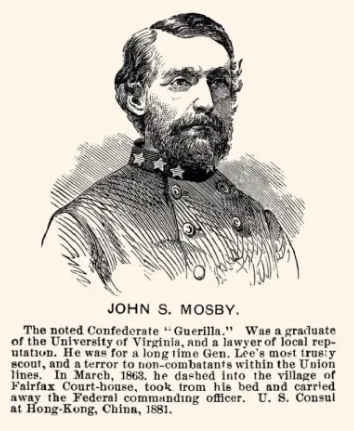
And there is the legend of John Singleton Mosby (1833-1916) behind the whole Confederate Captain encounter: Mosby, the real “Gray Ghost,” so called for his tactical stealth. It is true that the poor in 1920s Tulsa sometimes lived on what were then called shanty boats. Then there is the all-but-lost tradition of Confederate ghost stories that had their last big hurrah in weird western and weird war comics in the 1960s and 1970s.
These all contribute to a just-under-the-surface melancholy and an on-the-surface nostalgia, though I think it is a mistake to call the story a Ray Bradbury story, as one very smart Lafferty reader has claimed. What it does with narrative structure is far closer to the Lafferty we know than to anything in Bradbury.
Unlike a simple memory machine that brings back boyhood, the story is tightly constructed to suspend the reader between staged trickery and supernatural phenomena. Take Anselm Sheen, our authority figure. He starts the story as a gatekeeper who offers the boys a choice between paid dog races and free ghosts, but he tells them what he would do if he were younger. He would be brave.
This forked choice given to the boys is set against a credibility anchor in the form of Electric Park, a realism payload of local Tulsa geography, which Lafferty (or Laff) adds weight to by adding details about Peoria Road, the Arkansas River, the track’s electric rabbit, and a specific 1925 grandstand mishap. Our story takes place on Halloween night, 1924—a time culturally coded for hoaxes and tricks—so Lafferty knows what he is doing by establishing a baseline of trust before moving the boys a mere quarter mile south. All this proximity ensures the boys never really leave the safety of civilization's lights and sounds.
They are in the shadow-zone where the holy (the Holy Ghost Burial Ground) and the diabolical (the Devil’s Handshake) intersect. That spiritual topography is a microcosm of a spiritually vertical world that does not exist in Ray Bradbury, who, in my view, is interested in wonders that break into the world of experience from marginalized but imaginatively horizontal spaces.
Like almost every Lafferty story, this one is here to condition you as a reader. There are, by my count, at least three important structural switches. The first serves to make the reader suspicious of supernatural claims by confirming a mechanical hoax. At the Devil’s Handshake, Lafferty takes the time to walk us through the older boys’ blueprint for scaring the younger boys: you take a natural sinkhole connected to a riverbank cliff, then you tunnel into it and install a hidden participant who deceives the younger boy.
Now, the mechanism by which the Devil grabs a little boy by the hand and pulls him all the way down to Hell is this: Devil's Handshake Dune is only twenty feet from where the riverbank drops suddenly down to the verge of the river. The point of the drop is the face of a cliff about twelve feet high. Into the face of this cliff, boys have been digging tunnels and caves for years. And one of those tunnels, a meander of more than twenty feet through the sandy dark, reaches right to the middle of Devil's Handshake Dune.
The skeptical Hector O’Day ("in the light of day") is the boy who wants to see through deception. It is he who identifies the devil as Dirty Dugan, a fraud who has played the role for years. So what has Lafferty done? He has shown the reader how terrain and social pressure can be used to manipulate children, which primes the reader to apply this learned skepticism to the story’s second half.
Dugan also functions as a kind of control variable, later tied back into the supernatural ambiguity when the Confederate Captain tells him he “owes a trick” because he cannot pay. Does this mean that the Confederate Captain is just another trick?
Now take the second episode at the Holy Ghost Burial Ground. Lafferty introduces a second complication: it appears we get a glimpse of all the hoax-enabling hardware, managed by a myth-making ritual director. Amos Centenary Black, the cemetery caretaker who claims extravagantly mixed heritage and descent from Napoleon, is in control of the setting and the props, including the lantern, a basket full of odd things, and the key. Amos initiates the ritual by pouring brandy, which “wakes” Captain John Diehard.
And here is a very Lafferty touch. Lafferty ties Amos to the Captain with a symmetrical legend, biography, and epitaph: born January 1, 1800; died December 31, 1899; promised to return. What is Amos’s middle name? Centenary. The iron pipe and its locking cap are a plausible conduit for voices, a skeletal hand, bone dice, and the exchange of money, including the faded Confederate one-dollar bill given to Grover Whelk. These are the sorts of “souvenir proof” that are entirely feasible as planted props.
Here, Lafferty introduces his third complication: his fascination with memory. Despite what might be hoaxed hardware, in the theater of memory, we have a phenomenon that goes beyond simple stagecraft. Hector O’Day wants that testable sign to verify the encounter, so we get the lightning.
Following the lightning strike, the dog Gray Ghost appears. Laff tells us that the dog is entirely dry despite the heavy rain and vanishes directly through the solid stone of the monument. All this is unlike the tunnel or the pipe's physical conduit. It sure looks like a genuine supernatural payload, which counterbalances the hoax hypothesis.
Unsurprisingly, there will be no resolution of this ambiguity between the real and the tricked. If we want to undercut impossible events, Lafferty gives us a built-in epistemological escape hatch via the consumption of the graveyard cider. Anselm Sheen retroactively knocks the legs out from under the boys' testimony by diagnosing them as having a snootful. Old Amos got them drunk and took their money.
By introducing alcohol as a rationalizer for their heightened emotions, distorted memories, and visions of "winged spirits," Lafferty gives the reader one half of a rationalized ghost story. But then the story concludes with the boys hearing the "Resurrection Reveille" played on a wasp-filled bugle from four miles away. The angry wasps in the mouthpiece of the trumpet become the angels of the resurrection.

Or they don't, and the boys have been like the greyhounds at Electric Park tricked into chasing an electric rabbit, the following two passages cross-pressuring each other:
There are a lot of people who don't even remember the old Electric Park that was south of Tulsa, between the Peoria Road and the Arkansas River. It was the dog-racing track complete with electric rabbit.
Then there was a lightning flash that you wouldn’t believe. The lights of Electric Park shone black for a momentas though they were a negative of the lightning. The runt apple trees stood out like X-ray pictures of themselves in that lightning. The thunderclap was instantaneous and earth-shaking, and sudden rain could be heard in the near distance. Then everything was wet — well, everything was wet except the dog Gray Ghost. He had appeared suddenly, with a winner's blue ribbon around his neck, and dry as a bone. He yipped a hello. Then he disappeared right down through the stone top of the monument and yipped another hello to dead man Captain John Diehard there below. The four of us boys ran hard for Electric Park through the banging rain.
Thinking about where this leaves the reader, I kept returning to the Danish philosopher Søren Kierkegaard. One of the ideas of his that has never stopped fascinating me can be found in what I take to be his greatest work, Philosophical Fragments and Concluding Unscientific Postscript. He writes that it would be harder to believe in Christ’s resurrection had one met him at Emmaus or known him during his ministry. No amount of historical knowledge can bring you into close enough proximity to the divinely incarnational. Faith was harder for the first-century man who met Christ firsthand. That is also the bloodstream of the Chestertonian paradox.
In a difficult passage, Kierkegaard writes:
Faith is the objective uncertainty with the repulsion of the absurd, held fast in the passion of inwardness, which is the relation of inwardness intensified to its highest . . . Faith must not be satisfied with incomprehensibility, because the very relation to or repulsion from the incomprehensible, the absurd, is the expression for the passion of faith.
That is faith as a dialectical moment. It means something like faith is committing yourself passionately to something you can’t prove objectively, even though it can seem absurd. Faith isn’t a calm acceptance of ‘it’s mysterious’; it is the very intense, lived tension of being confronted by the incomprehensible/absurd and still choosing to hold on.
As a Thomistically minded Roman Catholic with a Jesuit formation, I’d want to qualify this Tertullian-like view of reason and faith, but let’s work with it a bit, first, because it is so relevant to the story and, second, because it is a consistent area where Lafferty isn’t Thomistic but stays true to his Augustinian formation.
This plays out on four levels. First, there is a bare living witness of the miraculous. As Amos Centenary Black says, “Ah, but I will have five highly intelligent witnesses present this night . . . I'll have Hector, Barnaby, Grover, Laff, and you, Dirty Dugan. If people will not believe you five, as Scripture says, neither will they believe one risen from the dead.” Then we have what Lafferty is blowing a raspberry at and using for a serious purpose: Is the South riz? Then there is the resurrection of the body, which is the Apostles' Creed, said in the Catholic Mass:
I believe in one, holy, catholic and apostolic Church. I confess one Baptism for the forgiveness of sins and I look forward to the resurrection of the dead and the life of the world to come. Amen.
Finally, there is mnemonic resurrection, the recollection of the members of memory, for Lafferty has played one of his best etymological games with the story's subtitle. He knows full well that reminiscence came into Latin from a Greek loan: anamnesis. And as Lafferty fans know, “Anamnesis” would be what he thought of as his final story and one of his skeleton keys.
I’ll wrap up with something else that could be explained in more detail, but this is already getting too long. That is the verses at the end. Lafferty’s verses might be doggerel, but it is a mistake for a reader not to think them through. The four concluding song snippets are like a checksum. They all point back to the story’s themes—bodies, gambling, money, and alcohol—and they pull together, at the very end, into a centripetal package all the story’s epistemological ambiguity.
The first verse about dismembered men is about partial evidence:
“We saw a man without a foot, and one without a head, And one without no legs at all, and all of them were dead.”
The second verse modifies the traditional "Jack of Diamonds" folk songs, which are often about gambling (booze and losing money), with imagery of mud and bloody aces, the best known version being about alcohol and a Confederate soldier:
“Jack of Diamonds, Jack of Diamonds, your real name is mud! In your hand are four aces, all covered with blood.”
And so forth.
Finally, in the narrator Laff’s imagination, the four sets of verses become linked to the "winged spirits" that supply the songs' missed beats, a detail subsequently made anagogical by the wasps blown through the Captain’s Resurrection Reveille bugle:
Then we heard it, loud and total, the “Resurrection Reveille” with the hottest licks this side of Hell. We should never have doubted that dead man Captain Diehard would get off that bugle song for us. And we knew that he hadn't bothered to clean that wasp nest out of his bugle. He was blowing right through those angry wasps: they were the dozen enraptured (were they mad, boy!) winged spirits. We heard that bugle from four miles away.
These are Hot Licks, another instance of Lafferty using counterfiguration. These hot licks are not the flames of fire burning a boy who has been dragged to hell, but the feeling of good cider warmth of those who have heard the waspy stingy Seraphim (“the burning ones”) in the background.
For those interested, here is where it started: a page from Lafferty's handwritten first draft. Note the Easter egg that the original Amos carved headstones, which explains the centenary dates and middle name, Centenary: