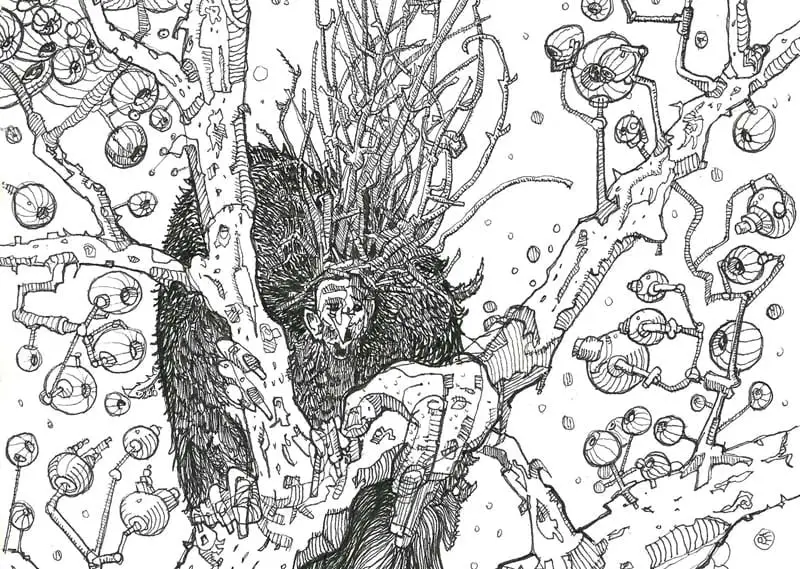
"L'Avare" (1958)

Updated: 1 day ago

Well, I started writing everything. I wrote a Saturday Evening Post story and an American Magazine story and a Collier’s Story, and some sort of a western story, and science fiction and mystery stories. I sent them around. The science fiction story sold and the others didn’t, so after several repetitions then, I just wrote science fiction. It took me about a year before I was selling. — "An Interview with R. A. Lafferty" (1983), D. Schweitzer
“L’Avare” is a 1958 vignette that looks as if it would have been at home in The Saturday Evening Post, with its colorful local character, a miser, and its ironic twist and implicit moral dimension. It’s brief. It’s very slick.
An older man tells his younger companion the story of Alphonse Aler, the miser. Many years ago, Alphonse would spend a nickel each night on a cigar. That is, until he noticed that another man, Lawrence Labatt, purchased a twenty-five-cent cigar every evening, took only a few puffs, and left it smoldering on a stone ledge. Alphonse stopped buying his own cigars and instead began collecting and smoking the expensive ones Labatt left behind in the dark.
From here, Alphonse expanded his methods of acquisition without expenditure. At Saint-Ange's restaurant, he sat at uncleared tables to pocket the previous diners' tips; then he would leave only a ten-cent tip of his own when he finished his meal. For breakfast, he ate leftover food off other customers' plates. Alphonse eventually got his morning coffee for free after the manager threw his payment back at him, saying that Alphonse must need it more.
To avoid paying rent, Alphonse imposed himself on an acquaintance who let him sleep in an extra bed at no cost. He escalated from stealing tips to stealing clothing by taking hats, coats, and shoes left unattended in public places. Finally, he pocketed loose change from his workplace. The rationale was always the same: Alphonse was saving rather than stealing.
At the end of the vignette, the old man points out a factory on the skyline and says to his companion that Alphonse is now the millionaire owner of Aler Industries. The older and younger men keep walking until the old man stops to buy a fifty-cent cigar, at which point the tobacconist greets him as Monsieur Labatt.
Labatt takes a few puffs of his cigar. He places it gently on a stone ledge. A chauffeured car pulls up to the ledge. The driver retrieves the discarded cigar to hand it to the passenger in the back seat. Labatt identifies the passenger as Alphonse, noting that they have not missed this routine in thirty years.
This is Lafferty at his most traditional. "L'Avare" takes its title from Molière's 1668 comedy of the same name, and its protagonist's name from French slang (an alphonse is a social parasite, usually one who takes advantage of women) while Aler comes from Latin alere, "to nourish." There is thus something like “to nourish the parasite” built into the character’s name, which of course Monsieur Labatt does.
One of the signs that this is a Lafferty story is the language's thorough theological grounding. Just a few examples: "In the cool of the evening" refers to Genesis 3:8, with Lafferty ironically reminding readers that the scenes are set in a post-lapsarian world. We are repeatedly told that Alphonse is a saving man, with that word’s soteriological implications being on the surface and becoming more damning with each repetition. Lafferty uses phrases such as "it pained his soul," "blessed with an extra bed," and "not immaculate in his person," which all pervert sacred vocabulary into alibis for avarice. My favorite of these allusions in the story is subtle:
But he did not consider it stealing. Had he so considered it, I am sure he would not have done it.
A damning take on Luke 23:34.
The story’s organizational structure is Lafferty at his simplest. He parallels the opening and closing scenes, which could be set in France or in New Orleans, though the “sinker” allusion makes me favor New Orleans. There are small interruptions from the young man throughout the story. Everything about Alphonse changes except his character. He grows old. He moves from poverty into wealth, from walking to riding, from using his own hand to using the hand of his menial, his chauffeur.
Labatt, by contrast, is the same man, older and still content. He takes the same evening walk, uses the same tobacconist, lays the cigar on the same stone, and shows the same gentleness.
There are two twists at the end. The first is that Labatt has been the narrator. The subtler one is that Alphonse has incorrectly believed he was being sneaky in taking the cigar, just as he was mistaken about being sneaky at the Saint-Ange, and this has only hurt him. Labatt has been leaving the cigar for Alphonse out of pity, just as the manager gave Alphonse free coffee:
"Ah, yes, that is Alphonse. We have not missed for thirty years. He is a very saving man."
That is agape from Labatt’s perspective. Alphonse experiences it only as an “I”—I take the tip, I steal the clothing, I take the cigar. As I said, this is slick Lafferty, but it is competently done, with the center of its message found in the second paragraph:
Alphonse had a terrible struggle with himself, but whether he won or lost is a question of viewpoint.
The question of "whether he won or lost" is Matthew 16:26. Alphonse seems to have gained the whole world, but what started many years ago in the cool of the evening now takes place at full night.