"The Six Fingers of Time" (1959/1960)

Updated: 1 day ago

But all the clocks in the city Began to whirr and chime: ‘O let not Time deceive you, You cannot conquer Time. — W. H. Auden, “As I Walked Out One Evening”
Often, and now more often, Vincent felt that he was touching the fingers of the secret. And always, when he came near it, it had a little bit of the smell of the Pit.
“The Six Fingers of Time” is a prenucleation Lafferty fantasy that already bears on questions at the center of his imaginative project: how to think the difference between eviternity and eternity, and how to render that difference in fictional form. In this early story, the distinction appears as a Faustian bargain made by a disreputable character, Charles Vincent, who gains a measure of wisdom, perhaps too late.
Vincent has been called a hero, but he is not one. His name, which means “I conquer,” can be read as ironic or not, depending on what the reader hopes for him, since the story ends in ambiguity. Vincent accepts a bargain that persuades him he can conquer time. He learns instead that he cannot conquer death. Lafferty leaves open whether Vincent comes into the gift that does conquer death. The story is an early instance of Lafferty’s half-horror, meant to apply philosophical pressure rather than to resolve itself.
Charles Vincent awakens one morning and is surprised. The world has entered a state of near-stasis. Objects move with incredible slowness, water behaves like thick syrup, and people appear as immobile statues (they’re really just moving at an imperceptible pace). Vincent soon understands what is going on: he is moving much faster than everyone else. This makes it possible for him to polish off days of office work in what seems like minutes to the outside world.
But Vincent wants to know what is really going on. He seeks a medical explanation from Dr. Mason, who suggests Vincent is sleepwalking. However, the doctor is privately curious about a report from a taxi driver who encountered an incredibly fast "ghost." The report matches Vincent’s self-reported accelerated actions.
Vincent next meets a mysterious, faceless man in a dark club who identifies himself by various names, such as Zubarin and Schimm. The stranger explains that Vincent has the ability to enter an accelerated state because of his "extradigitalism." Vincent has a misshapen thumb, a vestige, and is part of the extradigital family. The stranger teaches Vincent mental diagrams so that he can enter and exit this state at will, but there is a warning: using the power is a race against self-destruction.
Vincent immediately uses his ability to become filthy rich through petty theft. He masters dozens of languages and thousands of books. He crams years of experience into single nights. As he spends more time in the accelerated state, he notices something is changing. He is physically deteriorating. He is losing his hair and aging.
As Vincent's health fails, he decides to try to understand what is, in fact, going on. He researches the history of six-fingered geniuses and ancient cuneiform tablets, and he becomes convinced that he is being watched by a race of "men from the Pit" who exist in an even higher state of acceleration. He meets these faceless men again, and when they offer to let him join their team, he refuses their offer. He will use his remaining time to find a "final truth" that will allow humanity to use the power without being controlled by the men from the Pit.
At last, he discovers the key to defeating these entities, but it is too late. He dies quietly in a chair before he can publish his findings. Dr. Mason says that Vincent, though only thirty years old, died of extreme senility with the body of a ninety-year-old. The reader is left hanging.
Let’s begin with Charles Vincent himself. He appears at first as a man well suited for the Pit. He is cruel and arrogant. He uses his speed to bully and humiliate those around him. He steals wallets and mocks his victims, stuffing the stolen items into their mouths. Robbery is not enough for him; he wants to strip others of dignity as well.
He strikes athletes during matches for his own amusement. He slips live animals into the food of unsuspecting diners. His idea of “affection” leaves his coworker Jenny bruised and with loosened teeth. Other people are comic objects. He assaults museum guards who are simply doing their jobs. He abandons social obligation altogether and treats women badly. For most of the story, he feels no shame for the harm he causes.
There was pleasure in being able to shatter windows by chanting little songs . . . There was fun in petty thieving and tricks. He could take a wallet from a man's pocket and be two blocks away when the victim turned at the feel. He could come back and stuff it into the man's mouth as he bleated to a policeman... He would take food off forks on the way to mouths, put baby turtles and live fish into bowls of soup between spoonfuls of the eater . . . He unzippered persons of both sexes when they were at their most pompous . . . “I was always a boy at heart,” said Charles Vincent.
I say all of this because Lafferty is such a fine comic writer that I think people tend to overlook what a lousy excuse for a human being Vincent is, and overlooking this means that if there is a redemption arc, it tends to be obscured. The question then becomes: if there is such an arc, what does it turn on?
I’ll show my cards. Lafferty is playing an interesting game in this story. What Charles Vincent discovers is not an arcane formula for defeating the men of the Pit. This is not a tale in which he finds an obscure volume at the British Museum and learns how to abjure the servitors of Y’golonac.
Vincent turns to the Bible as desperation rises, and there he learns that the real thing to conquer is not time but death. There, too, he learns who the men of the Pit are and what the sixth finger means, because the place where he can learn about the sixth digit is Scripture and the texts that gather around it, including the Book of Enoch, which Lafferty mined relentlessly for ideas.
Or he doesn't. Lafferty leaves it open for you, dear reader, to decide. But if you want a typical Lafferty pattern, notice the link between his many Gregories and the Grigori of Enochic tradition.
In the Old Testament, the sixth digit appears most clearly in 2 Samuel 21:20. The passage describes a “man of great stature” from Gath who had six fingers on each hand and six toes on each foot, twenty-four digits in all. He is said to descend from Rapha and thus belongs to the lineage of giants known as the Rephaim.
In biblical numerology, six usually marks imperfection or the merely human. It falls just short of the completeness and perfection associated with seven. Lafferty, however, treats the extra digit as a sign of the supernatural, a mark that places a person partly in another world. The subtext is a hidden or lost history, populated by monstrous lineages cut off from divine blessing. The source of that tradition is clear. It comes from the Book of Enoch. Lafferty gives a glimpse of this “other” chronology through the tablets Vincent studies:
On the divergence of the basis itself and the confusion caused by — for it is Five, or it is Six, or Ten or Twelve, or Sixty or One Hundred . . . The reason, not clearly understood by the People, is that Six and the Dozen are First, and Sixty is a compromise in condescending to the people. For the Five, the Ten are late, and are no older than the People themselves. It is said, and credited, that the People began to count by Fives and Tens from the number of fingers on their hands. But before the People the—, for the reason that they had—, counted by Sixes and Twelves.
There, the sixth digit is linked to the Nephilim, the giant offspring of human women and the Watchers, the fallen angels. The Book of Enoch is concerned throughout with forbidden knowledge. It names Azazel—the principal figure, not the later minor demon—and describes how weaponry, magic, and other dangerous arts entered the human world. Chapters 72–82 deal with primeval knowledge of time itself. This knowledge is taught to humanity by the fallen beings, and later traditions and folklore associate that lore explicitly with polydactyly in the Nephilim. For these reasons, Lafferty forges connections in the story to ancient, pre-Flood races and to the giants who reappear after the Flood.
If that sketches part of the story’s genealogy, what finally matters most is Lafferty’s preoccupation with both time and salvation. I have argued that time stands at the center of the ghost story: historical time, lived time, and eschatological time, and the way each relates to what is eternal. The best sources for Lafferty’s views on time, expressed directly rather than through fiction, are his letters, though he returns to the subject in interviews as well. Again and again, he comes back to orthodox Catholic accounts of time, even as he is willing to work out their more ingenious modal implications.
Lafferty understands eternity as a state of absolute simultaneity, distinct from the linear and successive character of human time. Time has duration and sequence; eternity has neither. It exists as a constant “moment.” The Kingdom of Heaven is always “at hand,” but it remains separated from our world by a barrier thinner than the smallest instant of time. That barrier cannot be crossed by extending or multiplying temporal succession, even in experiences of extreme temporal dilation. Lafferty, therefore, stresses the limits of language in speaking about eternity. Even “simultaneity,” he says, fails to name a reality that lies beyond time itself.
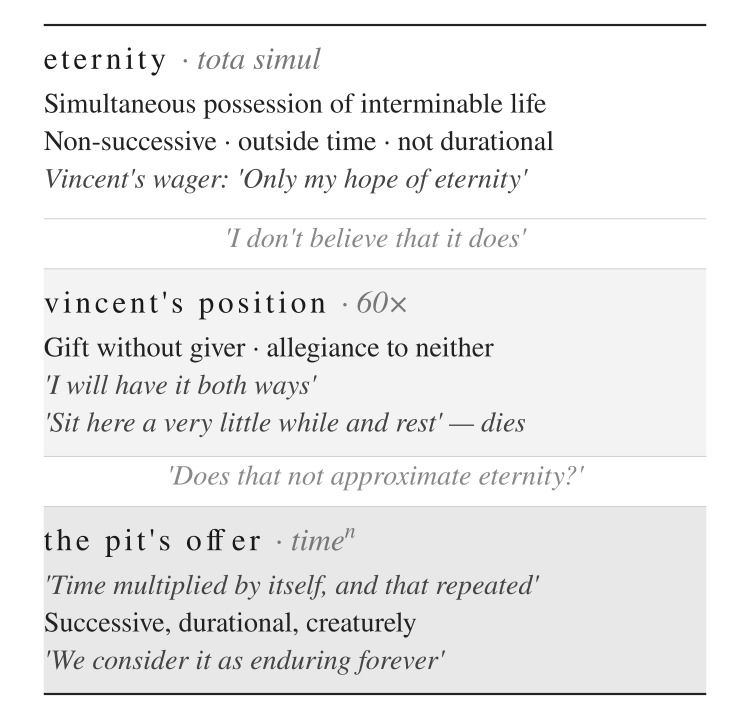
Theology and death are the primary intersections between these two states in Lafferty's philosophy. Recently, I have written about how he identifies the Second Coming as a point of contact between time and eternity. He thought that every individual encounters this event at the moment of their own death. That means that Charles Vincent experiences this, right off-page. When talking about time, Lafferty always has St. Augustine's concept of eviternity in mind, and as he grows as a writer, his games with eviternity in stories such as “Bank and Shoal of Time” and the Argo legend become ever more ingenious.
The big conflict lies in the Pit's attempt to substitute time dilation for the eternal, a distinction Vincent eventually recognizes in his final confrontation with the faceless men:
“But you are not sure either of surviving or receiving, nor could you accept the surety as sure. Now we have a very close approximation of eternity. When Time is multiplied by itself, and that repeated again and again, does that not approximate eternity?” “I don't believe that it does. But I will not be of you. One of you has said that I am too fastidious. So now will you say that you'll destroy me?”
What stays consistent in his view of time is that the question of "when" spiritual events occur is essentially meaningless because eternity exists completely beyond sequence, lacking any "before" or "after." Death is a door through which all people arrive at the same universal point. It is the door through which the men of the Pit desperately want to avoid stepping because past it are the other three of the four final things in Catholic theology: judgment, heaven, and hell.