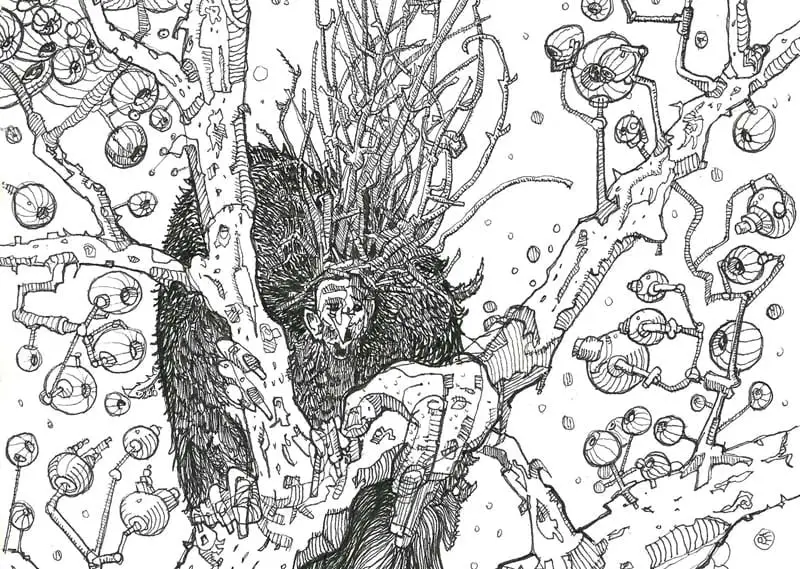
"Promontory Goats" (1975/1988)

Updated: 18 hours ago

V. Requiem aeternam dona eis, Domine. R. Et lux perpetua luceat eis. Fidelium animae, per misericordiam Dei, requiescant in pace. Amen.
"Promontory Goats" is a Lafferty piece that I don’t know what to do with. It is one of Lafferty's most ambitious and theologically serious works, and it is funny, weird, dark, hopeful, slippery, offensive, and Origenist in ways that puzzle me. It is also one of the Lafferty stories that is just impossible to summarize. If one looks at Lafferty’s notes, one sees the great care he took in creating its baroquely braided pattern. Just as Three Armageddons is not a novel even by Lafferty's standards, “Promontory Goats” breaks the short story through intense pattern work. Radically centripetal and exploding in design, it demands that the reader have a command of ancillary knowledge about Argo.
In addition, there are hermeneutic landmines, one of these being the ethnically Jewish Casey’s light verse about gassing chambers and soap: “A gallows always smells of rope / I don’t know why it shouldn’t. / A gassing chamber smells of soap / Though I’d have bet it wouldn’t.”
At its center is a powerful, simple image: the overdetermined goat of the biblical tradition. The first section introduces “Promontory Goats” as a fictional assessment-collection, a (mock) anthology that assembles the surviving works and testimonies of Kasmir "Casey" Szymansky, and is dated to All Souls’ Day. At this point, I read it as a meditation on the role of Purgatory and redemption in Lafferty.
At the very end, it loops. We return to the first author of the establishing fragment, but only after getting our fullest image of the goat and its significance in the text, for directly before this, we are told that when we pray for the dead, we burden them with our troubles, being the kind of self-involved humans we are, and this shows up as goats in Purgatory. Casey, who is kind to animals in all his incarnations, is tending to those goats in Purgatory:
"He has great concern for the goat caravans that arrive here every day. There has long been the cultus of praying for us Poor Souls in Purgatory; but the effect has not been so much the taking up of the burdens of the Souls here as the sending to us of further burdens to bear. People phrase their prayers for us very strangely. They pray mostly for themselves, that they be rid of their burdens. And they mention our names. And those burdens arrive here every day on caravans of laden scapegoats. Casey works with the beat-up and burden-weary goats pretty well. He is a good animal man, and he patches them up as well as can be done."
This sets up a contrast with Casey’s own grandiose fantasy of making himself a scapegoat for the Devil so that the Devil would be redeemed.
I suppose I should add that, in Roman Catholicism, All Souls’ Day is observed on November 2 to remember and pray for the faithful departed. It is connected with prayers for souls believed to be in purgatory, and it comes right after All Saints’ Day on November 1. Whatever “Promontory Goats” is, it is a meditation on failure and mercy with a great deal of black comedy thrown in.
A little background, if you haven’t really dipped into the Argo Legend: Casey is a precocious Chicago polymath who has a grand obsession with the Final Redemption of the Devil. That’s the whole bit about Casey wanting to trade souls with Satan, take his place in Hell, and liberate the most damned being in creation. In “Promontory Goats,” fifteen commentators (many old friends from Argo and beyond) assess him from outside, while we get Casey’s own poems, ballads, and prose meditations, which speak from inside.
The work takes place on at least four levels simultaneously, and the trick is that none of them cancels out the others.
First, Lafferty gives us a character study through reflection. We never get Casey directly making a case for himself, though we get his fragments. We do get a lot of Casey filtered through a dozen lenses, each distorting in its way. The aggregate portrait is irreconcilable by design. The form of the assessment-collection is the argument that a person cannot be known, only approximated by the shape of the empty container they leave behind. Glauch's opening metaphor about essence conforming to the shape of an empty crock is the story's operating principle:
"The form of this attempt to find and assemble the essence of some fifty years of Casey's works and days... will be shaped by the container that was Casey himself. The surviving essence, which should obey the laws of all gasses, ought to conform to the shape of the empty container that Casey left by his going . . . There are still invisible configurations and promontories in that emptied crock, and the essence will shape itself to them even when we are not aware of them."
Second, it's a theological thought-experiment pushed past the point of safety. Casey insists on acting as an advocate for the Devil, an act which may be the sin of presumption disguised as charity. One of the most effective segments comes from Margaret Stone, who exposes that Casey, who volunteers for an eternity in Hell, was afraid of one hour in Purgatory as a child:
“This cultus and practice consists of a child taking the place, for one hour usually, of the most forgotten soul in Purgatory. It is very painful, but it is not desolating . . . I questioned Casey about this once, when I had heard that he was talking nonsense about trafficking with the Devil. He remembered the cultus from his childhood, but he had never entered into it. He had been afraid. He was afraid of one hour in Purgatory, but he big-mouths about an eternity in Hell. I think that Casey's mind has blown.”
Third, it's an eschatological comedy. Lafferty creates a nonce theology of false preludes, suggesting that before every true cosmic event, there must be dozens of false ones. This creates a pattern in which Casey might be the real Antichrist, or one of many buzzing false antichrists, or a saint:
"Before the true redemption there had to be a dozen false redemptions; and after the true, there had to be many more of the false, and they are still going on . . . Before the return of Christ, there must be a dozen returns of false Christs, and one of them will be larger and more conspicuous than the others. Before the end of the world, there must be very many false endings; and I suspect that some of them will be very well done and pretty convincing."
Fourth, it's a story about artistic self-destruction as kenosis. Casey creates vast amounts of work, and then he burns it:
"In drawing and painting, in music, in verse and in prose, he cranked out a very lot of it. He destroyed most of it. The chimney of his house was called the Black Chimney of Hubbard Street because he burned so much of his stuff in the fireplace of his old house there . . . It is for this reason that even the scanty amount printed here is at least half reconstructed from the memories of those who heard it from him."
I’ll wrap up with a note on the title. "Promontory goats" comes from George Meredith, but in Lafferty's story, we are meant to hear Leviticus 16 and the goat driven into the wilderness bearing the people's sins. Besides this, we are intended to have the image of goats on high rocky promontories, exposed and precarious. Casey is the scapegoat who insists on climbing to the highest, most visible point before being driven out.
Lafferty will not tell us what he thinks; he forces us to infer it. The ironies suggest he sees Casey's impulse as theologically genuine. The compassion is real, and the question of extreme reconciliation seems seriously entertained. I read Lafferty depicting Casey himself as catastrophically unequal to the weight of what is going on. “Promontory Goats” is a demanding work, but an interesting one that I continue to wrestle with. Lafferty made a note that it wouldn’t be understood.