"Inventions Bright and New" (1983/1986)

Updated: 11 hours ago

And the four beasts had each of them six wings about him; and they were full of eyes within: and they rest not day and night, saying, Holy, holy, holy, Lord God Almighty, which was, and is, and is to come. — Revelation 4:8
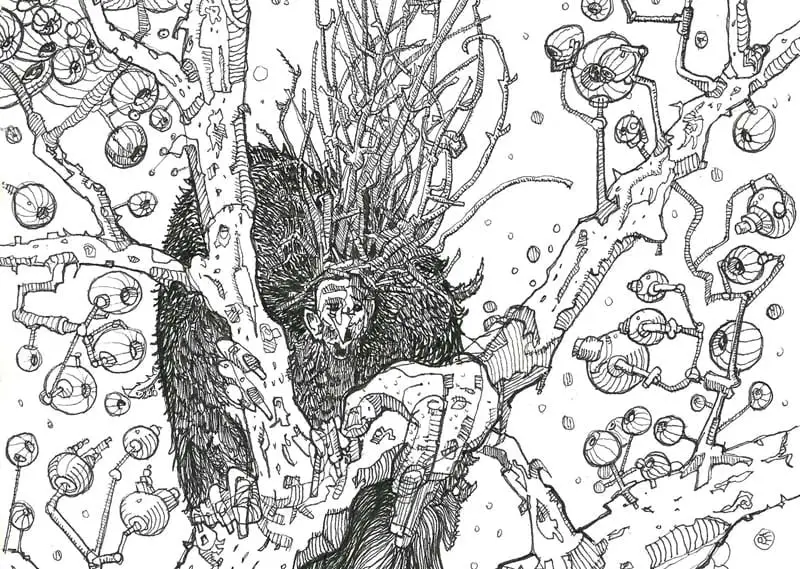
“And I’m on the verge of doing away with all eyes except one pair to a person,” said Mary Fat-Land. “All of them except one pair are an illusion anyhow. Let me touch my mind to that Illusion of an Exuberance of Eyes as I might touch my cigar to a child’s balloon, and it will burst and be no more. I’ll do it. I’ve done it! And it’s all legitimately within the ReEntrant Principle.” Why yes, Mary Fat-Land smoked cigars. Doesn’t everybody? And children often do have balloons. So the metaphor was a sound one. And the Illusion of the Exuberance of Eyes was exploded forever. At least every person in that Light-Rail-Rapid-Transit Car was reduced to two eyes only. Some of the persons were displeased by the change. And the Light-Rail-Transit Train-of-Cars came to a stop. Two gentlemen from the Rectitude Militia entered the car. Those fellows work fast.
Advanced Lafferty.
How astonishing that “Inventions Bright and New” was published in Isaac Asimov’s Science Fiction in 1986, even though we know that Gardner Dozois respected Lafferty as a writer. Here is a difficult late-Lafferty story. It is interpretatively difficult, and it is modally difficult. It could put a smile on the face of Jonathan Edwards.
At the same time, it puts an exponent on Lafferty’s familiar idea of reentrance. In earlier short stories and novels, Lafferty typically treats reentrance as a feature of space. Readers encounter versions of it in “Been a Long, Long Time” and Arrive at Easterwine. In “Inventions Bright and New,” Lafferty goes galaxy-brain on the idea. He pushes it as far as possible to make a vanity-of-vanities point about the place of originality across dimensions of human life.
All Lafferty stories are stories about ideas. “Inventions Bright and New,” though, is almost entirely about ideas. This post focuses on its angelology. The games reentrance plays with novelty and originality are easier to explain—and more likely to be understood—than the angelological dimension, so I am sidelining them to focus on the other half of what the story is doing. The angel aspect so qualifies the reentrant half that the story can hardly be understood apart from it. It deserves attention. The ending is unintelligible without it.
At the beginning of "Inventions Bright and New," readers learn that the world is just beginning and will always be beginning. Eight many-eyed passengers on a Tulsa light-rail line are about to play a game called n.n. or "Nifty Notions." The point of the game is to really originate an idea despite a cosmology in which nothing is truly new. At first, all this looks very playful. There is ReEntrant Time, ReEntrant Space, parallel universes, laser buffalo guns, and the invention of playing cards. Yet underneath all this, serious questions are being raised. I'll sketch the plot and then point to the way through the story by connecting it to noetic darkening and Lafferty's tropology of eyes.
Lafferty gives us locations, but it is probably better to think of all that happens in "Inventions Bright and New" as happening in conceptual space. On a light-rail transit line between Broken Arrow and Tulsa, we meet the eight passengers in the story and learn about the ReEntrant Principle. The universe is cyclical, parallel, and constantly beginning anew, making true originality difficult or impossible to achieve. Lafferty's characters discuss these paradoxes.
At one point, the character Mary Fat-Land removes the "Exuberance of Eyes." We are told this is a common physical illusion. It leaves the passengers with only two functional eyes. This act brings in a set of characters known as the Rectitude Militia. They summarily execute a passenger for expressing a preference for the change.
As the conceptual jaunt goes on, the passengers discuss their inventions. Catherine Tall-Tower repurposes clan cards into a deck of playing cards with a calendar-based structure. Hiram Working-Day machines a laser-beam attachment for a buffalo gun that brands the meat at the moment of the kill. Andrew Kingdom-Come claims to have invented Daylight Saving Time. John Rain-Tomorrow says he has altered the appearance of the threatening Casey's Comet (Argo) by adding a "monkey's tail" to it. He thinks derision will veer the celestial body off its course.
“According to the Relentless Circularity, there is no real difference between having already died and not having been born yet. There is no mathematical way to battle the circularity. But there is another way to battle it, and its name is derision. When a perfect circle is drawn huge out in the vasty void, people are impressed and they say, ‘It is the image of God himself.’ But if somebody draws a monkey’s tail on that perfect circle, people will say, ‘Oh, it is only a monkey!’”
Anna Thursday-Dawn then has a bright, inventive idea. She invents a new method of execution: the hangman’s noose. A noose, she thinks, affords a more dignified death than stoning or axing. Why? Because constricting the throat prevents the soul from escaping the body.
Next, the eight passengers reach the Tulsa station. The Rectitude Militia reappears. They say the noose is an illegal invention. Anna is put to death by her own design on a nearby lamppost, and she meets death with happiness. After all, she has invented something unique, one her parallel selves have not yet discovered.

An obvious place to begin with this dizzying story is Anna Thursday-Dawn. After the details of the story are forgotten, Anna is likely to be remembered, and understanding her may be the story’s biggest challenge. I am far from certain I have her understood, but I will say what the story seems to be doing with her. An exchange on EoL turned on whether the ending is happy or unhappy. That does not seem like the right question to me. It is where Lafferty's moral vision goes out of phase for most modern readers.
I read Anna Thursday-Dawn as a portrait of a fallen mind that receives its just deserts, so it is, in a sense, a happy ending, one most non-religious readers are likely to recoil from. Readers of East of Laughter have called the ending unhappy. But characters are not persons, and Lafferty’s characters are doubly and triply not persons; they are closer to pre-modern types than characters, and this is a Lafferty thought experiment, as difficult as Lafferty invariably is.
After Mary Fat-Land destroys the “Exuberance of Eyes,” Anna treats the soul as a Platonic ghost rather than a spiritual mystery. She invents the noose, which the Militia calls illegal and “too original to repeat.” The noose is a technological application of John Rain-Tomorrow’s logic of the monkey’s tail. The monkey principle thinks that derision can put one over on the universe, a recurrent Lafferty theme. So we get a rope that is supposed to “save” the non-Thomistic disincarnate soul by sealing it inside the body.
In short, I read this storyworld as one of Lafferty’s nastier Christian kosmoi, and its ending is happy. What Mary Fat-Land rejects is a sacred surplus that ties humanity to the angelic. She blinds everyone to an ontological ladder.
For that reason alone, anyone who wants to make sense of this story will need to deal with the Exuberance of Eyes. Humans in “Inventions Bright and New” start with multiple rows of eyes around their heads. Only one pair is functional. The other eyes are described as beautiful and illusory. Lafferty tells the reader that animals have two eyes, angels have many functional eyes, and humans occupy a middle position: angelic in appearance, animal in capacity.
Now, pay attention to the sequence and what happens to the eyes:
And she blinked three rows of her dazzling eyes.
His rows of eyes twinkled with humor even when, as now, he was speaking seriously.
When Mary was entranced by an idea she closed all her many eyes except one pair.
“And I’m on the verge of doing away with all eyes except one pair to a person . . . All of them except one pair are an illusion anyhow. Let me touch my mind to that Illusion of an Exuberance of Eyes . . .”
And the Illusion of the Exuberance of Eyes was exploded forever. At least every person in that Light-Rail-Rapid-Transit Car was reduced to two eyes only.
“Why would anybody want to destroy so beautiful an illusion as the Exuberance of Eyes? Animals have two eyes only. Angels have an Exuberance of Many Eyes, and all of them are functional. Until now, Humans have also had (even though it was illusory) the Exuberance of Eyes, though only one pair of them was functional.”
“I never did like that dazzle about my head. I like it better this new way, with only two eyes. I get a better focus now.”
“We would all be better poker players if we still had our Exuberance of Eyes . . . It is hard to fake it at poker with only one pair of eyes.”
“But with my Hangman’s Noose, the throat is constricted and the soul cannot fly out from any of the apertures of the head.”
Yes, by the end, eyes have been reduced to one part of a complete set of "apertures of the head." Noetic darkening. It is also worth rereading what Mary does with her eyes when entranced with an idea.
What is the Exuberance of Eyes? Several things, I think. One is sacramentality beyond the utility function. Lafferty uses them as a defamiliarizing image to make the sacred appear grotesque. My unironic reading of the story is that the eyes really are beautiful, though Lafferty writes them to seem weird, exploiting the strangeness of Hebrew angelology. That is a rhetorical strategy. It draws attention to the reader's spiritual self-alienation. He is doing it because he anticipates the reader's response. He believes human beings now are spiritually disfigured. The Fall was enucleation and evisceration.
The preternatural eyes are beautiful, visibly defining humanity’s sacramental participation in something higher. When Mary Fat-Land destroys this “illusion”—which, on my reading, is no illusion at all—she does so with a thought. She reduces all humans in the story to two eyes only, and she makes the world worse. Mary Fat-Land is rotten.
“That is not a Bright and New and Original Invention,” Mary Fat-Land protested. “Some of the militias have been using laser-beam pistols for a week.”
What happens next is that the Rectitude Militia arrives. They kill the man who likes the change. “I get a better focus now,” he says, the dope. Mary whispers to Elizabeth, “I won’t tell anybody if you won’t tell anybody.” The Rectitude Militia gives its great line, “What a cheap, shabby trick that was! Who would have done so crummy a thing?” And the sorry sap is taken down like a dim-witted Achan—the biblical figure who took what was devoted to God and was publicly executed (Joshua 7:19–26).
“Inventions Bright and New” is uncompromising Lafferty. It is Lafferty passing judgment on those who think they see the world more clearly by viewing it in the very ways he excoriates. Here one can line up familiar faces: secularism, humanism, theological Modernism, liberalism, Marxism, and the like.
Who are the Rectitude Militia? This seems so obvious to me that I can only assume others will disagree. The name “Rectitude Militia” sounds sarcastic, but I do not think it is sarcastic. Rather, Lafferty is playing a double game that indicts the reader, because the Rectitude Militia are angels. When they appear, the passengers cannot recognize them, because the balloon has already popped.
Play it out and spot the contradiction:
And the Light-Rail-Transit Train-of-Cars came to a stop. Two gentlemen from the Rectitude Militia entered the car. Those fellows work fast. "What a cheap shabby trick that was!" one of them said. "Why would anybody want to destroy so beautiful an illusion as the Exuberance of Eyes? Animals have two eyes only. Angels have an Exuberance of Many Eyes, and all of them are functional. Until now, Humans have also had (even though it was illusory) the Exuberance of Eyes, though only one pair of them was functional. Who would have done so crumby a thing?" "I would have, if I’d known how," a passenger in the car said. "I never did like that dazzle about my head. I like it better this new way, with only two eyes. I get a better focus now." "He’s the one!’ the second Rectitude Militia man said. So they dragged the better-focus man out of the car. Then two woodsmen with double-bitted axes reduced that man to a quivering mess that soon ceased to quiver. So they killed the man for causing a disturbance. "You let them kill him for what you did, Mary Fat-Land," Elizabeth Burning-Brand accused. "I won’t tell anybody if you won’t tell anybody,’ Mary Fat-Land said.
Why do these fellows work fast? Because they are angels. Think of Gabriel, who was “caused to fly swiftly” when the prayer was yet being spoken (Daniel 9:21). Think of Lot lingering, the angels hastening him and laying hold upon his hand to bring him out (Genesis 19:15–16). When Peter was in prison, the angel of the Lord came suddenly, smote him on the side, and said, “Arise up quickly”—and the chains fell off at once (Acts 12:7).
Over the course of one night, one angel struck down a hundred fourscore and five thousand (2 Kings 19:35). For the Lord “maketh his angels spirits; his ministers a flaming fire” (Psalm 104:4). Spirits do not crawl, nor does fire move slowly. It is a subject that Aquinas talks about in Summa Theologiae, Part I, Question 53: “The local movement of the angels.”
This is my favorite Lafferty, the very high IQ one who knows that readers are so jaded they will be tempted to misread. Many readers will come upon the phrase Rectitude Militia, and it will sound to them like something one might find to characterize those who live in H. L. Mencken's Sahara of the Bozart, all those fundamentalists out to kill the last lick of fun in town. These readers might well think, oh yeah, that Rectitude Militia can’t be taken seriously, and so they will monkey-tail the sacred, making the mistake the characters do in the story. Lafferty knows most readers are amnesiacs, and he deliberately plays against the untutored little ducks each day.
Rectitude Militia nearly takes care of itself, for angels are an organized, disciplined force that enforces moral and cosmic order. “Rectitude” here is used with Lafferty’s extreme strictness in etymology: it expresses what is right. Rectitude, from Latin rectus, “straight” or “right,” meaning moral uprightness. Militia emphasizes structured service rather than arbitrary violence.
In a story full of angel eyes, readers finally meet the angels, though most will entertain them unawares. They are contrasted with humans and animals. They possess the real “exuberance of many eyes,” a sign of heightened, non-human perception and authority. The Rectitude Militia appears with instantaneous arrival, absolute certainty, and impersonal severity. They arrive unexpectedly, like the Spanish Inquisition from Monty Python’s Flying Circus, but they are not a Monty Python caricature—because Lafferty liked angels and was likely sympathetic to the Spanish Inquisition as a defense against Islam, believing it had acquired a bad reputation through Protestant propaganda. Belloc certainly thought so.
The angelic executions in “Inventions Bright and New” are intended to be righteous, not cruel. They are procedural corrections within a thought experiment, making an invisible order visible.
This is very prickly for those who want to sand down a cactus. Again, it amazes me that it got published in Asimov's. The Rectitude Militia is sacramental in a hard way for a nonbelieving reader: they mediate no-nonsense judgment. They strip sacramentality of comfort and disclose its capacity to terrify when what is mediated is not mercy.
Old Testament angel eyes and squirm-inducing righteousness are what this story delivers, while the characters remain self-involved ego-worshipers. They are too dumb to know what is going on as they try to stamp the world with their own self-caused originality. This is Angel of the Lord–type material—מַלְאַךְ יְהוָה (mal’akh YHWH). Judgment. Justice. Punishment. And Anna Thursday-Dawn is too natteringly stupid, too noetically darkened, to see what the hell is even going on:
“Oh yes, that will be splendid,” Anna Thursday-Dawn said. And everybody went out of the cars. The gentlemen of the Rectitude Militia threw one end of a rope, the “monkey’s tail” end, over an arm of the lamp-post. And the other end was placed around the throat of Anna Thursday-Dawn in a beautiful hangman’s knot.
“Inventions Bright and New” looks harsh because it presents only one angelic role in isolation. Once angelic labor is differentiated, perspective comes back into focus. Yet Judgment can exist without tyranny, and sacramentality without sentimentality. This is another aspect of Lafferty's half-horror. There is nothing horrifying here for those on the right team.

Whatever one makes of it, “Inventions Bright and New” is a powerful test for anyone who wants to understand Lafferty. If the reader cannot give a coherent account of it, the reader has not yet worked out how to struggle with Lafferty or met him where he wanted to meet his reader. This was a major Lafferty story in an important venue at the end of his career. No doubt he debouched from the Isaac Asimov’s Science Fiction express, confusing science fiction passengers who were unwilling to take his religious imagination seriously. His contemporary readership has been unable to do much with this one. It may have something to do with whether one has eyes to see.
“I never did like that dazzle about my head. I like it better this new way, with only two eyes. I get a better focus now.”