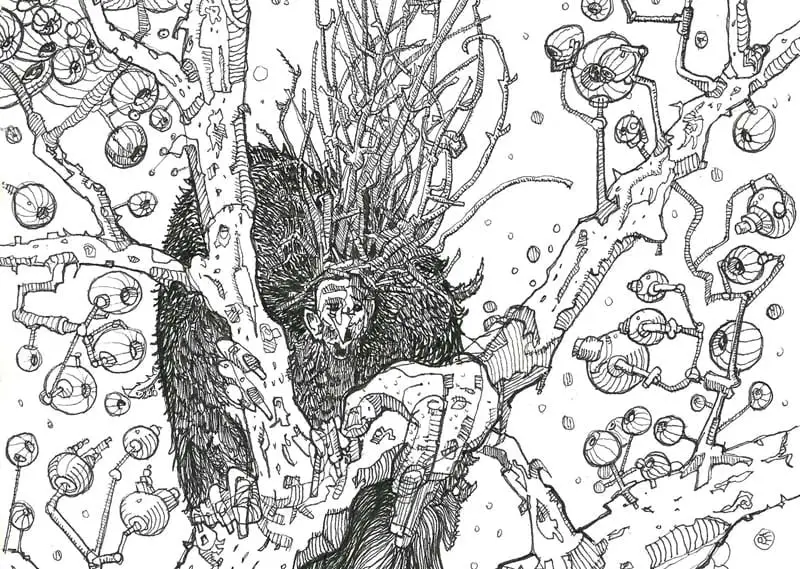
"Golden Gate" (1958/1982)

Updated: 12 hours ago

“Leaving aside all testimony of religion and revelation, I believe that a competent interdisciplinary biologist, working without prejudices, would come onto substantial evidence for the existence of unbodied beings or mentalities, from the effect they have on human persons; just as a competent interdisciplinary physicist-astronomer would arrive at the necessity of there being a moon of such a size and gravity and location and distance, even though, for some reason, the moon lacked the quality of visibility. And the physicist-astronomer would realize this necessity for such a moon from its influence on the earth. The biologist-psychologist should arrive at the necessity of the Devil-Satan, of such a power and location and activation-pattern, because of his influence on human persons." Interview
And after a while, Jeannie began to play devil's music,and Evil uncoiled like a snake and slid into the room. The lights in the world went out, and the torches were lit in Hell; and the melodrama began on the little stage. The world shuddered on its axis, and the villain was prince of the world. Once more the odd passion came on Barnaby. An animal surge went through the crowd as the noble hero and the trilling heroine and the dark villain acted out the oldest epic in the world.
“Will you still have the melodrama?” “Well, no. But we'll have skits. Well, not skits really; we'll have ukulele players and things like that. You'll like it.” “There's only one thing bothers me.” “What, dear?” “In the Twenties, how did they know who was the villain?”
Let’s start very wide and trivial. Is “Golden Gate” Lafferty’s first fantasia about lapsitting, that odd paraphilia that appears so often in his work, along with piggyback riding? Not much has been said to explain either cathexis, though Gregorio Montejo has interpreted lapsitting as a synecdoche for sex. I’m not so sure. My suspicion is simpler: Lafferty may just have liked sitting on laps and getting piggyback rides from the ladies. Not that either act is somehow unsexual or unflirtatious. It is somehow bound up with adrenarche in Lafferty.
Oh, and yes: “Golden Gate” is a brilliant Lafferty story, written in 1958. As with the brilliant “Wagons,” it is set against a musical backdrop, with the shift in theme from the 1890s to the 1920s keyed to songs. One should know the songs to appreciate how successful the story is. It makes a great companion piece to "Selenium Ghosts." Highly underrated.

First, the story
Our main character is a young man named Barnaby who patronizes the Golden Gate Bar. It isn’t in California, but because the sophomores we read about in it attend City College, I’d place it in America, not Europe, probably in the New York-to-Boston corridor. The Golden Gate itself is a family-friendly saloon with a gimmick. It has a Gay Nineties motif, with group singing and a nightly melodrama. Kids can get huge steins of cider.
We quickly learn that Barnaby is infatuated with the owner, Margaret, and her two daughters, Jeannie and Jenny (one of Lafferty's mother-parthens), who play the piano and the heroine in the stage show, respectively. Over the course of one week, Barnaby watches the performances and develops an intense fixation on the stage villain, Blackie. He becomes convinced that the actor is an actual embodiment of evil, a real devil. Lafferty tells the story in a day-by-day sequence in which Barnaby drinks with patrons, including college sophomores and seamen, while repeatedly expressing his desire to shoot the villain. As the story progresses, the companions and all else become increasingly odd and heightened.
Finally, on Thursday night, Barnaby attends the bar with a group of refinery workers and brings the six-shot revolver he has been thinking about all week. He has it loaded with five blanks and one live bullet. As the melodrama reaches its climax and the crowd hisses at the stage, Barnaby draws his trembling weapon and unloads all six shots at Blackie. For a moment, he thinks he has shot and killed Blackie, and he experiences a deep sense of peace and states, "I have killed the villain." But Blackie is somehow unharmed. He finishes his performance. Margaret later approaches Barnaby's table, white-faced, to reprimand him for the dangerous stunt.
On Friday afternoon, Barnaby goes back to the Golden Gate. He finds Blackie playing the piano and says that one of the fired shots was real. Blackie says he knows. He dug the live bullet out of the plaster. He then says he is leaving to work at Kate's Klondike Bar because the Golden Gate is changing its theme to a 1920s speakeasy. Everything about this encounter is depressing. That evening, the bar debuts its new era with flapper waitresses and ukulele music. Barnaby sees that it is dismal. He visits Blackie's room, where the actor is packing, asks for the new bar's location, and decides to move to that town so he can get a job and continue watching the traditional melodrama.
I think the most important line in "Golden Gate" is not its brilliant and memorable opening:
When you have shot and killed a man you have in some measure clarified your attitude toward him. You have given a definite answer to a definite problem. For better or worse you have acted decisively.
Instead, it can be found in Tuesday night's throwaway survey:
“A survey reveals that eighty percent of the people believe in Heaven but only twenty percent in Hell,” said Veronica. “That is like believing in up but not down, in a disc of only one side, a pole with a top but no bottom, Making Love to Alice Bly, in light but not in darkness.”
In this theological melodrama about good and evil with a lot of attention given to the devil, Lafferty's Barnaby belongs to the minority, and the story is an account of what that minority perception demands. The Golden Gate Bar, in its 1890s gimmick, is the institutional form through which the twenty percent's vision becomes briefly available to the eighty. Good and evil exist. You can see them being laid out almost liturgically in the nightly melodrama, with the gas torches, piano, and communal hissing. Like liturgy, it demands participation. This one happens to concentrate diffuse evil into a visible figure with a name: Blackie.
When the Golden Gate goes to a 1920s theme, this kind of figure has no place. In its environment, just as in the environment of the Modernist literature of the 1920s, there are social ills, accidents, and psychological facts, but there isn’t really any evil.
This is just to say that the old Golden Gate (with its allusion to heaven, not to San Francisco) is a place where people get together to share a moral response, not merely pleasure. We see this in the crowd's reaction to the stage show:
And when the crowd howled “No! No! No!” in simulated fury, it was not entirely simulated. And there were some who crowed “Yes! Yes!” wickedly against the crowd; and one of these was Hazel, bright-eyed and panting, as she felt the evil, like a dog in the corner, rise within her.
We see it when Barnaby achieves real clarity after firing (why doubt this clarity?). The ritual produces results because it makes the real thing really confrontable. Now consider the women's fondness for Blackie. That wouldn’t be a counter-argument because they are among the eighty percent, not the twenty. Hence, when the bar becomes a Twenties speakeasy, we see that what is lost goes beyond nostalgia, though Lafferty uses nostalgia and melodrama to code his point. It looks to me like Lafferty is doing something nearly liturgical. A community comes together to pursue a shared moral vision. There is room for the twenty who believe in Hell.
The new Golden Gate of the 1920s will be different because it is hedonistic. It is organized around eighty percent. There is irony, dissipation, and moral exhaustion. That is what happens when the ritual goes away. Evil does not disappear; it becomes invisible. It is from within this context that I would read Barnaby's closing decision to follow Blackie to Kate's Klondike Bar. Where the twenty percent go, the confrontation continues.
A postmodern reading is pretty easy to work out, which I am going to do to sharpen up the contradictions. Barnaby is a rum-dum, as Lafferty’s narrator says, using a great piece of 1890s slang (Lafferty is always amazing with small stuff like this).

Barnaby makes the mistake of thinking he is the hero. He’s an instance of the hypodermic theory of media, where playing too many video games leads one to go out and shoot up a school. His perception is a category error because he has mistaken a theatrical convention for reality:
It was clear to Barnaby that Blackie was really a villain. Not everybody knew this. A melodrama villain is only black behind the lights. Off stage he should have a heart of gold. [. . . ] That is no myth. Here it was not entirely true.
The story exposes and corrects that mistake. Blackie, offstage and sad at the piano, is demystifying. Barnaby goes with him because he wants to live in that old world of nostalgia and melodrama, even if it is not the real world. The Friday elegy is the cost of clarity:
Everybody sang together the music of Jeannie, and the only lights in the place were those old gas lights. Something went out of the world with them. These new lights, they have no smell to them, they have no flicker or real glow. You can't reach up and light a cigar or dramatically burn a letter. It's almost as though they weren't alive.
Now that the gaslights on the stage are gone, we see what is real. On this reading, the story could be about the seductiveness and inadequacy of simple moral forms, and the Twenties represent a more honest, if colder, relationship with complexity. Is this how most people feel? The 1920s are loved as a playground, but there is almost no popular sentimentality for the 1890s.
So, yes, Lafferty is doing something complicated (again) in this masterful early story. He is making Barnaby a real hero while keeping him very, very small and silly. It comes down to where one sees the irony. The postmodern reading shrinks the melodrama. The simple moral form of melodrama is naïve, and the story knows it is. Hence, Barnaby is deluded. An antimodern reading says hold up: Lafferty liked the melodrama and approved of moral vision, just as he loved the old Hairbreadth Harry comic strips and the melodrama scenarios he put into “Selenium Ghosts of the Eighteen-Seventies.” And he believed in the devil.
My reading situates the irony in the Twenties: its surface sophistication is moral naïveté, because it mistakes invisibility for absence. Friday really is the depressing prelude to it. Lafferty makes it hard for the reader because wisdom is being counterfigured in what can easily, and justifiably, be interpreted as Barnaby’s rum-dum escapism and flight into melodrama. On the antimodern reading, we throw in with Barnaby and Blackie and go to Kate's Klondike Bar because a melodramatic moral vision is better than no moral vision at all. Lafferty says the Golden Gate has nothing to do with San Francisco. How odd that no one has bothered to notice it has to do with heaven.
A soundtrack of the songs mentioned in "Golden Gate":
"Already, through the early crowd there was running a tide of resentment toward the seamen; and this only for their insistence that all the songs that night should be sea songs. Now there is nothing wrong with “As I was A-walking Down Paradise Street — With a Ho Ho Blow The Man Down,” but it has seventeen choruses, and when it is sung seventeen times, that makes either two hundred and eighty-nine or two hundred and ninety-nine. That is too much."


My point is only that I do not think the relation is synecdochic. If it is, then we have a problem, NASA, because of how often these two motifs are connected with children. In the first volume of In a Green Tree, for instance, we learn about Turnabout Parties, where the little boys rode on the backs of the little girls. That sounds like something Lafferty made up, but if I could ask the man a set of questions, one of them would be: did those parties exist? In any case, we still lack a good explanation for this aspect of his work, if there is one beyond something like Jean-Jacques Rousseau’s liking for cross-eyed girls, and that is simply the end of it.