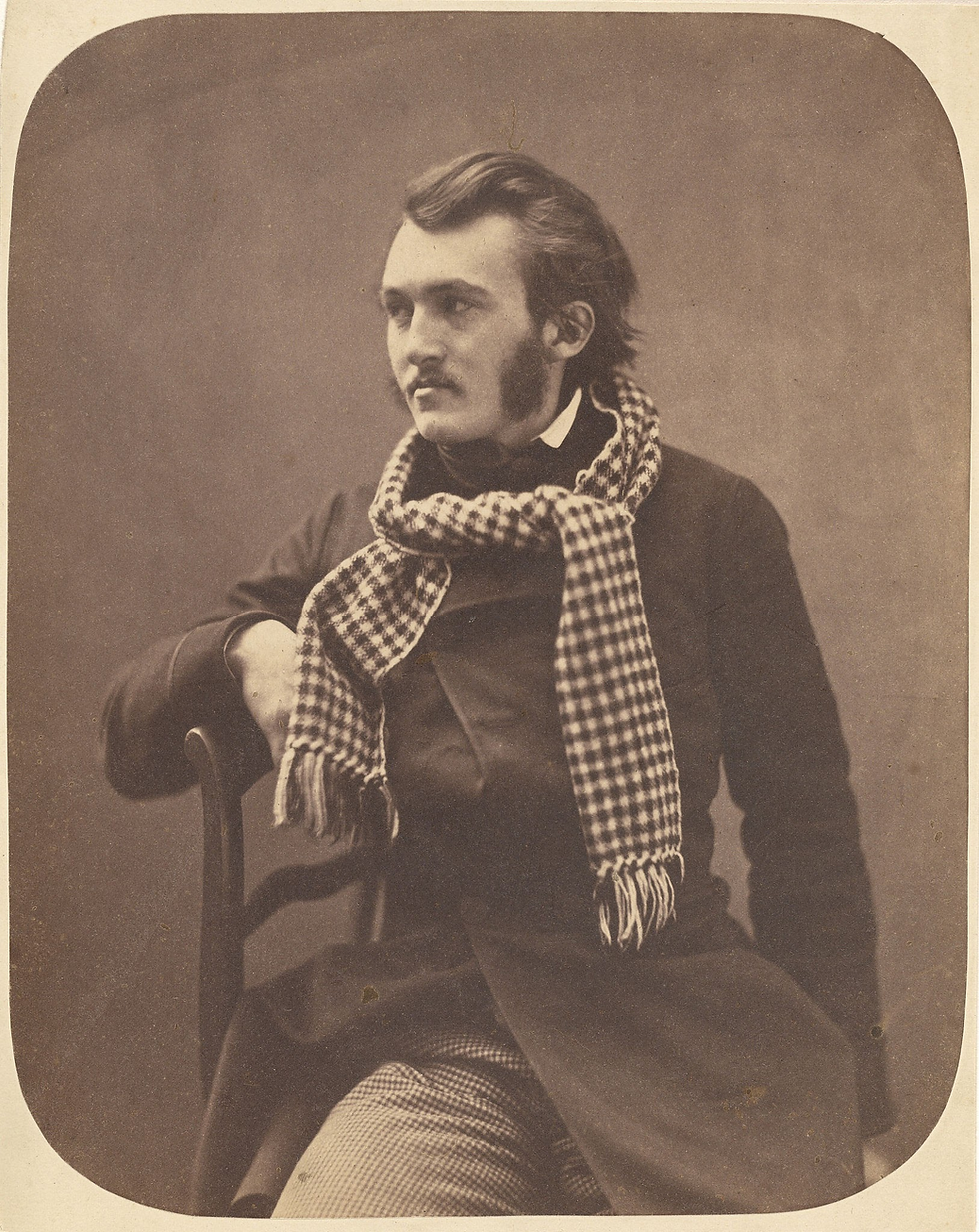
35 Misc Laff: Gustave Doré and Not to Mention Camels

Updated: 23 minutes ago
They keep accounts on Prime World; ultimate accounts, I mean. They keep crabbed, careful, fetishistic accounts. Oh, Noah, would I ever have to pay!
That world is real, and all others are shadows of it. You say this, but you are afraid to mean it, and you are afraid to acknowledge yourself a citizen of it. But your only alternative is to own yourself to be a reflected and not a real person.
408. When will Christ judge us? Christ will judge us immediately after our death, and on the last day. 412. What are the rewards or punishments appointed for men’s souls after the Particular Judgment? The rewards or punishments appointed for men’s souls after the Particular Judgment are Heaven, Purgatory, and Hell. — Baltimore Catechism No. 2, Lesson 37
Not to Mention Camels was one of the first Lafferty books I read, and it has deeply shaped how I read his work. It was obscure to me on the first reading, but over time I have firmed up my ideas about how it works. It is very loopy stuff. Read chapter 1, then chapter 15, and notice how prettily it loops.

And then note how it loops, and loops, and loops, jumpy as the pilgrim himself.

Lafferty’s best readers, especially Andrew Ferguson, have said smart things about it as a media satire. In a blog comment, Ferguson emphasized the rise of violence in media in the late 1960s and especially the 1970s, along with changes in star power and media celebrity. This is certainly one of the two or three most important contexts for making headway with the book.
Although the media satire in Not to Mention Camels is fairly well understood, the novel will still be unnecessarily difficult for some readers because Lafferty’s critique only works when read against its satirical norm. Recognizing the violence, celebrity, and cultural revolution of the period gives us the historical context. The satirical norm is the real world as Lafferty understands it, a world that includes the four final things: death, judgment, heaven, and hell. The pilgrim calls Prime the base and anchor of those four things:
It is the world where all facts are hard and there is no buoyancy at all. It is the base and anchor of the four final or eschatological things. Thankfully, there are no final things attached to any of the other worlds. (ch. 2)
Media worlds, both healthy and diseased, need not include the four final things. Most don't nowadays. On one side, the plots of The Hunger Games or the Final Destination series do not need judgment, heaven, or hell, even though they depend on death. On the other, a death-haunted work can bring in angels, miracles, and infernal machinery without taking the Christian account of the four final things seriously, as Daniel Kraus does in Angel Down, winner of the 2026 Pulitzer Prize for Fiction.
To borrow Lafferty’s language without wholly endorsing it, the characters in these artifices are eidolons. At least they fall somewhere on the eidolon continuum. Pilgrim is an extreme case, a man who dies more artifice than man: he wants the freedom of such a construction without personal accountability. No final things for him. He would love to be a post-fictional media artifice if post-fictional meant post-Prime. Prime is what makes that wish impossible.
Far less recognized is the novel’s debt to Ouspensky’s A New Model of the Universe and Aldous Huxley’s Heaven and Hell. Lafferty borrows ideas from both books to judge media by the four final things. Ouspensky also influenced other works of the 1970s. His ideas shape one of the great contingencies in the Argo Legend. The Ouspensky work most relevant to Not to Mention Camels is the long and tedious A New Model of the Universe, which anyone who wants to understand Lafferty’s novel should flip through.
I want to go deeper into what is going on, but today I’ll just note a few things you can look into for yourself if you read or reread Not to Mention Camels. Lafferty draws closely on chapters 3 and 11 of Ouspensky. In chapter 3, a significant point of discussion is the counterfeit superman whose supposed superiority licenses cruelty:
Malice, hatred, pride, conceit, selfishness, cruelty, all are considered superhuman, on the sole condition that they reach the furthest possible limits and do not stop at any obstacle. Complete liberation from all moral restraint is considered superhuman or approaching superhuman. “Superman” in the vulgar and falsified sense of the word means: all is permitted. (ch. 3)
Chapter 11 puts cult founders in the same company as cinema stars and commercially successful novelists, poets, musicians, painters, and actors. Their repeated lives make them more and more successful while leaving them spiritually arrested:
In each new life these people continue to do what they did before, spend less and less time on preparatory training, grasp sooner and sooner the technique of their business and the technique of success, attain greater and greater celebrity or fame. [ . . . ] The danger for the successful type of people is their success. Success hypnotises them, makes them believe that they themselves are the cause of their success. (ch. 11)
That is very much Lafferty’s pilgrim. Pilgrim uses knowledge carried between lives to manipulate followers, inflate his influence, and talk himself into a lie, namely that he can keep outrunning death and guilt. Lafferty takes and plays with Ouspensky’s warning that power can strengthen the defects a person should outgrow, without adopting Ouspensky’s account of the soul. One major change should suffice to show this: Ouspensky allows that a soul may “die altogether, become gradually reduced to nothing, vanish, cease to be” (A New Model of the Universe, ch. 11). Lafferty’s pilgrim’s repeated world jumps away from death end in the book’s final, endless scream:
Then he was heard in the very deep distance, far under the queasy feet of all of them. They didn’t need amplification to hear it. And they didn’t doubt that all of them would be hearing it forever. It couldn’t, of course, be an actual soul screaming forever in hell. It had to be some sort of imitation. But it was quite a good imitation. (ch. 15)
This got me thinking last night about what Lafferty does with Doré’s art in chapter 10 and how much becomes unintelligible within its new in-world media ecology without keeping the four final things in mind on every page. Cannes shows how media, debased by the assumption that it can evade judgment, can use sacred imagery without caring about its authority. The chapter’s epigraph gives the rich “nine more lives of pleasure almost hysterical in its immediacy and extent before they go to hell.” Cannes belongs to that reprieve.
Doré’s illustrations are full of moral choice, creativity, punishment, resurrection, and the afterlife. The spectators on Cannes remake them to suit their appetites. Jezebel is a pretext for murdering an innocent young woman. But the murdered girl departs from the script:
Who thus forgets, in hell or hot: No drop of blood will be forgot? (ch. 10)
The warning of judgment survives inside the performance that abuses it. The raising of Lazarus, meanwhile, gives the audience someone to torment:
And thirsty he would remain, and this was the delight of the whole animation. The elite audience would order cold drink after cold drink to allay in themselves the thirst of Lazarus. The Resurrection was always an audience-participation drama. (ch. 10)
Surely Lafferty’s satire depends on recognizing what has happened to the traditional meanings of these images. The four final things give us the standard by which to judge the performances and their audience. Without understanding this, I’m not sure what one gets out of its media critique beyond knowing that media can be coarsening and manipulative. Lafferty’s point seems to be that without an appreciation of the four final things one could easily become lost in the media maelstrom.
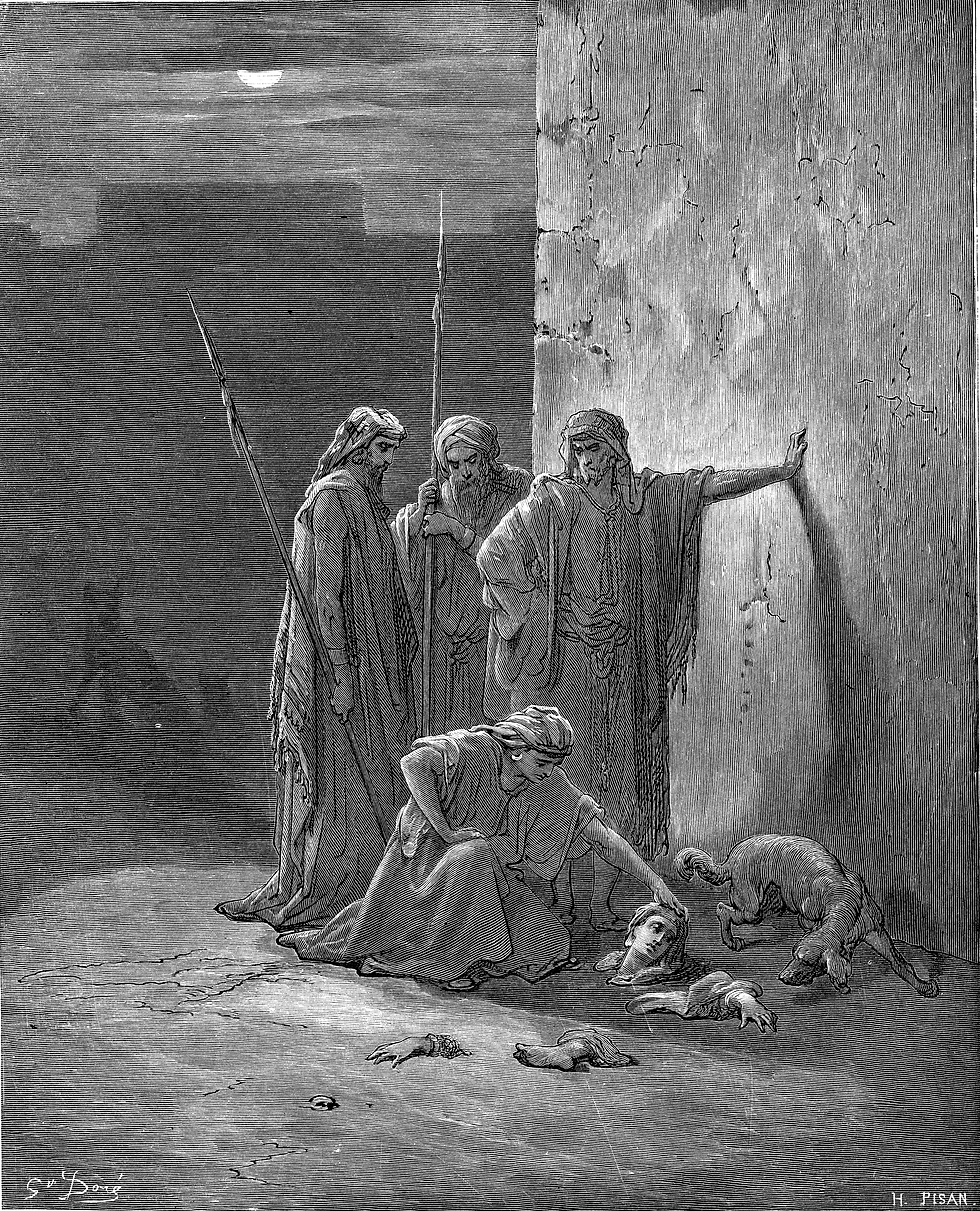
The presentation was always by moonlight (yes, certainly a real moon was used in the play), with the top half of the moon blocked out by clouds. The scene was beside a blind-faced stone wall in an obscure part of the city. Two wild dogs had withdrawn a ways at the arrival of Jehu’s Companions, but a third wild dog still gnashed at the pieces of Jezebel. There was a hand of her. There was a foot. Then there was the head lying in a natural position in the roadway and still wearing its coif. And then there was the other hand near the head. (ch. 10)
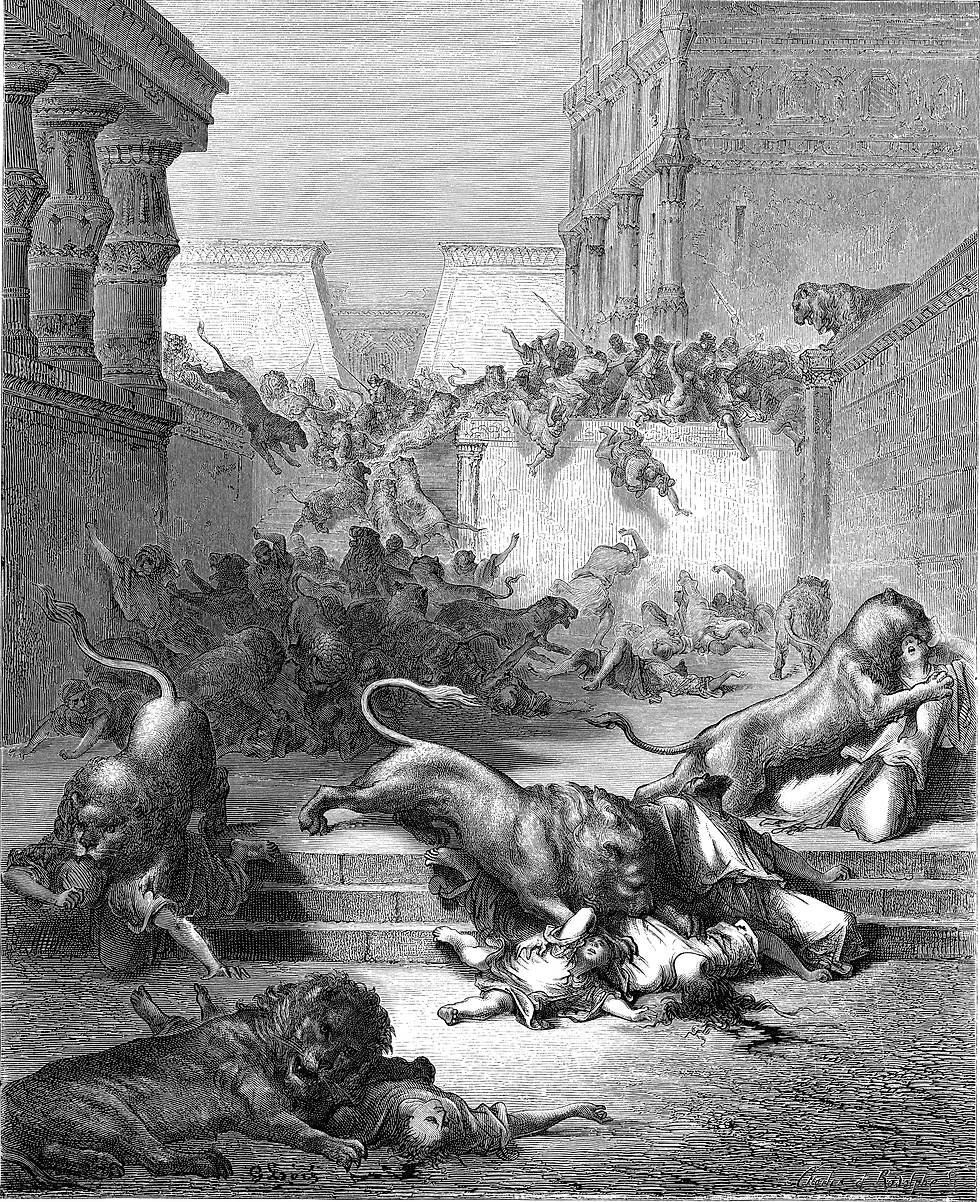

Pelion and Janie watched eight fine dramas, all based on great illustrations by the workman Dore: [ . . . ] Babylon Fallen;

Pelion and Janie watched eight fine dramas, all based on great illustrations by the workman Dore: [ . . . ] The Giant Antaeus;

Pelion and Janie watched eight fine dramas, all based on great illustrations by the workman Dore: [ . . . ] The Perilous Pass (elements from the Pass have gone into the Narrow Corner, you know); (ch. 10)

Pelion and Janie watched eight fine dramas, all based on great illustrations by the workman Dore: [ . . . ] The Mourners of Durandarte;

Pelion and Janie watched eight fine dramas, all based on great illustrations by the workman Dore: [ . . . ] Don Quixote in His Library (this is a misnamed illustration and drama; it is really God in the throes of Creation, before he learned to delegate the details);

Pelion and Janie watched eight fine dramas, all based on great illustrations by the workman Dore: [ . . . ] The Panther in the Desert;

The Resurrection of Lazarus was the best of the dramas: it was always a joy to watch. The Christus would raise him quickly and then be called away on other matters. Lazarus would rise from the dead putrid and thirsty; and putrid he would remain with rotted and half-rotted streaks of flesh, and the more completely rotted pieces sometimes falling clear off of him. And thirsty he would remain, and this was the delight of the whole animation. The elite audience would order cold drink after cold drink to allay in themselves the thirst of Lazarus. The Resurrection was always an audience-participation drama.
A cup of water was set before Lazarus. Then, by the power of the group mind of the partakers of the drama, the cup was set out of reach of the suffering man. Once more, small and putrid pieces fell off that good man (where would be the drama in torturing an ungood man?) who did not seem aware of his good fortune in being alive again. With a frantic, animal cry, Lazarus reached mightily for the cup, and the audience-participation group mind moved the cup away from him again.


Comments