Lafferty's Endings: Futurum, Adventus, Anagogy

“Novelty-seekers are complaining that Inneall’s story ends without a real ending. But it’s a log which ends only with the death of the logger, and she refuses to die.” -- Serpent’s Egg, 166.
Advanced Lafferty.
Readers of Lafferty’s novels sometimes seem puzzled by their inconclusive endings, and there are a number of interpretations regarding why he so often chooses to end so many of his longer works in the way he does. The invitation to participate in world-making with Lafferty is the best known of these. Andrew Ferguson has advanced this argument in several places. This view captures well the metafictional aspect of Lafferty’s work. What it doesn’t explain is the particularity of the elements that Lafferty likes to combine and recombine. Today I’m going to set out a few terms to try to make sense of these. One of them has already done a lot of work on the blog: anagogy. I’m going to take two others from the Protestant theologian Jürgen Moltmann, then twist them into a more Thomistic shape. The final term will label what happens when Lafferty brings anagogy and patterns of futurum and adventus together: promissory closure. Instead of saying that his books don’t have closure, I want to say that they have a specific kind of closure that looks like non-closure because they end with something open to change.
Anagogy is the fourth and least well understood of the four senses of Scripture: quo tendas anagogia (anagogy, where you are heading), as the medieval mnemonic put it. The literal level says what happened; allegory tells you what to believe; tropology tells you what to do; and anagogy sets out an enlargement: where the whole is going. The word itself is Greek and common. It just means a leading up. Cassian famously argued that anagogy ascends from the mysteries of the spirit to the secrets of heaven, his example being Jerusalem, which is a city on the literal level, the Church in allegory, the soul in tropology, and in anagogy the heavenly city that is the mother of us all (Conferences 14.8; Gal 4:26).
St. Thomas developed this, drawing on the tradition that the Old Law is a figure of the New, and the New Law is itself a figure of future glory, so that the things done in Christ and in the Church signify what belongs to eternal glory (Summa theologiae I, q. 1, a. 10; I-II, q. 106, a. 4, ad 1). This is like saying that the New Testament fulfills the Old Testament, but the New Testament itself will be fulfilled only in the creation of the New Earth. Lafferty himself seems to take this view in his fiction, with two consequences following. The anagogical referent is above us before it is ahead of us: eternal glory is possessed now by the angels and the blessed; it is in the future only for the wayfarer. For this reason, Scripture can say in one place that Jerusalem is above and in another that it comes down out of heaven from God (Gal 4:26; Rev 21:2). As allegory answers to faith and tropology to charity, anagogy answers to hope, whose object Thomas says is a future good, hard to reach, and reachable only with God’s help (II-II, q. 17, a. 1). So much for anagogy for now.
With an understanding of anagogical reading, much of Lafferty’s longer fiction will open up, but lately I’ve been thinking that something more is needed. To get at this, I want to use Moltmann’s distinction between two Latin words for the future because they can help us understand how Lafferty’s novels play with the events in time (plot action, such as it is) and something that is beyond but also inside the plot. Moltmann begins with a simple distinction:
“Futurum means what will be; adventus means what is coming.” -- Jürgen Moltmann, The Coming of God,
Futurum is the future that grows out of the present and can be extrapolated from present causes and planned for; adventus is the Latin for the Greek parousia (presence, arrival), the future that comes toward us and is produced by nothing in the present.
To make this concrete, consider the Pythons in Fourth Mansions. They are arranging the present to exert control on what will be. They have a theology of futurum, but an insufficient theology of adventus. This applies to all four factions in the novel, to one degree or another. What happens to Freddy Foley at the end, when the fourth mansion becomes part of the promissory closure of the novel, is adventus:
“He had been called, as the patricks had not been, as the Harvesters themselves had not been, as none of the exterior creatures had been of themselves. The Harvesters, the persons of the weave, had not themselves truly mutated. They couldn’t have done it; they hadn’t the holy simplicity for it.”
The distinction between being called and attempting to produce one’s own transformation is there in the language. Of course, both futurum and adventus are always bound up together.
Lafferty would almost certainly disagree with what Moltmann does with his conceptual pair of terms. Moltmann imagines the coming God as positioned against the “epiphany of the eternal present” and makes the future God’s own mode of being; God’s being is in his coming. That isn’t classical theism, and an Augustinian or Thomist will hold that God is eternal and lacks nothing. His coming changes us, not him. It is a newly created effect, the light of glory, by which the creature is brought to what God already is. It is Freddy Foley transformed, not any change in God. If this is right, then adventus in Lafferty is not ahead of God; it is above us and present to him, which is where anagogy had already located it in the Catholic tradition. For a related reason, one may want to reject Moltmann’s recovery of a millenarian history, a third age opening within time, but I’m not sure that Lafferty would reject this, and it is one way in which he is not a Thomist, but a thinker whose thought is inflected by Thomism. But I’m not entirely sure about that.
Back to making some of this a little more concrete. Astrobe in Past Master is a falsely perfected futurum, a human future engineered to completion, false because it is found empty. The book’s last words turn us toward the adventus of something else:
“Well, does it happen? Does the reaction become the birthing? What does it look like? Will we see it now, in face and rump, the new-born world? Be quiet. We hope.”
One might wonder, then, what the relation is between anagogy and the futurum and adventus pair. If they are to do critical work in reading Lafferty, one ought to recognize that they belong to different orders. Futurum and adventus classify modes of the future, or what develops out of present causes and what is given as a gift. Anagogy is a sense of Scripture, the one in which the things of the New Law signify eternal glory (ST I, q. 1, a. 10; Quodl. VII, q. 6, a. 2). They meet because anagogy zeros in on the mode of the glory it signifies, and that mode is adventus.
Now let’s cash it all out with the novel Serpent’s Egg by asking the hardest question one can about it: just what is inside the big egg itself? In the book, the intelligent computers have a secret eschatology:
“Oddly enough, the Intelligent Computers do have a consensus eschatology, a complete agreement as to their aim, goal, direction, destination, and final end. I have the feeling that the humans will have a smaller part, and the Computers a much larger part in the world that the Intelligent Computers are planning. But they are sworn not to reveal any of their plan to humans.”
These computers, in an interesting cross-reference in the Lafferty canon, descend from the Ambulatory Mime-Human Computers Smirnov and Shiplap created at the Institute of Impure Science. The Kangaroo, the novel's shadow government, conducts experiments to see what might emerge but is frightened by too much emergence. It assassinates those whose development threatens its rule. At the center of much of the book is Inneall, who is making an ocean and intends it to cover the earth. She doesn’t care if it kills many people. She is a complicated character, and accounting for her would take us far afield, but suffice it to say that her ocean is an attempt to manage futurum. Each tries to make the future spool off from arrangements made in the present. The novel is full of these competing projects of futurum.
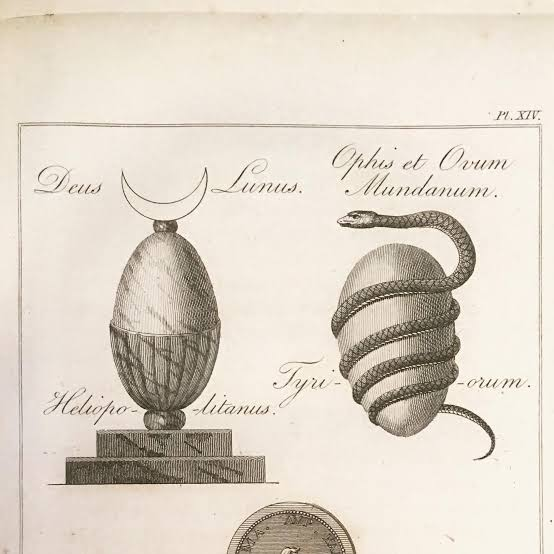
Then the great Egg appears in the python Lutin’s room toward the end of the novel. The kids were and weren’t the Serpent’s Egg all along. Lutin calls the Egg “that wonderful, that blessed, that hope-of-the-world thing.” Dubu, the bear, has helped arrange its appearance by putting Lutin and the midwife to sleep at the request of two transparent visitors. They describe what they are doing as “the joke by which the World will be saved and transformed.” In the middle of this account, Lafferty inserts a passage from The Book of Jasher:
“The First Coming was ridiculous beyond the point of laughter. The King and Creator of the Universe was born to road-people in a cow-and-sheep barn, and was wrapped up in a cow-blanket when he was brought forth and placed in a grubby feed-trough for a bed. What if the Second Coming should be even more ridiculous? But is it possible to think of anything more ridiculous? Let us try to think of the most ridiculous circumstance possible for the Second Coming, and we may still fall short of it.”
Just as the reader tries to understand the Egg’s sudden appearance, Lafferty drops in a paratext asking the reader to imagine the Second Coming in the most ridiculous circumstances possible. A gigantic, luminous egg looks to be Lafferty’s provisional answer to his imagined passage from The Book of Jasher. What is inside the Egg, on this reading, is Christ’s return or the consummation of the world.
Lafferty has taken the passage from Julius Caesar about crushing serpents’ eggs and counterfigured it again, just as he did in the much more accessible The Reefs of Earth. The authorities have called a “Serpent’s Egg” a person who must be killed before a dangerous potential develops. Those in power are like Herod, determined to prevent an unwanted future, determined to manage futurum. Lafferty has already given us a biblical connection in his account of the Kangaroo’s purges:
“Oh yes, there were instances of ‘—a voice was heard in Ramah, sobbing and loudly lamenting; it was Rachel weeping for her children, refusing to be comforted because they were no more.’ But those conspicuous cases were not so many, likely less than half a million Rachels out of several billion family mothers in the floating world. And such Rachels were sent after the children they mourned, and so they were no more either.”
The book we have been reading is a version of the slaughter of the innocents: hence the deaths of characters such as Axel and Lord Randal. Now the serpent’s egg appears as what Lafferty had been planning all along, the hope of the world. Lutin says that the phrase has “an entirely new meaning to me now.”
The Egg is unopened at the end of the book, but the novel gives us a reason to keep reading its signs. The epilogue says:
“What’s in the Big Egg is still secret, but Dubu guessed it and you may be able to do so also.”
So mystery has an answer. The reader is asked to recognize it from the clues already given.
“The trouble with mysteries is that the mystery-giver doesn’t play fair,” Inneall complained. “He doesn’t give us all the clues.” “Yes he does, Inneall. He gives all the clues,” Miol-Mor click-whistled. “Yes he does, Inneall, he gives all the clues,” Dubu repeated. “All the clues, always. Oh, by the way, Inneall, I just solved the mystery of the big egg here. It’s really interesting, but not to somebody like you who doesn’t like mysteries.”
This is what I mean by promissory closure: we can recognize the promised fulfillment before the narration shows it happening, but are positioned to have faith in the promise.
A few complicating factors. When Inneall inspects the Big Egg with her sensors late in the book, she says: “It's artificial . . . There's electronic gear inside the shell, and a mechanical pump is pumping in there. But there's something alive inside this big egg too.” What she is noting is adventus. Earlier, Inneall herself put an aquarium pump into her chest to act as a heart, circulating human and Ape blood. That was an attempt to manage futurum. Axel Grindstone prophesies that the Unfallen Ones would “take away the implicit vulgarity from machinery. They will make it another of the living and blessed things.” That is faith in adventus. A dialectic here shoewa that Lafferty's adventus redeems and sanctifies the mechanical order (futurum) rather than abandoning it, just as the monsters are sanctified in Fourth Mansions and put back under the throne, and just as Epkit is granted personhood in Arrive at Easterwine.
More ought to be said about this, not least because of how adventus is complicated by the book’s history of the recension moving from man to the computers to the whales, as well as how lying works in the book: each of the recensions has lost the dispensation to carry the logs because it has lied more than 50% and the book's Epilog casts a shadow on the current recension of the whales. There may be an allusion here to the prominent place of the “great whales” in the Douay-Rheims account of creation (Gen 1:21). But I’ll leave it here for now, with a quick formula: in Lafferty, conspiracies centered on controlling futurum come up against the unexpected appearance of adventus, while along the way Lafferty encourages the recognition of adventus through his use of the anagogical mode.


Comments