Argo Cycle 7: Later Lives and Last Things


IX. Later Timelines / Non-Linear Events
This section includes important events, character developments, and storylines that unfold outside the main post-World War II chronological timeline established in Section V, drawing heavily on the non-linear narratives of Archipelago and the later temporal displacements and voyages depicted in More Than Melchisedech. These include Duffey's early, formative "lost" period; Finnegan's increasingly isolated later travels and possible deaths or returns to life; the Argo journeys, set in a world featuring the revived and skeletal Duffey; and the separate realities found in the More Than Melchisedech short stories. These aspects frequently intersect with, run alongside, or exist entirely apart from standard time, highlighting the cycle's intricate, non-sequential structure.
A. Duffey's Seven Lost Years Revisited
Nature & Chronology: While situated chronologically between Duffey's St. Louis departure [M:69–71] and his Chicago establishment (1925) [M:77], this period takes place in a dimension outside normal time [M:71, M:298]. It's characterized by intense, unrecorded, and possibly temporally fluid activity, a state Duffey can seemingly revisit [M:290, M:445]. Bagby's posthumous letters describe Duffey as being in a comparable "skitting" state during later periods of withdrawal, as if it represents a recurring or accessible mode of being [M:248]. Not in St. Louis during these years [M:71].
Activities & Significance: Crucial for Duffey's development as Magus and seeding core conflicts. Travels aboard the Argo for seven nonconsecutive years, with intervening land adventures excluded from their count [M:71]. The hidden years include talisman bestowal, including the gift to Gabriel Szymansky for Casey [M:120–121]. Collects the Seven Christs and sends them back to himself [M:103]. Represents Duffey's journey into deeper realities.
B. Finnegan's Later Wanderings & Multiple Lives

Post-New Orleans Trajectory: After leaving the core Pelican Press group in New Orleans (following Stein's arrival) [A:120–122], Finnegan's existence becomes detached from linear time and standard reality. His narrative explodes into multiple paths and identities, reflecting his Teras heritage [M:107, A:258] and perhaps the consequences of his "first death" and entry into "shadow life" [D:158]. He is a "complex schizo" [A:187], living simultaneous lives [A:187, A:203–204].
Life Phases/Parallel Existences: Even within a single reality, Finnegan experiences almost self-contained life phases or parallel (schizo) existences. Along with the character studies of the Dirty Five, these schizo-adventures help order the second half of Archipelago:
Buffalo Salesman: Selling an indelicate dog housebreaking product, first to housewives, then successfully to "ribbers" (practical jokers) [A:189-190]. The New York painting episode follows this venture [A:191].
Gregory van Ghi: Acting as an eccentric, highly successful painter ("Orange Period") in New York City [A:191-192]. Develops mannerisms, lectures unconventionally, is patronized by Adrian and Mercedes Shapiro [A:193]. This persona is shattered by the realization of gaining weight and a compromising encounter with Mercedes [A:192–193].
Goat Man's Companion: Lives primitively in the New Jersey Barrens with Gautier the Goat Man and his herd, learning swamp lore and encountering preternatural elements (talking goats implied) [A:194-197, A:209]. Declines offer to be Gautier's heir [A:199].
Journey with Howland J. Howland: A specific, detailed journey north from an indeterminate point towards Chicago with a young Black man named Howland [A:178–180]. Involves living rough, working odd jobs, teaching Howland to read, and discussions of limited opportunities [A:178–180]. Howland later becomes a kitchen boy via Francine [A:181–182] and acts as Finnegan's valet during a Chicago visit [A:182–183].
Chicago Visits (Later): Finnegan revisits Chicago multiple times, interacting with key figures from his past or their associates. Key interactions include:
Presenting Howland as his valet to Casey Szymansky [A:182–183], engaging in high-spirited storytelling.
Briefly working as an artist, carving remarkable life-size cigar store Indians, demonstrating latent talent [A:183]. Hillary Hilton acquires one later [A:183].
Engaging with Hillary Hilton (Casey's nemesis) about business, distress deals (including his own diamonds), and Casey's fate [A:250–255].
Interacting with the esoteric dealer Askandanakandrian ('Asking Dan') about "nervous merchandise," the nature of reality, and his own impending murder [A:256–258].
105-Hour Fugue (Texas Chaparral): A disorienting, non-linear interval spent lost in South Texas chaparral, after leaving the D'Hannis area [A:202–203]. Experiences dream sequences, encounters noon-day devils and ancestral cities (rattlesnakes, buffalo) [A:205–206]. Attains "full clarity" about being the "only person in the world" [A:205]. Suffers physical hardship and delirium [A:204–205]. Rescued near D'Hannis by Ramires & Elena Musquiz [A:203, A:206]. (This episode chronologically precedes the final Cuban journey).
Alternate Marriage Awareness: Outside the chaparral interval, Finnegan and Theresa Piccone both retain awareness/memories of a shared 12-year marriage that ends in an ambiguous death in a parallel life stream [A:203–204]. Theresa commissions masses for their three children from this life (Chiara, Rafaello, Theresa Anna) [A:203–204]. This awareness shows the permeability between Finnegan's multiple existences.
Final (?) Journey & Death(s) - “How Many Miles to Babylon” / “Crotolo or Dorotea” (Archipelago Ch 11 & MTM story): Represents chronologically latest sequence, integrating elements from both books.
Return/Awakening: The novella opens with Stein’s notes on Finnegan’s reported deaths, then turns to his awakening after decades of death or time-stasis [M:548–550].
Havana Interlude: In the Cuban episode, Finnegan finds himself among Spanish speakers but thinks New Orleans has changed around him [A:269–270]. Befriends lawyer Ignacio and Elena [A:269-273]. Plays concertina [A:272]. Discusses alternate lives, the nature of St. Kitts, Papadiabolous, and his own identity [A:271-278]. Receives warning letter predicting his death [A:276].
Cuban Investigation: Duffey, Mr. X, and Horace Pie travel to Cuba's Marianao Coast to find Finnegan's tomb. They question local informants and follow boys to a sea cave [M:370–374].
The Assassin: Targeted by Niccolo Crotolus ('Nick the Rattle', left-footed killer) hired by Saxon X. Seaworthy [A:278–280]. Crotolus confronts Finnegan on the beach [A:281-282].
Dotty's Arrival & Confrontation: Dotty Yekouris receives a letter from Ignacio in Havana [A:277] and takes a cruise to find Finnegan [A:277]. Tracks him to the beach. A gunfight ensues: Dotty shoots Crotolus; Crotolus shoots both Finnegan and Dotty [A:281-282]. All three are hit.
Transcendence/Resolution: Duffey, accessing "yesterday" via time manipulation after putting Pie and X to sleep, finds Finnegan alive in the cave [M:374]. They recite psalms; Finnegan describes a mission on which the world's fate depends, then puts Duffey to sleep. When the visitors wake, Finnegan has gone on his journey [M:375–376]. The painting The Resurrection of Count Finnegan depicts Finnegan's aged, resurrected self emerging from this very cave [M:374, M:550–551].
Late Interactions: Finnegan encounters Mr. X and Doll Delancy at the graveyard [D:275–276]. These recurring figures connect the narrative lines of D and M [M:548–549].
Final Departure: Ending remains ambiguous across the texts – wounding on the beach [A:281–283], awakening for a further mission [M:554–556], continuation in "shadow life" [D:158], or possible escape from his attackers [M:556–557]. This conclusion for Finnegan, presenting conflicting possibilities (wounding on the beach [A:281–283], awakening for a further mission [M:554–556], continuation in a 'shadow life' [D:158]), exemplifies Lafferty's narrative strategy. The cycle intentionally avoids a single, definitive closure for its central wanderer, reinforcing the themes of multiple realities and unresolved destinies.
X. Eschatological Themes
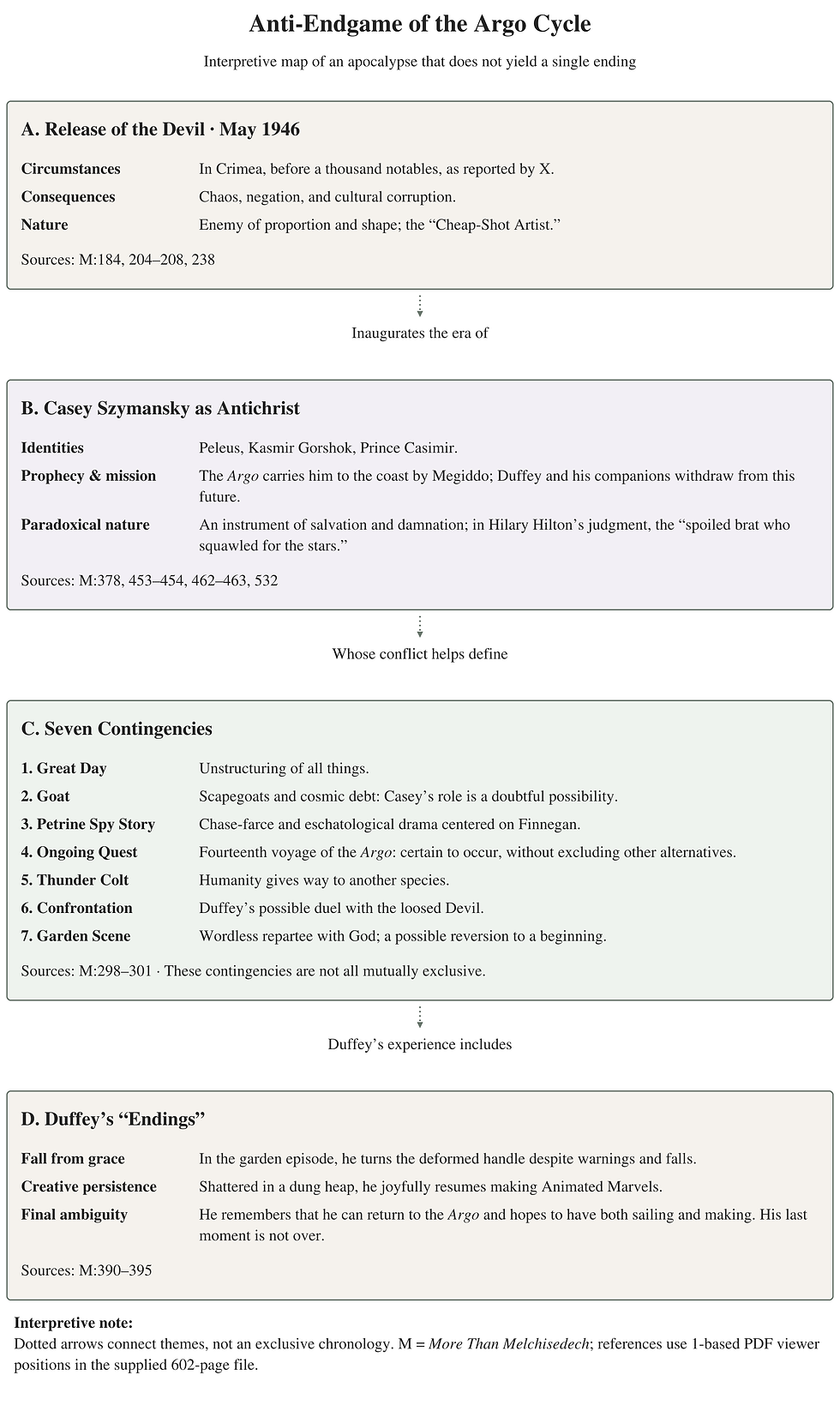
This concluding section explores the cycle’s culminating conflicts, centered on the Devil’s pivotal 1946 release, the Antichrist role of Casey Szymansky, the final showdowns, the Seven Contingencies (possible endings or transformations of the world), and the ultimately ambiguous fate of Melchisedech Duffey and the Argo Cycle. Though most of these events occur after Archipelago’s primary action, that work introduces the principal figures, their traits, and the conflicts leading to this endgame.
It begins with a transformative event that shapes the world the Dirty Five return to. On the last Saturday of May 1946—the same month their post-war paths converge at a wedding in St. Louis [A:95, A:114]—the devil is released from his thousand-year imprisonment in Crimea [M:184]. In front of a global gathering of admirers, this newly Loosed Devil, the “enemy of proportion and shape,” launches an onslaught of chaos and negation [M:206], against which Duffey and the Argonauts must stand, whether they recognize it or not.
A. Release of the Devil (1946)

Witnesses & Circumstances: In X’s account, in Crimea, in an underground prison—Phylake and Carcer are ancient names of the peninsula [M:204]— a crowd of one thousand permit holders—Catholic Cardinals, Jewish leaders, “cognoscenti,” “gnostics,” decadent artists, and world advisers—gathers to revere the freed Devil and receive “patents in the nobility” [M:205]. Mr. X claims to have infiltrated this event (permit #982) [M:205]. The Yalta Conference itself is reframed as having involved consultations with the imprisoned Devil [M:204].
Immediate Consequences: Emerging “misshapen” as the “enemy of proportion and shape” and signing with deformed letters [M:206], the Devil at once declares plans for ten thousand annual gatherings, the preaching of defamation and “the scenic and crooked way,” and the destruction of everything that stands (“Pull them down!”) and lives (“Kill them!”) [M:206]. His release inaugurates a heightened era of open evil, chaos, and cultural desecration [M:208]; twisted parodies of authentic arts arise almost at once [M:207]. This new reality becomes the backdrop for Duffey and the Argo Masters’ ensuing challenges.
The Timing: This happens on the last Saturday of May 1946. The narrative places the Devil’s release from his millennium-long Crimean confinement on that day, while also raising an 1846 release and possible recurrence [M:184]. It coincides with the wedding in St. Louis and the subsequent reunion of Argo figures in New Orleans, associating the Devil’s freedom with the conflicts among the Argonauts [M:184].
X dates the Devil’s imprisonment to 946 or 947; the narrative places his release in May 1946 while allowing possible recurrence. He stands in direct opposition to order and structure [M:184, 204–206]. His release is intentional and marks a religious shift that points to the growing presence of evil as the world approaches its end.
Beyond physical devastation, the Devil’s release fosters a systematic corruption of goodness and beauty, a “trashing” of culture [M:207–209]. It involves the deliberate creation of vile art [M:207], empty imitations supplanting genuine work, and an erosion of form and worth that leaves the world emptied of meaning [M:209]. This corrosive scheme is orchestrated by the Adversary—titled the “Cheap-Shot Artist” [M:242]—who aims to dismantle creation [M:242] through slander, false blame, and hatred. He favors crooked shortcut attacks through hatred, defamation, and falsehood, seeking the negation and withdrawal of Creation [M:242].
B. The Antichrist (Casey Szymansky / Prince Casimir / Peleus)
Identification: Casey Szymansky is strongly and repeatedly identified with the Antichrist figure, though Duffey’s commentary considers him much more likely to be a false or premature antichrist [M:378, M:535]. Archipelago establishes his Argonaut identity as Peleus [A:39] and his medieval aspect as Kasmir Gorshok [A:39]. Hilary Hilton identifies Casey with the Antichrist figure Rolo Danovitz and calls him a “spoiled brat” in the core narrative [M:378]. His commentary in “Promontory Goats” describes the signs he believes are placed on Casey, including the sign of salvation and damnation [M:531–532]. Absalom Stein's commentary in the same story discusses the soul-trading aspect and Casey's complex motivations related to the Devil [M:538]. This identity encompasses multiple aspects: Kasmir Gorshok (medieval necromancer), Prince Casimir (a figure Duffey associates with the High Middle Ages, chastity, and withdrawal), and Peleus (the Argonaut) [A:39, M:535–536]. His role as Antichrist is connected to his immense psychic and electronic power (foreshadowed by his dream worlds in Archipelago [A:156–161]), his complex moral state (soul-trading [M:169], compassion mixed with ruthlessness), his leadership of a powerful modern cult ("Casey of the Zodiac") [M:381–383], and his specific eschatological function [M:531].
Prophecy & Mission: Finnegan prophesies that the Argo will carry the Antichrist to Megiddo for the final world battle [M:453]. Duffey, Biloxi Brannagan, and Kasmir Gorshok himself then resolve to prevent the Antichrist from boarding [M:454]. Preventing this specific event – guarding the Argo against his boarding – becomes the primary mission of the Argo Masters in that reality stream [M:Bk13].
Nature: Casey embodies the "spoiled brat who squawled for the stars so loudly and stridently that they had to be given to him" [M:378]. He represents immense potential turned towards a complex, possibly destructive, end. Hilary Hilton’s reading of a sign calling him the "Instrument for the Salvation and Damnation of Many" [M:532] highlights his pivotal, ambiguous role in the endgame. He is a figure of immense contradiction: genius and folly, compassion and cruelty, creation and destruction, whose complex inner life and focus on the Problem of Evil are established early in Archipelago [A:154, A:156–161]. Casey's identification as the Antichrist is heavily mediated through the (perhaps biased or incomplete) perspectives of figures like Hilary Hilton [M:378, M:531–532] and Absalom Stein [M:538].
C. The Seven Contingencies / Alternate Futures

Origin & Nature: These possible futures, or resolutions for the world, follow from the narrative’s exploration of eschatology and metaphysics, crystallizing within Melchisedech Duffey's personal history. These are seven prominent possibilities among an indefinite number, emerging when Duffey and his history overrun the present and enter a "shattering state of contingency" or a "fracturing of reality" [M:298]. They are "manifesting futures" [M:298] jostling for realization, first introduced symbolically via the verses and scenes associated with the Seven Roads school play [M:293-296], which is a key to understanding the divergent possibilities. The narrative structure of More Than Melchisedech, particularly in its later sections, mirrors this fracturing, as Duffey enters or experiences the Sixth [M:301-304] and Seventh [M:389-394] contingencies. They are:
Great Day Contingency: (Verse: 'This is the clock that stopped at twelf. / This is the snake that swallowed itself.' [M:299]) This is an "unstructuring of all things," the "obliterating of boundaries," and the resulting "obliteration of persons" [M:298-299]. Lafferty writes this scenario in “Great Day in the Morning” [M:481–501], where time ceases to progress linearly, reality becomes subjective and unstable, and physical structures dissolve.
Goat Contingency: (Verse: 'Here is compassion hoked and hammed. / A K.C. swap is a swap bedamned.' [M:294]) This involves scapegoats bearing cosmic debt. Casey Szymansky is a "cosmos scapegoat and bad-trader of worlds" [M:299]. These scapegoats "will pay forever in a lower and more painful hell than the one commonly known, the fearful hell that is under the name-board ‘The End of Compassion’" [M:299]. This explicitly doubtful contingency addresses cosmic debt through vicarious suffering, specifically referencing Casey's soul-trading with Stein [M:299]. Lafferty presents this scenario in “Promontory Goats” [M:517–547], which examines Casey's complex compassion, motivations, and soul-trading.
Petrine Spy Story: (Verse: 'This is The Count who meets countdown. / And a dead man wears the triple crown.' [M:295]) Envisions the world resolved as a "chase-farce-tragic-drama" [M:300]. Involves Count Finnegan (maybe assuming the role of a "Peter the Second" [M:300]) and Dotty Yekouris. The outcome hinges on finding Finnegan (dead or alive) to fulfill his crucial, though perhaps unwitting, part in this "spy story" scenario [M:299-300]. Lafferty writes this scenario in “How Many Miles to Babylon” [M:548–599], exploring Finnegan’s last adventure and ambiguous end.
Ongoing Quest / Fourteenth Argo Voyage: The "Fourteenth Voyage of the Ship Argo, and the Reduction of Melchisedech Duffey" [M:300]. Set within the "pretertemporal circumstances of the Seven Lost Years" [M:300], it concerns "ongoing beatitudes, and the strong promise of Final Beatitude," along with the "'Quest Accomplished' motif" [M:300]. This contingency must happen, a Lafferty paradox. Lafferty writes: "The last death of Melchisedech Duffey has to occur on this Fourteenth Voyage of the Argo, or his ashes could not be brought back from it" [M:300]. This resolves through perpetual questing aboard the Argo, transcendence, and Duffey's final death, without excluding other contingencies.
Thunder Colt Complex / Decatur St. Opera: (Verse: 'A shattered world, and an end of fuss. / A new folk comes, and it isn't us.' [M:296]) Named as the "Thunder Colt Complex, or the Decatur Street Opera House Presentation of the World" [M:300]. This contingency unfolds theatrically at the opera house [M:349-351], involving the apocalyptic destruction of humanity ("the old and unregenerate species" [M:301]) and its replacement by a "glorious new species" [M:301], symbolized by the Thunder Colts. Represents resolution through violent transformation and species succession.
Confrontation with Devil: (Verse: 'This is the duel, and the bill of cost. / Oh sign it not, or it all is lost.' [M:296]) This involves the direct "confrontation of Melchisedech with the Loosed Devil in a closed place" [M:301]. A damning "covenant is offered there, but there are holes in that covenant" [M:301]. The ultimate resolution depends on Melchisedech's choice regarding this pact, with the text implying refusal is necessary to avoid damnation for Mankind, whom he represents in this encounter [M:301-303]. The confrontation remains unsettled and continues outside time while other events also occur [M:304].
Wordless Repartee / Garden Scene: (Verse: 'The Melk is a bust, and a crown, and toff. / He had it all there, and he booted it off.' [M:296]) A "wordless repartee between Melchisedech Duffey and the invisible God in a garden in the afternoon" [M:301]. Duffey experiences this state in Book Twelve [M:389-392], walking in the "Presence" on the "interior mountain" [M:390]. It offers the possibility of fulfilled grace and eternal permanence ("Everything is going right in this one... we will all come into our glory, immeasurable and eternal" [M:296]), but it contains a specific, subtle temptation (symbolized by the deformed branch/handle [M:391-392]) which, when acted upon by Duffey, leads to his fall from this state of grace [M:392].
D. Duffey's "Endings"

Melchisedech Duffey’s journey in More Than Melchisedech is a transcendence of linear chronology and an entry into the complex metaphysical states explored throughout the cycle.
Fractured State: Duffey's climactic journey sees him crossing out of sequential Time and into "moment" [M:301]. The later account distinguishes Time, Aeon, and Eternity, reserving the single, perfect abiding instant for Eternity [M:468–469]. This state, existing outside conventional temporal flow, is the plane upon which he experientially encounters the Seven Contingencies, the modal manifesting of futures wrestling for realization [M:298]. In the closing scenes of Book Twelve of More Than Melchisedech, he appears to fully enter the Seventh of these possibilities [M:389].
The Fall from Grace: Within the Seventh Contingency, a dying vision still short of death and finality [M:389], Duffey walks in the Presence of God on the "interior mountain" [M:390]. However, even in this state of highest potential, he remains vulnerable. Driven by what the text describes as "uncleansed corners" of his mind or "disoriented curiosities" [M:390], he yields to the subtle temptation presented by a flawed handle or lever within a thorn hedge: "‘Look, Pat, it's a mechanical lever of some sort. And the handle of it...’" [M:391]. Despite the warnings of his companion Plunket ("No, Duffey, no! Don't touch it!"), Duffey grips the handle, noting its "curious deformity" [M:391-392], and turns it. The immediate consequence is catastrophic: "The whole bottom falls out from under you!" [M:392], and he plummets "like a scorched rock" into a state of profound degradation [M:392].
Degraded State: Duffey descends into a debased physical and metaphysical condition. He finds himself sitting in a dung heap, physically shattered (hands, legs, hips smashed), tormented by base creatures (beetles, leeches, dung rats, buzzards), and afflicted by bodily flux and leprous skin [M:393]. This fall, precipitated by succumbing to a seemingly minor temptation ("disoriented curiosities") even within the Seventh Contingency’s dying vision [M:389–392], underscores a central theme in the Argo Cycle: the ever-present danger of internal corruption and the precariousness of virtue. Evil is not solely an external force like the Devil; the protagonists face constant internal struggles. Figures like Casey Szymansky engage in complex moral battles involving flawed compassion and ambition [M:538], while Duffey himself proves susceptible to pride or misdirected curiosity [M:391-392, M:481-501]. This internal dimension of the cosmic struggle, grounded in Lafferty’s Catholic understanding of grace, sin, free will, and consequence [M:140, M:194, M:229, M:298-301], shows that the greatest dangers, and the possibility of catastrophic failure, can arise from within the heroes themselves. Yet, even in this profoundly fallen state, Duffey recognizes that he is still in the Presence and continues his work as Magus and creator [M:393–395]. He joyfully moulds the dung into "marvels... with his own blood as integument," aided by million-volt lightning [M:394–395]. This state represents Duffey's ultimate paradox: fallen yet inherently creative, defeated yet capable of regeneration, leaving his final status deeply ambiguous.
Ambiguity & Non-Ending: Despite this devastating fall, the narrative resists definitive closure. While trapped in the dung heap, Duffey is reminded of the Argo and then remembers it ('You can go to it if you remember that you can go') [M:393–394], connecting his fate to the cycle's motifs of non-linear travel and rescue. Years aboard the Argo may accompany his 'last minute' of life without being contained in it or shortening it [M:386]; as he creates on the dung heap, there might still be as many as forty-nine seconds left [M:394]. Book Twelve gives further evidence: after returning from the Fifth Road, Duffey briefly appears as a ghost a year ahead of his own time [M:354–355, M:360–362]. Lafferty's concluding “Essay Explaining the Alternate Endings” serves as a metafictional capstone, refuting singular resolutions: "There aren't any endings at all... It is a forward surge on multiple tracks... that is the way the world works" [M:479]. Duffey’s fate remains unresolved. He speaks of sailing on the Argo before returning to his creative work [M:394–395]; he might exist simultaneously across multiple contingencies or be capable of re-entering other reality streams like the Seven Lost Years. The cycle concludes not with closure, but with an affirmation of multiplicity, ongoing struggle, and the enduring, paradoxical nature of Melchisedech Duffey himself.
Duffey's final state is unresolved. He is perhaps fallen, trapped in a degraded reality, yet still creative. He speaks of sailing on the Argo before returning to his creative work [M:394–395]; he might be able to re-enter the Seven Lost Years or another reality stream. He might exist simultaneously across multiple contingencies. His return from the Fifth Road and subsequent appearance as a ghost a year ahead of his own time confirm his non-linear, perpetually unsettled status [M:354–355, M:360–362]. The cycle ends not with closure, but with the affirmation of multiplicity, ongoing struggle, and Melchisedech's enduring, paradoxical nature. “Duffey and Time.”


Comments