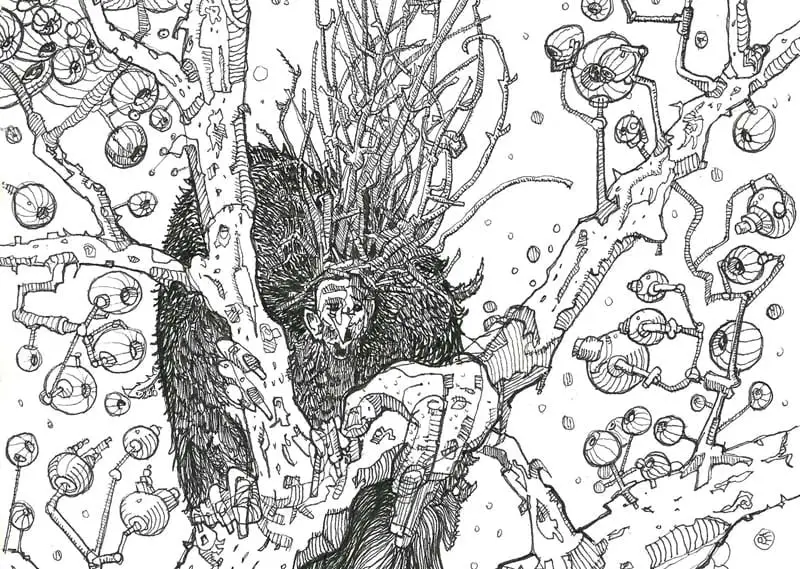
"The Story of Little Briar Rose" (1985/1988)

Updated: 1 day ago
For men are homesick in their homes, And strangers under the sun, And they lay their heads in a foreign land Whenever the day is done. To an open house in the evening Home shall men come, To an older place than Eden And a taller town than Rome. To the end of the way of the wandering star, To the things that cannot be and that are, To the place where God was homeless And all men are at home. — G.K. Chesterton, from "The House of Christmas"
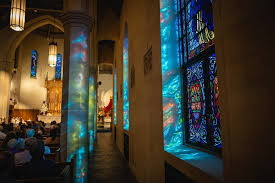
One of my favorite Catholic churches in town is Holy Rosary, administered by Dominican friars. Its fast-moving confession line is lovely, but the real beauty of the place lies in its stained glass and stonework. Step inside Holy Rosary, and the light washes over you. That's it in the thumbnail. You can see the Marian blues and the warm, rose-tinted hues. I’m going to belabor this whole rose point because it is so integral to what “The Story of Little Briar-Rose” does. Put simply, it wears Marian devotion the way some people wear the miraculous medal.
You probably know that the rose has long been one of the most important symbols in Marian iconography, with roots that stretch back to antiquity. In Greco-Roman culture, the rose of Venus was a symbol of love and immortality. Early Christians took that and remade it as a sign of spiritual love and paradise. By the Middle Ages, the rose was perhaps the best-known emblem associated with the Virgin Mary, who was often referred to as the rosa sine spina. This epithet points to her purity and Immaculate Conception.
When I think of all this, my mind goes to the vision of Paradiso 32, where Dante describes the celestial Rose, one of the great moments in Western literature. The celestial Rose is a divine amphitheater where the souls of the blessed are seated upon petals in perfect order. The Rose itself is bisected: one half holds those whose faith was in the Christ to come, and the other half those who believed after His arrival—a division marked by a line of Hebrew women.
Saints such as John the Baptist, Adam, and Peter are the structural anchors of this heavenly flower. Every soul, including infants in the lower ranks, has an ordained place determined not by chance but by God's grace and divine foresight, making the Rose a spiritual garden where every placement reflects a holy and just plan. Enthroned at the highest point of the Rose is Mary, with Eve seated directly at her feet:
And the angelic love who had descended earlier, now spread his wings before her, singing “Ave Maria, gratia plena.” On every side, the blessed court replied, singing responses to his godly song, so that each spirit there grew more serene. “O holy father—who, for me, endure your being here below, leaving the sweet place where eternal lot assigns your seat— who is that angel who with such delight looks into our Queen’s eyes—he who is so enraptured that he seems to be a flame?” So, once again, I called upon the teaching of him who drew from Mary beauty, as the morning star draws beauty from the sun. (Par.32.94-108)
In the Renaissance and Baroque periods, artists adorned the Virgin Mother with rose garlands. At the same time, the devotion to the Rosary—especially after the Feast of Our Lady of the Rosary was instituted in 1571—secured the rose as Mary’s emblem forever. Marian apparitions often bring roses: they bloomed miraculously at Guadalupe for Juan Diego; and they adorned Mary at Lourdes and La Salette, living signs of her presence. Little wonder, then, that when Lafferty began to think about Briar-Rose, Mary was there.
“The Story of Little-Briar Rose: A Scholarly Study” is one of my favorite Lafferty stories. It reimagines Sleeping Beauty by proposing a metaphysical reality reminiscent of Lafferty’s great oceanic novels. Cast in the form of a historical study, it traces a textual trail to unveil “unused, hidden, and explosive story riches” that, if uncovered, would shake the world.
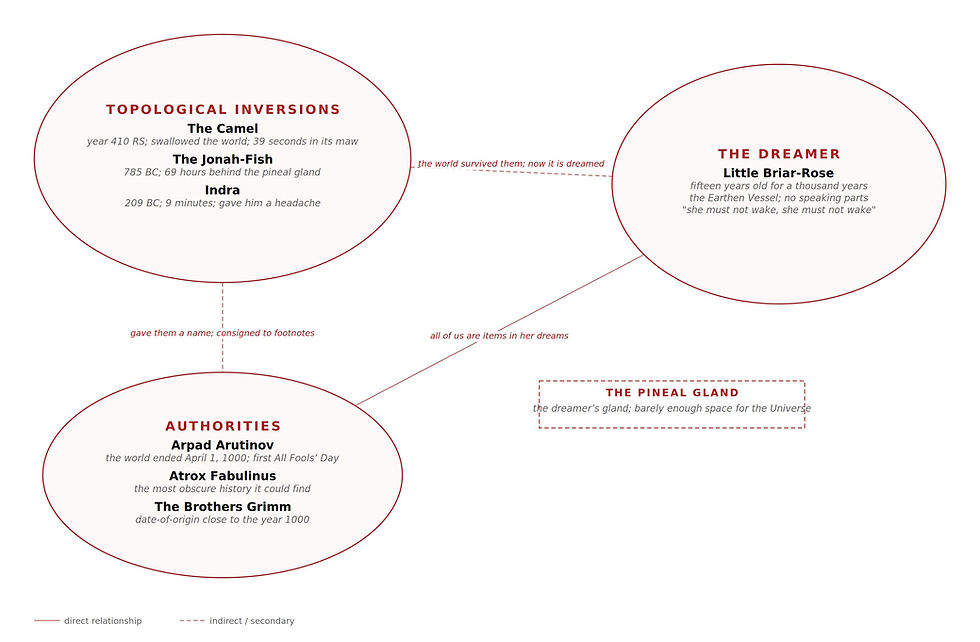
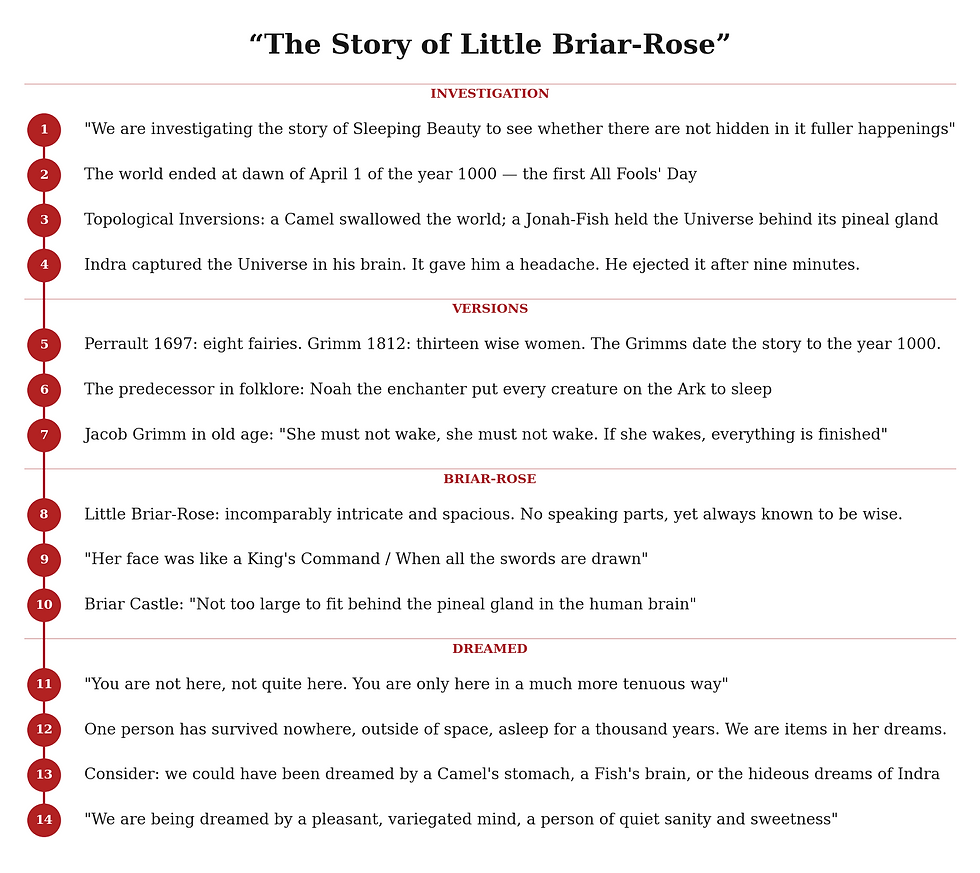
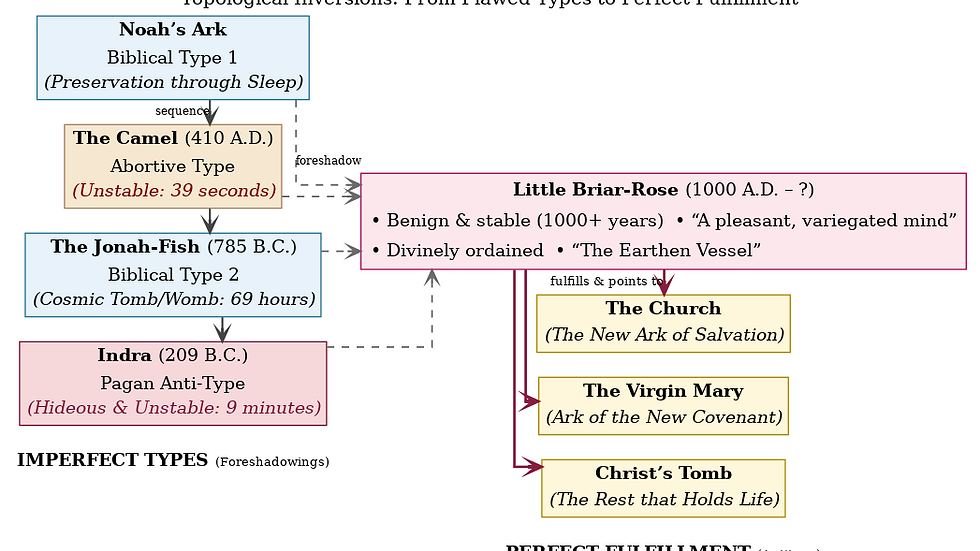
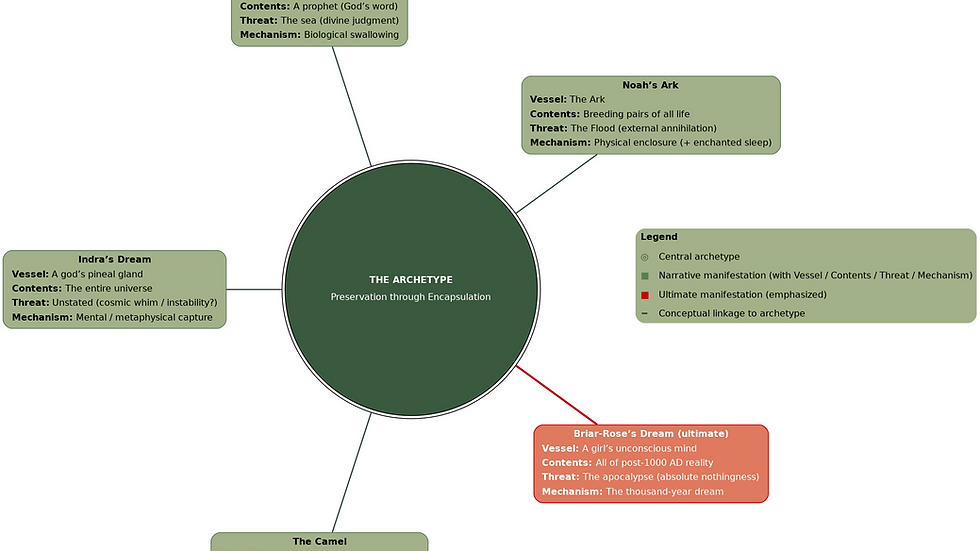
To uncover these, Lafferty’s narrator establishes a pattern of “Universal Inversion” or “Topological Inversion.” This is important, not just science fiction babble. Topological inversions are events where a larger reality is contained within a smaller vessel—for example, according to Atrox Fabulinus, a 785 BC incident in which a “huge fish swallowed the entire Universe and retained it . . . behind the pineal gland,” or a similar episode involving the god Indra. These precedents are the conceptual foundation for what follows.
I’ll show my cards: the greatest topological inversion, as Lafferty knew, is the Incarnation. The preceding topological inversions are failed typology, what St. Jerome called seeds of the Word, figurations of Christ in the myths of the pagans.
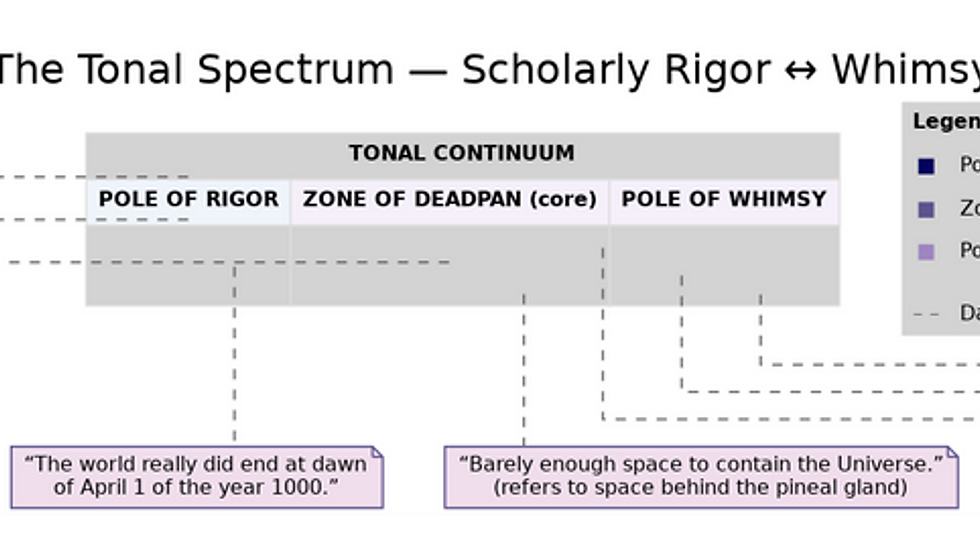
But let’s step back. A note from Arpad Arutinov explains that “the world really did end at dawn of April 1 of the year 1000.” This event in the story was not an observable cessation of existence—far from it. Instead, it precipitated a change in the nature of reality, shifting it into what the scholarly narrator describes as a “much more tenuous ‘here.’” The story ties this apocalyptic date to the fairy tale’s chronology, with the narrator saying that the Brothers Grimm’s analysis placed the origin of the “Little Briar-Rose” story as “being close to, but not before, the year 1000.”
What was the consequence of the unobserved apocalypse, the topological timeline that took us away from the Parousia? It is the “real story” of Briar-Rose and the truth of our current existence: we are all living inside her dream. Briar-Rose is the lone survivor of the world that perished, and she now dreams in a “nowhere place, outside of space.” Sleeping Beauty is not simply a cursed princess; she is a cosmic sustainer, an intercessor: “The Dreamer is fifteen years old, and she has been fifteen years old for nearly a thousand years.”
All humanity and the known universe since 1000 AD are phenomenal rather than noumenal entities: “all of us are items in her dreams.” The princess, even in her sleep, is positioned as being “in command,” an authority underscored by a quotation from Belloc describing a face “like a King’s Command / When all the swords are drawn.” Of course, Belloc was drawing on images of both Mary and the Maid of Orléans.
Lafferty ends “The Story of Little Briar-Rose” with a comparative analysis of this existential state against other recorded instances of Topological Inversion. There was a hierarchy of potential realities that did not take: the hypothetical entrapment within a camel’s stomach (a “damnable place”), a fish’s consciousness (“delirious insanity”), or the mind of Indra (“hideous dreams”). Fortunately, our present reality is being “dreamed by a pleasant, variegated mind, by a person of quiet sanity and balance and, yes, sweetness.” O dulcis Virgo Maria. How preferable, says Lafferty.
There are so many aspects of this worth considering—from the original notes the Grimms made in their version of the story, and how Lafferty writes over them, to how he brings together his great historical imaginers, Arpad Arutinov and Atrox Fabulinus, here in their closest partnership. There are also passages in Sindbad: The 13th Voyage (1989) that are important:
My favorite historian (because he is so droll and whimsical) (and because hardly anyone has ever heard of him) was the Roman Rabelais, Atrox Fabulinus. Writing in Rome about the year two-hundred, he carried his History of the World forward to the year one thousand. He had the world end in the year one thousand, and he had convincing explanations why it would do so. And from the year two hundred to about the year six-twenty-two his history was remarkably accurate. Though he died around the year two ten, he named correctly the Emperors and Empresses in both Rome and Constantinople for more than four hundred years after that. And he got the Frankish rulers named and described right up to the year one thousand. Only in the Near East did he go wrong, for he had never heard of Mohammed or the Moslems. The Emperor of Constantinople continued to rule Syria and Egypt and Asia Minor and Mesopotamia and a slice of Persia too, right up until the year one thousand when the world ended. And I’ve the feeling that Atrox Fabulinus was correct, that there really wasn’t any Mohammed of the Moslems (the very idea of them violates historical unity), and that the world really did end in the year one thousand. That was the correct version of history.
It is only in an alternate and not very substantial version of history, the version that I am unfortunate enough to live in, though, that we find the anomaly of the Moslems and the necessity to continue the world beyond its true ending date because of the impossible muddle that things had gotten themselves into. In this alternate version, the world couldn’t get neat and decent enough to be ended. There’d have been too much of it left over.
Unfortunately, I was born in the twentieth century of an historical detour, and not in that correct and main version of history which probably had no twentieth century.
What I want to focus on is the Noah/Mary typological pattern that Lafferty frequently employs. The classic source is found in Ephrem the Syrian (c. 306–373). Ephrem was a Christian theologian, poet, and hymnographer from the ancient city of Nisibis in Mesopotamia. Called the “Harp of the Holy Spirit,” he is a Doctor of the Church like Augustine and Aquinas. He wrote in Syriac, crafting hymns, sermons, and biblical commentaries. He had a genius for using imagery and symbolism to explain Christian doctrine, particularly on themes such as the Incarnation, salvation, and the battle between good and evil.
Ephrem’s "Hymn 28" is the locus classicus of the Noah–Mary typology.
The same melody If the animals in the precious tent, In the ark, were chaste, How much [more] would Mary, in whom dwelt Emmanuel, Turn against marriage. Your will increased and you sanctified you. Your Lord increases and adorns you, as well. The animals of Noah were compelled by force, But you [chose] by your will.
I think we should connect the melody with what Lafferty says about Tchaikovsky and Stephen Foster, and I suppose it goes without saying that Noah, through the ark, is God’s preservation of humanity and creation from destruction, a foreshadowing of the Church as the vessel of salvation.
Mary, as the new Eve and mother of Christ, is the ark of the new covenant, carrying within her the Savior who brings ultimate deliverance. Both are typological: Noah, foreshadowing God’s saving action through judgment and renewal, while Mary shows God’s saving action through incarnation and redemption. Together, they provide continuity in God’s plan across the Old and New Testaments. The best work I am aware of on this topic is Jean Daniélou’s work on typology, a helpful book for reading Lafferty.
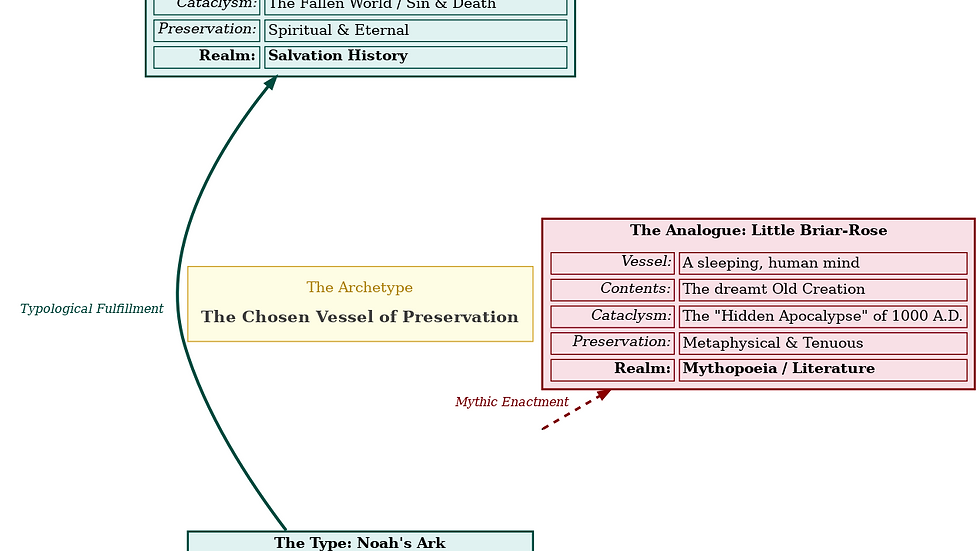
So why beat this drum? Because Atrox Fabulinus. The topological inversion motif is very much like Noah and Mary, as it involves some historical axes that Lafferty had regarding Islam. I’ll address this if I do something on Sindbad here. Here is how I see it working in this story.
Noah’s role as an enchanter shows sleep as a form of preservation within the refuge of the ark. By placing the animals, his family, and himself into slumber during the flood, he suspends creation in a state where survival no longer depends on ordinary effort or provision. This is prefigurative of Briar-Rose. The ark is both a vessel of wood and a vessel of sleep, carrying the world across catastrophe through an interval of dreaming.
In the same way, Briar-Rose’s sleep sustains life at the very moment when ordinary existence would have been destroyed. If Mary is the antitype of the ark (womb : hull : : Christ : passengers) then Briar-Rose is the antitype of the sleep that falls over the ark (Noahic apocalypse : Ark sleep :: 1000 AD apocalypse : Briar-Rose’s sleep). It is as if the Marian imagery of the rose has been pulled away from the explicitly incarnational and into the tardemah that ends an age, though even that is not so simple.
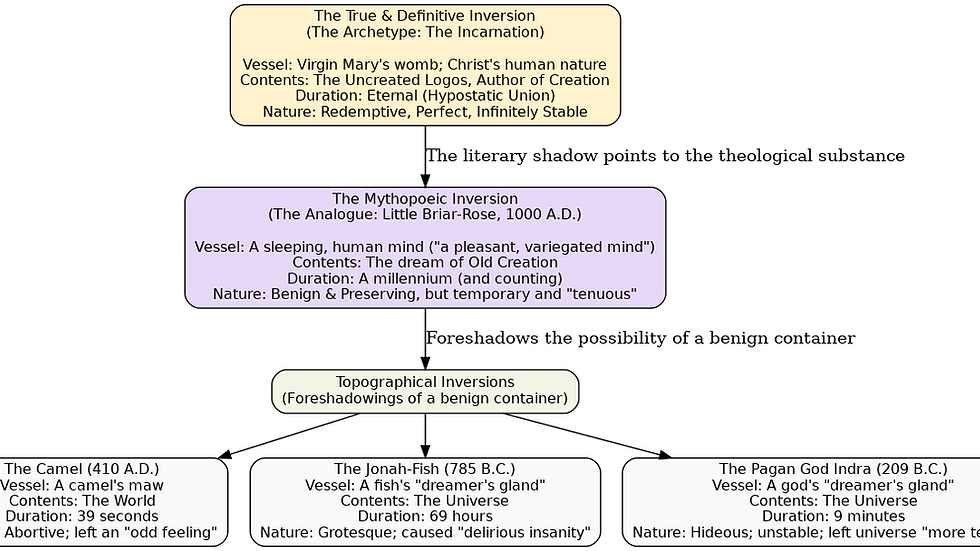
So Briar-Rose is not Mary. She is a means by which Lafferty considers the archetypes and their relationship to sacred history and eschatology. She is Marian in this sense, and the entire story is a brilliant variation on Lafferty's idea that we are inside the archetypes, not the other way around.
I’ll wrap up with a note on Jakob Grimm in the story. He does not want Briar-Rose to wake up. To understand why, one should read Lafferty’s “The Man Who Lost His Magic.” Like that story, this is one of Lafferty’s last. The logic is that the kiss of the prince will awaken her. It is the kiss of the one who contains many, who is the bridegroom of John 3:29.
If Briar-Rose woke up, the Enlightenment dream of a flattening, rationalizing, historicizing tendency would then crumble. Jakob knows this. It's also why Lafferty’s two great historian characters, Arutinov and Fabulinus, neatly give the reader the information that Jakob Grimm lacks and fears.