"The 99th Cubicle" (1984)

Updated: 9 hours ago

“A mood makes a world appear. —Martin Heidegger
A passing comment on the Lafferty Facebook group East of Laughter has me thinking about “The 99th Cubicle.” The first time I read it, I filed it away as a minor and heavy-handed bagatelle about sin built on the old hypodermic needle model of media. After re-reading it, I’m not so sure. That uncertainty is the point of this post. If you decide to read—or re-read—the story, be aware that it has variant endings. The original, shorter version is superior. It concludes in ambiguity.
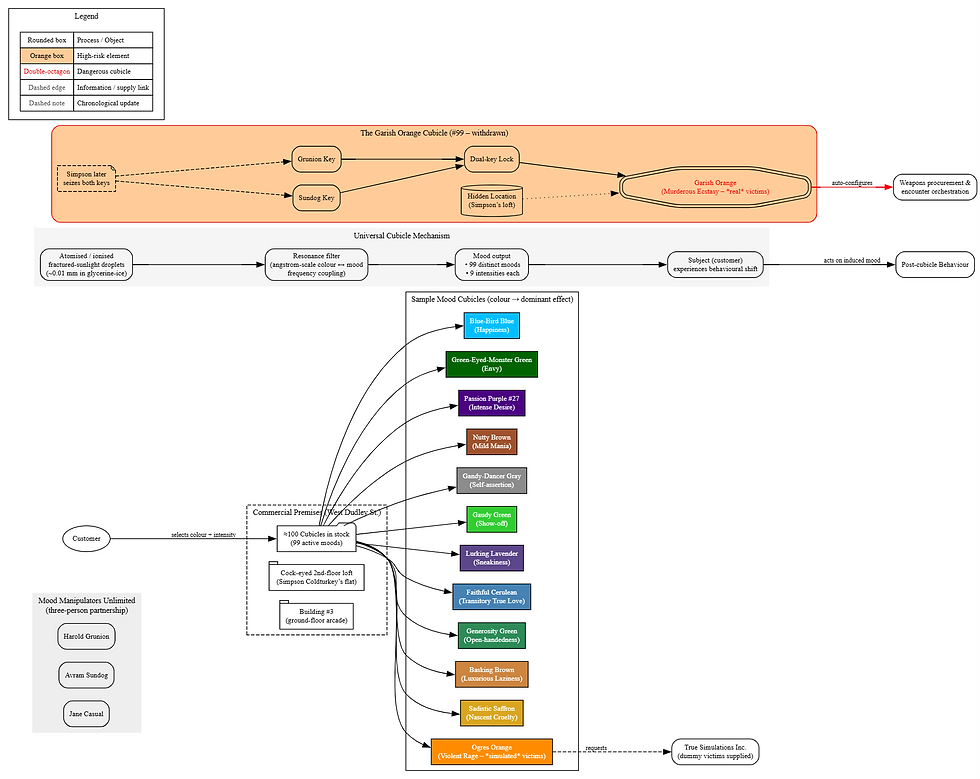
Here’s the plot. Simpson Coldturkey is a sour-tempered landlord. He owns three buildings. Whenever he can rent out the third building, he becomes “barely rich.” He rents it to three entrepreneurs who call their business Mood Manipulators Unlimited. The tenants set up arcade-style cubicles for users to rent moods. So, structurally, we have a three-on-three pattern and a rentier-on-rentier situation. Some of the cubicles seem like harmless fun, but most map onto the seven deadly sins, raising questions about how harmless they really are. One cubicle, the ‘Garish Orange,’ is the dangerous 99th of the title. It's intense wrath.
In an absurdly flawed security plan, the tenants hand over the 99th Cubicle—and both its keys—to their landlord, Simpson Coldturkey, for “safekeeping.” Then, each in turn, and without the others knowing, they say they will make themselves forget what they have done. After dabbling in the safer booths, Simpson gets a taste for the highs. When he learns what the Garish Orange Cubicle can truly do, he wants the peak experience of violence. He wants the real mass-murderous thing. He goes to the 99th Cubicle, and the story ends.
Three questions.
The first is how Coldturkey acquires the 99th Cubicle. Are the three Mood Manipulators coordinating a lie, manipulating him? It seems possible because . . . well, just look at what they call themselves, and look at what Jane Casual says: “You are a meek man [Coldturkey], but every meek man has a tiger or an ogre penned up in his heart. It will be so much fun for you to release your ‘Beast Within’.” We know that the Mood Manipulators have allowed this to happen in the past, and Coldturkey is an easy target. This appears to be what salesmen refer to as negative reverse selling.
But if that’s wrong, and the Mood Manipulators are sincerely trying to be rid of the 99th Cubicle, then another question pops up: What is Lafferty saying about culpable ignorance and self-induced forgetting? And what does that reveal about his views on media, nearly a decade after Not to Mention Camels?
Third, there is an important detail about Simpson himself that is easily overlooked. The story gives the reader the garish orange of the 99th Cubicle before Coldturkey activates it. This makes little sense unless the sweeping wave is internal, not from the 99th Cubicle itself.
Simpson Coldturkey started up the cockeyedstairs to that cockeyed, foreshortened second story where he lived. He dragged himself upward with sad steps. Then suddenly his steps became more animated. A wave of garish orange swept over him. He saw the whole world with garish orange eyes now. “I have it all!” he cried. “I can put it all together in a moment!”
This odd sequence makes me think that the hypodermic media model is not, in fact, at play; the disorder has been inside Coldturkey the whole time, waiting to be given expression and, just as significantly, a rationalization: "The cubicle made me do it. I would never have had the courage to become a mass murderer without its nefarious influence." In other words, Simpson Coldturkey is a man who wants to fall off the wagon.
Let’s go a step further. The forgetting “trick” the three tenants claim they can perform may be a subtle satire of the mind-trick Coldturkey plays on himself. As Jane Casual explains: “We supreme masters of moods have a trick of forgetting things, burying the memory of them so deeply that it can only be retrieved by triple hypnosis (with three different practitioners from three different continents).” There’s another word for this kind of thing: self-deception.
Returning to Coldturkey’s “garish orange eyes,” they may also explain Lafferty’s repeated use of the word cockeyed to describe the third building. It struck me as a curious choice at first—one I remembered vividly from my initial reading—but now it reads as a purposeful signal, especially given how Lafferty opens with it, builds the story around it, and intensifies it at the end.
[Coldturkey] sometimes rented it for an arcade. It was the place above which Simpson had his own living quarters, in that cockeyed, foreshortened second story.
“Try it and see,” tenant Jane Casual told him. “The ninety-ninth mood, the Garish Orange Mood, is entirely too dangerous. And I want to ask you a favor about that. I wonder whether, while my two partners are out, I might store the Garish Orange Cubicle itself somewhere up in that cockeyed foreshortened second story where you live.
And then there is its final, doubled appearance, Lafferty banging the drum twice to get our attention, just before the orange floods Coldturkey’s eyes:
Simpson Coldturkey started up the cockeyed stairs to that cockeyed, foreshortened second story where he lived. [...] He saw the whole world with garish orange eyes.
Behind this image, we see Lafferty’s Augustinian formation. The pull of sinful addiction is a classic Augustinian concern. In The Confessions, Augustine compares his own struggle with lust to his friend Alypius’s obsession with violence. Augustine was more of a Pink Panther or Passion Purple Cubicle guy, while Alypius dove headlong into orange mood cubicles.
This disordered set of lust and wrath is what the story focuses on. At one point, Jane Casual tries to coax Coldturkey toward a different substitutionary release, saying, “You’d better go in and relax in the ‘Pink Panther Cubicle’ or in the old faithful ‘Blue-Bird Blue Cubicle: be Happy as a Blue-Bird’.” She directs him toward sex as a compensatory fantasy for violence. In The Confessions, violence is the meek Alypius’s sex substitute.
Consider this passage from "The 99th Cubicle":
He tried the ‘Sadistic Saffron Cubicle’ and he began to suffer a monstrous and exciting change of personality. Then he entered the ‘Ogres Orange Cubicle’ and he turned into an ogre. He killed people, killed people, several of them. "This is the most exciting thing that ever happened to me,” he squealed with delight. “For this I was born. Oh, the tall, steep pleasure of it!"
Compare it to Augustine's description of Alypius at the games:
"As soon as he saw the blood, he at once drank in savagery and did not turn away. His eyes were riveted. He imbibed madness... he found delight in the murderous contest and was inebriated by bloodthirsty pleasure. He was not now the person who had come in, but just one of the crowd... He looked, he yelled, he was on fire, he took the madness home with him so that it urged him to return..."
In any case, there is enough here to suggest that the story isn’t really about magical cubicles that compel action, but about a placebo effect, which would explain one of the more memorable parts of the story:
“It sounds a little bit like pseudo-science to me,” Simpson Coldturkey said. “Yes, doesn’t it!” the tenant Harold Grunion agreed. “But it works. Try it and see.”
The cubicles “affect every possible mood to every possible intensity,” in Jane Casual’s exaggeration, but they also act as instruments of self-deception. They offer a way to dodge the responsibility of what Augustine called ordering one's loves. C. S. Lewis writes in The Abolition of Man: “St Augustine defines virtue as ordo amoris, the ordinate condition of the affections in which every object is accorded that kind and degree of love which is appropriate to it.”
Vice is what happens when this order breaks down, and it's what happens to Coldturkey. That makes the story more interesting than the “video game made me shoot up the school” parable I initially took it to be.