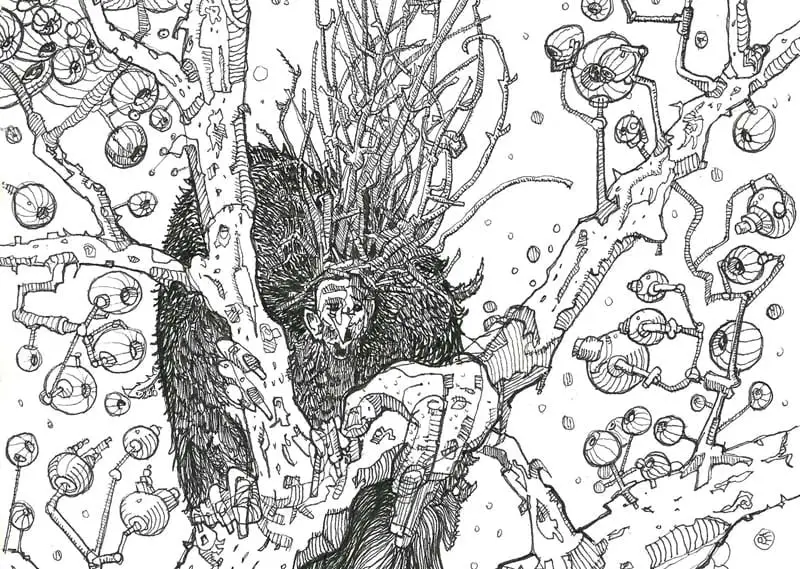
"The Cliffs That Laughed" (1966/1968)

Updated: 16 hours ago

“In any case the Apollonius story is not just a series of ‘and thens’: it drives us on toward a conclusion which restates the theme of the opening. At the beginning Apollonius encounters a king who is living in incest with his daughter, so that his daughter is also his wife: at the end Apollonius himself is a prince united with his lost wife and daughter. The story proceeds toward an end which echoes the beginning, but echoes it in a different world. The beginning is the demonic parody of the end, and the action takes place on two levels of experience. This principle of action on two levels, neither of them corresponding very closely to the ordinary world of experience, is essential to romance, and shows us that romance presents a vertical perspective which realism, left to itself, would find it very difficult to achieve.” Northrop Frye, The Secular Scripture: A Study of the Structure of Romance (Cambridge, MA: Harvard University Press, 1976), 63.
“Tragedy, or threatening tragic complications in romance, often involve stresses within families, such as a father’s overbearing will or the threat of incestuous relationship… A comic resolution, in fact, could almost be defined as an action that breaks out of the Oedipus ring, the destruction of a family or other close-knit social group by the tensions and jealousies of its members.” Frye, Secular Scripture, 137.
“Behind various incest and Oedipal taboos is the suggestion that the hunter is seeking a false identity which is the same thing as his own destruction.” Frye, Secular Scripture, 105.
Advanced Lafferty.
A few thoughts on one of Lafferty’s more intricately constructed stories, “The Cliffs That Laughed.” A summary would be less helpful than a sequence of events, so you will find a timeline at the end of this post, along with my notes on tracking its narration. The story uses variants of the first person over 130 times. It is a tour de force of indexical play, with Lafferty showing how slippery the I-index can be as he piles up pragmatic markers that make his fiction seem so oral.
The story is fascinating for this reason alone, and it is perhaps one reason Lafferty seems to have made Willy Jones Island a part of Argo. With so much I-indexical mayhem, it was a lock for dramatizing dissociation in The Devil Is Dead, especially since the two works share some geography.
Interesting posts could be made on these two topics, but today I want to look at something else: how “The Cliffs That Laughed” relates to sexual transgression in Lafferty. But first, I'll give my reading of how it handles the schizo-gash. In short, I think the two narrators are the same narrator, and we are seeing a version of what we find elsewhere in Lafferty's stories, such as "Junkyard Thoughts."
My dissociated-narrator theory says that the frame narrator and the “fellow in the bar” are a single person who has split. The narrator learned about Willy Jones Island from Galli at the end of the war, perhaps around the same time Finnegan had a fugue state in the Archipelago, linking the role of Willy Jones Island in the story to Finnegan's role in The Devil is Dead. As Don Lewis says in his version of "The Cliffs That Laughed," bringing out the dissociation idea:
On the morning of October 1, 1944, between ten and ten thirty in the morning, on an island that is sometimes called Pulau Petir and sometimes Willy Jones Island, three American soldiers disappeared, and have not been officially seen since. The three soldiers were Sergeant Charles Santee of Orange, Texas; Corporal Robert Casper of Gobey (Morgan County), Tennessee; and PFC Timothy Lorrigan of Boston. I was one of these three men, for my name is no more Don Lewis than the names of some others here are their real names. These three disappeared from a routine patrol. One of these boys was a coward; two were not; for this reason I do not say which one was myself. I have heard that one of these soldiers got out of the thing alive, that he has told the main part of the story in an unlikely version, and that that soldier is not me. So perhaps I am not of the living; I have felt like a dweller of the middle world since that time. Besides, I do not tell the main part of the story, but only the outré little introduction.
Whichever of the three soldiers Don Lewis is a further dissociation of (my bet would be Lorrigan), Don Lewis gives us the background.

Dissociation in "The Cliffs That Laughed" begins on Pulau Petir in 1945. The “twenty-year walk through the middle land” becomes another Ghost Story version of Finnegan’s fugues, bridging the gap between the three soldiers’ disappearance and the narrator’s 1965 two-level account. Supporting details include the narrator’s slip (“I was one of those three soldiers”), the congruence of the two accounts, and the barman’s note that the narrator and the “nutty” soldier seem indistinguishable. Thus, the story’s nested narration and the “Editorial Voice” press against the split mind. Legend, history, and biography merge into a fractured consciousness. Others may disagree.

Recall that when Finnegan experiences the fugue state that sends him to Ward Fourteen in Archipelago, he meets Ali. Ali, in turn, is met on Willy Jones Island by the dissociated Don Lewis.

Now to the real weirdness.
One recurring pattern in the ghost story that interests me is the reappearance of the Parthen. In two places in Lafferty’s work, the Parthen becomes a question of incest, though the nature of that incest differs in each case. However, one should add that because the Parthen in Lafferty is often accompanied by the mother, this is frequently something incest-adjacent to the figure.
In contrast, in “The Cliffs That Laughed,” the incest taboo is strong. It enrages the Welsh pirate Willy Jones, who is unable to have sex with his wife Margaret because he cannot tell her apart from his and Margaret’s daughter. As in Lafferty’s story “Parthen,” a mother-daughter pair is described as beautiful and near identical.
Let’s start with More Than Melchisedech. The biologically childless Melchisedech Duffey molests some of his fictional creations when they are children. The oddness of this is hard to overstate. It violates the incest taboo, and yet it also scrambles the question of physical genealogy.
The temptation is to psychologize Lafferty, which probably has to be done by someone, but it isn't something I want to do. So today I was thinking instead about The Secular Scripture and the way Northrop Frye treats incest there: as an obsessive and important structural convention in romance, not a reflection of social reality or psychological trauma. That claim has been controversial.
Frye argues that there is nothing in romance that inherently invites the incest theme. Incest appears in romance because it became a genre convention early on. He says incestuous themes, especially father-daughter relationships, belong to the night world, the demonic phase of narrative descent. This idea supports his argument that romance is defined by recurring patterns of ascent and descent.
What Frye says about incest as a feature of descent is especially interesting. Incest, in this context, is less about sex and more about moments in romance when male characters are alienated and caught in imprisoned identities. On a larger scale, these alienating moments become a kind of demonic parody of the romance's ultimate conclusion. In Frye’s view, romance moves from perversion toward reunion, eventually culminating in a legitimate, idyllic social order.
Frye’s approach to incest in romance is helpful for reading both “The Cliffs That Laughed” and More Than Melchisedech. The first story is very much romance’s descent into darkness, though with the Lafferty flavor. More Than Melchisedech complicates the descent-ascent pattern by branching into different trajectories. In both works, incest is tied to identity stasis or to the threat of frozen identity. Willy Jones is trapped in a nightmarish version of it. Melchisedech Duffey moves past it in a way many readers will find implausible or offensive. After playing the funny uncle, he goes to confession and says that both God and his wife have forgiven him.
Someone claims the soldier in the bar in “The Cliffs That Laughed” spent twenty years trying to get home. But that mischaracterizes the story's focus. The soldier says, “I wasn’t trying to get home. I was trying to get back to those girls even if it killed me . . .” He wants to return to where his identity was threatened. He wants to go back to Willy’s Island and its Margarets.