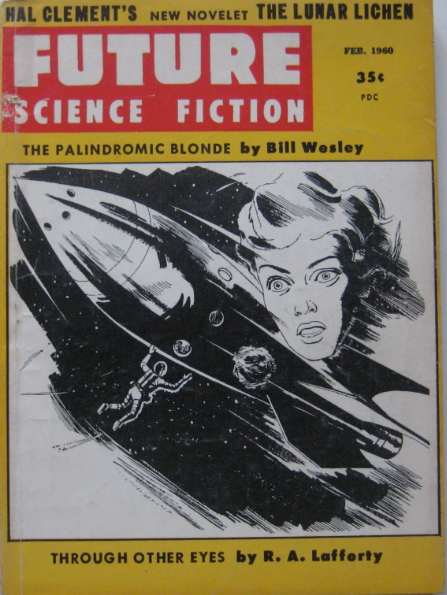
Some Thoughts about "Through Other Eyes"

Updated: 2 days ago

“I become a transparent Eyeball; I am nothing; I see all; the currents of the Universal Being circulate through me; I am part or particle of God. The name of the nearest friend sounds then foreign and accidental: to be brothers, to be acquaintances—master or servant, is then a trifle and a disturbance.”— Ralph Waldo Emerson, Nature
The attempt to see into the world of Karl Kleber was almost a total failure. The story is told of the behaviorist who would study the chimpanzee. He put the curious animal in a room alone and locked the door on it; then went to the keyhole to spy; the keyhole was completely occupied by the brown eyeball of the animal spying back at him. Something of the sort happened here. Though Karl Kleber was unaware of the experiment, yet the seeing was in both directions. Kleber was studying Cogsworth in those moments by some quirk of circumstance. And even when Cogsworth was able to see( with the eyes of Kleber, yet it was himself he was seeing.
That is one of my favorite passages in Lafferty. Karl Kleber, the forgettable peeping psychologist, prompts Charles Cogsworth to have a moment of moral reflection. One assumes that Lafferty took the view that most psychologists were peepers.
Today, I read an online essay about Lafferty’s “Through Other Eyes” that does a lot of essayistic hand-holding. It links defamiliarization in Lafferty—implicitly understood through Darko Suvin’s now classic view of science fiction as the literature of cognitive estrangement—to G. K. Chesterton’s swiping of the famous Mooreeffooc anecdote about Charles Dickens from an earlier biography:

Chesterton seized this anecdote to make a lightning-fast Chestertonian paradox about the relations of words to reality and of both to realism:
That wild word, ‘Moor Eeffoc,’ is the motto of all effective realism! It is the masterpiece of the good realistic principle—the principle that the most fantastic thing of all is often the precise fact.
This was a battle over the reality effect in fiction. What feels more real: Tess of the d’Urbervilles, by Thomas Hardy, or Ebenezer Scrooge, by Charles Dickens? G. K. Chesterton wants to say that Scrooge is more realistic (closer to Reality with a capital R) because realism need not bow to the low mimetic to capture what is real. The low mimetic is a problem writers bring on themselves. Life is bigger than that.
A great deal of this, in turn, is literary politics. Dickens was long looked down on by the great champions of the realist novel. In the twentieth century, F. R. Leavis was notorious for granting Hard Times the only Dickens novel any serious literary status. Chesterton’s Dickens is one of his masterpieces, written to celebrate a hero snubbed by the cultural elites. To understand the politics of this dispute, it is best read alongside its evil twin: Hugh Kingsmill’s Dickens—George Orwell’s favorite Dickens biography—brilliantly mordant and written explicitly against Chesterton, whose own life of Dickens often veers into what Wyndham Lewis savagely dismissed as Chesterton playing the great foaming Toby Jug. Chesterton’s favorite Dickens, tellingly, was the Dickens of The Pickwick Papers.

The argumentative thrust of the Substack piece on “Through Other Eyes” is that MOOREEFFOC may have been a form of defamiliarization that reached Lafferty through Chesterton, and that Lafferty in turn produces textbook MOOREEFFOC Effects. I would happily bet my bottom dollar that Lafferty had read the Dickens biography, a book I dearly love. In reading the essay, I kept thinking how more could be done with Lafferty and the Mooreeffoc effect, but what the article does is interesting enough.
The author concludes with the following:
Lafferty pushes Chesterton’s principle to its limit, showing that sudden, total understanding of another consciousness may be psychologically shattering rather than ennobling.
My problem with essays like this is pretty basic: there just isn’t enough thought. Instead, there is the dunnage of institutional voice—“it is perhaps not surprising,” “explores themes,” “comic yet unsettling,” “would later emerge,” “may find perplexing.” Who is this for, what is it doing for Lafferty, and what is the intellectual payoff? The payoff ends up being Hamlet telling Horatio that there are more things in heaven and earth:
Yet readers willing to take a gander through Lafferty’s Mooreeffoc lens may discover that reality itself—seen truly and from the right angle—is far richer, and more unsettling than they had ever imagined.
One reason the conversation around Lafferty is so often uninteresting is that the secondary literature offers very little to argue with—or think alongside. Most commentary is appreciative or celebratory, or else self-sabotaging. There are exceptions, such as Petersen on the ecomonstrous and Ferguson on bibliography. The online essay might on-ramp a new reader, but its stock formulations enrich the way formaldehyde does.
Do Lafferty readers really take “other minds can break us” as the uncomplicated lesson of “Through Other Eyes”? It’s certainly there, right on the surface. The story is early Lafferty. Maybe it really is that simple. Still, it puzzles me that readers who have spent much time with Lafferty would stop there. Cognitive shattering occurs, plainly enough — but ennoblement? That I don't understand. Charles Cogsworth is not trying to ennoble himself. He is trying to resolve his paranoia about the indeterminacy of translation (“What if I am a girl to everyone but me?”)—so he creates peeper tech. Ennoblement has nothing to do with the story’s aims. It reads to me like padding that shows up when one doesn't account for what else is going on. My view is that the online essay presents Lafferty as Christian and then extracts his incisors.
It set me thinking about the aspects of the story that tend to be overlooked in readings of “Through Other Eyes”: how Charles’s unethical arrogation of transparent access to other individual subjectivities usurps God’s authority. As part of his Cerebral Scanner experiment, Charles is willing to lie to his friends and acquaintances to acquire their brain data. His arrogation is perverse. In the first Institute story, Charles really is a dirty peeper, yet the temptation is to read Charles through what comes later, the rest of the Institute cycle. The story warns against what we might call new forms of technologically mediated empathy and the misuse of personal data.
While Valery Mok and Charles Cogsworth ultimately marry in the Institute cycle of stories, in “Through Other Eyes,” Charles’s overreach gets in the way of his shot at flawed and limited human love. Lafferty could have left it there. Once Charles sees Valery through the scanner, he can no longer see her through his own affectionate eyes and only makes his way back to a somewhat restored perspective by seeing her through Gregory Smirnov’s eyes. When Charles sees Valery as a beauty at the beginning of the story, Lafferty is in one of his rare moments of limited third-person, which he uses here to scrutinize the problem of perspective. Technique meets theme. By the story’s conclusion, Lafferty warns against the mechanical attempt to bypass the mystery of other persons.
“Misunderstandings can be agreeable. But there is something shattering about sudden perfect understanding.”
Fortunately, Charles Cogsworth is a man who can solve a problem.
Other readers tend to see the story as saying that people are different, and that empathy and wonder are good. We have our private worlds. Qualia seem to exist. I would say, sure, true enough. But what about the criticism Lafferty levels against the invasion of privacy, and what about what he says about Prime’s disclosure of reality? We see how much the invasion of privacy repulses him: in stories like “Sex and Sorcery” and “The Casey Machine,” in the invasion of privacy on Astrobe, in peeping on the Willoughbys, in the blackmail of Duffy, and so forth. There are many instances of this trespassing on the human person in Lafferty. Charles himself recognizes the degradation inherent in his technical peering:
“I am looking through the eyes of a peeper,” he said. “And yet, what am I myself?”
As for being shattered by divine-only knowledge, one could point to “In the Turpentine Trees.” It, too, is a theme Lafferty revisits throughout his work. All this made me want to work out some adequacy conditions that seem to be implied in “Through Other Eyes,” since they play out in his later work. This mainly interests me because the story draws a distinction between ontological adequacy and perspectival relativity, and I think one reason the story has been so popular for a wide range of Lafferty readers is that readers tend to conflate the two. It is perfectly compatible for Lafferty to endorse his kind of semi-radical perspectivalism while still thinking that there is some hierarchical way the World is, even if there are many worlds. Note how Smirnov’s perspective is special because it touches the "bones" of reality:
“The old bones of them stand out for him as they do not for me, and he knows the water in their veins . . . I am looking through the inspired and almost divine eyes of a giant, and I am looking at a world that has not yet grown tired.”
The billions of possible worlds in “Through Other Eyes” are not what I would call Prime in Lafferty’s work, the baseline reality grounded in his Catholic metaphysics. If that is right, then there should be a way to spell out the adequacy conditions. Because of the many ways "world" is used in Lafferty, I have a mental shorthand to keep track, which I'll quickly run through.
The billions of possible worlds found in “Through Other Eyes” are versions of World 7 in Lafferty. They are personal worlds. Lafferty’s Grolier history of the world set documents Worlds 3 from within the horizon of World 2. It was an attempt to survey the entire history of humanity at a late stage in the breakdown of Christendom.
Astrobe in Past Master is a fictional, futuristic world, a World 6. Fourth Mansions is a conspiracy fantasy, but it does not deal with Flatland; instead, it looks back to the feeling of the early sixties (note the JFK conspiracy theory material at the beginning of the novel, Freddy's failed story), and it imagines an eschatological leap from a structured World 2 to World 6 by bypassing World 4, making Freddy Foley a portal to the fourth mansion. Green Tree begins in World 2 and ends in World 4—unless we include its fifth part, an abandoned fragment that would have taken us into a World 6 in which mountains suddenly appear.

A "Through Other Eyes" World 7 is inadequate when it fails to see the life inherent in World 1 (Prime). As Valery tells Charles:
“I saw the world the way you see it. I saw it with a dead man's eyes. You don't even know that the grass is alive. You think it's only grass.”
In thinking through this, I came up with the following idea of ordering adequacy in "Through Other Eyes" along three dimensions: intensity of vital disclosure (V₁), scope of vital disclosure (V₂), and tolerability (T). It is agent-relative, varying with who is perceiving, i. e., my eyes or your eyes. No human being can maximize all three, because if they could, they would be God. The closest one can get to that is Ralph Waldo Emerson fantasizing about being a transparent eyeball.
As you know, the story reaches one peak with Valery's intensity:
“She has a keen awareness of reality and of the grotesqueness that is its main mark. You yourself do not have this deeply; and when you encounter it in its full strength, it shocks you . . . There is a filthiness in every color and sound and shape and smell and feel.”
Let’s be frank: Valery did not consent to this. Charles has committed the epistemological equivalent of rifling her lingerie—he has read her diary. He is a pig.
Euler peaks scope:
“It is the interconnection vision of all the details. It appalls. It isn't an easy world even to look at. Great Mother of Ulcers! How does he stand it? Yet I see that he loves every tangled detail, the more tangled the better.”
Neither of these is bearable to ordinary persons, which is one reason that I think Lafferty made Valery a Primordial in Arrive at Easterwine. Only The Lord in "Through Other Eyes" is max, max, max:
“It is almost like looking through the eyes of the Lord, who numbers all the feathers of the sparrow and every mite that nestles there.”
At the end of the story, we find out that Charles is busy building a mediator in the form of the Correlator, which is the ironic ending, because that is, in fact, the reality that already exists—something we glimpse early on in the subliminal-signal line: “A subliminal coupling, or the possibility of it, was already assumed by the inventor.” Charles is inventing something unnecessary because, according to Lafferty, it is what humans have always done with other humans: arrive at a consensus about what is.
There is something to be said here about the Holy Spirit and the transmission of revealed truth; truth must be mediated (assuming Lafferty takes something like the view in 1 Timothy 2:5). The Correlator trades absolute, peeping-tom-level epistemic disclosure for what already exists: mediated access, negotiated reality, sacramental participation, the human-made commons of “what is” of various types of world formation below World 1, Prime.
“The Correlator is designed to minimize and condition the initial view of the world seen through other eyes, to soften the shock of understanding others. Misunderstandings can be agreeable. But there is something shattering about sudden perfect understanding.”
The upshot is that perceptual error really can be error, and really can be graded. This is not the kind of relativism that worried Charles Cogsworth as a child, and the story gradually builds out a picture of why Charles had nothing to worry about all along, while satirizing how Charles has gone about learning this.
So what goes wrong in the article? Symptomatic absences. I would put it like this. Chesterton’s effective realism (Mooreeffoc) is a perceptual shock that re-enchants the same world; it makes the ordinary fresh. Strange words revivify a coffee room.
The end of all our exploring Will be to arrive where we started And know the place for the first time. — T. S. Eliot, Four Quartets
In Suvin's ideas about cognitive estrangement and science fiction, the novum is a rationally structured difference. It produces cognitive estrangement, which creates analytic distance. That analytic distance helps readers perceive and critique aspects of their existing worlds.
Both MOOREEFFOC-style effective realism and cognitive estrangement can be understood as versions of Shklovsky’s defamiliarization: using language to make the familiar strange, thereby renewing perception. Later Russian theorists would call this the poetic function; Shklovsky simply calls it poetic language. Think of Lafferty going to town with the poetic function here, displacing Valery Mok’s first-personal experience through Charles’s funny, poetic attempt to capture it in language, an attempt in which language is playing hob with reference:
“Every tree has a strong smell in her world. This was an ordinary elm tree, and it had a violent musky obscene smell that delighted her. It was so strong that it staggered. And to her the grass itself is like clumps of snakes, and the world itself is flesh. Every bush is to her a leering satyr, and she cannot help but brush into them. The rocks are spidery monsters and she loves them. She sees every cloud as a mass of twisting bodies and she is crazy to be in the middle of them. She hugged a lamp post and her heart beat like it would fight its way out of her body.”
In that sense, simple defamiliarization is the bridge between the MOOREEFFOC Effect and cognitive estrangement, since both are defamiliarizing techniques.
The online article is right that Lafferty gets much of his effective realism through Chesterton. Regarding “Through Other Eyes,” however, the online article neglects how Lafferty uses the novum of the Cerebral Scanner to say something important about privacy, technology, our bounded experience of others, and God’s omniscience and man’s nescience; and by doing this, it can say less about what Lafferty does through the Mooreeffoc effect. It gives the Mooreeffoc too much credit and the novum too little. Through the Cerebral Scanner, Lafferty says, “See the world as vividly and fully as you can, given who you were made to be, but for the love of God don’t violate the worlds of others.”
At the same time, it makes a statement about how perfection is graded, which explains why a mind can be shattered by peeping. There is the renovation of vision through the Mooreeffoc effect and the enablement of critique through the novum.
I’ll wrap up with one way of showing it:


Comments