Ip Consensus Realities and Prime

Updated: 3 hours ago
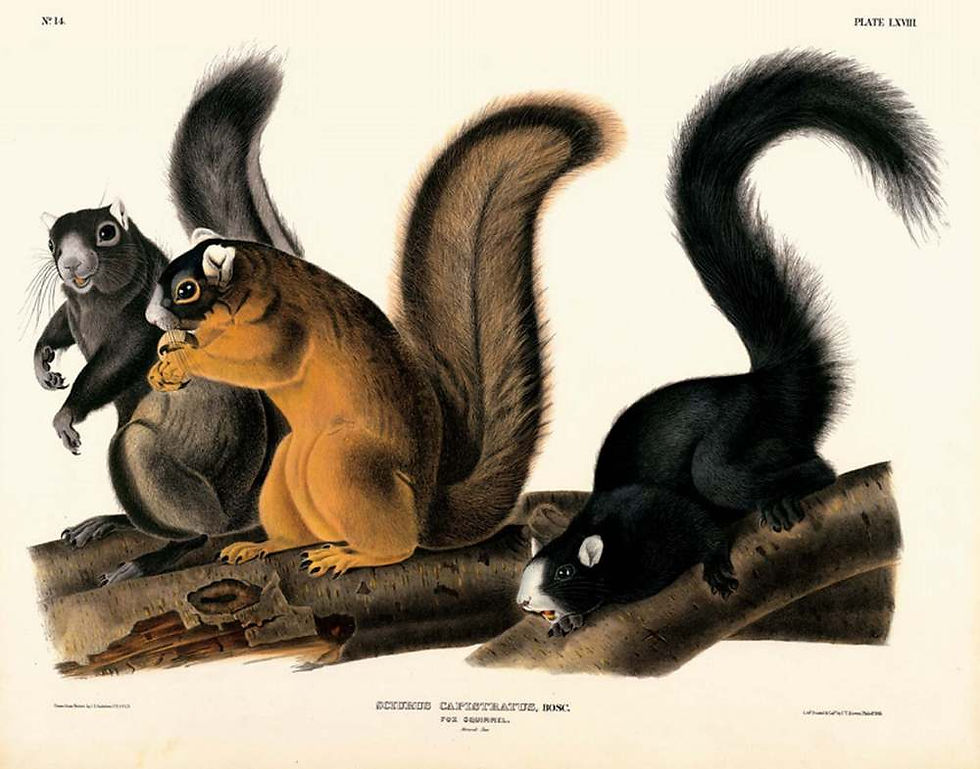
Some years ago, being with a camping party in the mountains, I returned from a solitary ramble to find everyone engaged in a ferocious metaphysical dispute. The corpus of the dispute was a squirrel—a live squirrel supposed to be clinging to one side of a tree-trunk; while over against the tree's opposite side a human being was imagined to stand. This human witness tries to get sight of the squirrel by moving rapidly round the tree, but no matter how fast he goes, the squirrel moves as fast in the opposite direction, and always keeps the tree between himself and the man, so that never a glimpse of him is caught. The resultant metaphysical problem now is this: does the man go round the squirrel or not? He goes round the tree, sure enough, and the squirrel is on the tree; but does he go round the squirrel? In the unlimited leisure of the wilderness, discussion had been worn threadbare. Everyone had taken sides, and was obstinate; and the numbers on both sides were even. Each side, when I appeared, therefore appealed to me to make it a majority. Mindful of the scholastic adage that whenever you meet a contradiction you must make a distinction, I immediately sought and found one, as follows: "Which party is right," I said, "depends on what you practically mean by 'going round' the squirrel. If you mean passing from the north of him to the east, then to the south, then to the west, and then to the north of him again, obviously the man does go round him, for he occupies these successive positions. But if on the contrary you mean being first in front of him, then on the right of him, then behind him, then on his left, and finally in front again, it is quite as obvious that the man fails to go round him, for by the compensating movements the squirrel makes, he keeps his belly turned towards the man all the time, and his back turned away. Make the distinction, and there is no occasion for any farther dispute. You are both right and both wrong according as you conceive the verb 'to go round' in one practical fashion or the other."—William James, What Pragmatism Means (1907)
You seem to posit a real world, but that is doubtful. There isn't any reality except the various consensus realities. And no two persons belong to quite the same consensus. So the world that a person lives in is largely a world that he has fictionalized, whether he is a fictioneer by trade or not. Whatever frustrations we find in the cantankerous combo-world are partly from our inability to shape things the way we want to.—R. A. Lafferty to Robert Sirignano
I’m fascinated by the philosophical problem of underdetermination. The philosophers who most interest me try to tackle it, and it’s one of the reasons Lafferty fascinates me. Lafferty has been seen as a post-modernist, or a post-post-modernist, but neither of those are categories that I use when trying to work through interpretative questions. Partly this is the old joke that from the modernism you choose, you get the postmodernism you deserve.
More seriously, it's a complete refusal to give a license to petitio principii. You set up a problem where the historical has already won and become absolute or has been vaporized into nihilism, something Leo Strauss understood in Natural Right and History (1950), when he saw that without a transhistorical standard of reason, historicism collapses into nihilism. Pick one or the other, says modernity.
I think this matters for Lafferty because a.) he wants to transcend the historical, b.) he rejects nihilism ("Flatland," "the trashed-life premise," "heroic tedium," etc.), and (c) he intensifies the problem of underdetermination. Consider what Lafferty says to Sirignano. We inhabit a “cantankerous combo-world” stitched from overlapping consensus realities, which means there is no "real world." Now consider the many essays that affirm a mind-independent World grounded in God, the "Real World" to which fiction and life ultimately answer, as when he wrote to Sheryl Smith, "What's this stuff about art not supposed to be didactic? I buy you geography and arithmetic books and you chew them up and don't learn what's in them. Then I put the stuff in SF parables, and you say it's fine but it doesn't teach anything. Sure it's supposeta. SF is the literature of ideas. Its whole idea is to serve as a shoe-horn to get ideas into funny-shaed head."
Both the cantankerous-combo worlds and the Real World somehow coexist for him without contradiction (Lafferty's use of Worlds).
In the venerable tradition of getting rid of a contradiction with a distinction, I'm going to set out some possibilities.

Assumptions:
(a) a real, mind-independent created order exists;
(b) reason can know some truths about God from creation;
(c) revelation is binding and truth is one (no “true for me” vs “true absolutely”).
Level distinction (phenomenology vs. metaphysics):
P1: Human experience is always mediated by consensus (“worlds we fictionalize”).
P2: Mediation doesn’t entail non-existence of a mind-independent reality.
∴ The quote speaks of how we encounter; PRIME states what ultimately is.
This distinguishes how we experience from what exists.
Epistemic anti-realism + ontic realism (critical realism).
P1: Our knowledge is theory/consensus-laden and underdetermined.
P2: A real, independent World exists (PRIME).
∴ We’re fallible knowers of a real World—both claims stand.
This treats us as fallible knowers of a real world.
Domain restriction (social vs. cosmic).
P1: Many “realities” in the quote = socially constructed orders (law, money, norms).
P2: Catholic metaphysics concerns creation’s being under God.
∴ Social worlds are plural; creation/PRIME is singular.
This situates many social worlds inside one created order.
Analogical predication of “world.”
P1: “World” can mean experiential lifeworld; also the total created order.
P2: Catholicism uses analogical language for being.
∴ “No reality but consensus worlds” = true analogically; PRIME = true properly.
This treats “world” analogically in a way standard to Catholic metaphysics.
Noumenal/phenomenal reading.
P1: Phenomenal reality = intersubjective, scheme-bound.
P2: Noumenal/PRIME = mind-independent, God-grounded.
∴ Two standpoints, no contradiction.
This keeps intersubjective appearances distinct from a mind-independent order without declaring the latter unknowable in principle. Keep natural knowledge of being and of God.
Thomistic participation.
P1: Created things participate in Being (ipsum esse subsistens as source).
P2: Human minds “form” secondary worlds by intention/language.
∴ Consensus worlds = participations/forms within the one World (PRIME).
This explains created being as participation in the act of Being.
Sacramental mediation.
P1: Signs and rituals constitute shared consensus spaces.
P2: Sacraments truly mediate the one World of grace.
∴ Plural mediations don’t negate the unity and objectivity of PRIME.
This acknowledges multiple mediations while preserving one reality of grace.
Eschatological unveiling (now/not-yet).
P1: In history, appearances are fractured by competing consensuses.
P2: At the eschaton, reality (PRIME) is fully disclosed.
∴ Both are true at different stages of the same story.
This sees partial grasp now and fuller disclosure later without denying present truth.
Peircean/pragmatist convergence.
P1: Truth is what inquiry would converge on under ideal communal conditions.
P2: Revelation/deposit orients that convergence toward PRIME.
∴ “Consensus worlds” describe our current fragments; PRIME names the limit.
This treats communal convergence as an aid to truth rather than a replacement for correspondence and revelation. Guardrail: Let correspondence to reality and revelation remain norming.
Hinge realism.
P1: All knowing operates within language-games/hinge commitments (consensus).
P2: The Catholic hinge aims at and is responsible to reality (PRIME).
∴ Framework plurality + ontological accountability cohere.
This locates reasoning within frameworks that reality and revelation can correct. Do not seal frameworks off from correction.
Two-city model (mixed orders).
P1: The earthly city = overlapping consensuses; the City of God = reality under grace.
P2: Lives straddle both orders.
∴ Apparent clash is an overlap of distinct but interpenetrating polities.
This frames life within overlapping earthly and heavenly orders.
Indexical truth vs. absolute truth.
P1: “There isn’t any reality except consensuses” = true for-us-as-subjects.
P2: “PRIME is the World” = true absolutely (God’s vantage).
∴ Double-aspect truth, not double-truth: indexed vs. absolute.
This recognizes perspective in knowing while maintaining the unity of truth. Guardrail: Reject any “double-truth.”
Theistic idealism (Augustinian).
P1: Created reality exists as ideas in the Divine intellect.
P2: Human consensuses are finite participations/representations of that reality.
∴ No mind-independent created reality apart from minds—and yet PRIME is maximally real in God.
This grounds intelligibility in the Divine intellect while retaining real extra-mental creatures. Preserve real created substances.
Formal/material/final causes split.
P1: Consensus supplies forms and interpretations (formal causes) of experience.
P2: PRIME supplies the act of being and teleology (material/final in God’s order).
∴ Different causal registers; no conflict.
This analyzes experience through multiple causes consistent with Aristotelian-Thomist thought.
Underdetermination + revelation as tie-breaker.
P1: Multiple conceptual schemes fit the same data (underdetermination).
P2: Revelation/deposit provides non-empirical constraints fixing metaphysical commitment to PRIME.
∴ Many consensus worlds; one binding metaphysical anchor.
This allows many live theories while letting revelation decisively orient fundamentals.
Rhetorical/ironic persona (literary–philosophical).
P1: Lafferty sometimes stages voices to dramatize positions.
P2: A staged phenomenological claim can coexist with a personal realist confession.
∴ The two utterances function at different rhetorical levels.
This treats authorial stance as a device with no doctrinal entailments.
Participatory ontology of truth.
P1: Humans co-make “worlds” responsibly or irresponsibly.
P2: Truth is conformance of intellect to the real (PRIME) and to the Good.
∴ World-making is judged by, and can align with, PRIME.
This understands truth as the intellect’s conformity to reality within moral responsibility.
Mystery-bracketing (apophatic guardrail).
P1: Our speech about the World is analogical and limited (cantankerousness = limits).
P2: The deposit of faith asserts real truths while acknowledging divine incomprehensibility.
∴ Plural consensuses reflect finitude; PRIME remains affirmed without overreach.
This affirms true claims while acknowledging divine incomprehensibility
Double-coding of “fictionalization.”
P1: “Fictionalize” = select/compose from facts (not fabricate ex nihilo).
P2: Composition presupposes a factical field grounded in PRIME.
∴ The quote describes curation, not denial, of reality.
This treats fictionalization as selection and composition that presuppose real facts.
Moral realism with descriptive pluralism.
P1: Descriptions of the world vary by consensus (pluralism).
P2: Moral/metaphysical facts (Good/God/ends) are objective.
∴ Plural descriptions under a single moral-metaphysical order.
This admits many descriptions while upholding an objective moral order.