"And Read the Flesh Between the Lines" (1972/1974)

Updated: 18 hours ago

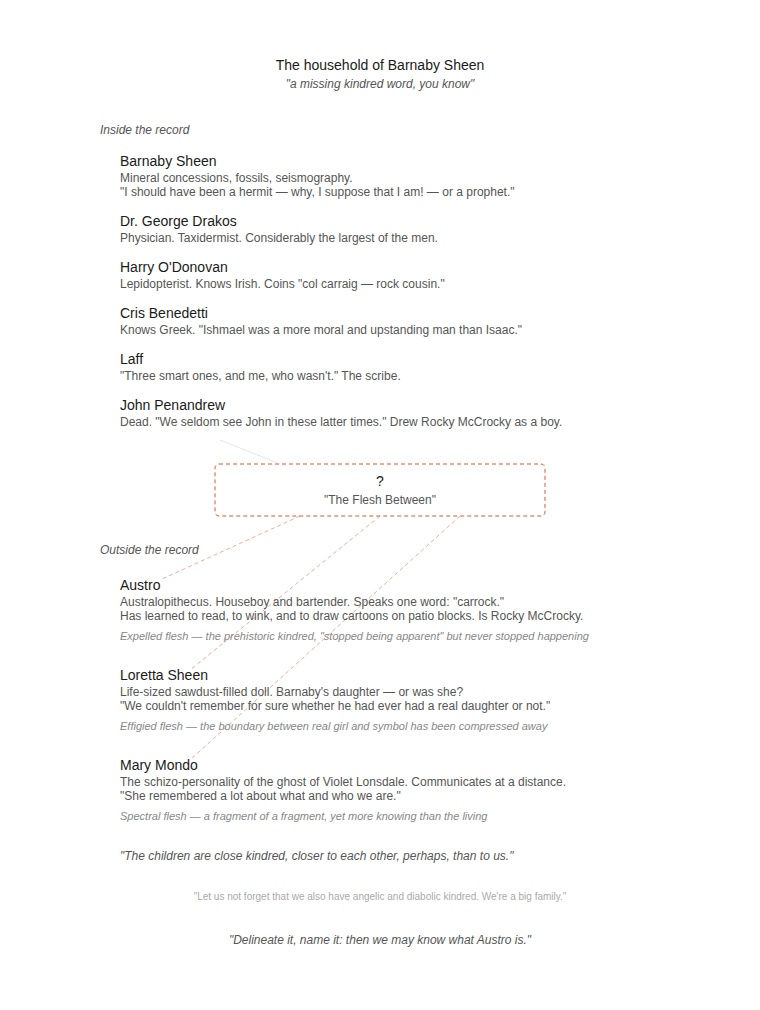
“The children, Austro and Loretta and Mary (none of them is more than a child or at most an adolescent), are close kindred, closer to each other, perhaps, than to us. It is common, perhaps universal, that children are of a slightly different race (I mean it literally) than they will later become. But it is all right with them.” “When were the several decades left out of United States history, Barnaby?” Cris Benedetti asked him. “Early, and recent, and present, for I rather suspect that our own contingent present will not be firmly inscribed in the records.” “You mean that we may not be recorded as real?” Drakos asked. “Possibly not,” Barnaby said.
Let’s begin with the obvious. Lafferty wrote many stories and novels in which amnesia is a central problem. For him, amnesia cuts across human and animal ontologies, across history and culture, and, in its widest circle, across salvation history, thus preparing his kaleidoscopic range of possible apocalypses and eschatologies. What Lafferty does not often do is give the reader a centered vantage point on anamnesis. It happens, but rarely. What is shown when amnesia lifts? Here, Lafferty gives it a name: the Flesh Between.
That take on anamnesis must be qualified at once, because almost everything in Lafferty involves backing into anamnesis and exposing the Flesh Between. It is merely that, as a writer who creates machines to trigger anamnesis, he usually writes indirectly, through anti-secrets. People often miss the anamnesis. Anamnesis sneaks up. Or it comes in from the flank. It does not explode into view. Only in a handful of moments is it unapologetically joyful, which is how Lafferty saw it in its naked form.
For the most part, anamnesis takes a back seat to apocalypse in Lafferty. Yet anamnesis is the rem desideratum. It had to be clothed: out of propriety, to sell in a market, to make artistic form, and because this was the most effective way to get people to shed the amnestic burden. A real exception is “Read the Flesh Between the Lines,” one of his great stories, though it will probably never be recognized for how central and great it is. In his E. I. Watkin sequence, it takes the place of Indigo, the color between the constraints of materiality, Violet, and the wonder of metaphysical vision, Blue. It is the site of history and ethics. No surprise then that Lafferty gives the reader of “Read the Flesh Between the Lines” a lesson in historiography. It is also a lesson in reading generally, and in reading Lafferty in particular.
This would be a bad place to start with the Austro stories. We are now several steps into The Men Who Knew Everything Sequence, and, unlike the Institute sequence, TMWKE should be read in order for maximum understanding and enjoyment. It begins with the one-off “The All At-One-Man,” makes the full turn into thinking with E. I. Watkin in “Mud Violet” (hylicon) and “Barnaby’s Clock” (violet). The latter introduces Austro.
In “Read the Flesh,” the second Austro story, Austro learns to speak more than one word. Readers learn more about the strangeness of the TMWKE universe, along with the fact that Austro was created and not created by the dead John Penandrew. In its final explosive scene, there is a callback to “The All-At-Once Man,” with the blast moving the doomed, weird Penandrew house. It is easy to miss this if one does not remember that the Penandrew home is at Harrow. There are many funny, fine, and small things here. I’ll mention one and then summarize the story. Pluto Water.

At one point, Lafferty asks the reader a question about forgetting, and the answer, I think, must be yes. It’s a joke question, because here is a story about compaction that ends with an explosion, the question is about a laxative, and Pluto Water was common knowledge in the U.S. and now is utterly forgotten. In the story, George Drakos, as a boy, uses empty Pluto Water bottles to store his specimens. They contain memories, and Lafferty embeds his question directly into the physical description of the room:
There was the taxidermy of George Drakos: stuffed owls, snakes, barn swallows, water puppies, mountain boomers, flying squirrels, even foxes and wildcats. And there were the dissections (also of Drakos) of frogs, of cat brains, of fish, of cow eyes, and many other specimens. The best of these (those still maintaining themselves in good state) were preserved in formaldehyde in Pluto Water bottles. Pluto Water bottles, with their bevel-fitted glass corks and wireclamp holders, will contain formaldehyde forever: this is a fact too little known. (Is Pluto Water still in proper history, or has it been relegated out?)
It’s a symbol for what the story wants to bring to the reader’s attention. And Drakos’s experience of anamnesis will be where the story ends.
Some background. Pluto Water was a bottled mineral water from French Lick, Indiana. An American staple, it was sold in the United States as a strong laxative in the early 1900s. Its mineral salts, especially sodium and magnesium sulfate, made it really potent stuff, and it was marketed with the line “When Nature Won’t, PLUTO Will.” It was discontinued in 1971, shortly before Lafferty’s story was written, because lithium in the water became a controlled substance.
Pluto Water is one of the story's master images because it rumbles like an irritated gut, then explodes, voiding the content of history. That is a very low and comic image for something very serious, but Lafferty knows what he is doing when he gives history a laxative in "Read the Flesh Between the Lines," as we see in his long digression on Rabelais, whose earthy humor is here. We are on a thin, sweating brane of consensus history.
What happens at this time is that the four Men Who Know Everything and Laff meet at the home of Barnaby Sheen, whose old room over the garage is emitting that weird rumble. Dr. George Drakos, Harry O'Donovan, Cris Benedetti, and Laff have had a long shared history in the space, going back to their boyhoods, when this was their clubroom. The room has vast accumulations from different eras, for it belonged to Barnaby’s grandfather, and used to be a barn. This is Lafferty reminding the reader of the history of how garages became garages in America (the first garages were converted carriage houses because those were the people who could first purchase cars):
In the time of Barnaby Sheen's grandfather, who came out here from Pennsylvania at the first rumor of oil and who bought an anomalous “mansion”, this was not a room over the garages, but over the stables and carriage-house. It was a hayloft, that's what it was; an oatloft, a fodderloft. And a little corner of it had been a harness room with brads and hammers and knives and needles as big as sailmaker's needles, and cobbler's bench...
There are hayloft remnants, early automobile parts, taxidermy specimens, and thousands of old comic books and Sunday funnies. We quickly see that all these pieces are indices of the several mutually exclusive boyhoods the men lived through. Barnaby asks his friends to investigate the space and warns them.
At this point in the sequence, Austro, the Australopithecus houseboy, has become essential to the series. As I mentioned, at the beginning of the story he can say only one word: “Carrock.” We also have Loretta, Barnaby’s daughter, the sawdust-filled doll, and the schizo-gash ghost Mary Mondo.
Barnaby tells his friends that human history is artificially compressed, and that unrecorded or suppressed events, people, and entire centuries build up explosive pressure over time. Lafferty gives us wonderfully inventive detail and alternative history. We learn that the Library of Alexandria did not burn, but exploded, when centuries of excluded historical record forced its way back into space. There is a discussion about Austro and the nature of cousinship, a figure for how we are related to all the past we repress and forget. The friends finally begin to see him as a forgotten cousin, and Austro begins drawing primordial cartoons on concrete patio blocks with a bone stylus and ocher paint.
The rumbling builds. Then the garage violently explodes, knocking out walls and filling the air with a localized storm of suppressed history. The men see howling, animate clouds, forgotten political parades, strange dog breeds, and past versions of themselves flying through the wreckage. It's all done in Lafferty’s listing of brilliant proper nouns that never were:
All the air was filled with reek and smoke and howling animate clouds. These clouds at first seemed like flying masses of biblical grasshoppers and locusts, plague creatures, but they had faces on them, and remembered parts. And they were upbeat and strong and not at all overwhelmed by the destruction. There were the blown-apart pieces of boys flying through the air, and some of them looked a lot like ourselves. There were flying effigies by the thousands. Why, there was one whole parade or convention with banners flying. “Re-elect President Parkinson” was the message on the banners. He had been the leader of the Cow-Moose Party when he was elected president. How had he been forgotten, when weak echoes of him had been remembered?
After the blast, Austro comes out singed but laughing and says his first complete English sentence: "Carrock, carrock, we bust the crock." The men then have a moment of anamnesis: they know the caveman comic strip character named Rocky McCrocky, whom their dead friend John Penandrew drew as a boy, as he happily continues drawing his million-year-long saga on the salvaged stones in front of them.
This is a fantasy, but let’s take it seriously, as if it were a philosophy of history. It begins from a premise that, of course, violates our standard modern assumption, the one shared by positivists, progressivists, and most working historians: the historical record, however incomplete, is a reasonable approximation of what happened. What we don't know is just what we haven't yet discovered or what was never recorded.
Barnaby has a counterproposal. The record is a compression of something orders of magnitude larger, and the compression is not passive (we forgot) but active (it was made not to have happened). Lafferty is often conspiratorial, but he has a side that bucks against that hard, and this is anti-conspiracy theory. Barnaby is not saying that some cabal hid the real history. He is saying that the act of narrating violates reality and has cumulative consequences.
Every history written leaves things out. That is just the problem of space. But the things left out do not vanish after having been left out. The Pluto Water is still there, putting pressure on the intestines of history. Lafferty’s big image for this is in the story, an involuted number series. Between any two integers on the calendar, there are "very, very many" real numbers, real years, real events, real people. They are compressed into the gap. As Barnaby explains, compression is dangerous:
"But when you try to compress a hundred thousand years of history into six thousand years, something has to give. When you try to compress a million years, it becomes dangerous. An involuted number series, particularly when applied to the spate of years, becomes a tightly coiled spring of primordial spring-steel. When it recoils, look out! There comes the revenge of things left out."
Now the theological dimension. Lafferty takes the claims of salvation history and brilliantly scrambles them. The Millennium of Revelation 20 happened, he says. The Devil was bound for a thousand years. The traditional image of that is one of calm and bliss, but it was not what anyone expected:
"It was the Millennium itself, and the Devil was bound for a thousand years. But he surely was not quiet about his binding. He clanked and howled; he shook the whole world, and he caused land tides and sea tides. He caused mountains to collapse and people to go fearful and even to die literally petrified. And then the people discovered a cloud-capping and roaring humor in their fearfulness. A giantism appeared, a real awareness, a ridiculousness which has always been the authentic rib-rock of the world."
It was a chaotic, wonderful period. Then it was dropped from the record because history could not bear the weight of it. This is a view of the Middle Ages that one finds through Lafferty that he shares with G. K. Chesterton. One finds it in stories such as “Among the Hairy Earthmen.” Lafferty fills out this, and he tells us about another lost period. Barnaby knows about it through the work of Atrox Fabulinus. It is the history of the three Roman Kingdoms, the three Republics, and the three Empires, each lasting more than a thousand years.
Then Lafferty gives us what I take to be a real version of how he sees history: something that brutalizes and simplifies into ideal types. He tosses out the idea that the eight kings named Henry in England were once eighty. At some point, there will be one. He imagines that there was a President John Braintree Adams between the two we remember. Barnaby says speaking literally, and the story gives us no reason to doubt him. I’ve written about Lafferty’s sliding scale of allegory, but this does not seem to me like simple allegory. Lafferty is, in his one-of-a-kind way, depicting the historical process.
The apocalypse at the end of the story is one of Lafferty's literal ones, an unveiling. Harry O'Donovan recognizes that "one of me sailing through the air with my head half severed off" was a version of himself from a lost boyhood, and says, "you have given me back the lost two-thirds of my boyhood." The members of the household are larger and fuller after undergoing anamnesis. They remember things they did not know they had forgotten, including what kindred Austro is to them. "We remembered now. John Penandrew used to draw Rocky McCrocky when we were boys. But Austro was Rocky McCrocky. No wonder he had always looked familiar."
At the same time, the recovery does not give anyone the original million years back. Instead, they get Austro's cartoons on patio blocks, Loretta dribbling sawdust, after-images like a fire in a fireplace, and Austro’s crooked wink.
The extended passages on the cousinship in the story are a lesson on history. In the exclusion zone that blocks off so much of our history are forgotten cousins, rumbling facts, the difficult-to-read flesh-between-the-lines of Loretta, Mary Mondo, and Austro:
“Austro is such a trace,” Barnaby insisted. “He is a Flesh Between. I am believing that no creatures have ever stopped happening, but some of them have stopped being apparent. This calls into question the whole nature of reality.”
A million years go by; Rocky McCrocky comes out. It looks like another joke, but Lafferty is making a serious claim when he writes, "There is a lot of good information to be found in the weekly Rocky McCrocky documents."