"Slippery" (1985)

Updated: 1 day ago

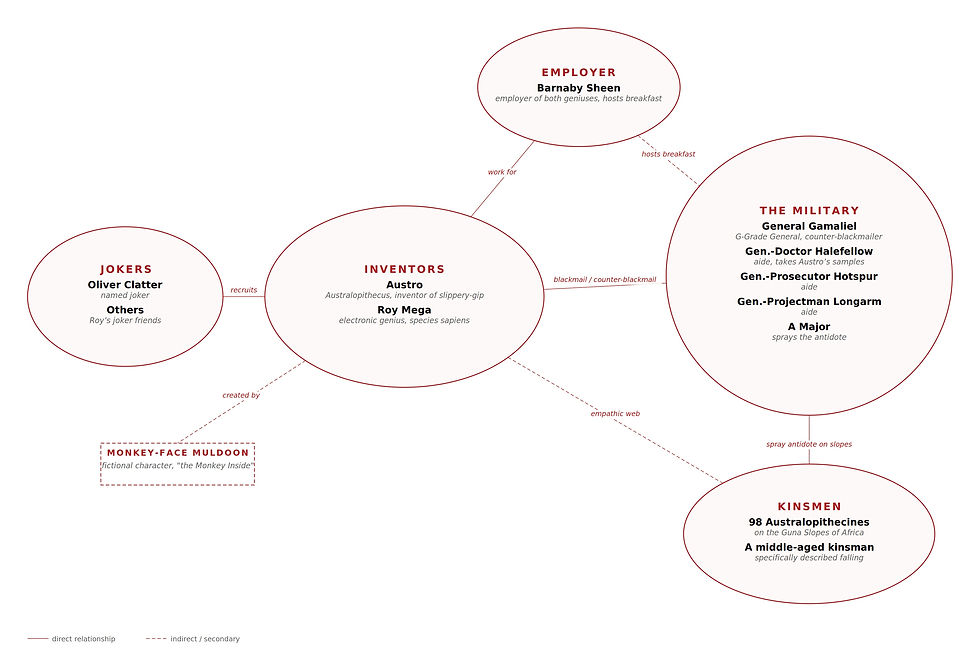
Lafferty’s “Slippery” is a good example of how Lafferty can be both light-hearted and subtly moralizing. The moralizing here is lightly applied. Roy Mega and Austro develop a friction-destroying mist called “Slippery-Gip,” which unleashes chaos. Austro delights in the way everything slides about uncontrollably, and he plans to blackmail the world by targeting people and their possessions with this hyper-slick substance, derived from super-glycerine.
General Gamaliel and his team arrive to stop him, and the general unveils a counterplot that endangers Austro’s kindred on the Guna Slopes of Africa. Faced with the threat to the Australopithecines, of whom there are exactly ninety-nine, Austro backs down and abandons the plan, though he still tries to profit from it.
Where is the moral dimension? Slippery-Gip unsticks. It “gyps” people out of having what should be theirs. When it does this, all the unspoken social, moral, and physical rules that hold culture together are put at risk. In the story, Lafferty gives us an astonishing catalogue of goods that slide free, making their ordinary moral affordances impossible. Here, unlike in most Men Who Knew Everything stories, Austro is a moral primitive. Only empathy brings him back into the space of moral reasons, and even then, he tries to cash in on the failure of his blackmail scheme by creating stock options. That, of course, is itself a moral critique.