"Rang Dang Kaloof" (1971/1972)

Updated: 6 hours ago

“Bertigrew Bagley was fat and ungainly, grown old ungracefully, balded and shaggy at the same time, rheumy of eyes and with his mouth full of rotten teeth, discredited, violent and vulgar: an earthen pot, and a cracked one at that.”— Fourth Mansions (1969)
The French surgeon René Leriche once said that “Health is life lived in the silence of the organs.” Lafferty’s “Rang Dang Kaloof” is about what happens when a gnome makes them scream. It’s one of his funniest stories, and also one of his meanest. The laughs are Hobbesian and schadenfreude-filled. Behind them is something quiet and sad—not in tone, which is merciless, but in the story’s subject matter and big ideas. Few Lafferty stories are more direct, and this is one of the few that might have appeared in Playboy, even if it did not, in fact, run there.
Yes, it’s a conte cruel. But it dips, with studied casualness, into some serious territory, even as its story world makes it seem absurd to take the "Rang Dagn Kaloof" seriously at all. Yet here is a story about aging, private pain, loneliness; about how one person’s intense physical suffering can seem to others like nothing more than an inconvenience or nuisance. And also gnomes. That part is very Lafferty: don’t take this too seriously, even if it was about his own physical suffering.
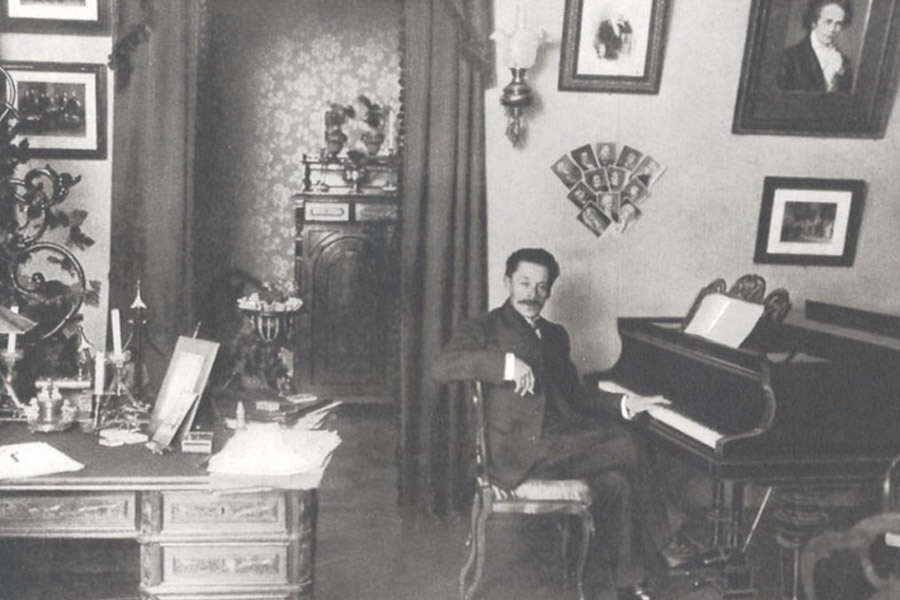
The subject matter was deadly serious for him. If you are unfamiliar with his biography, you might not realize that this story is one of the few instances in which Lafferty writes about his own health in fiction. There’s no comparable story stemming from his later accident, when he fell and broke both knees decades afterward. But after suffering a heart attack, he wrote this one. He had undergone the kind of medical regimen that the main character in “Rang Dang Kaloof” follows. For years, a photograph has circulated of an almost unrecognizably slimmed-down, convention-going R. A. Lafferty.

The story’s treatment of moral and natural evil is one of its most interesting features. I will come back to that after summarizing the plot.
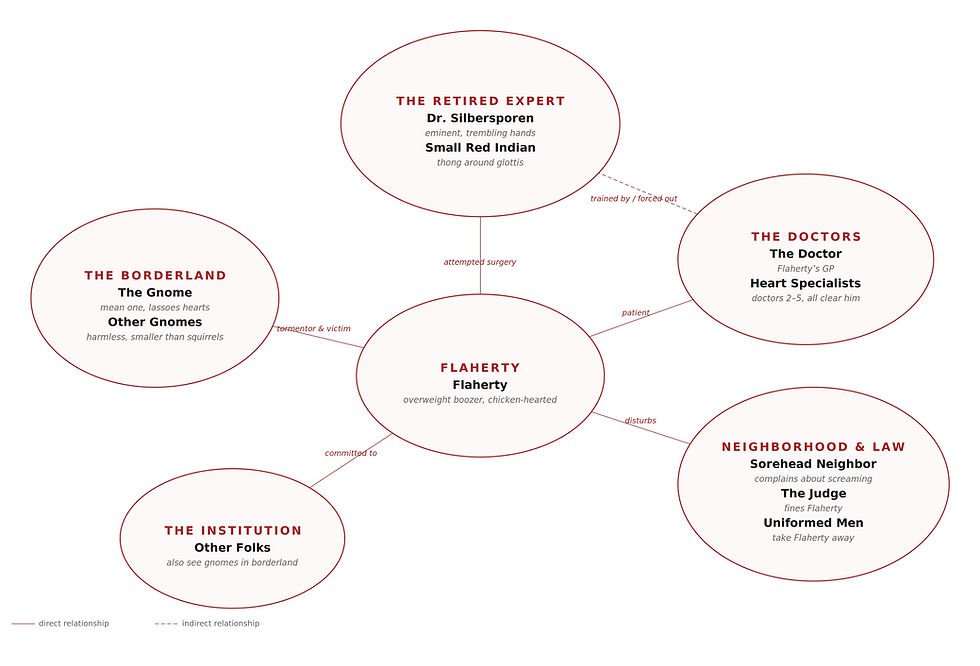
In the evenings, a middle-aged man named Flaherty often sees small, gnome-like creatures in the borderland between wakefulness and sleep. Until this point, he has lived peacefully with them, but today that changes. A new arrival with "something a little mean about him" incites a quarrel by trying to drag away Flaherty's old left slipper. The gnome (Lafferty tells us they aren’t really gnomes, of course) offers a justification, claiming, “I’d never take the right one... I have no province at all over things of the right hand or the right foot.” As an added insult, the gnome says, “And you do need new slippers. These are a disgrace.” When Flaherty tells it to “Go to hell,” it retaliates by throwing a magical lasso that fastens around a vein in his heart, causing what Flaherty feels as a weird little tug.
And here is where the title comes in. The gnome reveals that Flaherty can only get relief from the heart pain by crying out the un-magical phrase, "Rang dang kaloof." This is the beginning of a cycle of torment, with the gnome being a sadistic performance coach. “When I say louder, I mean louder,” says the gnome, tightening the loop until Flaherty screams. This leads him to doctors. They can find nothing wrong. One physician concludes, “I believe your heart’s nearly the soundest thing about you,” before offering a list of lifestyle changes that concludes with the dry advice, “And bad jokes—take it easy on them.”
Flaherty's life then unravels as the gnome’s sessions become more demanding. Flaherty’s attempts to medicate his pain away are mocked. “Valium,” the gnome sneers, “How are you going to get rid of a noose with Valium pills?” One evening, the gnome criticizes his attempts to muffle the noise, yelling, “You soundproofed the place, you piker! Open all the doors and windows... We may as well put on a good show.” This leads to Flaherty’s arrest for disturbing the peace. After exhausting conventional medical options, he seeks out the old Dr. Silbersporen, a brilliant but for some reason disgraced specialist who, he is told, “doesn’t practice now because he’s agreed not to.” Flaherty is right that something fishy is going on.
Dr. Silbersporen immediately validates Flaherty’s experience. You see, Silbersporen suffers from a parallel affliction involving a small red Indian and a rawhide thong around his glottis. He confirms the existence of the specific heart vein and offers to perform an immediate surgery with a paring knife. Flaherty asks, “But is it sanitary?” Silbersporen admits, “No, of course it isn’t.” Terrified, Flaherty flees as the doctor makes the first incision. Lafferty writes, “For Flaherty did have something the matter with his heart. He was chicken-hearted.”
The escape is bungled. Flaherty runs into a tree, is knocked back into the borderland, and is captured by the waiting gnome. Taken away by uniformed men, Flaherty is placed in a bughouse where, though his torment continues, his profound isolation has ended. “There are other folks there who can see the gnomes... There are other folks there who suffer from them.”
In thinking about “Rang Dang Kaloof,” I’m struck by how Lafferty took an instance of what most moderns would call natural evil and reimagined it as moral evil. That is, of course, a question about this story, but it ties into something pervasive in Lafferty: a rejection of any hard line between the two. Western philosophy and theology have struggled with the problem of evil for as long as they have existed. But it’s really only in the Enlightenment that both developed a critical distinction between suffering caused by moral agents and suffering that arises from natural processes: moral evil and natural evil.
I suppose it’s obvious, but moral evil refers to harm resulting from the blameworthy choices of free agents, such as acts of cruelty or malice, or telling a gnome trying to steal your left slipper to go to hell. Natural evil, in contrast, encompasses harms such as disease, earthquakes, or famine that appear to have no direct human agent.
It is a defining trait of a post-Enlightenment mind to see it as belonging to the natural order. If a tornado hits my neighbor's house and not mine, even if he is a s.h.n., to say that it was divine wrath looks like I’m doing some selective sampling. So this conceptual division is interesting because of how Lafferty likes to flaunt it. While only formalized in the modern era, the distinction has deep roots in early Christian thought.
Lafferty would have known that St. Augustine of Hippo categorized all evil as either "evil of sin" (malum culpae) or "evil of punishment" (malum poenae). For Augustine, malum culpae was evil committed through the misuse of free will, which aligns with the modern concept of moral evil. Malum poenae, or evil suffered, included natural harms like illness and death, which he viewed as the just, divinely ordained consequences of humanity’s original sin. Thomas Aquinas later systematized this framework. He argued that sin was a privation in the will’s act, while suffering was a privation in a creature's due perfection, such as health.
This was the Catholic view that developed over centuries. During the Enlightenment, we find theologians beginning to use terms like malum naturale, and Gottfried Wilhelm Leibniz’s Theodicy (1710) popularized the threefold division of malum morale (moral evil), malum physicum (physical or natural evil), and malum metaphysicum. If one were to say there is a moment where natural evil became intellectually unavoidable, it was the 1755 Lisbon earthquake and the intellectual debates that followed. After that, one finds the modern way. We assign responsibility for suffering to either human choices or natural—and thus potentially divine—causes. But we are measured in our approach to the latter.
"Rang Dang Kaloof" shows Flaherty’s suffering as being simultaneously moral and natural in its origins and manifestation. Lafferty gives the inciting incident as one of clear moral evil: a gnome, acting out of spite, makes a conscious choice to inflict harm on Flaherty. The gnome says he is not accountable (topologically) to the moral axis. But it is an act, not a causally opaque occurrence of nature, but a deliberate, malicious decision. The gnome is personal and petty, and he won’t thaw. The lasso is fastened around Flaherty’s heart vein “for orneriness, that’s why.” The gnome’s delight is evident as it declares, “Ah, I love myself when I do things like this,” placing its actions squarely in the category of malum culpae, or evil done. I’ll admit: this makes me laugh, but I can see that what Lafferty is doing in making me laugh is morally complex.
Now, the consequence of this moral act manifests in Flaherty as a seemingly natural evil. He experiences tangible, physical symptoms—what he feels as “a very weird little tug” and “a queasy feeling”—that mimic a medical condition. How could Flaherty ever explain that he is the victim of moral evil? To the outside world, including a series of doctors, Flaherty's suffering appears to be a malum physicum, a spontaneous breakdown of his body or mind. A physician, unable to find a physical cause, concludes, “I believe your heart’s nearly the soundest thing about you,” while Flaherty protests, “There is still a stricture about a nameless vein in my heart, even though you say there is no such vein as I describe.” In the absence of the moral evil as cause, Flaherty's cause must be otherwise: mental. Flaherty is cracking up just as Doctor Silbersporen cracked up.
"Rang Dang Kaloof" puts intellectual pressure on the categories of moral and natural evil by creating an unbreakable causal chain between them. The natural evil (Flaherty’s physical torment) is not an independent phenomenon. It’s the result of a moral evil. A gnome does it to him. Within the story, I see the Augustinian view of sin and punishment, and I see Lafferty offering the reader a dark and complex parody of it, one that feels very light due to its filtration through Irish folk-Catholic beliefs and American popular culture.
In the traditional Augustinian view, natural evils (malum poenae) are the divinely ordained consequences of moral sin (malum culpae). Lafferty preserves this causal structure but twists it, replacing the agent of divine justice with a malicious, non-divine figure from folklore. The punishment does not come from a distant, just God in response to sin. It is delivered by a creature from “another country entirely,” who acts not to condemn or redeem, but out of pure orneriness. This being, outside our conception of the divine plan but still within a fallen world, imposes a grotesquely disproportionate penalty.
Like Dr. Silbersporen’s little red Indian, the gnome is a comic image of the primordial—the physical world that turns against us when our bodies fail. If Lafferty saw sacramental participation as a spiritual remedy, one reason it is needed lies in the indignities of fallen flesh. The gnome’s command, “Feel when I pull it tighter,” is one of Lafferty’s best and most memorable existential lines.