"Oh, Those Trepidatious Eyes" (1975/1977)

Updated: 13 hours ago

“But on the third hand, and often to the exasperation of critics, the writer usually knows what is wrong or right with a story better than a critic does.” — Letter
The drowsy stillness of the afternoon was shattered by what sounded to his strained senses like G. K. Chesterton falling on a sheet of tin. — P. G. Wodehouse
To start a fight with someone who loves Chesterton, say that Chesterton was an alcoholic. Though it is in poor taste to mention, one of the qualities Lafferty shared with his favorite writer is immoderation with food and alcohol. Immoderation, as a sign of spiritual disorder, was one barrier in Chesterton’s progress toward sainthood more than a decade ago, and I am one of those people who thinks the mysterious period of illness in Chesterton’s life was related to his drinking.
When I read “Oh, Those Trepidatious Eyes!,” I find myself thinking, against my will, that both Chesterton and Lafferty paid for not taking better care of themselves. Chesterton died too young, and Lafferty suffered his first heart attack too young. The strokes that silenced Lafferty for nearly a decade at the end of his life were no doubt connected to the way he treated his body—that is to say, badly. At one point, before the false teeth, he was apparently down to a yellow tooth.
There is not much self-consciousness in Lafferty about being a fat man, but it is hard not to see, as many readers have, a portrait of himself in Berigrew Bagley. Lafferty was asked about it. His answer was disingenuous. He was sometimes disingenuous, as when he said he didn’t put his religion into his works beyond Past Master. One suspects he was self-conscious about his weight. Why? Because he repeatedly called himself a fat man.
It is also simply a fact that there is a great deal of food in Lafferty’s work, and he is extremely memorable on the subject, from the Big Breakfasts of Space Chantey to the dead dog in “Once on Aranea.” I think he is brilliant on food. Much of that brilliance centers on grotesque eating. People like to point out the Lafferty violence, but food is as libidinal and grotesque as blood in his fiction.
What to do with that detail is not clear to me, except to note that there are stories in which shame and food, and censure and food, are tightly knotted. To give two examples, consider “The Doggone Highly Scientific Door” and “Pleasures and Palaces.” “Oh, Those Trepidatious Eyes!” is somewhat difficult at the margins because of how it treats food, or more exactly, how it marshals the affect attached to the food. On the other hand, what it says about food critics, and by extension about the pretentiousness of most critics, is crystal clear.
One of the Epicures in the story, Vanessa Van Wyck, defines some critical standards:
“We are impossible to please,” said Vanessa Van Wyck who was another of the Epicures, “because it isn't mere pleasure that we wish. We do not ask to be pleased, but to be astonished. And we are easily astonished: it takes no more than total novelty and total excellence, and the transcendence to be found in one dish in a million. Astonish us now, Winchilsea.”
The main character, if one can really call him that, is the person Van Wyck addresses: August Winchilsea, an arrogant restaurateur. Winchilsea is deferential to only three people. They are the powerful patrons and critics known as the Epicures: Alban Raffels, Vanessa Van Wyck, and Cushman Sweetbasil. These Commissars (as they are called) wield the power of life and death over ordinary people. They demand foody transcendence during their monthly dinners at Winchilsea's Far Eastern Restaurant.
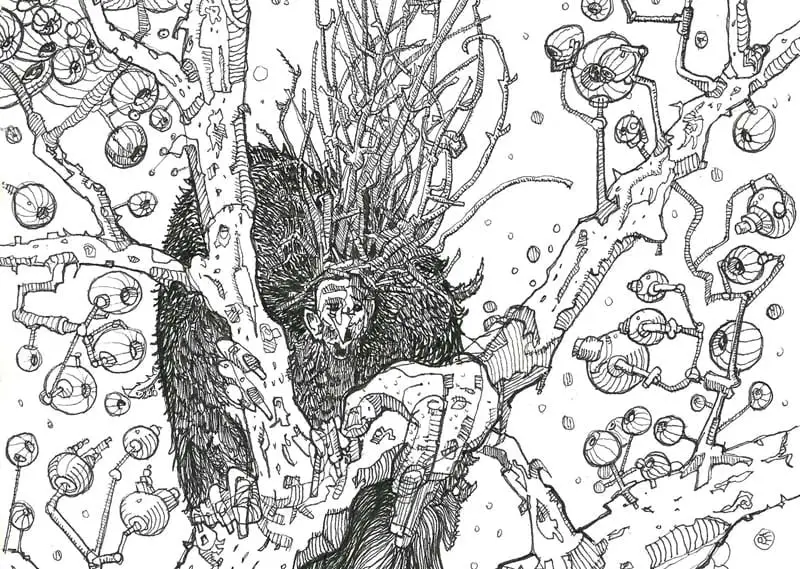
This makes Winchilsea a nervous wreck, but he finds a way. He serves the three critics the roasted tails of three rare, giant lizards known as Anagenno Draco Draco. These are very smart lizards, and they have a weird trait: they snap off their highly edible tails when spooked. Winchilsea develops a technique to rapidly regrow the creatures' tails by placing them in a nutrient vat.
The three lizards—Maco, Caco, and Draco—are great for business. Winchilsea even trains them to assist with cooking tasks in the kitchen. At the same time, he is frightening the hell out of them three times a day to harvest their tails for the Far Eastern Restaurant. Yet the lizards are good-natured; they don’t seem to mind. And that is part of the problem, because soon they become too friendly and trusting to be frightened by him.
To keep the meat supply, Winchilsea hires Herman Boggle-Eyes, a man with terminal Grox Disease. His appearance scares the lizards into dropping their tails. Over time, the lizards once again become inured. By the week of the next scheduled Epicure dinner, Boggle-Eyes is unable to frighten the dragons into snapping off their tails. It looks as if there will be no snap-dragon steaks.
So, on the afternoon of the dinner, Winchilsea, desperate, banishes Boggle-Eyes from the kitchen and tries to scare the giggling lizards himself. During his frenzy, he falls into a spinning buzz saw and severs his leg just below the hip. The friendly lizards want to help. They plop Winchilsea into the nutrient vat to regrow his limb, and he drowns.
Facing the dinner deadline, the lizards use the buzz-saw on Winchilsea's severed leg to get three pieces. They roast and serve it to the Epicures. Unaware of the substitution, the Epicures begin eating the leg, including its roasted shoe and burnt clothing, while the three lizards wait nearby, displaying the same trepidatious eyes their former master once had:
Vanessa had the piece of Winchilsea's leg with the shoe on it. And she was tasting the shoe first, and she was so deliberate about it. Would the Epicures like the presentation? That was the worry. They were so slow about it all, and so much depended on it. Fiddling with shoes and baked pants. Would they never get to the meat of the thing! Worry! Apprehension! Trepidation! Oh, the trepidatious eyes of those dragons!
As one can see, Lafferty comes down hard on the critics here, and he does so in what we might call his white-hot outré mode, piling up gnarly details to tell a story that bears on something Chesterton once wrote about gluttony. He said, “Gluttony is a great fault, but we do not necessarily dislike a glutton. We only dislike the glutton when he becomes a gourmet—that is, we only dislike him when he not only wants the best for himself, but knows what is best for other people.”
The Epicures are gourmets in this sense. They are more repulsive than the mere glutton because their disorder is deeper. It is pride, a form of immoderation far more poisonous than gluttony. The poor lizards move in the story from simple physical fear, which leads to their tail-snapping and the happy making of something out of themselves for others when they cook up their tails, into the penumbra of dread cast by the critics.
That dread is understandable. Lafferty occasionally saved his reviews. He even saved some rough ones, so I’ll wrap up with something memorable in this regard, a letter Lafferty sent to The Library Journal. It is hard not to read the story as a payback for such slights.