"Mud Violet" (1971/1973)

Updated: 5 hours ago

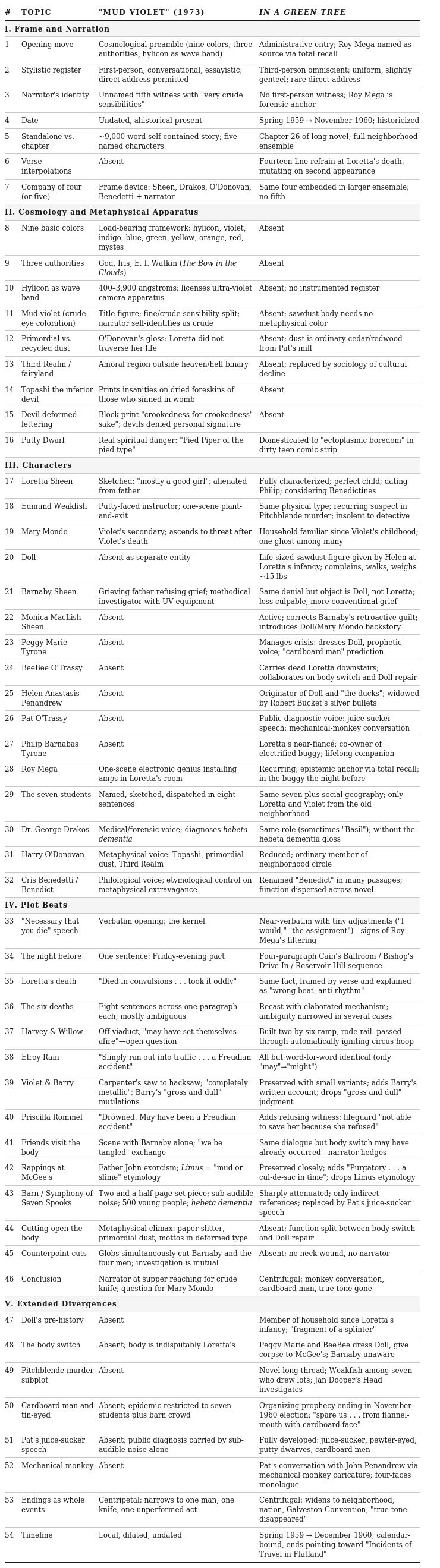
There are nine basic colors: hylicon, violet, indigo, blue, green, yellow, orange, red, and mystes. There are persons who say that there are more basic colors than these: but they confuse hues with colors, or they list non-basic colors such as the purples and magentas and the variously named non-spectral violets and reds. To such persons we can only say, "You are mistaken." There are other persons who say that there are fewer basic colors than these listed here, that the first and last colors of our list are not visible colors at all. To such persons we can only say, “Go get your eyes fixed.” The three most knowledgeable authorities on this subject (God, a cosmopolitan; Iris, a Grecian lady; and E. I. Watkin, an Englishman) agreed that there were these nine basic colors in the bow in the clouds and that all other colors are contained in them.
A totally unformed energy-matter cannot actually exist; it is mere potentiality. But the formed matter of one level becomes the matter of a higher form. Inorganic energy-matter is the matter of vital form, life in turn of spirit. — E. I. Watkin, The Bow in the Clouds
Probably advanced Lafferty. A great story.
Lafferty fairly often returns to the possibility of nulled existence: not overpowering evil, but low-energy conditions of smallness, boredom, apathy, unimaginativeness, indifference, and negation of the duty (interviews; Aurelia) to be happy. It creates what he calls the wan wit and the tin eye. What he calls the trashed-life principle and the story blight of heroic tedium.
The best-known example in the Lafferty canon is Ouden-related, the cliché. Ouden is nothingness, the principle of privation figured as an empty mouth; but Ouden is also that which exploits negation and enervation. That which kills with lies and platitudes. The latter is how I understand Lafferty’s mysterious Putty Dwarf, who is called both a devil and ectoplasmic boredom. He is Lafferty’s most pathetic devil.
For me, the Putty Dwarf is also Lafferty’s most memorable image of embodied yet abandoned actualization. I find Edmund Weakfish to be far creepier than Carmody Overlark. He is perversion in its truest sense, one of the archetypes of the age in Not to Mention Camels. Matter (putty) insufficiently informed (dwarf) with the result that the breathing person sets itself against what ultimately must be pneuma or Ruach. Matter that rejects Christ’s spittle. As such, he is a figure for noetic darkening. The anti-rhythm (in the story’s language) within the person degrades into cliché and motto, appetite and routine. The self falls into das Man. (“That business about the slime of the earth and of spittle has offended many.”) Or, in Lafferty’s other image for it, into pied, disordered, printer’s type. Words become un-worded. Logos is withdrawn. Better to have never been born.
It is the rejection of order Barnaby finds when, desperate to talk to her, he cuts into his dead daughter’s throat and sifts through the primordial dust extruded by her backward passage into sub-cognizable hyle. Barnaby wants to communicate with his dead daughter, but she is now this:

The Putty Dwarf is the pied piper of pied type, we are told, and pied type is a nightmare.
Two relations seem to be at work, what I am going to call negation and privation, so that I can talk about the strangeness. Both bear on what Lafferty takes to be the moral evil most associated with the Putty Dwarf: suicide. Understanding how negation relates to privation in Lafferty’s imagination is part of what makes “Mud Violet” so difficult, and I may be wrong about this, yet it is where I have arrived after reading the story many times. I’ll spare you my crazy theory about how Roy Mega works in the story.
Big picture now. Strictly speaking, in the Catholic tradition, only privation is evil. As you know, privation is the absence of a good that ought to be present in a thing according to its nature, which is determined by its essence, which has a final cause. A stone does not have sight, but the stone’s lack of sight is not evil. It is a negation, not a privation.
But Lafferty imagines what Harry in the story calls the Third Realm. The Third Realm is a condition of near-nonexistence in which a person negates himself by sinking toward hyle, stopping just short of the pure and innocent potentiality of prima materia.
It is not an aesthetic strength of “Mud Violet” that it equates this with rock and roll. Lafferty’s choice to enfigure his metaphysical conceit as anti-rock just distracts from it now that most people can hear what is artful in rock. This is an aesthetic blemish that one feels strongly in 2026, but that may be less of a distraction for future readers. I have called it theotropic dissonance. Lafferty knows all this is difficult stuff, and he knows he is taking a cheap but fun for him shot, so he gives the following dialogue between Edmund Weakfish and a student:
“Mere matter is always invisible,” Priscilla maintained. “It becomes visible only when touched with spirit. Mere matter may recognize itself in other ways though. I have always suspected that Loretta is mere matter with none, or very little, spirit.” “I have lots of spirit,” Loretta Sheen protested. “Oh, we will tangle, girl, we will tangle!” “How is it that all of us see rocks, for instance?” Weakfish asked. “I suppose that all of us can, and surely rocks are somewhat lacking in spirit.” “I don’t know,” Priscilla said. “I haven’t worked out that part in my mind yet.”
“I haven’t worked out that part in my mind” is a beautiful Lafferty line.
That the prima materia is invisible is a position that goes back to Aristotle. Familiar lumber from the metaphysical tradition. It is invisible because it lacks all form, and even rocks have form. One can’t see what is absolutely formless.
“Mud Violet” presses on the relation of matter and form by imagining persons who can negate themselves sideways. They do not simply rise or fall on the ladder of being. They somehow step out of it, orthogonally, into a state of near nonexistence. They do not merely lose a perfection proper to personhood the way I do when I act uncharitably to someone. They try to become an entity for which that perfection would no longer be required. They poltergeist themselves. The sound of success is that poltering knock.
What is left is not ordinary moral deformation, but something more radical: aspects of form that would make evil intelligible have been subtracted from the person. The result is a residue of personhood nearly without form, or more specifically, a new morphe with less eidos. It is less like losing sight in one eye than like losing the Pax6 gene that in-formed the eye.
To underline the difference, consider ordinary suicide beside the mud-violet death trip. The latter is an ontological arrest or regression, a scrambling of form back into mud of barely shaped hyle. It is a decision to stop, to back out of the life affair by surrendering one’s final cause. The secondary matter composing the physical body is, as it were, rewound from achieved actuality. Such an act would not simply deprive a formed organism of life. It would negate very advanced forms, presence, and actuality that make being good. Its horror lies in un-creation: the dialing down of being into something less good, less full of being, because less fully present, even if not more culpably evil.
The mud violet death is an orthogonal exit that makes “Mud Violet” a cautionary tale. I think Lafferty’s point is that what presents itself as mere negation is usually privation in disguise, so that the horror of the Putty Dwarf is the presence of unrealized form that thinks itself happy to remain unrealized: the shabby face of privation masquerading as negation. In Green Tree, Lafferty has a down-home phrase for it. He calls it looking for “something with not much to it.” It is the life affair looked at through tin eyes. One can recognize it in various ways. It appears as political naivety, satisfaction with inferiority, hostility to beauty, and susceptibility to self-destruction.
“Mud Violet” is the second of the Men Who Knew Everything stories, but the first to use E. I. Watkin’s The Bow in the Clouds, and to ask big questions like this. I think Lafferty has the following passage from Watkin on his mind:
Material energy reflects on a lower plane the energy of the will—the former informed by the order of physical arrangement, the latter by the order of divine charity. Nowhere from the bottom to the summit of the ladder of being is there a complete break. Physical energy differs from biological instinct only by lack of being; it is biological instinct minus. Similarly, biological instinct differs from rational will by lack of being; it is will minus. And the concupiscent will of natural man is in turn a deficiency of being as compared with his will of supernatural love, receptive of the Absolute Will that is Love itself. Finally the obscurity, the enigma of matter, known only by its effects in so far as they can be formulated in mathematical sequence, but itself an unknown, indeed an unknowable, mirrors the transcendent incomprehensibility of God. And its operation, electric force, in itself also an unknown quantity, becomes manifest in the light and power it supplies.
The idea is to write a story about persons reduced to the lowest possible degree of being, the last point at which personhood can still be predicated of them.
“The All-at-Once Man,” the first of TMWKE's stories, is a Valentinian fantasy, and its connection to the second story in the sequence is puzzling, though I suspect that the connection is matter, or hyle. In the Valentinian system, there are pneumatics, psychics, and hylics, and Lafferty’s poltergeists in the story are literally hylics, mud violet. I wonder what Lafferty knew about Heracleon.
Whatever the case, Ultraviolet is the first story that argues with Watkin on color. Along the way, Watkin is named as one of three authorities, the other two being God and the rainbow itself, a Greek woman named Iris. There are more than a few allusions to Watkin’s meditation. Barnaby’s daughter, Loretta Sheen, does not die just of convulsions, but of empurpled convolutions; Elroy is beyond Violet (Lonsdale); and so forth. Running through the story’s somewhat odd three-part design is a question of hyle as matter, of matter coming into existence, or rather, of matter suspended on the edge of nonexistence, held there through the realization of form and divine conservation.
It is a heavy story. After the summary, I’ll give some aspects that would (I think) be important for understanding it: Watkin, Lafferty’s criticism of youth culture, and, finally, how that criticism fits into the sociology of In a Green Tree.
In a high school psychology class taught by the unappealing Edmund Weakfish, students are challenged to use "participation psychology" to understand poltergeists. That means they will need to enter the state of mind of the dead.
In this section of the story, there is a philosophical discussion about the nature of matter, death, and schizo-gashing. Taking the assignment seriously, seven students—including Loretta Sheen—die through various means: convulsions, “Freudian” accidents, and suicides. Rather than disappearing, the dead teenagers seem to transition into a paranormal state existing within the "hylicon" or ultraviolet spectrum. Lafferty establishes early on that perceiving this lowest spectrum of being requires a specific, and perhaps degraded, perceptual lens:
The present account is suffused with the first of these colors, hylicon. This color, lying in the wave band between 400 and 3,900 angstroms, is sometimes called ultra-violet... There are persons of the very finest sensibilities who can see this color clearly and can see all manner of objects suffused by this color; they say that it is like the finest violet color, but incredibly extenuated. There are likewise persons of the very crudest sensibilities who can see this color; they say that it is the color of mud.
From hylicon, they appear to be dim, mud-violet globs, and they can communicate in some ways, through knocking, then through sub-audible frequencies, perceptible only to those possessing either these admirably noble or distinctly coarse sensibilities.
The first part of the story relates the background about the teenagers, then the center subtly shifts to Barnaby Sheen, who keeps Loretta's dead body in her bedroom. It becomes a headquarters for the teenagers' spectral forms.
Barnaby, along with the other men who knew everything, and Laff, who is the unnamed narrator, attempts to study the entities using specialized equipment and philosophical debate.
Simultaneously, the paranormal phenomenon attracts a large following of living youths who gather in a nearby barn. Roy Mega is introduced, and he uses his genius to use amplifiers so that other youth can experience the mind-altering presence of the "Seven Spooks." As the investigation continues, Loretta's physical body transforms into a doll-like husk. It is filled with what Harry O’Donovan calls primordial dust, from which Barnaby periodically uses a razor to cut out cryptic, distortedly printed messages that look like unorganized type and mottos.
The end of the story centers on the narrator, who says he has the "crude sensibilities" required to see the hylicon spectrum clearly. He observes a hidden, reciprocal interaction between the living men and the dead girls, Loretta Sheen (who is pretending to be dead, according to Barnaby) and Mary Mondo, the split-off personality of Violet Lonsdale. The narrator realizes that just as Barnaby cuts into Loretta's body to extract answers, the spectral forms of Loretta and Mary Mondo are invisibly slicing into the throats and jaws of the living men to pull out bloody, cartilaginous messages of their own.
Discovering that he, too, bears these unseen wounds, the story ends with the narrator selecting a coarse physical knife, intending to cut into the ghostly matter of Mary Mondo at their next meeting to forcibly extract his own answers, presumably, on how he can become a Primary person.
In the deep background of this story is a scribbled note for a story idea that Lafferty wrote on August 24, 1969, from which the first third of the story seems to spring. Under the word POLTER, and next to the word “Theme,” Lafferty writes: “Seven young teenagers die violently, one by one, but in a short period of time. Most are out of the families of the fundamental barrenness [?]. Thereafter, there are manifestations. The seven have become Poltergeists. And they are [?] from the Poltergeist point of view. They come to them; they are trapped. They are a blind-end and cannot grow up, except one or two of them in an even more horrible direction.” To this story kernel, Lafferty adds the theme of schizo-gashing, already explored in “The All-at-Once Man,” and the ideas he modifies from Watkin.

Watkin treats the ultraviolet, the unseen lower edge of the rainbow, as a figure for the lowest rung of being, where actuality trembles on the edge of nothingness yet is held in existence by God’s creative conservation. He emphasizes that, even at this minimum, matter is not sheer materia prima: some measure of form gives direction to the potential energy that serves as its substratum. If this minimum of form were absent, there would be nothing to perceive, a point that matters for the exchange between Weakfish and Violet Lonsdale about why stones are visible. Physics can formulate the form of corporeal matter, electron orbits and wave fluctuations, through mathematical symbolism; the underlying potential energy itself remains unknowable. This threshold between the barely knowable and the unknowable animates Lafferty’s story.
Watkin himself uses the ultraviolet idea to draw a series of analogies to the supernatural order. The dance of electrons around the proton images the Communion of Saints revolving around God as Absolute Positivity. Potential energy, form, and actual energy mirror Father, Son, and Holy Spirit. The continuous “ladder of being” runs without break from physical energy through biological instinct, rational will, and supernatural love, with each higher rung containing the lower as a deficiency of itself. He closes by reading matter’s very obscurity as a created reflection of divine incomprehensibility. Electric force, itself unknown, becomes manifest in the light and power it supplies, just as the Godhead is made manifest in the wisdom and love communicated to the saints.

Lafferty argues with Watkin, and he introduces the uncanny. He calls this range of experience Hylicon. As it is in Watkin, it is on the far end of the spectrum from ultra-red, the color Lafferty calls Mystes, which poses its own challenge to cognition. Lafferty never wrote the Mystes story, completing stories for matter (ultraviolet), violet (“Barnaby’s Clock”), indigo (“And Read the Flesh Between the Lines”), blue (“Animal Fair”), green (the four green stories), yellow (“St. Poleander’s Eve”), and orange (“Brain Fever Season”). He retrospectively assigned “brass” to “The All-at-Once Man.”

Ultraviolet is the launchpad for Watkin’s philosophical meditation, but in “Mud Violet” Lafferty turns it into an instrument of social critique. This is complicated by the fact that the Edmund Weakfish experiment has a slightly different relation to youth culture in its two tellings, “Mud Violet” and Green Tree. The short story belongs unmistakably to its moment of composition, from the first story idea in 1969 to its completion in 1971. Lafferty is criticizing the youth culture of the 1960s and early 1970s, the culture of the hippies.
Now consider how Lafferty reworks the “Mud Violet” sequence of ideas in Green Tree. He pushes the "Mud Violet" events back in time. In Green Tree, the children die in the 1959 school year. It is as if the Edmund Weakfish experiment belongs to a world that precedes even the world of Lafferty's unpublished Cold War novel, Civil Blood.
The events in “Mud Violet” are undated, but they seem to take place in the 1960s or early 1970s. If so, the original short story criticizes the teenagers of the 1960s as spiritless and alienated. Their youth movement seeks apathy and self-destruction. As a group, the students listen far too readily to Edmund Weakfish. They commit suicide in order to enter the dull, mud-violet limbo, which is quickly celebrated by popular culture in the story as worthy entertainment. The narrator presents this as a generational desire to escape life's vividness in favor of a blunted state.
That, in turn, leads to a breakdown in communication, as the muddied young speak in fragmented, nonsensical garble and, more generally, act with narcissistic disregard for history, beauty, family, or thought. Roy Mega even comes in for some of this criticism.
Perhaps the story’s master image for the younger generation is their cult-like gathering in a shed to absorb mind-numbing, subaudible noise. The scene satirizes the era’s drug and music cultures, emphasizing collective detachment over life-affirmative participation:
Five hundred young persons, and numberless free spirits, crowded into the old barn or shed and enjoyed a flesh-crawling silence in glazed-eyed rapport. It was a silence that often shattered glass panes in the neighborhood and brought all the malaise of a sonic boom. It was just below the audio range, as the free spirits themselves were just below the visual range.
The figure of five hundred is a bit of biblical resurrection satire, recalling St. Paul’s count of those who had seen the risen Christ. The kids get the sub-audible. But what has happened across the human community is clear: intergenerational communication has completely broken down.
I read the story’s most memorable image, the pulling of language from throats, as one figure for that breakdown. Vocal dialogue is impossible; in its place comes a mutual, physical extraction of unreadable texts. The adult Barnaby cuts into Loretta’s throat with a knife and pulls out chopped-up mottos printed in deformed, mismatched lettering on scraps of dust, the pied type and mottos. At the same time, the mud-violet globes perform a corresponding act on the older generation, slicing the living men’s throats and extracting bloody, cartilaginous strands of running cursive. As the narrator observes, this grotesque harvesting of language replaces actual conversation:
Two of the mud-violet globs (really, they aren’t so unseemly if you have naturally coarse eyes) were at the same time cutting into Barnaby Sheen down the side of his jaw and neck and into his chest till they came to the primordial gore of him. These two globs were, I believe, the shapes and persons of Loretta Sheen and Mary Mondo. At the same time they were doing this, they were asking questions (not exactly in words) of Barnaby Sheen, and they were then pulling the answers out of his throat-slash.
At one point in his notes, Lafferty toyed with the idea that Watkin’s color cycle might repeat itself: after each Mystes, a Hylicon. Perhaps something like that is going on here. But the image looks to me more like signal decay. Lafferty seems to be making a comment about Barnaby as a formed person, more psychic than hylic, drawing upward, while the two who chose to become hylic bits of mud-violet draw downward. However one interprets it, the image disappears when Lafferty later integrates the “Mud Violet” material into Green Tree. The throat-slashing disappears altogether.
It is perhaps possible that something odd is happening: Loretta and Mary could want to escape. Mary was smart enough to take over her primary, Violet Lonsdale. Maybe Mary is leading the escape, and the question the narrator wants to ask is, “Mary, is the same principle that you used to take over Violet the same principle that you used to become a primary. I, Laff, am a secondary, I think. Can I use it to become a primary? If you are taking over being to actuality, I want to know more.” One needs to be able to thread the three-part structure together. To do that, one has to take it by the throat.
What did the throat image originally mean, and why did it disappear in Green Tree? That needs to be worked through. I don’t know, so I have made a suggestion. At this point in the story sequence Mary and Loretta are not what they come to be.
When Lafferty returned to “Mud Violet” while writing the related material in Green Tree, he copied some passages nearly verbatim and substantially rewrote others. In the process, the story changes shape. It moves from metaphysical horror, with its somewhat tacked-on ending in which Laff questions Mary Mondo about how he, as a secondary, can replace a primary, into a broader sociological account of cultural decline. In a sense, Lafferty returns to the original story note and brings forward what had interested him from the beginning: young people whom he thought had turned against life.
The short story relies on a first-person narrator, whom later TMWKE stories identify as Laff, and it carries an esoteric cosmology of nine basic colors, primordial dust, and mud-violet beings. When Lafferty later integrates the “Mud Violet” material into Green Tree, he removes the Watkin-derived metaphysical scaffolding, adopts third-person omniscient narration, and grounds the events in 1959–1960.
What happens to the young people becomes part of a public epidemic of “tin-eyed” people, the disappearance of “true tone,” the breaking of music, the coming of Flatland, and the political events of the period. We also learn that Loretta Sheen may have been meant for a religious order. The novel expands the social field, placing the episode within the larger neighborhood murder subplot that matters so much to its action and that may mark the moment when Flatland sets in. All the events of “Mud Violet” now happen in the lead-up to the election of JFK: “Oh spare us, Lord, and spare our place / From flannel-mouth with cardboard face.” The political imaginary shifts from the background to the foreground, resulting in the excision of what is most interesting about the original story's metaphysics. In its place is the story of the tin-eyed.
In the novel, we learn that the “tin-eyed,” also called “pewter-eyed,” “blankies,” and “zombies,” are a generation of young people who have internally “dimmed out” and now live in darkness. They desire emptiness and tedium at the deepest level; they want experiences void of content. They idolize the empty Cardboard Man as their leader. We learn that they have ruined art and dance, that they love the tuneless music of “Rotten Rock,” and that they only later become tied to the emergence of the hippies through Beatrice Belle O’Trassy.
The tin-eyed are the children of society’s “unstructuring” into tedious Flatland. Edmund Weakfish’s experiment is only one incident in a much larger sociology. Characters offer different explanations for the condition. Pat O’Trassy says the tin-eyed have a collective desire to become automatons, while Peggy Marie Tyrone says that a temporary withdrawal of special grace from the world has left the young vulnerable to it. The extreme manifestation of the tin-eyed condition is the “Mud Violet” episode, in which Harvey Clatterback, Willow Gaylord, Elroy Rain, Violet Lonsdale, Barry Limus, and Priscilla Rommel become tin-eyed just before killing themselves.
This skims over interesting differences between the two versions (see below). In “Mud Violet,” for instance, the doll-thing is Loretta’s body; in Green Tree, the doll is a childhood toy that belonged to Loretta and replaces her dead body. Whatever one makes of this and other changes, the Mud Violet incident is an extraordinarily significant part of two major Lafferty projects, TMWKE and Green Tree. Lafferty’s living readers are on the other side of how he thought American youth culture participated in the cultural experiment that unstructured the world. Ask your parents, but they won’t remember.