Cochin, Tonkin, Annam, Vietnam

Updated: May 4

“Say, this is not quite the speech I intended to give. Nobody is throwing fruit or vegetables or eggs at me. But in the Indo-China War things are not muddy. There is no possibility of American gain or advantage. There are just not any lootable assets for us in Indo-China. We do not need their rice crop, we do not need their fish crop. Times were good when we intervened in accord with our treaty promise, and it was our involvement that turned times bad for us. The enemy does not have any trace of right on his side. It was a naked invasion of a free people by the power of the entire Communist world [ . . . ] an item on a hellish time-table, and that time-table is being rattled. And the ‘victims’ are completely guiltless, as guiltless as anybody can be in this world. The free people of Viet Nam and the other provinces of Cochin were attacked by the biggest and rawest conspiracy in history, and we were treaty-promised to defend them from that conspiracy.”
The image of soldiers receiving Communion at Mass in Vietnam is not the image the war usually evokes, but it does fit the spiritual-war perspective of In a Green Tree. War is central to Lafferty’s major projects, the Argo Legend, Coscuin, and In a Green Tree. For Lafferty, Vietnam was not merely a war. The Vietnam War was just, moral, and necessary. He wanted his readers to understand this fact, so Indochina has a vital role as part of the masterplot of Green and Red Revolution that runs through Lafferty’s imagination.
The big festering point is that the Vietnam War was not merely one more heated political matter on which Lafferty held a conservative view. It drove him back to the 1840s to write his sprawling alternative political history of the nineteenth century. It became a key to how he understood Western history, his own century, and American decay; and its place in his peak writing years is a brute fact that shaped his whole project. The Vietnam War, and the American left’s response to it, came to stand for what had gone wrong with America and the world. One didactic aim of Green Tree is simply to make the reader see Vietnam as Lafferty saw it. Not many will.
Not long ago, someone on East of Laughter posted a version of the June Vietnam War ads, in which two opposing lists of SF writers appeared side by side. You probably know them. One statement said that the United States must remain in Vietnam. It was signed by writers including the moth-eaten magician Robert Heinlein, Poul Anderson, John W. Campbell, Larry Niven, Jerry Pournelle, Jack Vance, and Lafferty.
The other side opposed the United States' participation in the Vietnam War and was signed by Isaac Asimov, Ray Bradbury, Samuel R. Delany, Philip K. Dick, Thomas M. Disch, Harlan Ellison, Ursula K. Le Guin, Joanna Russ, Kate Wilhelm, and many others. The anti-war ad was organized by Judith Merril and Kate Wilhelm, and the resulting hawk counter-ad turned the page into a compact snapshot of the SF field’s Vietnam-era political divide.
One old Lafferty hand on Facebook replied to the post by saying that Lafferty’s conservatism was not news.

Now, here is some news about the Vietnam War that might really surprise you: the United States won it. That is, the U.S. wins the war within the universe of In a Green Tree, and presumably on Prime as well, if one accepts Lafferty’s version of events in 1973 and 1975. That extrapolation can be argued with. One might say that reading the work this way naïvely confuses the narrator with the author.
Lafferty’s account does not read to me as satire, total fantasy, or code. He uses allegory to talk about history, then he just talks about history. It does not look as though he is playing a historical game, as he often does with his pseudo-authorities. He has a view. Thus, I do, I suppose, naïvely take the novel’s historical explanation of Vietnam as documenting Lafferty’s own views about Vietnam. The same goes for Lafferty's views on communism, Senator McCarthy, JFK, the rollout of Vatican II, and much else in the work. You can be more sophisticated.
This is how it happens:
The Vietnam War was won in January of 1973. Hardly anybody seems to remember how completely and solidly it was won. Those who had worked so hard to lose it still do not admit that it was ever won. It is a bad dream to them, an interlude divorced from reality. But it was won. A cease-fire was obtained from the invaders, and the means of enforcing that cease-fire were at hand. The war was won, and the Communist attempt to seize that crucial and cardinal corner of the world was balked. This was all brought about by pulling out several thousand officials and officers who wished that the war should be lost. It was brought about by taking the military moves that the "defeat at any price" faction had always insisted that it would be impossible to take. Chief among these military moves was the mining of Haiphong Harbor . . . .
The complication comes next, after the U. S. won the Vietnam War. The Prince of This World brings about the betrayals that culminate in the otherwise inexplicable throwing away of victory. Then something happens that will be very familiar to readers of Lafferty: amnesia sets in. Americans forget that they ever won the Vietnam War. They fail to see that ascendant liberal traitors threw it away, the victory. You, too, might just be an amnesiac.
This is spelled out at the novel’s mythic level, and there is no way to not make this sound strange. The liberal traitors are used by Strategos, the novel’s name for the Prince of This World, who is freed in the Green Tree universe during the Spanish Civil War. It is another version of the liberation of Satan that occurs in the Argonauts' legend at Yalta. All three of Lafferty’s thousand-page works treat communism as a mythic evil in league with Hell and Lafferty’s family line of devils. For the most part, Green Tree is low mimetic, but he builds this mythic level into it. It is not unrelated to the techniques of historical allegory Lafferty developed in the first two Coscuin Chronicles. Think, for instance, of the way he uses Ashley’s spiders in The Flame Is Green to summarize European geopolitics on the eve of the revolutions of 1848.
On Green Tree’s mythic level, related to us by the narrator, the devil, called Strategos, is angered that none of his Democratic presidential candidates won the presidency in 1968. Instead, the Roadblock won, setting back Satan’s plans, much as the devil’s timeline is delayed in Dark Shine. The legions of Strategos then set out to make the Roadblock the most hated man on earth. In frustrated fury, the Prince of This World issues a directive:
"Remove that man who is the Roadblock,” Strategos ordered. “Ruin him. Bury him in hatred and loathing. Destroy him utterly. Annihilate him. The destruction of that man now becomes of utmost urgency.”
Yes, the Roadblock is Richard Nixon. In Green Tree, he is an obstructive providential figure in a spiritual war.
The vast majority of Green Tree is not written in this heroic or mythic mode, obviously, but one of its wonderful idiosyncrasies is that it launches off into it, and some of its most apocalyptic passages are centered on the Vietnam War. I’m not going to say much more about how the mythic side of this works in the novel, but I do want to go through its non-mythic/historical argument about Vietnam.
Not only was the Vietnam War won by the U.S., there was not really a South Vietnam or a North Vietnam at all in the way amnesiacs misremember, for “Vietnam” was just as much of an exonym as the old French colonial names were, but at least the people in the old days had seen themselves in those old exonyms. “Vietnam” is what happened because New York and London papers “had begun to write about two imaginary countries named North Viet Nam and South Viet Nam.” That loops into Lafferty’s larger view of post-WWII conspiracy, but suffice it to say that Lafferty says: remember Tonkin, Cochinchina, and Annam. Annam has disappeared from memory, and in its place there is an imaginary thing called “Vietnam,” split into halves:
What, by the way, had happened to Anam, the country that had been between Tonkin and Cochin? Did ever a country disappear so completely and suddenly with less mention of the fact in the journals? Now you see it, now you don’t; and then Tonkin and Cochin, however it came about, had a common border and different names.

Lafferty uses an analogy, illustrating the absurdity of the geopolitical narrative the American public swallowed:
It was a little bit as if Hitler should have called France by the name of Southwest Gascony and Germany by the name of Northeast Gascony and expressed the pius wish that the two halves of divided Gascony should be reunited again; and then launched his invasion to bring that pius wish to fruition. But Hitler was not capable of such dishonesty as was shown by the leading American and British newspapers.
In the novel, nine of the inner-neighborhood Tulsa kids enlist, hoping to help Cochin; six others enlist to bring the Army to total paralysis. On the mythic level, they’re out to fight the timetable of old Strategos.
Every Lafferty reader will quickly see that Lafferty is anti-Communist. But why this emphasis on Cochinchina, especially? The novel does not get into this aspect in any detail, but Lafferty was certainly aware of the Catholic history in South Vietnam, which gained real political prominence amongst Catholics following the 1954 partition of the country. Hundreds of thousands of Northern Catholic refugees fled south during Operation Passage to Freedom, and it was those Catholics who formed a staunchly anti-Communist political base for President Ngo Dinh Diem.

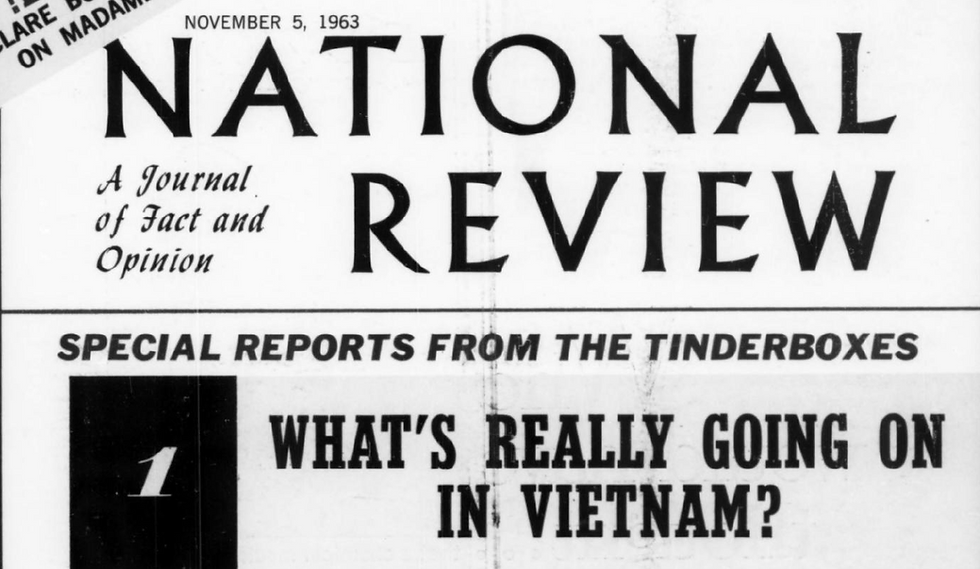
Read any mainstream history of Vietnam, and you will very quickly come across a common criticism of Diem’s regime, which is that it favored Catholics in civil service, land distribution, and military appointments. This has been seen as a sectarian bias tied to Diem’s prominent Catholic family and to the influence of his elder brother, Ngo Dinh Thuc, the Archbishop of Hue. All this, along with other sectarian issues, alienated the country's Buddhist plurality, and it culminated in the 1963 Buddhist Crisis. That, in turn, led to the November 1963 military coup and the assassination of Diem. Post-coup, South Vietnamese Catholics lost their guaranteed state patronage, but they stayed hardline anti-Communists. This Catholic context, which was being covered in The National Review that Lafferty read, is one reason the Catholic neighborhood in Green Tree is so pro-Cochinchina, and it is part of why Lafferty rejects the idea of a South Vietnam that was somehow half of an atheistic and Communist north.

In Green Tree's history of America, after the fall of the Proud Peasant and the assassination of the Cardboard Man in 1963 comes the Barry Lyndon allegory. Lafferty treats the 1964 election as a staging of Thackeray’s 1844 novel, just played out across television screens and town halls as an American schizo-gash. He writes:
It used an interesting bit of innovation: it represented the split personality of the leading character Barry Lyndon by two different actors, one for each of the personalities, as though one of them should represent the id and one of them the ego of the main character. And it worked well. The two actors were named Barry Goldwater and Lyndon Johnson, and between them they played the broad but shallow character of Barry Lyndon faithfully. As in the novel, the ego side of the character won.
Now skip forward to how Lafferty says America won the Vietnam War. In May 1972, the United States mined Haiphong Harbor under Operation Pocket Money. The mines interdicted Soviet, Red Chinese, and English supplies, and, as Lafferty tells it, communist aggression began to smother to death. A cease-fire was obtained from the invaders. The means of enforcing it were still at hand: the mines could be reactivated within hours, so for the communist forces to resume their assault would be to resume their own strangulation.

What happened next is Strategos and ten thousand good traitors. The mines were removed from Haiphong, and the cease-fire could no longer be enforced. Congress then passed the Case-Church Amendment, prohibiting any further American military action, and Democrats controlled both the House and the Senate by 1975. Lafferty scorches the American government:
It issued a wide-open invitation to the defeated invaders to reinvade, and declared that no obstacle would ever be placed in their path again. It further declared, in words that could have no other meaning, that the invaded people would not be allowed to defend themselves, that they must stand as lambs to the slaughter.
The invaders predictably invade again, now with the backing of the whole communist world. In April 1975, the war ended in total defeat. From within the Whole Lafferty, the Vietnam War is a mythically charged spiritual battle against demonic communist forces, just as one would expect from The Flame Is Green and the Argo Legend. That story runs, in In a Green Tree, into 1978, then into the unfinished fifth part. Its version of the Vietnam War is the story of a noble, hard-won moral victory deliberately betrayed and thrown away by a complicit American media, a complicit Congress, and the American public itself.
So, yes, we find Lafferty on the Right, where we already knew him to be. But, as always, the matter is stranger than that, given his view of infernal powers in history. In many ways, it is recognizably Augustinian. In The City of God, Augustine treats Roman ideology and imperial history as, in effect, a demonic psy-op. Lafferty’s novels return to that pattern of devils in history again and again. In Green Tree, he does something he very rarely does, though. At one point, he imitates the sound of scripture, as if he were the voice of inerrancy, to make the point.
This is rich territory. I hope that others will start thinking more about what Vietnam meant to Lafferty and how it shapes the work, rather than noting that he was a hawk on the war or that it is old news that he was a hawk. That is a dead end. We need to be many steps beyond it.