“World Abounding” (1970/1971)

Updated: Sep 4

And what if all of animated nature Be but organic Harps diversely framed, That tremble into thought, as o’er them sweeps Plastic and vast, one intellectual breeze, At once the Soul of each, and God of all?
It was another of those extraordinary enlivening events. It got them. It got Erma Planda of the golden body, and Judy Brindlesby of the sometime incredible hair. It got Lisetta Kerwin of the now shattered serenity; it got Rushmore and Hilary and Blase. Perhaps it had been thought that connubial passion happened without regard to place or planet. Such is not the case. And the case on World Abounding was very different from the case on Gaea or Camiroi or Dahae. There was a pleasantness at all times on World Abounding, there was a constant passion of a sort, an almost pantheistic communion of all things together. But there was something else that came on much stronger at special times, that was triggered by special events without an exact time arriving, that was wild and rampant and blood-and-seed-pungent. It was the rutting reason. Ah, we deck it out better than that. It was a night, or a day and a night, of powerful interior poetry and music, of personal affirmation, of physical and moral and psychic overflowing, of aesthetic burgeoning. It was clear crystal passion. But let us not deck it out so nice that we won't know it. It was the horniest business ever, and it went on all night and all day and all night.
Advanced Lafferty.
“World Abounding” is one of those really hard Lafferty stories. Not hard in terms of what happens, as is sometimes the case. Hard in terms of understanding what Lafferty says about significant, complicated aspects of reality. It is full of important stuff. Sex, love, nature, grace, youth, experience, betrayal, death, communion, family, perfection, parenthood, myth, mercy, cruelty, exaltation, more sex, agony, comedy, resurrection. It radically reconfigures the orders of nature and grace, creating in me something like the perceptual alternation of a bistable image. It disorients. I think a smart reader instinctively registers its importance and is then dizzied by it. One sees comedy, then horror; grace, then parody of grace; nature perfected, then nature grotesquely swollen beyond its bounds: nature as what Genesis calls Tov, then nature as profanely exuberant gland. Did Marrying Sam yoke Misericors and Festinatio? This is a great but difficult story.
So what happens here?
An expedition of seven explorers arrives on the planet Aphthonia, also known as World Abounding. They arrive to investigate why more than twenty previous missions ended with reports that defied explanation. The group lands and discovers that the planet's environment, influenced by a potent natural growth hormone called Gorgos, accelerates biological processes. It induces a state of heightened exuberance. We learn that Lafferty’s recurring character, John Chancel, discovered the planet fifty years ago and built a monument spire on a flat plain; a massive stepped plateau, known as the Terraces, has since grown to engulf the site. The crew begins excavating, uncovering layers of perfectly preserved, deceased members from prior expeditions. These earlier explorers look to have died peacefully while enjoying banquets, having been willingly buried by localized ash and lava flows from the nearby volcano, Misericors.
Lafferty writes,
The happy dead people had been preserved by the volcanic fill, and perhaps by the essence Gorgos or some other substance of World Abounding. They didn't feel dead. They were rather waxy to the touch; they were about as warm as the air, and they hadn't any clamminess . . .
Shortly after the expedition’s arrival, and after some "heightened exuberance," the three women in the expedition experience accelerated pregnancies, giving birth to children who mature physically and intellectually within a matter of days. These World Abounding Nation (birth born) children, along with their own offspring, form a native population with a mysterious connection to the planet's ecology. They have no interest in systematic scientific study. Instead, they share a telepathic consciousness, compose music, craft sculpture from volcanic flows, and embrace the planet's intense mating periods. The World Abounding children are unusual:
They were at all times in close wordless communication with their parents and with all other persons present, and they were at the same time total aliens. The children were puzzling, but they themselves certainly weren't puzzled: they were always quite clear as to their own aims and activities.
While the expedition's commander, Fairbridge Exendine, first reacts with horror and tries to distance himself from the seductive environment, he is courted by and ultimately yields to the firstborn daughter of the World Abounding Nation, Least Lass.
Then the story moves to its close at the end of a month on the planet. The native-born generations know that they have experienced everything Life has to offer. They say that doing a thing more than twice becomes repetitious, and that repetition is the unforgivable sin (not blasphemy against the Holy Spirit). So they assemble atop the Terraces for a last supper. Least Lass instructs a devastated Fairbridge to tell the volcano that it is the fullness of time. He conveys the message. The volcano erupts, burying the World Abounding Nation in hot ash and lava as they peacefully eat and drink lava. Fairbridge throws himself onto the smoking ground, wanting to die with Least Lass at her feet, but she refuses him.
Because he is a Gaea human and not "completed" (another example of Lafferty's Thomistic view of perfection as completion) within the Aphthonian planetary cycle, she denies him:
“Shall I feed you scraps from the table as though you were a dog at my feet?” Least Lass asked Fairbridge. “Go at once now. You have no business dying here. Go with them. They come in great danger and pain to themselves to get you.”
Dragged away by his crewmates, Fairbridge and the original seven explorers flee to their hovercraft. Defeated, they decide to file the same kind of disgraceful, Lafferty’s word, unbelievable report that the other explorers have filed.
I mentioned the story being bistable. If I look at the planet Aphthonia one way, I see an environment so fertile, animated, and generous that it resembles nature as unstinting gift. But the story keeps throwing off clues that the “grace,” or whatever blows through the planet and makes it so pullulating, comes from within nature rather than from beyond it.
Seen this way, the arrangement becomes coercive, as if the planet has imposed rut, or mating season, on human bodies with year-round hormonal cycles and concealed ovulation. It is as if a leering nature has encroached on the world of grace. Because Aphthonia is so terrifyingly gratuitous, grace has been effectively de-transcendentalized. The result is that nature itself, from the propagation of the little acorn to the perfection and completion of the mighty oak, becomes grotesque. The story’s account of embodied personhood becomes a distortion chamber, though it remains wisely affirmative about the unitive side of procreation. Let’s call this first view World Abounding as Pseudo-Sacramental.
Then the perception alters, and I begin to think of Lafferty and his surprises. Perhaps one should simply accept that life born on Aphthonia has its own sacramental rules. Nature there is perfected. It has its own alien sacramental system, strange only because its temporal scale is so radically different from ours. Set aside, for the moment, the absence of any promise of transformation or resurrection. World Abounding may still be understood as perfecting its offspring, as fully sanctifying them as realized persons, according to its own sacramental order. It could even be read as having its own weird Trinity: the Father of Planets, the Miracle Maker, and Marryin’ Sam, named after a character in Li’l Abner. This would be World Abounding as Crypto-Sacramental. Here is the real deal, on amphetamines.
My view is that “World Abounding” excels in creating this effect. Lafferty builds perceptual instability into the story as a tactical ambiguity. The ambiguity leaves the reader thinking about personhood and sexuality, about the relation of both to nature and grace, and about the relation of all of them to primal, mythic metaphors that become more than metaphor. This convergence peaks in the story's dream sequence that I quote at length because of its thematic significance:
The fulfilled persons would sometimes sleep while walking or even running, especially those of the full World Abounding generations. “Are we awake or sleeping?” Least Lass asked her lover one day, or night. “That I do not know,” Fairbridge said, or thought, in whatever state he was in. “But we are together. May the Planet Plucker grant that we be always together.” “We are together,” Least Lass agreed, “and yet I am climbing and leaping on the north ridges of the Volcano Misericors, and I am sound asleep. And you are swimming in the estuary of the River Festinatio, very deep below the surface where it is ocean water below the running water, and you also are asleep. Give me your hand. There! On a false level of reality it might seem that my hand was closed on the meaty bloom of a rock crocus, but that rock crocus is a part of yourself. It might seem, to an observer of no understanding, that your own hand has closed on an Aphthonia Blue-Fish (the Blue-Fish himself is such an observer and he believes this), but that Blue-Fish is really myself with the scales still on his eyes and on his whole fishness. But the scales have fallen from our own eyes a little bit so that we may see reality. Grip my hand very hard.” They gripped hands very hard. They were together.
To return to the metaphor of a bistable image, it is the same image as Lafferty's brilliant bit of rhetorical sinking, "But let us not deck it out so nice that we won't know it."
I think “World Abounding” is an especially advanced Lafferty story because it intensifies the relation between satire and didacticism. Satire is usually indirect; didacticism often wants to be direct. “World Abounding” clearly has something to say, but it says it through so much comic grotesquerie, biblical allusion, planetary myth, erotic theater and phantasmagoria, and science-fiction world-building. The story is alight with biblical language: the line to Judas (“What you do, do quickly”), the crumbs or scraps from the table, the dangerous wine that bites like a serpent, Edenic abundance, the Peaceable Kingdom, the Last Supper, Eucharistic imagery (chalice and paten) and wordplay about belief and disgrace. These allusions make the story world feel Christian, the way Lafferty’s open kosmoi are open, not closed like ones found in his gnostic works, but also displaced. But this is closer to the Christian pantheism of Coleridge’s breeze. Christian patterns have been rerouted through an alien planet that is supposedly related to perfected nature (the biblical language of there being no gnawing worm or moth signifies, but World Abounding has perfected it terminally.
The expedition's first encounters on the planet read like a parodic Edenic paradise. Lafferty describes the planet's flawless, protective ecology:
Everything that can be chewed or swallowed here is safe to eat or drink. There is no insect or animal that bites, nor worm that gnaws, nor moth that harms.
Then the story doubles down on mythogenic color and suspends ordinary realistic values. Its first climax is the dream sequence that maps Fairbridge onto the female Festinatio and Least Lass onto the male Misericors. The story reverses that pattern at the end, when Fairbridge climbs the mountain in the fullness of time to bring on the latest terrace apocalypse. From its first pages to its last, the planet runs the full spectrum from pathetic fallacy to animism to full anthropomorphism. Yet even that is not quite right, because if we enter the dream logic of the story, this is not simply figurative language. Misericors is not “like” a living volcano. He has a face, he responds to speech, and his volcanic gas plume is both a pyroclastic surge and a belch. Misericors is an aerophagic and ejaculatory person. Figurative language has moved beyond metaphor: the story treats its own mythogenic master figures as persons, not things. What would ordinarily be pathetic fallacy or personification is re-literalized within the mythogenic logic of the scene, so that the volcano’s mouth and belch are not decorative comparisons but the embodied expressions in which Misericors is enliveningly present:
The cone was a ragged laughing mouth; the whole face was a distorted laugh. One eye of that face was far down the north slope, and the other eye was over in the blue-stem hills . . . The Volcano belched a bit of fire. There was something of cruel laugh in that sound: a snort, really.
In reimagining the relation of nature and grace apart from the temporalities of the human life cycle, World Abounding makes it impossible to keep many other boundaries intact: living thing and environment, parent and planet, genetics and epigenetics, nature and agency, body and world.
The terminality is best seen, I think, in the way the communion of the dead works in the story. Death is, as it often is in Lafferty, definalized: the dead are not simply gone, and the World Abounding Nation comes into communion with the dead of all the previous World Abounding cultures. Kora even says that the dead communicate with the native-born children more easily than with the Gaea adults, and Rushmore explains the rapport by saying that all of them share “one common parent, World Abounding.” Yet the dead generations are not one continuous lineage in the ordinary human sense. They are more like a set of stacked folders: each Terrace contains a discrete culture, a distinct genetic-cultural unit, sealed when Misericors covers its perfection in ash. The group on one Terrace is not descended from the group below it; rather, each group is generated anew from some contact between Gaea humans and World Abounding itself. Their only common lineage is planetary. This is why the communion of the dead in the story is not the same as the communion remembered by the Catholic Church on All Souls’ Day.
First, the World Abounding dead are not souls still needing prayer,
purification, or mercy. In the planet’s own terms, they are already “completed”; they have “done everything,” and their burial is treated as the seal of that completion.
Chara Kerwin articulates this collective saturation of experience as a communal, rather than merely individual, achievement:
“But I have. I have borne myself, I have borne my mother Kora, I have borne you, my grandmother Lisetta, I have borne every person ever birthed on World Abounding or elsewhere. What we do not do as individuals, we do in common. All of our nation has now done everything, as I have. So we will wind it up.”
Second, their communion is not mediated by Christ, the Church, the sacraments, or the hope of resurrection, but by World Abounding itself—by place, ash, fertility, and the planet’s strange role as common parent. Something like this must be the World Abounding as a Pseudo-Sacramental view. The World Abounding as Crypto-Sacramental view would need to say something like, De dicto, the World Abounding Nation people recognize that the Father of Planets, the Miracle Maker, and Marrying Sam exist as an immanent versus economic Trinity. De re, since the Father of Planets is God the Father, the Miracle Maker is Christ, and the Lil Abner named Marrying Sam is the Holy Spirit, they know God the Father, Christ, and the Holy Spirit. But they do not know de dicto.
Third, this communion does not gather all generations into one pilgrim Church moving toward a final redemption. Instead, each terrace set arises, reaches its own eschaton, and enters waxy death, like incorruptible bodies. These terminal subcultures stack up into layers. World Abounding is a terminal planet (and not the terminal called Easterwine) because the apocalyptic exigence has become part of nature’s cycle, but subordinated to it. More provocatively, what has not happened is the perfection of nature itself that happens with the New Heaven and New Earth in St. John’s Apocalypse. The reader is told that the people of World Abounding hate repetition, but World Abounding itself is caught in a repetitious nature cycle of apocalypse because repetitious apocalypse always happens within nature on World Abounding, not to the natura of World Abounding.
This cyclical dead-end is recognized by the surviving human
observers, who realize that the planet's ecological loops allow for no human future:
“The report will be a difficult one,” Hilary hazarded. “Just how are we to explain that a normal human settlement is impossible here? How explain that it will always end in such swift short generations? How explain that every World Abounding culture is, by its nature, a terminal culture?”
It is as if the uniformitarian principles that one uses to understand nature
have finally dominated catastrophism. They subsume ecological catastrophe as sex that nature buries through an eroticized sex-death cycle: each time the mountain takes the river human offspring die. This sees the story from the World Abounding as a Pseudo-Sacramental perspective, but one could run it through the Crypto-Sacramental view. Again, I hover because the story is strategically ambiguous on the orders of grace and nature. The most common Catholic way of stating the relation between those two orders is Aquinas’s formula that grace does not destroy nature but perfects it. That language is in the story. Lafferty has it on his mind. The formula requires both terms: nature must have its own integrity, and grace must be a supernatural gift that elevates nature rather than arising from it.

This leads to what has been called the problem of natura pura, or “pure nature.” At moments, “World Abounding” looks like a thought experiment about natura pura. The issue concerns whether human nature can be imagined as complete in itself, with its own natural end, apart from grace. This is sometimes called man’s proportionate end. The pure-nature tradition wants to preserve the freedom and gratuity of grace, but it risks making nature look closed and self-sufficient. Henri de Lubac pushed back against this by arguing that human beings are naturally ordered toward God.
But think about what that means. If the desire to see the face of God belongs to one’s proportionate or natural end, then grace begins to look intrinsic to nature, since human nature would remain unperfected without the vision of God. This is the problem of the intrinsicism and extrinsicism of grace: the danger that nature will swallow too much of grace, or that grace will swallow too much of nature. If man can be fulfilled without grace in his proportionate end, why is grace necessary? If man’s proportionate end already points to grace, have you rigged the game by supernaturalizing nature? Essentially, if nature can fulfill itself without God, what do we need God for? There are interesting ways to think through this problem, but they would take us too far afield. Besides, Lafferty’s story does not arrive at a solution but at Fairbridge’s physical and spiritual agony.

Although I think the story invites the reader to hover between the Pseudo-Sacramental and the Crypto-Sacramental, I am more drawn to the former, as it seems closer to the spiritual shape of what is happening. If that reading is right, “World Abounding” turns the theological problem of grace as something given from beyond nature into a fantasy thought experiment. Aphthonia is a world where nature behaves not as if it were graced, but as if it were arrogating the grace function. The planet gives fertility, ecstatic love, immediate growth, marriage, communion with the dead, ritual meals, “mercy,” and a kind of afterlife. Is the story really presenting a naturalized sanctification through Gorgos, sex, volcanic ash, lava, and the rest? There is much that seems right about this. Nature is wonderful, and if one is a Catholic like Lafferty, one thinks that perfected nature is not finally a fantasy. It is pro-unitive and pro-procreative.
The Gaea explorers seem to bring a modern outlook in which physical explanation is expected to account for nature. If that is too strong, then they at least bring a view of nature in which grace, if it exists, remains extrinsic. As a singleton, Fairbridge is the hardest-nosed of the explorers, but all of them expect ordinary biology, scientific explanation, and settlement. They have come to solve the mystery left behind by John Chancel and the other expeditions. Aphthonia surprises them by making nature monstrously miraculous, but what it creates is a naturalized correlate of grace, a counterfeit that, precisely as counterfeit, points to the real thing it parodies. Fairbridge begins the story as the character who wants to dig down to the bottom of the terraces, but in the end, he is the one who is dug through, left prone and begging to die, rather than being elevated. Least Lass calls him a patsy. World Abounding absorbs human nature into the planet’s own cycle of fertility, completion, death, preservation, and apocalypse. What it does not do is extend anything like real grace to the Gaea people. One can see this by imagining what would happen if the Gaea explorers stayed on Aphthonia. Would they move toward completion?
This exclusion of grace is made brutally clear when Least Lass denies Fairbridge participation in the planet's eschatological climax:
“Shall I feed you scraps from the table as though you were a dog at my feet?” Least Lass asked Fairbridge. “Go at once now. You have no business dying here. Go with them. They come in great danger and pain to themselves to get you.”
That said, one could make the Crypto-Sacramental case. One could argue that this is sacramental, that the children of World Abounding are holding their Eucharistic/apocalyptic banquet. What is grace for the World Abounding Nation is not grace for the World Gaea Nation. But the denial of the scrap makes me suspicious of the scene. When Christ says to the Canaanite woman in Matthew 15 that it is not meet to throw bread to the dogs, she answers, “Truth, Lord: yet the dogs eat of the crumbs that fall from their masters’ table.” She asks for mercy, “Miserere mei, Domine fili David,” and Christ gives it. Christ then goes down to the Sea of Galilee and up onto a mountain, where perhaps the second-best-known banquet in the New Testament takes place in the same chapter: the miracle of the loaves and fishes, in which four thousand are fed. Compare that meal to the perfected children:
All eight of the gilded youths of the World Abounding nation came at the same time to the realization that they had done everything. They called it back and forth, they echoed the information from the blue-stem hills to the orchards to the mountains. They all came together full of the information. They assembled on the top of the Terraces. They sat down at table there, and demanded that the elder World-Gaea nation should serve them. “Out-do yourselves!” Least Lass Exendine called to all those elders. “Give us a banquet better than any you ever invented before. But you may not share it with us. It is for ourselves only. Serve us. And eat ashes yourselves.”
And
Hot ash filled the banquet plate of Least Lass by then, and hot lava filled her cup. Smiling and easy, she ate and drank the living coals to her pleasant death. Then she had disappeared completely under the flow of it, as the rest of them had done. The Volcano covered them with another two meters of fill. Then he pushed on to have his will with the river.
To go one level deeper, this is where having a Lafferty’s “world” model becomes useful. In “World Abounding,” the world is not a single thing, as it rarely is in Lafferty, and we don’t talk about this well. It can mean a physical planet, a civilization, a ruined aftermath, an imagined story-space, a future culture, or one person’s lived reality. The story asks how many habitable worlds there are, depending on what one means by “habitable” and “world.” That is the question Lafferty is always asking.
Lafferty foregrounds this epistemological problem in the story's opening lines, framing the entire narrative around the instability of these very terms:
How many habitable worlds there are depends on the meaning given to ‘habitable’ and to ‘world.’ Habitable without special equipment and conditioning is the usual restriction on the first. ‘Of no mean size’ and ‘of no extreme distance’ are two common conditions of the second.
Red herrings.
Aphthonia is first a physical world, but the Gaea explorers bring their own modern/scientific world into it. The buried Terrace peoples reveal that many previous civilization-worlds have already risen and ended there. The children born on Aphthonia first look like a future world, but it exhausts itself like a mayfly: marriage, music, drama, art, banquets, and ritual death.
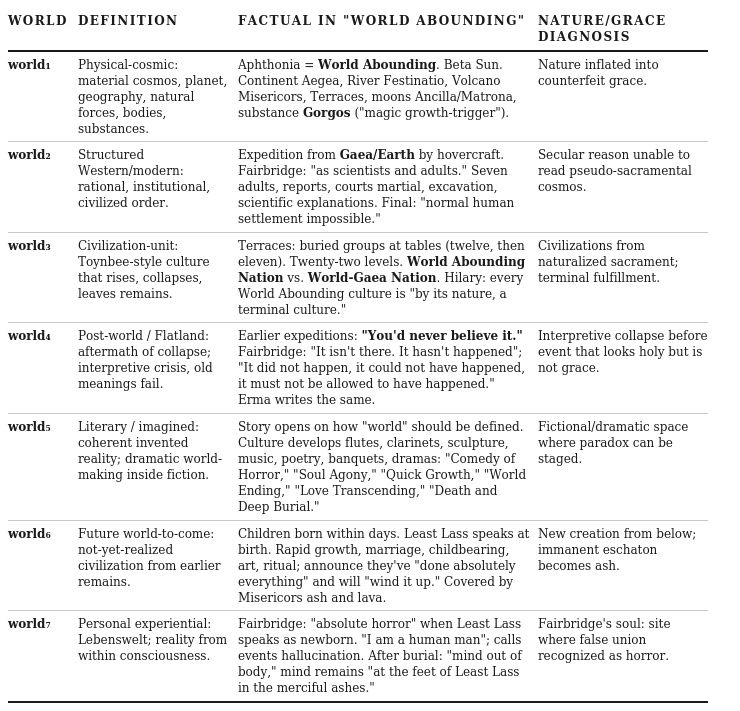
I usually find it helpful, when reading Lafferty, to be mindful of equivocations on the word “world.” I have written several times about my shorthand for this, and it is certainly part of how I understand “World Abounding.” Aphthonia turns part of world₁, a physical planet in the Beta system, into a dynamo of either pseudo-grace or crypto-grace. The planet’s own natural powers either imitate fertility, sacrament, communion, mercy, and final fulfillment, or somehow constitute an alien sacramental economy.
This world experience takes human genetics from Gaea, from the people who make planetfall, and produces something like an evolutionary leap in their children through a counterfactual epigenetics: Aphthonia as parent, not merely as environment. All planets are somehow like this. From the world₂ perspective of the Gaean order, modern scientific reason cannot make sense of a pseudo-sacramental or crypto-sacramental micro cosmos. It looks as though there will be a thriving world₆, filled with the children of those who made planetfall, an ever-expanding World Abounding Nation. Be fruitful and multiply. But World Abounding never really creates world₆, an angel of history flying into the future looking backward on its wreckage. It resets instead, because nature on Aphthonia has absorbed apocalypse as one of its cyclical, that is naturalized, features. Instead of world-ending followed by the new creation of a thriving world₆, there is only another world₃. That makes each terrace a terminus: a last supper and preservation with no hope of, or interest in, resurrection. It is a paralytic eschatology that never arrives at post-coital clarity.
The aftermath leaves those who visit World Abounding as inhabitants of world₄. The survivors say, “You’d never believe it,” because ordinary hearers would lack the horizon needed to understand what happened. As metafiction, Aphthonia is a world₅ horror-comedy. But ask yourself, is it a metaphysical horror (with comedy) or a metaphysical comedy (with horror)? This is another version of its bistable quality. Readers who read it as I do will emphasize seeing the effects on the world₇ of a guy who was a singleton with an interest in engineering, Fairbridge’s inner world, where one might come to think that Aphthonia’s mercy is anything but merciful. But how explain that every world abounding culture is a terminal culture?
A few final points. The accelerated eroticism is obviously relevant to other difficult areas in Lafferty. Matrona and Ancilla moons are part of Lafferty’s mother-parthen complex, a curious aspect of Lafferty’s Beta system. The Fairbridge in this story has interesting connections to the version of him in Annals of Klepsis. I’m going to leave it here for now. This could be four times as long.