"Seven Scenes from Sheol"

Updated: 12 hours ago

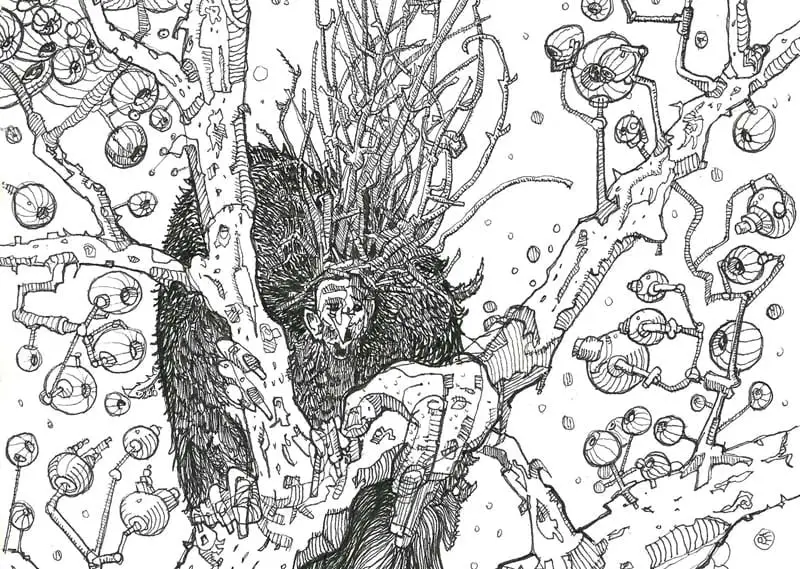
Casey's verses are all doggerel . . . His musical compositions hide a greatness, but they hide it well. His drawings are all comic, but only a few of them are meant to be. Let us consider the drawings on the opposite page: (For technical reasons, there is no drawing on the opposite page, but Schrade's description will suffice.) This supposed itself to be a drawing of Hell, but it is a second-hand drawing of a second-hand Hell. We believe that, in most respects, it is authentic. Well then, that means that Hell is a second-hand or second-rate place. — "Promontory Goats"
A short note on a curiosity related to "Promontory Goats." Casey's drawing of Hell alludes to an unpublished archival Lafferty piece, "Seven Scenes from Sheol," which survives in typed form. The sketch is a vignette in which characters from the Argo legend discuss Finnegan's Sheol paintings. This is all pretty niche, even within the niche of people who care about a Lafferty. If you are learning about the Argo legend, you can look up the people involved in the Argo Glossary.
Lafferty seems to have imagined seven stories that would form a sequence. What survives is a fragment that starts with art dealers Claude Bozart and Melchisedech Duffy debating the valuation of seven "post-ultimate" paintings recently produced by Finnegan. Duffy sets the price at $100,000 each, noting that the works are executed on mats of GIUNCHI or rushes using pigments such as sepia, cochineal, and the artist’s own blood.
We quickly learn that Finnegan created these paintings of Sheol after his death, and they were brought to the dealers by an unknown courier. Bozart questions the realism of the pricing and the nature of the materials, but Duffy points out that the paintings contain a connection to the apokatastatic currents we find in "Promontory Goats, " a sunniness and a sense of hope that contradicts the expected death stench of the afterlife:
"That good man is not in Hell, Claude. He's tortured, but he accepts the pain with a cheerful sort of heart-pang. Look at the sunniness that steals into the darkest corner of that one! Or the freshness, the ineffable aroma of hope that shatters the death stench of this other. Would a man in Hell be able to supply such touches?"
Attention is drawn to one painting, Trombettieri. It depicts Finnegan as a lithe, yearling bull of a man climbing hills and conversing with a nervous "evil captain" from his past. We aren't told who the captain is, and the first suspicion a reader might have is Oretes Gonof, the captain of the Brunhilde from The Devil is Dead, but it is the military doctor and psychiatrist in Ward Fourteen in Archipelago who is just called "the Captain." In that novel, the Captain does what he can to trammel Finnegan's spirit when Finnegan is at one of his lowest points. The “Sheol” scene is a callback to Finnegan’s major dissociative breakdown at the end of the war, as well as to a promise he made.
From "Sevens Scenes in Sheol":
(A long time before this, Finnegan had been persecuted by this evil captain: that is who the evil man was. That had been when they were soldiers in the GREEN ISLANDS. "Someday, Captain, after you die and go to Hell, you're going to hear someone call your name," Finnegan had said on that long ago time in life. "And it'll be me. And it will be as if you had only seemed to be in Hell before.")
From Archipelago:
The Sergeant [Finnegan] sobbed for a few seconds, and by that time the hatred and excitement in the Captain's face had been covered by a mask again. The Sergeant lifted his head and grinned crookedly at the Captain. "I may not remember my own name, sir," the Sergeant said, "but I'm never going to forget yours. I'll remember it no matter what. Someday, Captain, after you die and go to Hell, you're going to hear somebody call your name. And it'll be me. And it will be as if you had only seemed to be in Hell before. I'll know your name, and the address will be easy, and I'll come down there and get you." "I'll have you for that! You can be courtmartialed!" the Captain shrilled. "Courtmartialed, Captain?" asked the Colonel, "For the kid saying he'll see you in Hell?" "But he means it. Yes, courtmartialed. He is threatening me, an officer. No, not threatening. He is showing disrespect for an officer." "That's enough, Captain. The boy is sick, and I'm not so sure about you."
I absolutely love that Lafferty closed this arcane loop, even if exceedingly few people will ever know about it.
In "Seven Scenes from Sheol," Finnegan and the Captain then carry on their conversation, and Finnegan now knows exactly who and what he is. Finnegan calls himself a Neanderthal and says that his people were the true painters of prehistory, while Cro-Magnons were just uncreative patrons. He then calls his current environment an "ambiguous place" rather than Hell, and says that his restless wandering is the result of a casual burial that failed to weigh him down.
Then we move outside the frame of the painting where Argo people, including Mary Virginia Schaeffer and Margaret Stone, analyze the work's naturalistic accuracy and synesthetic qualities until Absalom Stein arrives. In a very Stein move, he says he just spent the night with the dead Finnegan.
This is the kind of painting of Hell that Casey can’t make, and it is interesting that Finnegan’s paintings depict Sheol, not Hell—Sheol being the ancient Hebrew concept of the realm of the dead in the Hebrew Bible, where all people were believed to go after death. It was not originally a place of punishment like later ideas of hell, and Duffy seems to know this in his comment about sunniness and, as Finnegan says, “No, no . . . This is the ambiguous place.”