Media Ecology and The Elliptical Grave

Updated: 7 hours ago

"Pioneer [Reventlo] was a sort of ghost in that he had a very loose association between body and soul. He was inhabited a little by the ‘Eden Archetype,’ a projection from the future. He knew of course . . . that all archetypes are these projections from the future and none of them from the past. And yet he sincerely believed it was the past he was excavating.”
They were all quiet for a day and a night and a day. Then the spirit came and moved over them. But which way did it move?
Someone should do a piece on the connection between the Collective Unconscious and Purgatory, and discover whether the name of the connecting land is not Middle-Earth. But Christ suffuses Purgatory, and Christ is the Lord of the Archetypes in the unconscious. — “Tolkien as Christian”
Advanced Lafferty.
Today I want to play with some ideas around media ecology. This came to mind because of how Lafferty toys with Marshall McLuhan and Teilhard de Chardin. Both figures are central to his short story "Great Day in the Morning," the subject of my last post. They're also very important to his novel The Elliptical Grave. In fact, I think the novel is unintelligible without them.
After writing The Elliptical Grave, Lafferty largely leaves Teilhard and McLuhan behind, those two meteors of the 1960s. He enters his final phase and tries to become popular again by exploiting pulp tropes, but by then he is too much himself. No number of space pirates (Annals of Klepsis) or Arabian Nights adventures (Sindbad: The 13th Voyage) was going to win him a larger audience. The turn to pulp did, however, revivify ideas that had become too occulted for all but his most dedicated readers. This helps explain both the great unpublished novels of the 1970s, with their extreme demands, and the bewilderment produced by the few that squeaked into print. Think Apocalypses.
In Lafferty's correspondence, the earliest mention of the book I know of is in a letter to Sheryl Smith, where he ends a 1977 letter with "Elliptically yours (the next novel is The Elliptical Grave)." In the letters that I have read, mentions of the book disappear until 1988, when it is again mentioned to Dan Knight in the preparation of the verse brought together in the thin volume Strange Skies. There one will find the following poem:

In August 1988, Lafferty told Knight he was reluctant to send the manuscript because he didn't have extra copies. He said, "I'll send you the ELLIPTICAL GRAVE today or tomorrow. I didn't send it to you before because I didn't find any extra copy (the one I am sending you is the only one I have, so send it back someday), and because it doesn't really seem very good to me when I dip into it again." Then he added, "I hope you're not too disappointed in The Elliptical Grave."
What is clear when you read these letters is that Lafferty was eager but not in a rush to see it published. He sent his letter to Dan Knight to Virginia Kidd for her thoughts on what to do with the book. He later assured Knight that there wouldn't be any impediment to moving toward publication, and that he knew Virginia Kidd just sometimes takes her time answering them.
In 1989, Lafferty wrote to Knight again, saying, "I look forward to seeing the publication and also that of The Elliptical Grave. We will have to come up with 3 catchy subtitles for the three parts of EG." In March of 1989, Lafferty expressed his desire to see the book released as an independent, stand-alone publication by United Mythologies Press. He wrote, "Sure, I'd like to see The Elliptical Grave published as a complete book."
In June of 1989, Lafferty says he is delighted to hear that Virginia Kidd has greenlit the project. He wrote, "I'm glad that Virginia sent the message down the Mount and that The Elliptical Grave will soon be printed and bound and published. I think EG will be a pretty good book, with or without the art."
Also in June, Lafferty told Knight to stagger the releases of Dotty and The Elliptical Grave, "Put it aside though for a couple of months after THE ELLIPTICAL GRAVE is published, and see how EG does . . . I don't want you to be weighted down with two rocks around your neck at the same time." In August 1989, Lafferty mailed Dan Knight the signed pages that would be part of the book's limited run. In September of 1989, Lafferty praised what Knight had produced.
Turning now to The Elliptical Grave, I’ll point out something obvious: it will never have many readers. I imagine that its readers number in the hundreds at most, and I’m a little skeptical that most people who start it finish it. It is Lafferty at his most extreme. He once told Dan Knight that it was his least publishable book. Andrew Ferguson is right, I think, to call it Lafferty’s second important book on the nature of media. Lafferty wrote many short stories about media in the 1970s, but The Elliptical Grave is his attempt to put those ideas together. It is a really demanding book.
Let’s boil the plot down to its essentials before turning to what the novel says about media.

I want to create a tool that shows how I think it works as a system of media, not as a haphazard series of strange devices. In this diagram, the center is what I'm calling the formed receiver. That would be the body, person, and company, the place where any medium becomes active. Around that center are the novel's main channels of mediation. These are things like:
body
language
instrument
air
space
ritual

The diagram has left and right poles, which make a temporal argument. The left pole is archive, by which I mean inherited trace: the dead, fossils, hands, air, and memory as a bodily medium. The novel returns obsessively to these things.
The right pole is archetype. As I understand it in The Elliptical Grave, archetype exerts pressure from the future. It has an eschatological pull. Here Lafferty is thinking with Teilhard de Chardin again. Strange forms appear before they can be described or fitted into a narrative. Reventlo’s great error is to confuse the two poles ("The 'Golden Age' is not past. It begins tomorrow."). He mistakes archetypal pressure, which comes from the future, for archival memory.
The upper and lower poles show the moral stakes. Media may lead upward toward communion and metamorphosis or downward toward domination and enclosure. They may be things people inhabit or things that possess and enclose them. This is the difference between the coffin and the cocoon, between burial as termination and gestation as passage. The ark, the ouroboros, and the novel itself complicate this division. If one reads the novel as Lafferty constructed it, one ends up inside it, which is to say inside the pavilion at the end.

Finally, I thought it would be fun to take up an idea of Marshall McLuhan’s that has received little attention: the tetrad. Near the end of his life, McLuhan began searching for a common form through which any medium could be understood. Drawing on his work on figure and ground, he developed the tetrad with his son Eric and experimented with it for years. It was published posthumously in Laws of Media, after Lafferty had written The Elliptical Grave. A later book, The Lost Tetrads of Marshall McLuhan, presented McLuhan’s own experiments with the form. Every tetrad asks four questions of a human medium:
What does it enhance?
What does it displace?
What older forms or media does it retrieve?
What does it become when pushed to an extreme, at which point the medium tends to flip?
These effects, Marshall McLuhan thought, are simultaneous dimensions latent in any medium, so we're not dealing with sequence. This first diagram shows what a tetrad is and how the tetrad illustrates what McLuhan called the four laws of media.

With the tetrad in place, we can ask: What is the elliptical grave as a medium? The pavilion gathers persons, images, objects, animals, and different times into a strange enclosure spanning the distance from archive to archetype. It ceases to be a place observed from outside and becomes a vessel whose occupants are caught up in its action. At the point of reversal, stasis may become voyage, while enclosure may become burial or open into birth. Lafferty leaves the direction uncertain. At the end of the novel, he tells us that the Holy Spirit moves, but not in which direction.

Now, I think we can start to look at how he arrives at this meta-medium of elliptical grave through other forms of mediation.
Cinema is one of the novel’s main tests of presence. At first, it belongs to the ghostly economy of the pavilion. Cecelia calls early cinema “real ghost movies,” and the screen becomes a contested place where ghosts, actors, and spectators compete for reality. Fritz Otto’s projections go further. He does not merely show images. He “projected total darkness” and then gave the company coffins “that weren’t there. But they were there.” One projected coffin leaves behind “rich cream-gray velvet.” The image has crossed into matter.
By the time the pavilion itself “sailed directly into the cinema,” film is no longer representation in the ordinary sense. It has become an event, a medium that captures bodies, alters space, and draws the spectator into the action it projects.

Another technological medium that Lafferty creates for the novel is what he calls scanners and reconstructors. Scanners recover the traces that ordinary observations can't reach, and reconstructors turn those traces into what might be called conjectural seeds. Lafferty is pretty clear in distinguishing the two. The scanners, he writes, "do good work," while the reconstructors are "speculating and guessing machines." The upshot of this is that mediation is a genuine extension of knowledge, but not every mediation is an account of truth.

The Promethean Company is the collective name for the novel’s cast of investigators. It, too, functions as one of the book’s media. Jeffery Wind gives the clue when he calls the expedition “a particular singular device” and says that “this device will tell us what we ourselves are all about.” Its method is corporate perception. Lucille says that the Prometheans must be “both open and fastidious,” open to “outlandish persons and ideas and things,” because no single discipline is adequate to White Goat Valley.
As the pavilion closes around them, this collective instrument can no longer observe from outside. Abramswell says that the haunted air must be seen “as being inside it,” and the trapped party gathers “all in one people.” By the end, the Prometheans are “the most variously talented group in the world,” but they are also the material under trial. They have “formed ourselves into a group to mutate.”

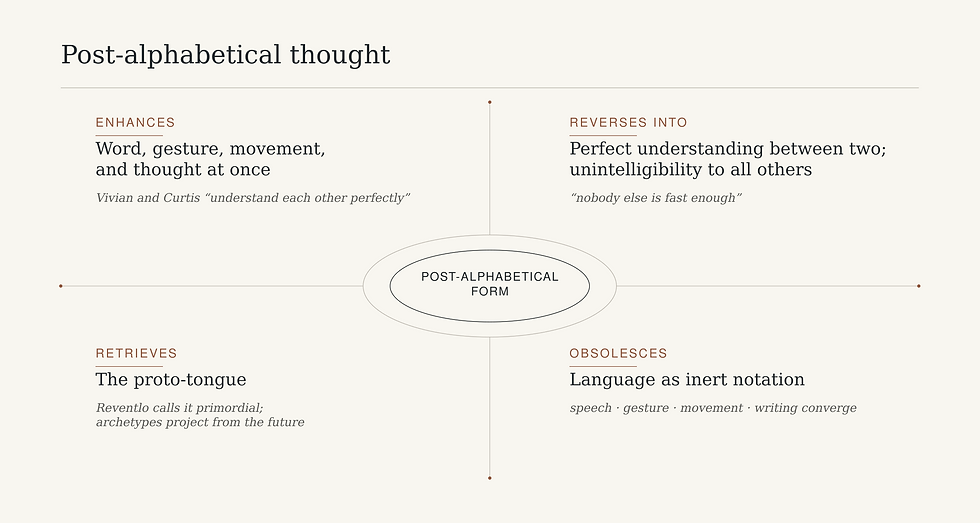
Post-alphabetical thought is where the McLuhan connection becomes hardest to miss.

Reventlo begins the novel with a huge claim: primordial language was richer than modern language and surviving “post-alphabetical forms” lie buried in later speech. Vivian Oldshoe and Curtis Bald at first seem to confirm him, since they “understand each other perfectly” while everyone else lags behind. Do they have access to the primordial language? If so, it seems to join movement, image, speed, gesture, and writing into a communicative medium. Their acrobatics, for instance, are called “bee-dances in the air,” but Vivian says that the medium is not “in words yet.”
Finally, we have been spatializing the logic of The Elliptical Grave. We can now resequence it with these points in mind, with Teilhard on one side and McLuhan on the other:
Bioscopic messages orient the company toward the pavilion;
The pavilion closes around them;
Projected coffins take on material form;
The enclosure becomes coffin, cocoon, ark, ship, and world;
The film absorbs the Promethean Company that enters it.
Through the tetrads, this sequence draws the novel’s separate media into a single action, but it does not flatten that action to a univocal meaning. The pavilion is a grave, but it is also a cocoon, an ark, a ship, and a world. This is what tetrads try to show through the logic of mutually implicating enhancement, reversal, obsolescence, and retrieval. Each medium in the novel reverses into a condition that changes those who enter it.
The enclosure may be burial because the company is sealed within it; it may be divine judgment because the members are tested; it may be birth because the cocoon will take the pupa and make it an imago; it may be a stranger transformation, with the Promethean Company as the material of some woollier mutation. These possibilities do not cancel one another. As McLuhan writes, “The tetrads of Laws of Media present not sequential but simultaneous facets of media effects” (127).
I am tempted to leave it there, but my current reading of the novel’s ending reads it as one of Lafferty's finest and most esoteric Half Horrors. It is pessimistic about Promethean mastery. The Promethean Company ends up trapped in a media environment that isolates its members. It takes their tools, breaks them, and forces them to face their impending deaths like people suffocating inside a locked safe.
Why? The great leap, in this novel, cannot be achieved through smarter technology, better language, cleverer science, or human media. The Lord of the Archetypes calls from the future, which Reventlo mistakes for the archive. This signal from the future passes through the “elliptical grave” of the present world, which collapses inward and becomes a sunken grave waiting for the Holy Spirit to move over it.