"Company in the Wings" (1960/1983)

Updated: 17 hours ago

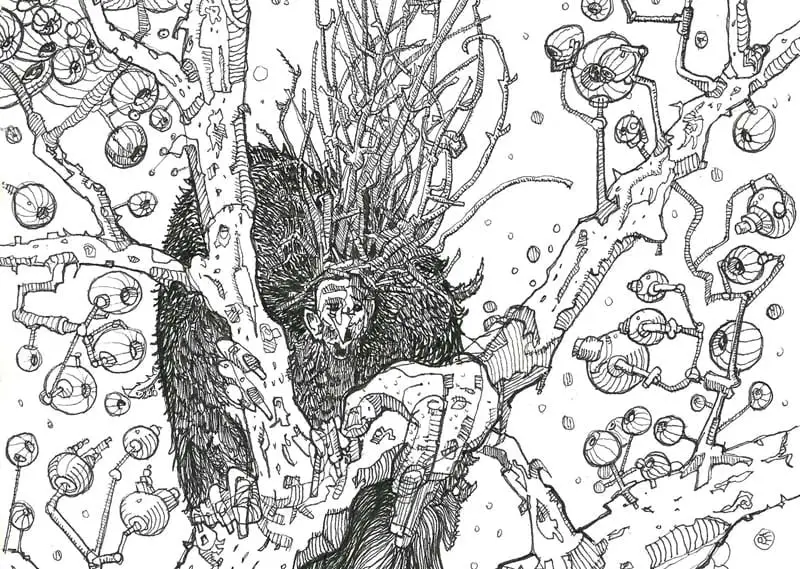
Simon Frakes stood there with his grin that was a caricature as a cartoonist might have drawn it. He was there. Then only his grin was there, mocking them in the empty air. "I’m sure that I know that grin from somewhere," Professor Dodgson mumbled. Ah, but memory is a cat-like thing. It creeps away soft-footed, and is gone. "If you do not believe this, then you will not believe anything," said the grin of Simon Frakes. Then the grin itself vanished, and that was the last that anyone ever saw of Simon Frakes in that neighborhood.
Fairbridge O'Boyle is a professor. He often wakes in the morning with a sense of unremembered pleasure, finding himself standing and clothed but unable to recall where he has been. His unusual new associate, Simon Frakes, is now delivering a series of academic lectures. The topic is Simon’s theory that all imagined beings and objects possess literal reality within a "psychic pool" or a "limbus of those not yet born." Humans do not invent these fictional entities; they encounter them through imagination.
Simon demonstrates his theory by materializing a passage-penny, an obolus, from a five-line drawing. He can pull it off the page, and it is magic. It lets one cross the mythological River Cocytus. "Mythology is one trick to avoid complete forgetting," says Simon.
Simon takes Fairbridge across the river into a multitude of alternate universes. In one pseudo-bucolic world, they encounter people and objects that exist only in the physical dimensions visible to the observer, a kind of anamorphosis that adjusts to the view. Chairs can lack back legs, and bottles can have no reverse sides. Fairbridge experiences hundreds of these universes. It feels transcendent when it is happening. Despite his repeated vows to remember his night travels, he wakes up every morning as a "morning fool." The memories are gone.
A songwriter named Benny B-Flat also learns the secret of the obolus from Simon, and he decides he wants to dip into the psychic sea for new musical tunes. Unlike Fairbridge, Benny is an opportunist, but he somehow retains the technique and uses it to bring back melodies that become commercial hits, which is how the story ends. Before this, however, we learn something important about Simon Frakes. Simon reveals to the skeptics attending his lecture that he was never born and vanishes, leaving a lingering grin behind.
So the good-will mission of Simon Frakes had been without effect. Nobody had understood what he was trying to tell them, not even his friend Fairbridge O’Boyle. And nobody knows how to visit the myriad and interesting and valid worlds of the unborn, the company waiting in the wings.
The story concludes with Fairbridge unsuccessfully searching for the hidden doors to these worlds, while the ability to visit the "company in the wings" is known to certain children and Benny B-Flat.
Originally titled "Anamnesis," Lafferty completed “Company in the Wings” in 1960, and he kept working on it until it took its final form in 1971. It is a version of the oceanic, this time as a geography of imagination, but without the sea of archetypes that becomes important to Lafferty. Instead, we get the entire universe of fictional characters (including Richard Nixon). In this story, writers do not create characters; they discover them, so consider the billions of Dickens characters Dickens never found. It’s also an excellent place to look for a Lafferty reading list.
In a fragment for an unwritten story, “Chiromancy Story,” preserved in the Tulsa archives, Lafferty imagines a corpse whose hands have been sawn off and then adds an offhand philological note: Latin, he says, had no word for “wrist.” It is an example of how he thought with etymology when creating stories.
He would have known that, in ancient Greek and Latin, invention and discovery were not distinguished as they are in modern languages, because novelty was understood as a kind of finding. One brought to light what already existed in nature, reason, or divine order. Latin invenire means “to come upon,” and inventio names the discovery of arguments as much as the making of devices; Greek verbs of finding cover both uncovering something hidden and arriving at an idea. What if fictional entities were like this?
I read "Company in the Wings" as a fantasy, perhaps inspired by Alexius Meinong (1853-1920). Lafferty owned Copleston’s history of philosophy, but Copleston wouldn’t get to Meinong until Volume VII, which was published three years after Lafferty’s first draft. Even so, I have no doubt that Lafferty knew about Meinong. Bertrand Russell made him the whipping boy of every intro to philosophy textbook—a piece of cultural literacy even if one didn’t know the details. Meinong’s golden mountain took its place next to the Ship of Theseus.
Alexius Meinong argued that objects possess their properties (Sosein) independently of whether they exist (Sein)—the golden mountain is golden whether or not it exists—and that being and non-being are equally external to the object as such, a condition he called Außersein.
Simon’s lecture topic is pretty close to this: fictional entities “are not because we imagine them. We imagine them because they are . . . . To imagine the non-existing is an impossibility.” (Hear the hiss telling you not to treat a logical operator like negation as if it were a thing.) What separates Simon from Meinongianism could be called Lafferty's growing interest in the oceanic topographies. Meinong placed objects beyond being and non-being; Simon treats Außersein as experiential.
But the experience we get in "Company in the Wings" is not oceanic. The Limbus Nondum Natus is a place: there is a river to cross, and the obolus is a magic ticket to it.
What gives it away as prenucleation Lafferty is how quickly it moves across Außersein, and how lucid it all is. Lafferty’s oceanic mode is very much about the travel experience, as it were. You can see the prenucleation DNA in this story, which overlaps with his more mature work as he rewrites it, by reading its finished version alongside “Configuration of the North Shore.”
Lafferty is playing with ideas, not with archetypes. Characters stand in for archetypes, which is not to say they aren’t archetypal in displaced ways, but that the pseudo-bucolic world is not dreamy in the way that “Configuration” or The Devil is Dead or any of the other important oceanic taproots are. It is a thought experiment of a piece with Fletcher Pratt, a game being played with paper cutouts, and the shotgun-wedding device is one of the rare moments when Lafferty’s humor feels tacked on: he has already said what he wanted to say, but he needs a way to end the scene and amuse the groundlings.
Returning to Meinong, the pseudo-bucolic world is filled with Meinong’s incomplete objects (unvollständige Gegenstände), objects that are indeterminate with respect to certain properties. If seen from the front so that the back legs are not visible, the chair will have front legs but no back legs until it is observed; the room can have two or three walls but never four at once; the parthen O'Boyle meets has no back to her dress until she turns around. “If one thing hid another, it was not necessary for the hidden thing to be.”
The idea of the obolus as a silver key and what happens to O'Boyle alludes to the second line of the nursery rhyme:
Said the pieman to Simple Simon, Show me first your penny; Says Simple Simon to the pieman, Sir, I haven’t any.
The palimpanic dimension of the story links this to Theo Marzials’s “Twickenham Ferry.” Lafferty quotes only the first part of the ballad at the start of Section One and leaves out lines relevant to O'Boyle's loss of passage, something Lafferty often does, trusting the reader to reconstruct how the paratexts work together:
"Ahoy! and O-ho! and it’s I’m for the ferry,” (The briar’s in bud and the sun going down) “And it’s late as it is and I haven’t a penny— Oh! how can I get me to Twickenham Town?”
Instead of more "Twickenham Ferry," Lafferty writes his own version for Benny B-Flat:
What bride and what ferry, what bright ford, is this it? What half-penny passage so open to get! If miss you this crossing, forever you’ll miss it. To worlds in the wings all unbornable yet. — Benny B-Flat, Cocytus Crossing
I enjoy Lafferty’s games with his paratexts, and what follows this is an especially cool one, with a metafictional trick up its sleeve. It lets the reader imagine hearing some of the music Benny has brought back from the far side of Außersein. It is music that O’Boyle has lost. And if it sounds familiar, don't think of “Twickenham Ferry,” because Lafferty has the explanation:
[Benny] still goes and listens to Fiddle-Foot Jones and a thousand others in a thousand worlds. He brings back the tunes that serve his purpose, so he stands high in his profession. His loot is on all the jukes, and they have what is necessary for good tunes: They sound familiar. And they are out of this world.
I'll wrap up with a word on Lewis Carroll.

He is clearly a major influence on the story, from Lafferty’s use of the Cheshire Cat’s smile as a key to understanding the grin on Simon Frakes, to Lafferty’s Meinongian play with the logic of incomplete objects. With this in mind, I think a key intertext of "Company in the Wings" is the ending of Alice’s Adventures in Wonderland. If you recall, Alice refuses to believe that the characters in Wonderland are real, becoming decidedly anti-Meinongian as she shouts to the court cards, “You’re nothing but a pack of cards!” That brings the fantasy to an end: Alice snaps herself awake, and then she tells her sister about her dream of Wonderland.
In “Company in the Wings,” Lafferty writes, “Except that in every group of children there is one who knows. He will do the trick, and the other children will wonder a little.” Alice is one of those kids who can do the trick. She remembers. She is a counter-image to Lafferty’s O’Boyle, who repeatedly wakes up confused, clothed, and standing, one of the most melancholy images in Lafferty.
Fairbridge O’Boyle had been the ‘morning fool’ before, waking empty from exciting dreams that he could not hold onto. But there was a difference this time. He did not awake in bed, but standing and clothed. He did not know how he had spent the night, save that it had been elsewhere and that it had been pleasurable.
Fairbridge O’Boyle did visit many more than a hundred universes with Simon Frakes that night. He swore that he’d remember them all. And he didn’t. He woke at dawn, standing and clothed and oblivious, a morning fool.
And Fairbridge woke in the morning, standing and clothed, a morning fool with the manifold memories of the past night slipping away from him forever.
But Fairbridge O’Boyle wasn’t one in a million. Fairbridge was an ordinary man who now worried because he woke up every morning standing and clothed and with his hat on his head. He woke with residue of unremembered pleasure and with frustration of loss. He worried because he didn’t know where he spent his nights.